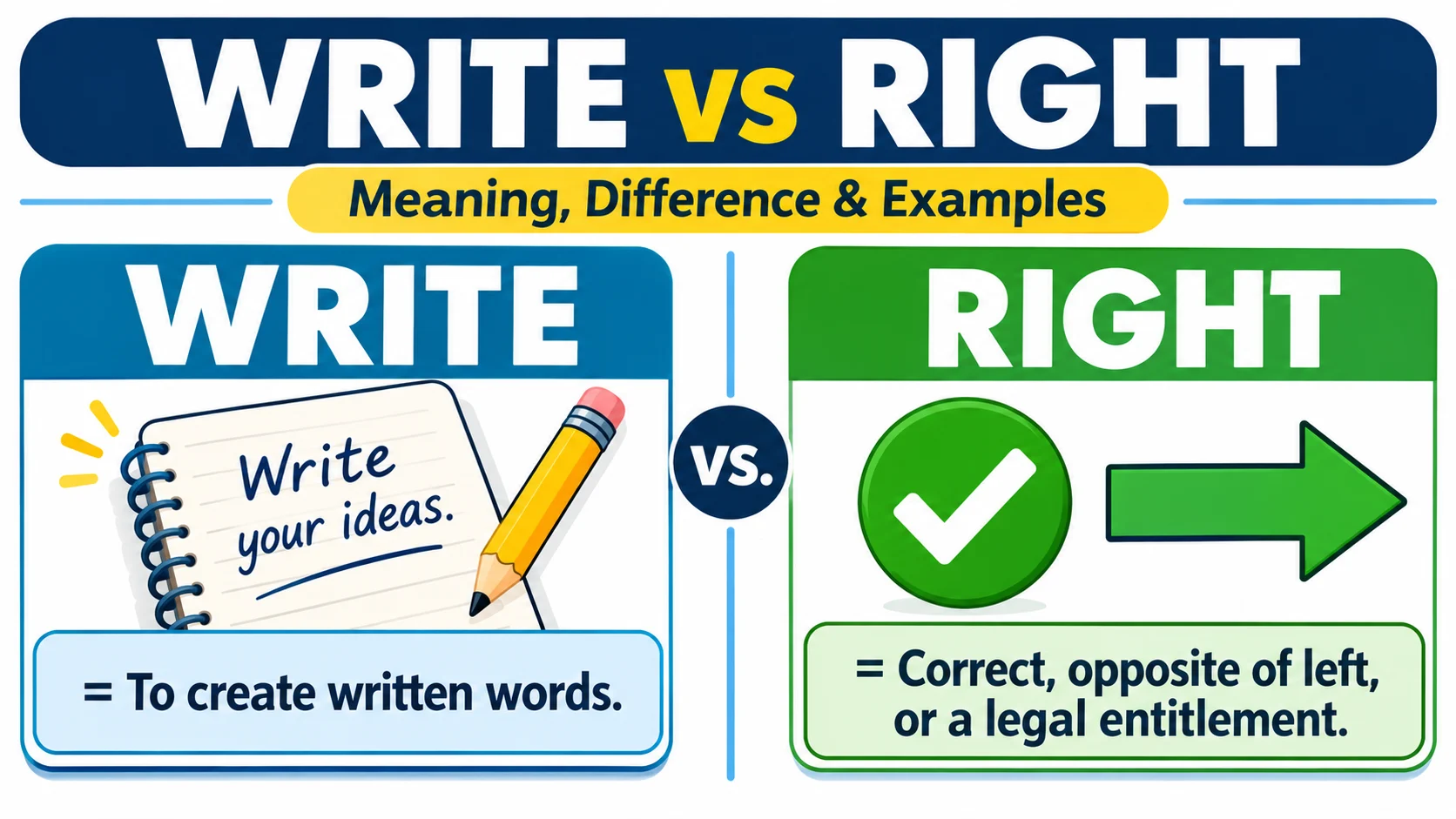
Write and right are two English words that sound the same but have different meanings and spellings. Write means to form words using a pen, keyboard, or other tool, while right means correct, proper, or the opposite of left.
Have you ever stopped while writing a sentence and wondered whether to use write or right? You are not alone. These two words often confuse English learners, students, and even people who speak English every day. They sound exactly the same, but their meanings are very different.
The main difference between write and right is their meaning and use. Write is a verb. It means to create words, sentences, notes, or other written content. Right has several meanings. It can describe something correct, refer to the direction opposite of left, or mean a legal or moral freedom.
For example, you might write a letter to your friend, but you should make sure the information in that letter is right. Both words sound alike, yet they cannot replace each other.
Learning the difference between write and right can help you avoid spelling mistakes and make your sentences clearer. In this guide, you will learn their definitions, grammar rules, examples, common mistakes, and practical ways to remember which word to use.
Write vs Right: Quick Answer and Overview
The easiest way to understand write vs right is to remember that write is connected to creating written words, while right is connected to correctness, direction, or something you are allowed to do.
Although these words have the same pronunciation, they belong to different word groups and serve different purposes in a sentence.
| Word | Part of Speech | Meaning | Example |
|---|---|---|---|
| Write | Verb | To form words or create written content | Please write your name. |
| Right | Adjective | Correct or accurate | Your answer is right. |
| Right | Noun | A legal or moral entitlement | Everyone has the right to speak. |
| Right | Adverb | In the correct direction or way | Turn right at the corner. |
| Right | Verb | To correct or restore something | They worked to right the wrong. |
The Main Difference Between Write and Right
The main difference is simple:
- Write: Use this word when someone creates words, sentences, notes, or documents.
- Right: Use this word when talking about something correct, the opposite of left, or a person’s entitlement.
Consider these examples:
- I need to write an email to my teacher.
- You are right about the answer.
- Turn right after the traffic light.
- Children have the right to education.
A simple trick is to connect the W in write with words. When you create words on paper or a screen, you write them.
Use right for correctness, direction, or rights.
What Does Write Mean?
Write is a verb that means to create letters, words, sentences, or other written information. You can write with a pen, pencil, marker, computer, phone, or any other tool that allows you to record words.
It is one of the most common verbs in English. People use it in schools, offices, homes, businesses, and online conversations.
Definition of Write
According to its common English meaning, write refers to the act of forming words or recording information in a written form.
It can describe several activities, including:
- Writing a letter.
- Creating a school assignment.
- Taking notes during a lesson.
- Preparing a business report.
- Sending a text message.
- Writing a book, story, or article.
- Recording important information.
For example:
- I write in my journal every morning.
- She wants to write a children’s book.
- Please write your phone number here.
- He writes emails to his clients every day.
In each sentence, write describes an action.
Write as a Verb
Write is an irregular verb. This means its past forms do not follow the usual pattern of adding “-ed.”
Here are its main forms:
| Verb Form | Word | Example |
|---|---|---|
| Base form | Write | I write every day. |
| Third-person singular | Writes | She writes poems. |
| Present participle | Writing | He is writing a letter. |
| Simple past | Wrote | I wrote a story yesterday. |
| Past participle | Written | She has written a book. |
Understanding these forms is important because people sometimes confuse write with its past forms.
For example:
- Correct: I wrote a letter last night.
- Incorrect: I writed a letter last night.
The correct past tense is wrote, not writed.
Similarly:
- Correct: I have written three articles.
- Incorrect: I have wrote three articles.
After helping verbs such as has, have, and had, use written.
Different Uses of Write
The word write can be used in several situations.
To create written content
This is the most common meaning.
Examples:
- I write short stories.
- She writes articles for a website.
- They write reports every month.
To record information
Write can also mean putting information into a written form.
Examples:
- Write down the address.
- Please write your name on the form.
- I wrote the meeting time in my notebook.
To communicate through writing
People also use write when sending messages or communicating through letters and emails.
Examples:
- I will write to you tomorrow.
- She writes to her grandparents every week.
- Please write back when you receive my message.
To create professional or academic work
Write is commonly used in education and professional settings.
Examples:
- Students write essays.
- Researchers write scientific papers.
- Employees write business proposals.
- Journalists write news reports.
Synonyms of Write
Synonyms are words that have similar meanings. However, they may not work in every sentence.
| Synonym | Meaning | Example |
|---|---|---|
| Compose | Create written or musical content | She composed a letter. |
| Record | Store information in written form | Record the important details. |
| Draft | Prepare an early version | He drafted a report. |
| Document | Record information officially | The team documented the results. |
| Note | Write down information briefly | Please note the date. |
| Pen | Write or compose something | She penned a short story. |
| Author | Create a book or written work | He authored a novel. |
For example, compose may replace write in some formal situations, but it does not fit every sentence.
“I write my name” is natural English. “I compose my name” is not.
What Does Right Mean?
Right is a word with several meanings. It can describe something correct, refer to the direction opposite of left, or identify something a person is legally or morally allowed to do.
Unlike write, which is mainly a verb, right can function as an adjective, noun, adverb, and verb.
Definition of Right
Right generally means correct, proper, suitable, or opposite to the left side.
It can also refer to a freedom or entitlement that a person should have.
Examples:
- You gave the right answer.
- Turn right at the next street.
- Everyone has the right to education.
- She made the right decision.
The exact meaning depends on the sentence.
Right as an Adjective
An adjective describes a person, place, thing, or idea.
Right is often used to describe something correct, suitable, or appropriate.
Examples:
- That is the right answer.
- You made the right choice.
- This is the right way to solve the problem.
- He is the right person for this job.
In these examples, right describes something as correct or suitable.
Right as a Noun
As a noun, right can refer to a legal, moral, or personal entitlement.
Examples:
- Everyone has the right to education.
- Freedom of speech is an important right.
- You have the right to express your opinion.
- Protecting human rights is important.
Right can also refer to the direction opposite of left.
Examples:
- Take a right at the next street.
- The shop is on your right.
- My right hand is stronger than my left.
Right as an Adverb
An adverb describes how, when, where, or to what degree an action happens.
Right can be used as an adverb to mean correctly, directly, or immediately.
Examples:
- You answered right.
- She stood right beside me.
- Turn right after the bridge.
- The bus stopped right in front of our house.
In everyday English, people also use right to add emphasis.
For example:
- I am right here.
- The answer is right in front of you.
- He came right after lunch.
Right as a Verb
Right can also function as a verb. It means to correct something wrong or restore something to its proper position.
Examples:
- They wanted to right an injustice.
- The company tried to right its past mistakes.
- He worked hard to right the situation.
This use is less common than right as an adjective or noun.
Different Uses of Right
Here is a quick overview of the main meanings of right.
| Meaning | Explanation | Example |
|---|---|---|
| Correct | Something accurate or true | Your answer is right. |
| Opposite of left | A direction | Turn right here. |
| Entitlement | A legal or moral freedom | Everyone has rights. |
| Suitable | Something appropriate | She is the right candidate. |
| Immediately | Used for emphasis | Come right now. |
| Restore | Correct something wrong | They tried to right the situation. |
Synonyms of Right
The synonyms of right depend on its meaning.
| Synonym | Meaning | Example |
|---|---|---|
| Correct | Free from mistakes | Your answer is correct. |
| Accurate | Exact or reliable | The information is accurate. |
| Proper | Suitable or appropriate | Follow the proper steps. |
| Appropriate | Suitable for a situation | Wear appropriate clothing. |
| Just | Fair or morally correct | It was a just decision. |
| Valid | Acceptable or legally sound | That is a valid reason. |
| Entitlement | Something a person is allowed to have | Healthcare can be a legal entitlement. |
Remember that these synonyms cannot replace right in every context.
For example, correct can replace right in “Your answer is right,” but it cannot replace right in “Turn right at the corner.”
Write vs Right: Key Differences
Now that you understand both words, let’s compare them directly.
| Feature | Write | Right |
|---|---|---|
| Pronunciation | /raɪt/ | /raɪt/ |
| Main meaning | To create written words | Correct, opposite of left, or entitlement |
| Main part of speech | Verb | Adjective, noun, adverb, and verb |
| Past tense | Wrote | Righted |
| Past participle | Written | Righted |
| Related words | Writer, writing, written | Rights, rightful, rightly |
| Common use | Writing letters, notes, and articles | Correctness, directions, and freedoms |
| Example | Write your name. | Your name is right. |
Are Write and Right Homophones?
Yes. Write and right are homophones.
Homophones are words that have the same pronunciation but different meanings. They may also have different spellings.
Both write and right are pronounced /raɪt/.
This means you cannot tell which word someone is using simply by hearing it. You need to understand the context.
For example, consider these two sentences:
- I will write the answer.
- I will give you the right answer.
When spoken aloud, the words write and right sound identical. However, their meanings are completely different.
Other common English homophones include:
| Word Pair | Meaning |
|---|---|
| Their / There | Belonging to them / A place |
| Two / Too | Number 2 / Also or excessively |
| See / Sea | To look / A large body of salt water |
| Hear / Here | To listen / A place |
| Flower / Flour | A plant / A baking ingredient |
| Break / Brake | To damage or separate / A stopping device |
| Weak / Week | Not strong / Seven days |
Learning homophones can improve spelling, reading, and writing skills.
When Should You Use Write or Right?
Choosing between write and right becomes easy when you understand the purpose of the sentence.
Use write when the sentence describes creating written information.
Use right when the sentence describes correctness, direction, suitability, or entitlement.
When to Use Write
Use write in these situations:
- When asking someone to record information.
- When talking about creating a letter or email.
- When discussing school assignments.
- When describing books, articles, or stories.
- When asking someone to communicate in writing.
Examples:
- Please write your full name.
- I want to write a letter to my mother.
- Students must write their answers clearly.
- She will write an article about education.
- Can you write this information in your notebook?
When to Use Right
Use right when talking about correctness.
Examples:
- You selected the right answer.
- Is this the right address?
- She made the right decision.
- Your spelling is right.
- We are going in the right direction.
Use right for directions.
Examples:
- Turn right at the next street.
- The school is on your right.
- My right foot hurts.
- Keep to the right side of the road.
Use right for rights and entitlements.
Examples:
- Everyone has the right to education.
- Children have a right to feel safe.
- You have the right to ask questions.
- People should know their legal rights.
Write vs Right in Different Real-Life Situations
Understanding real-world examples makes it easier to use these words correctly.
Let’s look at common situations.
In School and Education
Students use both words regularly.
Write is used when completing schoolwork or recording information.
Right is used when checking answers or describing correct information.
Examples:
- Write your homework in your notebook.
- Your answer to question five is right.
- The teacher asked us to write an essay.
- She gave the right explanation.
- Write the correct answer below the question.
Notice the last sentence uses both ideas. Write describes the action, while correct describes the answer.
In Offices and Professional Settings
In workplaces, write is commonly used for documents, reports, emails, and business communication.
Right is often used to describe correct information, suitable decisions, and employee rights.
Examples:
- Please write a report before Friday.
- Make sure you have the right information.
- I need to write an email to the manager.
- Employees have the right to a safe workplace.
- Choose the right person for the position.
In Daily Conversations
People use both words in everyday speech.
Examples:
- Can you write down my address?
- You are right about the weather.
- Turn right at the next road.
- I will write to you later.
- Is this the right bus?
In Digital Communication
Technology has made writing easier. People now write messages, emails, comments, and posts using phones and computers.
Examples:
- Write me a message when you arrive.
- You are right about the latest update.
- I wrote a comment on her post.
- Is this the right website?
- Write your password in the correct field.
In digital communication, right can also describe a button, setting, or option that performs the intended action.
For example:
“Click the right button to continue.”
In Legal and Social Discussions
Right is frequently used when discussing freedom, fairness, and legal protection.
Examples:
- Every person has the right to privacy.
- People have the right to express their views.
- Children have the right to protection.
- Everyone deserves equal rights.
Write is less common in these discussions, but it can still appear.
Example:
“Citizens can write to their representatives about public concerns.”
Advantages and Disadvantages of Write and Right
Write and right are useful words, but their different meanings can create spelling problems.
The following table explains their advantages and possible challenges.
| Word | Advantages | Possible Challenges |
|---|---|---|
| Write | Useful for communication, education, and recording information | Can be confused with right because they sound alike |
| Right | Expresses correctness, direction, and entitlement | Has several meanings that depend on context |
Advantages of Using Write Correctly
Using write correctly helps you:
- Communicate instructions clearly.
- Create professional emails and documents.
- Improve academic writing.
- Record information accurately.
- Express ideas in written form.
Disadvantages of Using Write Incorrectly
Using write when you mean right can create confusion.
For example:
Incorrect: “You are write.”
Correct: “You are right.”
The incorrect version makes the sentence look like a spelling mistake and may reduce the quality of professional communication.
Advantages of Using Right Correctly
Using right correctly helps you:
- Describe correct information.
- Give clear directions.
- Explain personal and legal entitlements.
- Express suitable decisions.
- Communicate more accurately.
Disadvantages of Using Right Incorrectly
Using right instead of write can change the meaning of a sentence.
For example:
Incorrect: “Please right your name.”
Correct: “Please write your name.”
The incorrect sentence does not communicate the intended action.
Common Mistakes When Using Write vs Right
Many English learners confuse these words because they sound identical.
Here are some common mistakes and their corrections.
| Incorrect Sentence | Correct Sentence | Explanation |
|---|---|---|
| I will right a letter. | I will write a letter. | Write means to create a letter. |
| You are write. | You are right. | Right means correct. |
| Please right your name. | Please write your name. | Write describes the action. |
| Turn write at the corner. | Turn right at the corner. | Right describes a direction. |
| I have right three pages. | I have written three pages. | Written is the correct past participle. |
| She is write about history. | She is writing about history. | Writing is the present participle. |
| This is the write answer. | This is the right answer. | Right means correct. |
| Everyone has the write to speak. | Everyone has the right to speak. | Right means entitlement. |
Mistake of Confusing Meaning
The biggest mistake is choosing a word based only on how it sounds.
For example:
“Please write the right answer.”
Both words are correct here.
- Write tells someone to record something.
- Right describes the correct answer.
Always consider the meaning of the complete sentence.
Mistake of Using Write as an Adjective
Write is usually a verb. It does not normally describe a correct answer.
Incorrect: “This is the write option.”
Correct: “This is the right option.”
Mistake of Using Right as a Verb for Writing
Right can be a verb, but it means to correct or restore something. It does not mean to create written content.
Incorrect: “I need to right an email.”
Correct: “I need to write an email.”
Mistake of Forgetting the Verb Forms of Write
Another common problem is using the wrong tense.
Remember:
- Present: I write.
- Past: I wrote.
- Present continuous: I am writing.
- Present perfect: I have written.
Examples:
Incorrect: “She has wrote a story.”
Correct: “She has written a story.”
Easy Tricks to Remember Write vs Right
If you often confuse these words, use the following memory tricks.
Connect Write With Writing
The easiest way to remember write is to connect it with writing.
Both words begin with the same sound, but the word write contains the letters “w-r.”
Think of these related words:
- Write.
- Writer.
- Writing.
- Written.
All these words are connected to creating or recording written information.
Example:
“I write stories because I want to become a writer.”
Connect Right With Correct
Remember that right can mean correct.
For example:
- The right answer.
- The right choice.
- The right decision.
- The right information.
If you can replace the word with correct, you probably need right.
Example:
“Your answer is right.”
You can also say:
“Your answer is correct.”
Both sentences have the same basic meaning.
Connect Right With Direction
Right is also the opposite of left.
Remember:
- Left hand.
- Right hand.
- Left turn.
- Right turn.
If the sentence talks about direction, use right.
Remember the Three Main Meanings of Right
You can remember most common uses of right with three simple ideas:
- Correct: That answer is right.
- Direction: Turn right.
- Entitlement: You have the right to speak.
If you are describing the act of creating written words, use write.
Write vs Right: Regional and Global Usage
English is spoken in many countries, including the United States, the United Kingdom, Canada, Australia, New Zealand, and India.
Although spelling and pronunciation can vary across English-speaking regions, write and right have the same standard spellings and meanings in these varieties of English.
American English
In American English, write means to create written content, while right can mean correct, opposite of left, or an entitlement.
Examples:
- I need to write an email.
- You are right.
- Turn right at the next street.
British English
British English uses the same spelling and basic meanings.
Examples:
- Please write your name here.
- That is the right answer.
- Turn right after the bridge.
Canadian English
Canadian English also follows the same standard spelling rules.
Examples:
- She wants to write a book.
- You made the right choice.
- Everyone has the right to education.
Australian English
Australian English uses write and right in the same way.
Examples:
- I will write to you tomorrow.
- You are right about that.
- Take a right at the traffic lights.
Indian English
Indian English also uses these words with the same basic meanings.
Examples:
- Write your answers in the notebook.
- You are right about the result.
- Students have the right to education.
Do Write and Right Have Different Pronunciations Around the World?
In standard English varieties, write and right are homophones. Both are pronounced /raɪt/.
The pronunciation may sound slightly different because of regional accents, but the two words remain identical in pronunciation within the same accent.
Their spelling and meanings do not change across these regions.
Related Concepts: Write vs Right vs Rite vs Wright
English has several words that sound exactly like write and right.
Two other examples are rite and wright.
All four words are pronounced /raɪt/, but their meanings are different.
Understanding all four can help you avoid more spelling mistakes.
| Word | Meaning | Part of Speech | Example |
|---|---|---|---|
| Write | To create written content | Verb | I write stories. |
| Right | Correct, opposite of left, or entitlement | Adjective, noun, adverb, verb | You are right. |
| Rite | A formal or traditional ceremony | Noun | The wedding rite was meaningful. |
| Wright | A person who makes or builds something, often used in compound words or surnames | Noun | A playwright creates plays. |
What Does Rite Mean?
Rite refers to a formal ceremony or traditional religious or social practice.
Examples:
- The wedding rite was beautiful.
- The community follows an ancient rite.
- The religious rite takes place every year.
Rite is commonly used when discussing traditions, ceremonies, and rituals.
What Does Wright Mean?
Wright traditionally refers to a person who makes or builds something.
It is often found in compound words.
Examples:
- A playwright writes plays.
- A shipwright builds ships.
- A wheelwright makes or repairs wheels.
Wright is also used as a surname.
How Are All Four Words Different?
Consider these sentences:
- I will write a letter.
- You are right about the answer.
- The ceremony includes a traditional rite.
- The shipwright built a new boat.
All four words sound alike, but each has a different meaning.
Write vs Right in Common English Expressions
Both words appear in many common English expressions.
Learning these phrases will help you understand how native English speakers use them.
Common Expressions With Write
| Expression | Meaning | Example |
|---|---|---|
| Write down | Record information | Write down the address. |
| Write back | Reply in writing | Please write back soon. |
| Write up | Prepare a written report | She will write up the results. |
| Write off | Cancel a debt or consider something a loss | The company wrote off the debt. |
| Write out | Write something completely | Write out the full sentence. |
| Write about | Create content on a subject | He likes to write about history. |
| Write for | Create content for a publication or audience | She writes for a magazine. |
| Write in | Send a written request or response | Readers can write in with questions. |
Common Expressions With Right
| Expression | Meaning | Example |
|---|---|---|
| Right away | Immediately | I will call you right away. |
| Right now | At this moment | I am busy right now. |
| All right | Acceptable or satisfactory | Everything is all right. |
| Right hand | The hand on the right side | He raised his right hand. |
| Right choice | The correct or suitable decision | You made the right choice. |
| Right away | Without delay | Please come right away. |
| Right side | The side opposite the left | The shop is on the right side. |
| Right person | Someone suitable for a role | She is the right person for the job. |
How to Use Write and Right in Formal and Informal English
Both words are suitable for formal and informal communication. However, their use depends on the meaning of the sentence.
Write in Formal English
Write is frequently used in professional and academic communication.
Examples:
- Please write your response in the space provided.
- The researcher will write a detailed report.
- Students must write an explanation of their findings.
- Kindly write to the department for further information.
Write in Informal English
In daily conversation, write is used for messages, notes, and personal communication.
Examples:
- I will write to you later.
- Write me when you get home.
- Can you write this down?
- I love to write short stories.
Right in Formal English
Right is commonly used in professional, academic, and legal settings.
Examples:
- The information provided is right.
- Employees have the right to request assistance.
- Please select the right option.
- Every individual has certain legal rights.
Right in Informal English
In informal conversations, right is often used to agree with someone or confirm information.
Examples:
- You are right!
- That’s right.
- Right, let’s go.
- I knew you were right.
Exercises With Answers: Write vs Right
Practice is one of the best ways to learn the difference between write and right.
The following exercises will help you understand when to use each word.
Exercise: Fill in the Blanks
Choose write or right to complete each sentence.
- Please _____ your name on the paper.
- You are absolutely _____.
- Turn _____ at the next street.
- I want to _____ a story.
- Is this the _____ answer?
- Students should _____ their homework.
- Everyone has the _____ to education.
- She will _____ an email to her manager.
- My _____ hand is stronger than my left.
- You made the _____ decision.
Answers
| Number | Correct Word | Completed Sentence |
|---|---|---|
| 1 | Write | Please write your name on the paper. |
| 2 | Right | You are absolutely right. |
| 3 | Right | Turn right at the next street. |
| 4 | Write | I want to write a story. |
| 5 | Right | Is this the right answer? |
| 6 | Write | Students should write their homework. |
| 7 | Right | Everyone has the right to education. |
| 8 | Write | She will write an email to her manager. |
| 9 | Right | My right hand is stronger than my left. |
| 10 | Right | You made the right decision. |
Exercise: Choose the Correct Sentence
Select the grammatically correct sentence in each pair.
Question 1
A. I will right a letter.
B. I will write a letter.
Correct Answer: B. I will write a letter.
Explanation: Write means to create written content.
Question 2
A. You are right.
B. You are write.
Correct Answer: A. You are right.
Explanation: Right means correct.
Question 3
A. Please right your answer.
B. Please write your answer.
Correct Answer: B. Please write your answer.
Explanation: Write describes the action of recording an answer.
Question 4
A. Turn right at the traffic light.
B. Turn write at the traffic light.
Correct Answer: A. Turn right at the traffic light.
Explanation: Right refers to a direction.
Question 5
A. Everyone has the right to speak.
B. Everyone has the write to speak.
Correct Answer: A. Everyone has the right to speak.
Explanation: Right means a legal or moral entitlement.
Exercise: Correct the Mistakes
Find and correct the incorrect word in each sentence.
- I want to right a book.
- You are write about the problem.
- Please right your address here.
- This is the write answer.
- Turn write after the bridge.
Answers:
- I want to write a book.
- You are right about the problem.
- Please write your address here.
- This is the right answer.
- Turn right after the bridge.
Advanced Exercise: Understand the Context
Choose the correct word based on the meaning of each sentence.
- The teacher asked me to _____ a paragraph about nature.
- She was _____ when she said that practice improves skills.
- The driver turned _____ at the intersection.
- Every child has the _____ to receive an education.
- I have _____ five pages of my assignment.
- Please make sure you select the _____ file.
- He wants to _____ a letter to his parents.
- The company tried to _____ a serious injustice.
Answers:
- Write
- Right
- Right
- Right
- Written
- Right
- Write
- Right
The last sentence uses right as a verb. It means to correct or address something wrong.
Tips to Improve Your English Spelling
Learning the difference between write and right is a good step toward improving your English spelling.
Here are some practical tips.
Read English Every Day
Reading helps you recognize words in their correct context.
Try reading:
- Short stories.
- News articles.
- Educational blogs.
- English textbooks.
- Online discussions.
Pay attention to how writers use words with similar pronunciations.
Practice Writing Sentences
Create short sentences using both words.
For example:
- I write in my notebook every day.
- My answer is right.
- I write emails at work.
- Turn right at the next street.
Writing your own examples helps you remember the difference.
Learn Words in Groups
Do not memorize write and right separately. Learn related words together.
For write, remember:
- Writer.
- Writing.
- Written.
- Wrote.
For right, remember:
- Rights.
- Rightful.
- Rightly.
- Righteous.
This method helps you understand how words are related.
Use a Dictionary
If you are unsure about a word, check a reliable English dictionary.
A dictionary provides:
- Definitions.
- Pronunciation.
- Parts of speech.
- Example sentences.
- Related words.
This can help you understand the difference between similar-sounding words.
Review Your Writing
Before submitting an assignment or sending an email, check your spelling.
Ask yourself:
- Am I talking about creating written content?
- Am I describing something correct?
- Am I referring to a direction?
- Am I talking about a legal or moral entitlement?
These questions can help you choose the correct word.
Frequently Asked Questions About Write vs Right
What is the difference between write and right?
Write means to create words or record information. Right means correct, opposite of left, or a legal or moral entitlement. Both words sound the same but have different meanings and spellings.
Are write and right homophones?
Yes. Write and right are homophones because they have the same pronunciation but different spellings and meanings. Both are pronounced /raɪt/.
Is it write or right a letter?
The correct phrase is “write a letter.” Write is a verb that describes creating written content. Right does not mean to create a letter.
Is it you are write or you are right?
The correct sentence is “You are right.” Right means correct or accurate. Write refers to the action of creating written words.
How do you remember write vs right?
Connect write with writing, words, and written content. Connect right with correct answers, directions, and personal rights. These simple associations make the difference easier to remember.
Is right the opposite of left?
Yes. Right is the opposite of left when referring to direction or position. For example, “Turn right at the next street.”
Can right be used as a verb?
Yes. Right can be a verb meaning to correct something wrong or restore something to its proper condition. For example, “They worked to right an injustice.”
What are the four words that sound like write?
The four commonly recognized homophones are write, right, rite, and wright. Write means to create written content, right means correct or direction, rite means a ceremony, and wright refers to a maker or builder.
Is write a noun or a verb?
Write is mainly a verb. It describes the action of creating written content. Its related noun forms include writer and writing.
What is the past tense of write?
The past tense of write is wrote. The past participle is written. For example, “I wrote a letter yesterday” and “I have written three letters.”
Should I use write or right in a sentence about an answer?
It depends on the meaning. Use write when someone needs to record an answer, as in “Write your answer.” Use right when describing a correct answer, as in “Your answer is right.”
What is the difference between write, right, and rite?
Write means to create written content. Right means correct, opposite of left, or an entitlement. Rite refers to a formal or traditional ceremony. All three words have the same pronunciation.
Conclusion
Understanding the difference between write and right is important for clear and correct English communication. Although these words sound exactly the same, they have different meanings and uses.
Write is a verb that describes creating words, sentences, letters, notes, and other written content. Right has several meanings. It can describe something correct, refer to the direction opposite of left, or identify a person’s legal or moral entitlement.
The easiest way to remember write vs right is to connect write with writing and right with correctness, direction, and rights. You should also practice using both words in everyday sentences.
For example, remember this sentence: “Write the right answer in your notebook.” It shows how both words can appear together while serving different purposes.
Read regularly, practice spelling, and review your sentences before submitting them. With consistent practice, you will quickly learn when to use write and when to use right.