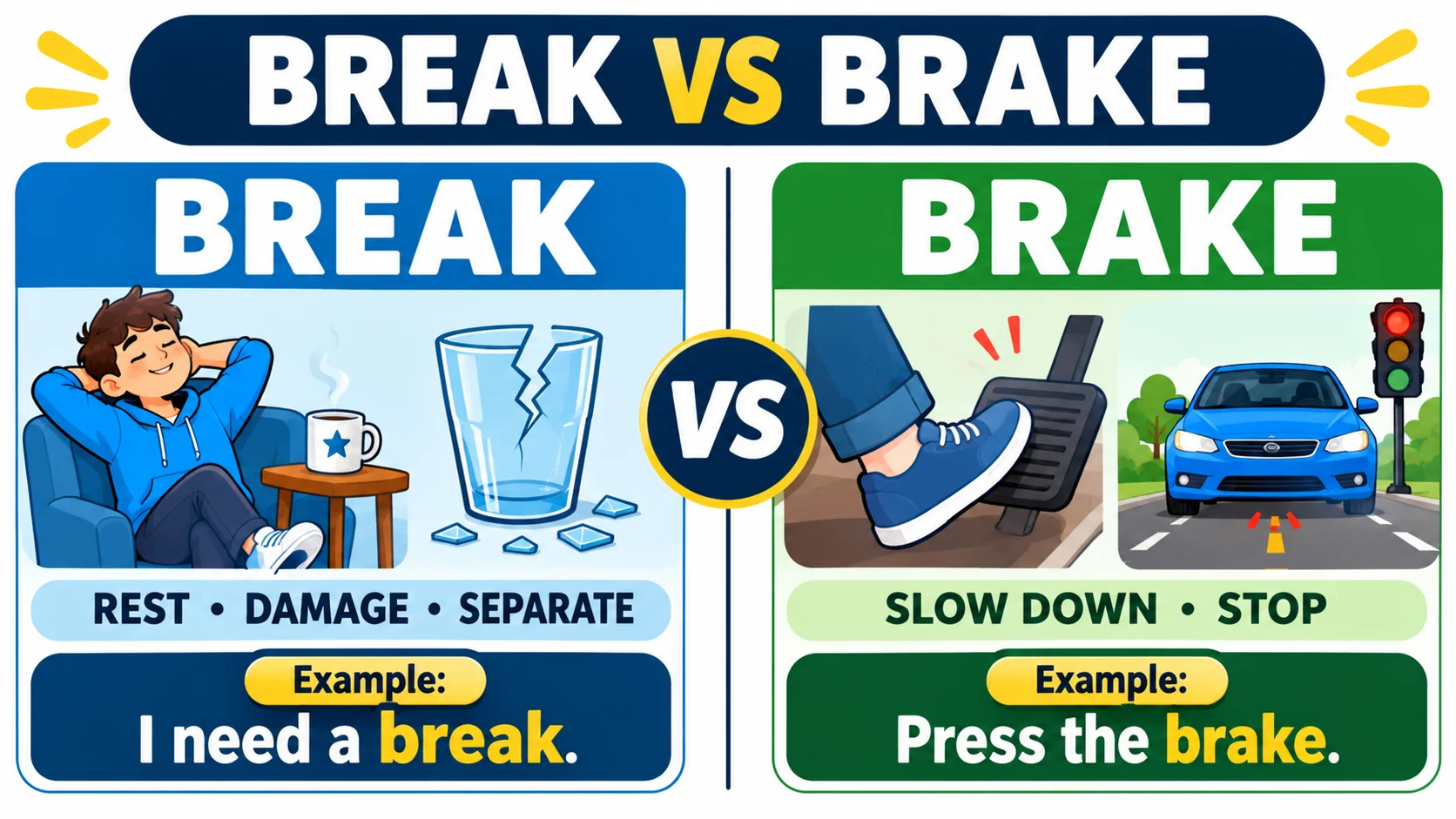
Break and brake sound the same, but they have different meanings. Break means to damage something, separate it, or take a rest. Brake means to slow down or stop a moving vehicle. Learn how to use both words with simple rules and examples.
Have you ever wondered whether to write break or brake? You are not alone. Many people mix up these two words. They sound the same, but their meanings are very different.
The difference is easy to learn. Break can mean to damage something or take a short rest. Brake means to slow down or stop a moving vehicle.
For example, you can break a glass by dropping it. But you press the brake to stop your car. You can also take a break after a long day at work.
These words often cause spelling mistakes. You may see them mixed up in emails, schoolwork, and text messages. Even good writers can make this mistake.
In this guide, you will learn the meaning of each word. You will also see simple examples from daily life. We will cover common mistakes, word forms, and useful phrases. At the end, you can test your skills with easy exercises.
Quick Answer: Break vs Brake
Here is the simple difference between break and brake:
- Break: To damage, split, interrupt, or rest.
- Brake: A part of a vehicle used to slow down or stop it.
Look at these examples:
- I need a short break after work.
- Please press the brake to stop the car.
- Do not break that glass.
- The driver used the brakes near the crossing.
| Word | Meaning | Example |
|---|---|---|
| Break | To damage or take a rest | I need a break. |
| Brake | To slow down or stop a vehicle | Press the brake. |
Easy trick to remember:
Think of break when you need rest. Think of brake when you drive a car.
What Does Break Mean?
The word break has several meanings. It can mean to damage something, split it, or stop an activity.
It can also mean taking time to rest.
Break works as both a noun and a verb. Its meaning depends on how you use it in a sentence.
Break as a Verb
A verb shows an action. The word break is often used when something gets damaged.
For example:
- Do not break the glass.
- He broke his phone.
- She broke her favorite cup.
- The child broke the toy.
- Strong winds can break tree branches.
Break can also mean splitting something into smaller parts.
Examples:
- Break the chocolate into small pieces.
- She broke the bread in half.
- Please break this stick into two parts.
- He broke the large rock into small pieces.
You can also use break when someone stops an activity or ends something.
Examples:
- She decided to break her silence.
- They broke their agreement.
- He broke his promise.
- The loud noise broke the silence.
Break as a Noun
A noun names a person, place, thing, or idea.
As a noun, break often means a short time to rest.
Examples:
- I need a break.
- We have a lunch break at noon.
- She took a short break from studying.
- The children enjoyed their school break.
- He went outside during his coffee break.
Break can also mean a good chance or a sudden change.
Examples:
- She got her big break in the music world.
- The team finally got a lucky break.
- We had a break in the bad weather.
- The police found a new clue in the case.
In these examples, break does not mean damage. It means a chance, change, or rest.
Different Forms of Break
Break is an irregular verb. This means its past forms do not follow the usual pattern.
Here are its main forms:
| Verb Form | Word | Example |
|---|---|---|
| Present | Break | Do not break the plate. |
| Third-person present | Breaks | Glass breaks easily. |
| Past | Broke | He broke the window. |
| Past participle | Broken | The window is broken. |
| Present participle | Breaking | She is breaking the chocolate. |
Remember: The past tense of break is broke, not breaked.
Incorrect: She breaked the glass.
Correct: She broke the glass.
What Does Brake Mean?
The word brake has a different meaning. It refers to a part of a vehicle that helps it slow down or stop.
Cars, bikes, buses, and trucks all use brakes.
Brake can work as both a noun and a verb.
Brake as a Noun
As a noun, brake means a part that helps control a vehicle’s speed.
Examples:
- The car has strong brakes.
- My bicycle needs a new brake.
- The driver checked the brakes.
- The mechanic fixed the broken brake.
- The car’s brake system needs repair.
There are different types of brakes.
Here are some common examples:
- Foot brake: A brake that you control with your foot.
- Parking brake: A brake that keeps a parked car from moving.
- Disc brake: A brake that uses pads to slow a wheel.
- Drum brake: A brake that uses shoes inside a drum.
- Emergency brake: A common name for a backup or parking brake.
Brake as a Verb
As a verb, brake means to slow down or stop a moving vehicle.
Examples:
- Brake before you reach the turn.
- The driver braked to avoid a dog.
- She braked when the light turned red.
- Always brake slowly on wet roads.
- He braked when a car entered his lane.
You can also use brake when talking about trains and bicycles.
Examples:
- The train began to brake near the station.
- The cyclist braked before the turn.
- The bus braked near the school.
- The truck driver braked to avoid an accident.
Different Forms of Brake
Brake is a regular verb. Its past forms follow a simple pattern.
| Verb Form | Word | Example |
|---|---|---|
| Present | Brake | Brake before the turn. |
| Third-person present | Brakes | He brakes slowly. |
| Past | Braked | She braked suddenly. |
| Past participle | Braked | The driver has braked. |
| Present participle | Braking | The car is braking. |
Remember: The past tense of brake is braked.
Incorrect: The driver broke suddenly.
Correct: The driver braked suddenly.
Break vs Brake: Key Differences
Break and brake sound alike. However, their meanings are not the same.
Break is used for damage, rest, or an interruption. Brake is used for slowing down or stopping a vehicle.
Here is a simple comparison.
| Feature | Break | Brake |
|---|---|---|
| Meaning | Damage, split, or rest | Slow down or stop |
| Pronunciation | /breɪk/ | /breɪk/ |
| Part of speech | Noun and verb | Noun and verb |
| Past tense | Broke | Braked |
| Past participle | Broken | Braked |
| Common use | Daily life and work | Cars and other vehicles |
| Example | Take a break. | Press the brake. |
Difference in Meaning
Break has many uses in English. You can use it when talking about damage, rest, or a sudden change.
Brake has a more specific meaning. It relates to stopping or slowing movement.
Compare these sentences:
- I need a break from work.
- I need to check my car’s brake.
The first sentence talks about rest. The second talks about a car part.
Difference in Spelling
Both words have five letters. Their spelling differs in the middle.
- Break: B-R-E-A-K
- Brake: B-R-A-K-E
The letters A and E change places.
This small change gives each word a different meaning.
Difference in Grammar
Both words can work as nouns and verbs. However, their verb forms are different.
| Form | Break | Brake |
|---|---|---|
| Present | Break | Brake |
| Past | Broke | Braked |
| Past participle | Broken | Braked |
| -ing form | Breaking | Braking |
For example:
- She broke the cup.
- He braked the car.
- The cup is broken.
- The car is braking.
Learning these forms will help you avoid common mistakes.
When Should You Use Break?
Use break when you mean damage, rest, or an interruption.
Here are the most common uses of break.
When Something Gets Damaged
Use break when an object gets damaged or split.
Examples:
- Do not break the window.
- I broke my phone yesterday.
- She broke her glasses.
- The child broke his toy.
- The storm broke several tree branches.
When You Need Rest
Use break when you stop working or studying for a short time.
Examples:
- Let’s take a break.
- I need a break from work.
- She took a break after lunch.
- We have a short break between classes.
- He went out during his coffee break.
Some common phrases include:
- Lunch break
- Coffee break
- Study break
- Work break
- School break
- Summer break
- Short break
When Something Stops or Ends
Break can also mean to stop something or bring it to an end.
Examples:
- He broke his promise.
- They broke the rules.
- She broke her silence.
- The company broke its agreement.
- The news broke their normal routine.
When You Talk About Feelings
Break is common in sentences about feelings and relationships.
Examples:
- He broke her heart.
- She broke down in tears.
- The sad news broke his spirit.
- They decided to break up.
- He could not break his bad habit.
These phrases do not always mean physical damage. They describe feelings or changes.
When Should You Use Brake?
Use brake when you talk about slowing down or stopping a vehicle.
It is also used when talking about car parts and repairs.
When Driving a Car
Use brake when a driver slows down or stops a car.
Examples:
- Press the brake before turning.
- The driver used the brakes.
- My car brakes very well.
- You should brake before the stop sign.
- He braked to avoid an accident.
When Riding a Bicycle
Bicycles also have brakes. They help riders control their speed.
Examples:
- My bicycle brake is not working.
- Check your brakes before riding.
- She braked before reaching the hill.
- The cyclist used the front brake.
When Driving Large Vehicles
Trucks, buses, and trains also use brakes.
Examples:
- The truck driver applied the brakes.
- The bus braked near the school.
- The train began braking near the station.
- The driver checked the truck’s brakes.
When Talking About Car Repairs
Use brake when talking about parts of a vehicle.
Examples:
- My car needs new brake pads.
- The mechanic checked the brake fluid.
- The rear brakes are making noise.
- The brake pedal feels soft.
- My car needs a brake check.
When Talking About Speed
Brake can also describe the act of slowing down.
Examples:
- The driver braked before the turn.
- She braked when she saw the red light.
- The cyclist braked near the crossing.
- The car began braking on the wet road.
Important: Brake is not only a noun. It is also an action. You can use it in sentences about cars, bikes, buses, and other moving vehicles.
Break vs Brake in Everyday Sentences
The best way to learn these words is to use them in daily life.
Look at the examples below. Notice how the meaning changes with each word.
| Using Break | Using Brake |
|---|---|
| I need a break from work. | I need to check my brake. |
| She broke her phone. | She braked her car. |
| Do not break the glass. | Press the brake slowly. |
| He broke his promise. | He pressed the brake pedal. |
| We took a short break. | The driver used the brakes. |
| The child broke his toy. | The cyclist checked the brakes. |
| They broke the rules. | The truck braked suddenly. |
| I broke the chocolate bar. | The driver checked the brake system. |
Examples at School
Students often use break when they talk about rest or damage.
Examples:
- We have a 15-minute break after class.
- The students went outside during their lunch break.
- Do not break the school rules.
- She broke her pencil during the test.
Brake may also appear in driving lessons.
Example:
– The teacher showed us how to use the brake pedal.
Examples at Home
Break is common in daily home life.
Examples:
- Be careful not to break the dishes.
- I need a break from cleaning.
- The child broke his favorite toy.
- Please do not break that chair.
Brake is used when talking about cars or bikes.
Example:
– My father checked the car brakes before our trip.
Examples at Work
People often use break when talking about work time.
Examples:
- I take a lunch break at noon.
- She needs a short break.
- The workers took a coffee break.
- He broke the company rules.
Brake is common in jobs related to driving and repair.
Examples:
- The driver reported a problem with the truck’s brakes.
- The mechanic replaced the brake pads.
- The company sells car brake parts.
Examples on the Road
Both words can appear in the same situation.
Examples:
- The driver pressed the brake to stop the car.
- A sudden stop caused a box to break.
- The cyclist took a break after a long ride.
- The mechanic replaced the damaged brake pads.
These examples show why context matters. Always look at the meaning of the sentence.
Common Expressions With Break
Break is part of many common English phrases.
These phrases appear in books, conversations, emails, and daily life.
| Expression | Simple Meaning | Example |
|---|---|---|
| Take a break | Stop and rest | Let’s take a break. |
| Break the ice | Help people feel relaxed | He told a joke to break the ice. |
| Break the news | Share important news | She had to break the news. |
| Break a promise | Fail to keep a promise | He broke his promise. |
| Break the rules | Not follow the rules | Do not break the rules. |
| Break down | Stop working or lose control | My car broke down. |
| Break up | End a relationship | They decided to break up. |
| Break out | Start suddenly | A fire broke out. |
| Break through | Get past a problem | She broke through the barrier. |
| Break even | Have no profit or loss | The shop finally broke even. |
| Give someone a break | Be less strict with someone | Please give him a break. |
| Lucky break | An unexpected good chance | That job was a lucky break. |
Take a Break
This phrase means to stop working or studying for some time.
Examples:
- I need to take a break.
- Let’s take a break after lunch.
- She took a break from her studies.
Break the Ice
This phrase means to make people feel comfortable.
It is useful when people meet for the first time.
Example:
– The teacher told a funny story to break the ice.
Break Down
Break down has more than one meaning.
It can mean that a machine stops working.
Example:
– My car broke down on the highway.
It can also mean that someone becomes very upset.
Example:
– She broke down after hearing the sad news.
Break Up
Break up often means to end a relationship.
Example:
– They decided to break up after many years.
It can also mean to divide something into smaller parts.
Example:
– Break up the large pieces of chocolate.
Common Expressions With Brake
Brake also appears in many useful English phrases.
Most of these phrases relate to vehicles and driving.
| Expression | Simple Meaning | Example |
|---|---|---|
| Apply the brakes | Use the brakes | Apply the brakes slowly. |
| Hit the brakes | Press the brakes quickly | He hit the brakes. |
| Brake pedal | Pedal used to stop a car | Press the brake pedal. |
| Parking brake | Brake used when parking | Use the parking brake. |
| Brake pads | Parts that help slow a wheel | The brake pads need repair. |
| Brake fluid | Fluid used in the brake system | Check the brake fluid. |
| Brake lights | Lights that show braking | The brake lights came on. |
| Brake system | All parts used for braking | Check the brake system. |
| Hard braking | Strong or sudden braking | Avoid hard braking. |
| Brake failure | When the brakes stop working | Brake failure is dangerous. |
Apply the Brakes
This phrase means to use the brakes to slow down or stop.
Example:
– Apply the brakes before the turn.
Hit the Brakes
This phrase means to press the brakes quickly.
It often happens when something unexpected appears.
Example:
– The driver hit the brakes when a dog crossed the road.
Brake Failure
Brake failure means the vehicle cannot slow down or stop as expected.
Example:
– The driver noticed a problem with the brakes.
Never ignore a brake problem. Ask a qualified mechanic to check the vehicle.
Break vs Brake: Common Mistakes
Many people confuse break and brake because they sound the same.
Here are some common mistakes and their correct forms.
Using Brake Instead of Break
Incorrect: I need a brake after studying.
Correct: I need a break after studying.
Why? A short time to rest is called a break.
Using Break Instead of Brake
Incorrect: Press the break to stop the car.
Correct: Press the brake to stop the car.
Why? A car uses brakes to slow down or stop.
Confusing Broke and Braked
Incorrect: The driver broke suddenly.
Correct: The driver braked suddenly.
Why? Braked is the past form of brake. Broke is the past form of break.
Writing Breaked Instead of Broke
Incorrect: She breaked the glass.
Correct: She broke the glass.
Why? Break is an irregular verb. Its past form is broke.
Writing Braked Instead of Broke
Incorrect: He braked his phone.
Correct: He broke his phone.
Why? A damaged phone needs the word broke.
Using the Wrong Word in Common Phrases
Some phrases always use break. Others use brake.
| Incorrect | Correct |
|---|---|
| Coffee brake | Coffee break |
| Lunch brake | Lunch break |
| School brake | School break |
| Break pedal | Brake pedal |
| Brake pads for a car | Brake pads for a car |
| Break the car to stop | Brake the car to stop |
| Brake the rules | Break the rules |
| Break the glass | Break the glass |
The correct forms depend on the meaning. Remember that a break is a rest or an action that causes damage. A brake helps stop movement.
How to Remember Break vs Brake
You do not need to memorize long grammar rules.
A few simple tricks can help you choose the right word.
Remember Break Means Rest or Damage
Think about the common phrase:
Take a break.
You use break when you need rest.
You also use it when something gets damaged.
Examples:
- Take a break from work.
- Do not break the glass.
- He broke his phone.
Remember Brake Means Car
Connect brake with the word automobile.
When you drive a car, you use its brakes to slow down or stop.
Examples:
- Press the brake.
- Check the brakes.
- The driver braked suddenly.
Ask Yourself a Simple Question
Before writing, ask yourself what you want to say.
- Are you talking about rest? Use break.
- Are you talking about damage? Use break.
- Are you talking about stopping a car? Use brake.
This simple test can prevent most mistakes.
Learn Their Past Forms
The past forms are also different.
| Word | Past Form | Past Participle |
|---|---|---|
| Break | Broke | Broken |
| Brake | Braked | Braked |
Examples:
- I broke my cup yesterday.
- The driver braked near the school.
- The window is broken.
- The car has braked.
Learning these forms makes both words easier to remember.
Advantages and Disadvantages of Using Break and Brake Correctly
Break and brake are different words. Neither word is better than the other.
However, using the right word has many benefits.
Benefits of Using Break Correctly
- Clear meaning: Readers understand what you want to say.
- Better writing: Your sentences become easier to understand.
- Good grammar: You avoid common spelling mistakes.
- Natural English: You can use common phrases with confidence.
- Better communication: Your emails and messages look more professional.
Problems Caused by Using Break Incorrectly
- Readers may misunderstand your message.
- Your sentences may have the wrong meaning.
- Schoolwork may contain spelling mistakes.
- Professional emails may look less polished.
- Your writing may become harder to understand.
Benefits of Using Brake Correctly
- Your driving instructions become clearer.
- You can explain car parts correctly.
- You can write about vehicle repairs with confidence.
- You can understand driving and safety information.
- You can avoid common spelling mistakes.
Problems Caused by Using Brake Incorrectly
- Your sentence may have a different meaning.
- Readers may misunderstand your message.
- Vehicle instructions may become unclear.
- Your writing may contain grammar errors.
The best way to avoid these problems is to learn the meaning of each word and practice using it.
Regional and Global Use of Break vs Brake
Break and brake have the same meanings in major English-speaking countries.
Their spelling does not change between American and British English.
You can use both words in the United States, the United Kingdom, Canada, and Australia.
American English
American English uses both words in their standard forms.
Examples:
- I need a break from work.
- Press the brake before stopping.
- The driver checked the brakes.
- She broke her phone.
Common American phrases include lunch break, coffee break, brake pedal, and brake pads.
British English
British English uses break and brake in the same way.
Examples:
- We had a short break at school.
- The driver applied the brakes.
- Do not break the window.
- The mechanic checked the brake system.
There is no spelling difference between these words in British and American English.
Canadian English
Canadian English also follows the same spelling rules.
Examples:
- I need a break after work.
- The car brakes need attention.
- She broke her glasses.
- The driver used the brakes.
Australian English
Australian English uses both words with the same meanings.
Examples:
- Let’s take a break.
- The driver checked the brakes.
- He broke the glass.
- The cyclist applied the brakes.
Global English
English speakers around the world use these words in the same way.
The main challenge is their pronunciation. Both words sound exactly alike.
For this reason, English learners should focus on the meaning of each sentence.
Why Are Break and Brake Called Homophones?
Break and brake are called homophones. Homophones are words that sound the same but have different meanings and spellings.
For example, break and brake both sound like /breɪk/.
You cannot tell which word someone means by sound alone. You must understand the sentence.
What Is a Homophone?
A homophone is a word that shares its sound with another word.
However, the words may have different spellings and meanings.
Here are some common examples:
| Word 1 | Word 2 | Difference |
|---|---|---|
| Break | Brake | Rest or damage vs stopping a vehicle |
| Their | There | Belonging to them vs a place |
| Here | Hear | A place vs listening |
| Right | Write | Correct vs putting words on paper |
| Sea | See | A body of water vs using your eyes |
| Buy | By | Purchase vs near or through |
| One | Won | A number vs winning |
| Pair | Pear | Two items vs a fruit |
| Flour | Flower | Baking ingredient vs a plant |
| To | Too | Direction vs also or very |
Why Do Homophones Cause Mistakes?
Homophones can confuse writers because they sound alike.
For example, you may write “I need a brake” when you mean “I need a break.”
The sentence may still look correct at first. However, the wrong spelling changes its meaning.
The best way to avoid these mistakes is to read each sentence carefully.
Related Words and Comparisons
Break and brake are not the only words that people confuse.
Some other words have similar meanings or spellings. Learning their differences can improve your English.
Break vs Broken
Break is the base form of a verb. Broken is its past participle.
Broken can also describe something that is damaged.
Examples:
- Do not break the plate.
- He has broken the plate.
- The plate is broken.
Brake vs Braking
Brake is the base form of the verb. Braking is its -ing form.
Examples:
- Brake before the corner.
- The car is braking.
- Sudden braking can be dangerous.
Break vs Pause
Break and pause both mean stopping an activity for some time.
However, they are not always used in the same way.
| Break | Pause |
|---|---|
| Often means a short rest | Means a short stop |
| Can last several minutes | Can last only a few seconds |
| Can mean damage | Does not mean damage |
| Example: Take a break. | Example: Pause the video. |
Examples:
- I need a break from work.
- Please pause the video.
Break vs Rest
Break and rest are similar when talking about time away from work.
However, break often means a short period away from an activity. Rest focuses more on relaxing or getting energy back.
Examples:
- I need a break from studying.
- I need to rest after exercising.
Brake vs Stop
Brake and stop are related to vehicle movement.
However, they have different meanings.
- Brake: To slow down or stop by using a braking system.
- Stop: To bring movement or an activity to an end.
Examples:
- The driver applied the brakes.
- The car came to a stop.
A driver can brake without stopping completely.
Break vs Brake in Different Types of Writing
Both words appear in many forms of writing.
Knowing where to use them can help you write better sentences.
In Academic Writing
Students often use break when talking about rest, damage, or interruptions.
Examples:
- Students need breaks during long study sessions.
- Do not break the school rules.
- The team took a short break.
- The glass broke during the test.
Brake is useful when writing about vehicles or transport.
Example:
– The study examined the car’s braking system.
In Professional Writing
Correct spelling is important in emails and business documents.
Examples:
- Please take a short break before the next meeting.
- The company will replace the damaged brake parts.
- Do not break the agreement.
- The driver reported a problem with the brakes.
In Creative Writing
Writers often use break to describe feelings and events.
Examples:
- She could not break her silence.
- He did not want to break her heart.
- A loud noise broke the silence.
- The bad news broke his spirit.
Brake is useful in stories about cars and road events.
Example:
– The driver hit the brakes just before the wall.
In Text Messages and Social Media
People often type quickly when sending messages.
This can lead to spelling mistakes.
Here are some correct examples:
- I need a break today.
- My car brakes are not working.
- Don’t break my trust.
- He braked suddenly.
Even in short messages, correct spelling makes your meaning clear.
Practice Exercises: Break vs Brake
Now it is time to test what you have learned.
Choose the correct word in each sentence. Read each sentence carefully before answering.
Exercise One: Fill in the Blanks
Choose break, brake, or the correct form of either word.
- I need a short _____ after working all morning.
- The driver pressed the _____ to stop the car.
- Please do not _____ the glass.
- My bicycle _____ are not working well.
- She decided to _____ her silence.
- Use the _____ before reaching the corner.
- The children took a lunch _____ at school.
- He accidentally _____ his phone.
- The driver applied the _____ suddenly.
- Do not _____ the rules.
- The car is _____ near the traffic light.
- She has _____ her favorite cup.
Exercise Two: Choose the Correct Answer
Select the right option for each sentence.
1. I need a short _____ from studying.
- A. Brake
- B. Break
2. The driver used the _____ to stop the car.
- A. Break
- B. Brake
3. She _____ the glass yesterday.
- A. Broke
- B. Braked
4. The car _____ near the crossing.
- A. Broke
- B. Braked
5. We had a coffee _____ after the meeting.
- A. Break
- B. Brake
6. The mechanic checked the car’s _____.
- A. Breaks
- B. Brakes
7. He promised not to _____ the agreement.
- A. Break
- B. Brake
8. The cyclist used the _____ before turning.
- A. Break
- B. Brake
9. My computer has _____ down.
- A. Broken
- B. Braked
10. The driver was _____ carefully on the wet road.
- A. Breaking
- B. Braking
Exercise Three: Correct the Mistakes
Each sentence has a spelling mistake. Find it and write the correct sentence.
- I need a short brake before the next class.
- The driver pressed the break pedal.
- She braked her favorite cup.
- He breaked the window.
- My car breaks are making noise.
- The cyclist broke before reaching the corner.
- We had a lunch brake at noon.
- The driver breaked suddenly.
- Please do not brake the rules.
- He needs a brake from his daily work.
Exercise Answers
Check your answers below after completing all three exercises.
Answers to Exercise One
| Number | Correct Answer |
|---|---|
| 1 | Break |
| 2 | Brake |
| 3 | Break |
| 4 | Brakes |
| 5 | Break |
| 6 | Brake |
| 7 | Break |
| 8 | Broke |
| 9 | Brakes |
| 10 | Break |
| 11 | Braking |
| 12 | Broken |
Answers to Exercise Two
| Number | Correct Answer |
|---|---|
| 1 | B. Break |
| 2 | B. Brake |
| 3 | A. Broke |
| 4 | B. Braked |
| 5 | A. Break |
| 6 | B. Brakes |
| 7 | A. Break |
| 8 | B. Brake |
| 9 | A. Broken |
| 10 | B. Braking |
Answers to Exercise Three
| Incorrect Sentence | Correct Sentence |
|---|---|
| I need a short brake before the next class. | I need a short break before the next class. |
| The driver pressed the break pedal. | The driver pressed the brake pedal. |
| She braked her favorite cup. | She broke her favorite cup. |
| He breaked the window. | He broke the window. |
| My car breaks are making noise. | My car brakes are making noise. |
| The cyclist broke before reaching the corner. | The cyclist braked before reaching the corner. |
| We had a lunch brake at noon. | We had a lunch break at noon. |
| The driver breaked suddenly. | The driver braked suddenly. |
| Please do not brake the rules. | Please do not break the rules. |
| He needs a brake from his daily work. | He needs a break from his daily work. |
Check Your Score
There are 32 questions in total. Use this guide to check your progress.
| Score | Your Result |
|---|---|
| 29–32 | Excellent! |
| 25–28 | Very good! |
| 20–24 | Good work! |
| 15–19 | Keep practicing! |
| Below 15 | Review the lesson again. |
The more you practice, the easier these words become.
Frequently Asked Questions About Break vs Brake
What is the difference between break and brake?
Break means to damage something, separate it, or take a rest. Brake means to slow down or stop a moving vehicle. Both words sound the same but have different meanings.
Is it take a break or take a brake?
The correct phrase is “take a break.” It means to stop working or studying for some time. Brake is used for stopping vehicles.
Is it break or brake the car?
The correct word is brake. You brake a car when you use its braking system to slow down or stop it.
Is it break pedal or brake pedal?
The correct term is brake pedal. It is the pedal a driver presses to slow down or stop a car.
What is the past tense of break?
The past tense of break is broke. For example, “She broke her phone yesterday.” Its past participle is broken.
What is the past tense of brake?
The past tense of brake is braked. For example, “The driver braked suddenly to avoid an accident.”
Are break and brake homophones?
Yes, break and brake are homophones. They have the same sound but different spellings and meanings.
Is it coffee break or coffee brake?
The correct phrase is coffee break. It means a short rest during work or another activity.
Is it brakes or breaks on a car?
The correct word is brakes. It refers to the parts that help a car slow down or stop. Breaks means damage, rest, or interruptions.
How can I remember break vs brake?
Remember break as a word for rest or damage. Think of brake as a car part. This simple trick can help you choose the right word.
Can break and brake be used as nouns and verbs?
Yes, both words can work as nouns and verbs. For example, “Take a break” uses break as a noun. “Break the glass” uses it as a verb. Similarly, “The brake is broken” uses brake as a noun. “Brake before turning” uses it as a verb.
Why do break and brake sound the same?
They are homophones. Their spellings and meanings are different, but their modern pronunciations are the same.
Conclusion:
Understanding break vs brake is easy once you learn their meanings. Both words sound the same, but you use them in different situations.
Use break when talking about damage, rest, or an interruption. For example, you can break a glass, break a promise, or take a break from work.
Use brake when talking about stopping or slowing down a vehicle. For example, you can press the brake, check the brakes, or brake before a turn.
Remember this simple rule: You take a break, but you use a brake to stop a car.
Also, learn their past forms. The past tense of break is broke. The past tense of brake is braked.
Pay attention to the meaning of each sentence. Practice with the examples and exercises in this guide. Soon, you will know which word to use without thinking twice.