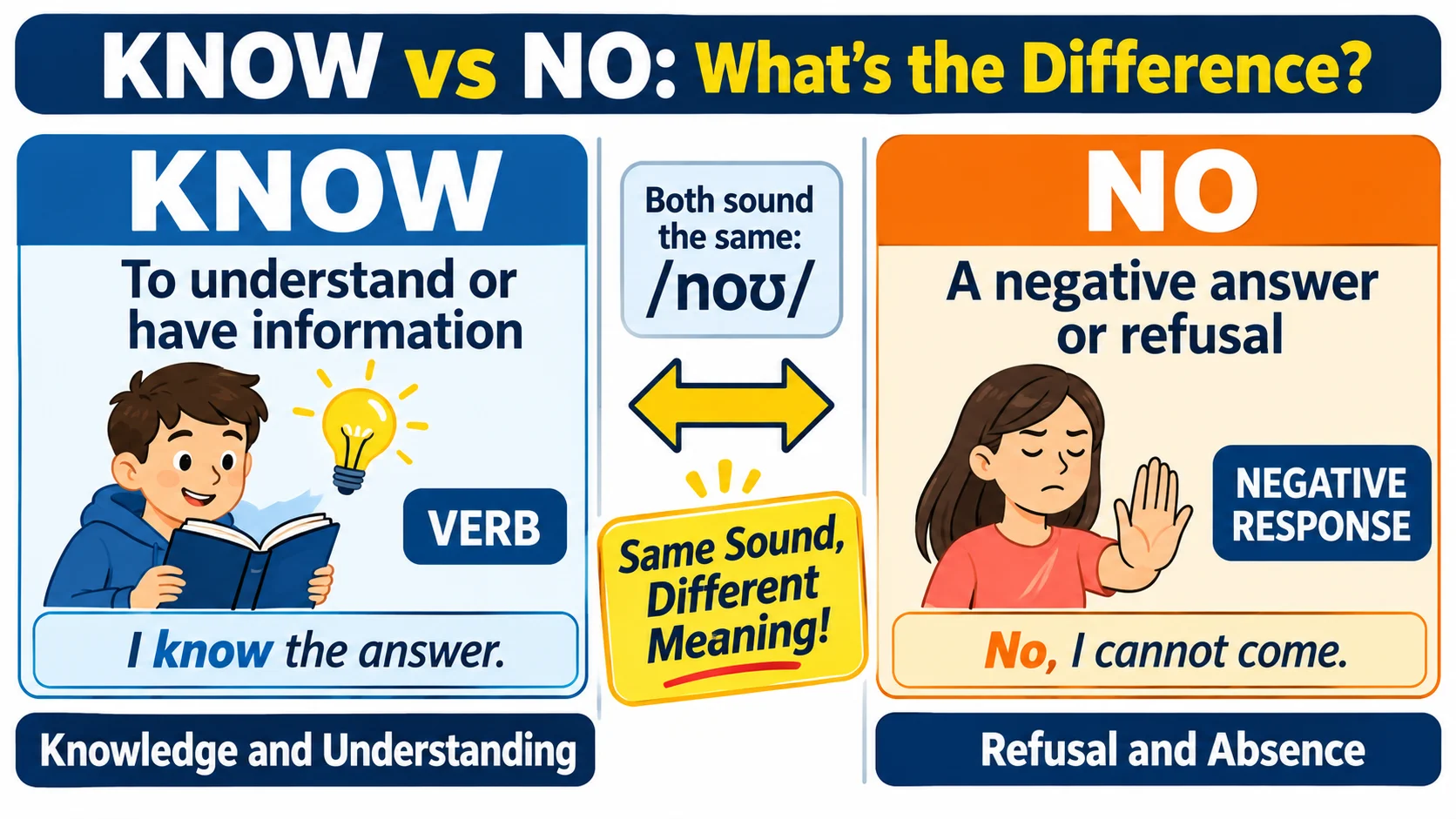
Know and no sound exactly alike, but they have different meanings and uses. Know is a verb that means to understand or have information about something, while no is a word used to give a negative answer, refuse something, or show that something does not exist.
English has many words that sound the same but have different meanings and spellings. These words can make writing confusing, even for people who speak English every day. Know vs no is a common example of this problem.
Both words have the same pronunciation, but they do not have the same meaning. One word is about having information or understanding something. The other is used to say that something is not true, not wanted, or not allowed.
For example, you might say, “I know the answer” when you understand something. However, you would say, “No, I do not know the answer” when you want to give a negative response.
The confusion often happens because both words sound exactly alike. This makes it easy to choose the wrong spelling when writing an email, text message, school assignment, or professional document.
In this guide, you will learn the difference between know and no, their meanings, grammar rules, sentence structures, and everyday uses. You will also find practical examples, common mistakes, and exercises to help you use both words correctly.
Know vs No: Quick Answer and Overview
The easiest way to understand know vs no is to remember that one word describes knowledge, while the other expresses a negative response.
- Know: A verb that means to have information, understand something, or be familiar with someone or something.
- No: A word used to give a negative answer, refuse a request, or show that something is not present or allowed.
Both words belong to a group called homophones. Homophones are words that sound alike but have different meanings and spellings.
Know vs No Comparison Table
| Feature | Know | No |
|---|---|---|
| Meaning | To understand or have information | A negative answer or statement |
| Part of speech | Verb | Determiner, adverb, or interjection |
| Pronunciation | /noʊ/ | /noʊ/ |
| Main purpose | Express knowledge | Express denial or refusal |
| Example | I know your name. | No, I am not ready. |
| Opposite | Forget or be unaware | Yes |
| Common use | Knowledge and understanding | Refusal and negative answers |
The Easiest Way to Remember
Use know when talking about something you understand or have learned.
Use no when you want to say the opposite of yes or show that something is not available.
Consider these examples:
- I know how to drive.
- No, I cannot drive today.
- Do you know her?
- No, I do not know her.
A simple trick is to connect the word know with knowledge. Both begin with the letter combination “kn” in writing, even though the K is silent.
What Does Know Mean?
The word know is a verb that means to have information, understand a fact, recognize someone, or be familiar with something.
It describes a state of knowledge or awareness.
When you know something, you have learned it, understood it, or become familiar with it through experience or information.
For example:
- I know the answer to this question.
- She knows how to cook.
- They know where the school is.
- We know each other very well.
- He knows the truth about the situation.
In each sentence, know describes information or understanding.
Definition of Know
According to its common English meaning, know can be defined as:
Know (verb): To have information or awareness about something, understand a subject, or be familiar with a person, place, or thing.
The word is used in everyday conversations, academic writing, professional communication, and formal documents.
Different Meanings of Know
The word know has several related meanings. Understanding them can help you use it correctly in different situations.
Knowing a fact
This meaning refers to having information about something.
Examples:
- I know the capital of France.
- She knows his phone number.
- We know the meeting starts at nine.
Understanding something
Know can also describe understanding a subject, idea, or process.
Examples:
- I know how this machine works.
- He knows the rules of the game.
- Do you know what this word means?
Being familiar with someone
The word can describe a personal relationship or familiarity.
Examples:
- I know your brother.
- She knows my teacher.
- They have known each other for years.
Recognizing someone or something
Know can mean recognizing a person, voice, place, or object.
Examples:
- I know that voice.
- She knew him as soon as she saw him.
- Do you know this song?
Having experience
Know can also refer to understanding something through personal experience.
Examples:
- I know how difficult this job can be.
- She knows what it feels like to lose.
- Parents know how quickly children grow.
Know as a Verb
Know is an irregular verb. This means its past and participle forms do not follow the regular pattern of adding “-ed.”
Its main forms are:
| Verb Form | Word | Example |
|---|---|---|
| Base form | Know | I know the answer. |
| Third-person singular | Knows | She knows the answer. |
| Past tense | Knew | I knew the answer yesterday. |
| Past participle | Known | I have known him for years. |
| Present participle | Knowing | Knowing the truth helped me. |
Notice that the spelling changes in the past tense and past participle.
Examples:
- I know her name.
- He knows her name.
- I knew her name before.
- I have known her for years.
These forms are important because using the wrong verb form can make a sentence grammatically incorrect.
Common Expressions with Know
The word know appears in many common English expressions.
| Expression | Meaning | Example |
|---|---|---|
| Know about | Have information about something | I know about the problem. |
| Know how | Understand how to do something | She knows how to swim. |
| Know for sure | Be certain | I know for sure that he is right. |
| Let someone know | Inform someone | Please let me know tomorrow. |
| Know by heart | Remember completely | I know this poem by heart. |
| Get to know | Become familiar with someone | I want to get to know you. |
| As far as I know | Based on available information | As far as I know, the shop is open. |
| Know better | Have enough experience to avoid a mistake | You should know better. |
These expressions are useful in daily conversations, emails, schoolwork, and professional communication.
What Does No Mean?
The word no is used to express a negative response, refusal, denial, or absence.
It can mean the opposite of yes. It can also show that something is not available, allowed, wanted, or present.
For example:
- No, I do not want coffee.
- There is no milk in the fridge.
- She said no to the invitation.
- No student was absent today.
- We have no time to waste.
Unlike know, which is a verb, no can perform different grammatical roles depending on the sentence.
Definition of No
No: A word used to express a negative answer, reject something, indicate the absence of something, or show that something is not permitted.
It is one of the most frequently used words in English.
Different Uses of No
Understanding the different functions of no will help you use it correctly.
No as a negative answer
This is the most familiar use of the word.
Examples:
- Are you hungry? No.
- Do you live here? No, I live nearby.
- Can you help me? No, I am busy right now.
Here, no directly answers a question negatively.
No as a refusal
No can be used when someone does not accept an offer, invitation, or request.
Examples:
- She said no to the job offer.
- He said no to the invitation.
- I said no because I was tired.
It can express a personal choice or decision.
No as a determiner
No can appear before a noun to show that something does not exist or is not available.
Examples:
- There is no water in the bottle.
- We have no information about the accident.
- There are no tickets left.
- He has no experience in this field.
In these sentences, no modifies a noun.
No as an adverb
No can be used to make an adjective or another word negative or to indicate that something is not true.
Examples:
- This answer is no better than the previous one.
- The project is no longer active.
- There is no less effort involved in this task.
No as an interjection
An interjection expresses a sudden feeling or reaction.
Examples:
- No! Do not touch that.
- No! I forgot my keys.
- Oh no! We are late.
In these examples, no expresses emotion, surprise, or disagreement.
Common Expressions with No
No is also used in many everyday English expressions.
| Expression | Meaning | Example |
|---|---|---|
| No way | Strong disagreement or disbelief | No way! That cannot be true. |
| No problem | It is not an issue | No problem, I can help. |
| No doubt | Certainly or probably | She will no doubt succeed. |
| No longer | Not anymore | He no longer works here. |
| No matter | Regardless of something | I will help you no matter what. |
| No idea | Not knowing something | I have no idea where he went. |
| No worries | It is okay | No worries, everything is fine. |
| No wonder | Something is easy to understand | No wonder she is tired. |
These expressions are common in both spoken and written English.
Know vs No: Key Differences in Grammar
Although know and no sound the same, they have different grammatical functions.
Understanding their grammar is one of the best ways to avoid spelling mistakes.
Parts of Speech
The most important difference is their part of speech.
Know is a verb.
A verb describes an action, state, or condition. Know describes having information or understanding something.
Examples:
- I know the answer.
- She knows my name.
- They knew the truth.
No can be a determiner, adverb, or interjection.
Examples:
- No children were present. (Determiner)
- This is no better. (Adverb)
- No! I disagree. (Interjection)
No can also function as a negative answer on its own.
Sentence Structure
The two words appear in different sentence structures.
| Word | Common Structure | Example |
|---|---|---|
| Know | Subject + know + object | I know the answer. |
| Know | Subject + know + how/what/where | She knows how to cook. |
| No | No + noun | There is no food. |
| No | No as an answer | No, I cannot come. |
| No | Subject + say + no | He said no. |
Remember that know usually needs a subject and works as the main verb or part of a verb phrase.
No can appear alone or before a noun.
Positive and Negative Sentences
Both words can appear in positive and negative sentences.
Examples with know:
- I know the answer.
- I do not know the answer.
- She knows the truth.
- She does not know the truth.
Examples with no:
- No, I cannot help you.
- There is no problem.
- We have no questions.
- No one was waiting outside.
Notice that the word no can be part of a negative sentence without using “not.”
Know vs No: Real-World Examples
The best way to understand the difference between know and no is to see how people use them in real situations.
Here are examples from common everyday settings.
In Daily Conversations
People use both words regularly when speaking with friends, family, and other people.
Examples:
- I know what you mean.
- No, I am not interested.
- Do you know where my phone is?
- No, I have not seen it.
- I know you are trying your best.
These sentences show how both words can appear naturally in the same conversation.
In School and Education
Students use know when discussing information, learning, and understanding.
They use no when answering questions or describing the absence of something.
Examples:
- I know the answer to question five.
- No, I did not complete my homework.
- Do you know the meaning of this word?
- There is no calculator in my bag.
- The teacher knows the correct answer.
In Professional Communication
Both words are important in workplace communication.
Know is often used to share information or request confirmation.
No is used to refuse requests, describe missing information, or answer questions.
Examples:
- I know about the upcoming meeting.
- Please let me know if you need assistance.
- No, the report is not ready yet.
- We have no further updates.
- I know the client is waiting for a response.
In Emails and Messages
Choosing the correct spelling is especially important in written communication.
Consider these examples:
Incorrect: I no the meeting starts at 10 AM.
Correct: I know the meeting starts at 10 AM.
Incorrect: Do you know the answer? Know.
Correct: Do you know the answer? No.
Incorrect: There is know reason to worry.
Correct: There is no reason to worry.
Incorrect: Let me no when you arrive.
Correct: Let me know when you arrive.
A small spelling error can change the meaning of a message or make it look unprofessional.
In Social Media and Online Communication
People often write short messages on social media, where spelling mistakes can happen easily.
Examples:
- I know this song!
- No, I do not agree.
- Let me know your thoughts.
- No way! This is amazing.
- I know exactly what you mean.
Even in informal communication, using the correct word makes your message easier to understand.
In Professional Writing
Consider the following examples:
| Incorrect Sentence | Correct Sentence |
|---|---|
| I no the company policy. | I know the company policy. |
| There is know evidence. | There is no evidence. |
| Please let me no. | Please let me know. |
| She said know to the offer. | She said no to the offer. |
| We know longer need this service. | We no longer need this service. |
The correct choice depends on what you want to communicate.
Advantages and Disadvantages of Using Know and No
Know and no are both essential words in English. However, their different functions can create problems for learners.
It is useful to understand their benefits and the challenges associated with their use.
Advantages of Know
- It helps express knowledge and understanding.
- It makes it easier to share information.
- It is useful in education and professional communication.
- It appears in many common English expressions.
- It helps describe personal experience and familiarity.
For example:
“I know how to solve this problem.”
This sentence clearly communicates understanding and ability.
Disadvantages or Challenges of Know
- Its pronunciation can cause spelling confusion.
- Its irregular verb forms may be difficult for beginners.
- It can be confused with no in fast writing.
- Some expressions require specific grammatical structures.
For example, learners may write “I no him” instead of “I know him.”
Advantages of No
- It provides a simple negative answer.
- It helps express personal boundaries and decisions.
- It can show the absence of something.
- It is useful in everyday conversations.
- It can make instructions and warnings clear.
For example:
“No, I cannot accept the offer.”
This sentence communicates a clear decision.
Disadvantages or Challenges of No
- It can sound too direct in some professional situations.
- Its tone may seem rude without polite wording.
- It is easily confused with know because of pronunciation.
- It has several grammatical uses that learners must understand.
For example, saying only “No” in a formal conversation may sound less polite than saying, “No, thank you for the offer.”
Comparison of Their Practical Uses
| Situation | Correct Word | Example |
|---|---|---|
| Sharing information | Know | I know the answer. |
| Rejecting an offer | No | No, thank you. |
| Describing understanding | Know | She knows the rules. |
| Showing absence | No | There is no electricity. |
| Requesting information | Know | Let me know the result. |
| Giving a negative answer | No | No, I am not available. |
Why Do Know and No Sound the Same?
One reason people confuse know and no is that both words have the same pronunciation in English.
They are called homophones.
What Are Homophones?
Homophones are words that sound the same but have different spellings and meanings.
For example:
- Know and no
- See and sea
- Write and right
- Their and there
- Pair and pear
- Flour and flower
The pronunciation may be identical, but the meaning depends on the spelling and context.
Silent K in Know
The word know contains a silent K.
This means the K is written but not pronounced.
The word is pronounced as /noʊ/, just like no.
Other English words also contain a silent K at the beginning.
Examples:
| Word | Meaning |
|---|---|
| Know | To understand |
| Knee | A body joint |
| Knife | A cutting tool |
| Knock | To hit a door |
| Knowledge | Information or understanding |
In these words, the K is silent.
Why Does Know Have a Silent K?
The silent K comes from the history of English.
In older forms of English and related Germanic languages, the K sound was pronounced in words like know. Over time, pronunciation changed, but the spelling remained.
This is why modern English contains words where written letters are no longer pronounced.
The spelling of know preserves an older form of the word.
Know vs No in American and British English
There is no major difference between American and British English when it comes to the meaning, spelling, or pronunciation of know and no.
Both varieties use the words in the same way.
| Feature | American English | British English |
|---|---|---|
| Know spelling | Know | Know |
| No spelling | No | No |
| Know meaning | Understand or have information | Understand or have information |
| No meaning | Negative answer or absence | Negative answer or absence |
| Pronunciation | /noʊ/ | /nəʊ/ |
| Usage | Same grammatical rules | Same grammatical rules |
The International Phonetic Alphabet shows a small difference in how the vowel is represented in many American and British pronunciation descriptions.
However, the words remain homophones within each variety.
Know and No in American English
Examples:
- I know what you mean.
- No, I do not need help.
- Let me know when you arrive.
- There is no reason to worry.
Know and No in British English
Examples:
- I know where the station is.
- No, I do not want any tea.
- Let me know when you are ready.
- There is no problem.
The spelling and grammatical rules remain the same.
Global English Usage
English is spoken in many countries, including:
- The United States
- The United Kingdom
- Canada
- Australia
- New Zealand
- Pakistan
- India
- South Africa
Across these regions, know and no have the same basic meanings and spellings.
However, pronunciation may vary slightly because of regional accents.
For English learners, the most important point is that the spelling does not change according to the country.
Know vs No: Common Mistakes and How to Correct Them
Many English learners confuse know and no because they sound identical.
The mistake often happens when someone writes quickly without checking the meaning of the sentence.
Here are some common errors and their corrections.
Using No Instead of Know
Incorrect: I no the answer.
Correct: I know the answer.
Explanation: The sentence describes having information. Therefore, know is the correct verb.
Incorrect: She no how to swim.
Correct: She knows how to swim.
Explanation: The sentence describes someone’s ability or understanding. The correct verb form is knows.
Incorrect: I no your brother.
Correct: I know your brother.
Explanation: Know describes familiarity with a person.
Using Know Instead of No
Incorrect: Know, I do not want it.
Correct: No, I do not want it.
Explanation: The sentence gives a negative answer, so no is correct.
Incorrect: There is know food left.
Correct: There is no food left.
Explanation: No indicates the absence of food.
Incorrect: She said know to the invitation.
Correct: She said no to the invitation.
Explanation: No expresses refusal.
Confusing Common Expressions
Some expressions are especially easy to misspell.
| Incorrect Expression | Correct Expression |
|---|---|
| Let me no | Let me know |
| I no better | I know better |
| No longer know | Know longer (incorrect in this context) |
| Know problem | No problem |
| No what I mean | Know what I mean |
| I know longer agree | I no longer agree |
| No one knows | No one knows (correct) |
Pay close attention to the meaning of each sentence.
Simple Ways to Avoid These Mistakes
Use these practical techniques:
Think about the meaning.
Ask yourself whether the sentence describes knowledge or expresses a negative response.
If it describes understanding, use know.
If it expresses a negative answer or absence, use no.
Connect know with knowledge.
The word knowledge starts with the same letters as know. This can help you remember the correct spelling.
Look at the words around it.
If the sentence contains phrases such as “let me,” “I,” or “she,” check whether the sentence needs a verb.
For example:
- Let me know.
- I know.
- She knows.
If a sentence says “There is ___ food,” the correct word is no.
Read your sentence again.
A quick review can help you find spelling mistakes before sending a message or submitting an assignment.
Know vs No: Related Words and Comparisons
Understanding other confusing English words can help you improve your spelling and vocabulary.
Know and no belong to a larger group of words that have similar sounds but different meanings.
Know vs Now
Know and now sound similar to some English learners, but they have different pronunciations and meanings.
| Feature | Know | Now |
|---|---|---|
| Meaning | To understand or have information | At the present time |
| Part of speech | Verb | Adverb |
| Example | I know the answer. | I need it now. |
| Pronunciation | /noʊ/ | /naʊ/ |
Examples:
- I know what happened.
- I need to leave now.
No vs Not
No and not both express negative meanings, but they are used differently.
| Feature | No | Not |
|---|---|---|
| Function | Negative answer or determiner | Negates a verb, adjective, or other expression |
| Example | No, I am busy. | I am not busy. |
| Example | There is no food. | I do not have food. |
Examples:
- No, I do not want coffee.
- I am not interested.
- There is no milk.
- This is not correct.
Know vs Understand
Know and understand are related verbs, but their meanings are not always identical.
Know usually refers to having information or familiarity.
Understand usually refers to grasping the meaning, reason, or process behind something.
Examples:
- I know his name.
- I understand his problem.
- She knows the rules.
- She understands why the rules are important.
You may know a fact without fully understanding it.
For example, a student may know a mathematical formula but may not understand how it works.
Know vs Believe
Know and believe are also different.
Know suggests that someone has information or is certain about something.
Believe expresses an opinion, trust, or acceptance that something is true.
Examples:
- I know that the Earth revolves around the Sun.
- I believe this plan will work.
- She knows the answer.
- He believes her story.
Yes vs No
Yes and no are opposite responses.
| Feature | Yes | No |
|---|---|---|
| Meaning | Positive answer | Negative answer |
| Function | Agreement or acceptance | Disagreement or refusal |
| Example | Yes, I agree. | No, I disagree. |
| Common use | Confirmation | Denial |
Examples:
- Do you know him? Yes, I do.
- Do you know him? No, I do not.
How to Use Know and No in Different Sentence Types
To become confident with these words, it is important to understand how they work in different sentence structures.
Statements
A statement provides information.
Examples:
- I know the answer.
- She knows my address.
- There is no milk.
- We have no time.
Questions
Know often appears in questions that ask about knowledge or understanding.
Examples:
- Do you know her name?
- Do you know the way?
- Does he know about the meeting?
- Did they know the truth?
No may appear as a short answer to these questions.
Examples:
- No, I do not know her name.
- No, I do not know the way.
- No, he does not know about the meeting.
Negative Sentences
Know can be used with negative helping verbs such as do, does, and did.
Examples:
- I do not know the answer.
- She does not know the rules.
- They did not know about the event.
No can be used before nouns to express absence.
Examples:
- There is no information.
- We have no questions.
- No students were present.
Commands and Requests
Know can be used in polite requests.
Examples:
- Let me know when you arrive.
- Please let us know your decision.
- Let me know if you need anything.
No can be used in warnings or instructions.
Examples:
- No parking.
- No smoking.
- No entry.
- No running in the hallway.
These examples show how the words serve different purposes.
Exercises: Practice Know vs No
Practice is one of the best ways to learn the difference between know and no.
Complete the following exercises by choosing the correct word.
Exercise One: Fill in the Blanks
Choose know or no to complete each sentence.
- I _____ the answer to your question.
- _____, I cannot attend the meeting.
- There is _____ sugar in the kitchen.
- Do you _____ where my keys are?
- Please let me _____ when you arrive.
- She said _____ to the invitation.
- We _____ the truth about the situation.
- There is _____ reason to worry.
- I _____ how to use this computer.
- _____ one was waiting outside.
Exercise Two: Choose the Correct Sentence
Select the grammatically correct option.
Question 1
A. I no your name.
B. I know your name.
C. I know no your name.
Question 2
A. There is know food.
B. There is no food.
C. There is no know food.
Question 3
A. Let me know tomorrow.
B. Let me no tomorrow.
C. Let know me tomorrow.
Question 4
A. She said know.
B. She said no.
C. She no said.
Question 5
A. Do you no the answer?
B. Do you know the answer?
C. Do you know no the answer?
Exercise Three: Correct the Mistakes
Find and correct the incorrect word in each sentence.
- I no how to solve this problem.
- There is know milk in the fridge.
- Please let me no your decision.
- He said know to the offer.
- She no longer lives here.
- We know have enough time.
- No what I mean?
- I know longer need this book.
Exercise Four: Write Your Own Sentences
Write one sentence for each situation.
- Use know to describe something you understand.
- Use no to refuse an invitation.
- Use know to describe someone you are familiar with.
- Use no to describe something that is missing.
- Use know in a polite request.
This exercise will help you apply both words in real-life situations.
Answers to Exercise One
| Number | Answer | Correct Sentence |
|---|---|---|
| 1 | Know | I know the answer to your question. |
| 2 | No | No, I cannot attend the meeting. |
| 3 | No | There is no sugar in the kitchen. |
| 4 | Know | Do you know where my keys are? |
| 5 | Know | Please let me know when you arrive. |
| 6 | No | She said no to the invitation. |
| 7 | Know | We know the truth about the situation. |
| 8 | No | There is no reason to worry. |
| 9 | Know | I know how to use this computer. |
| 10 | No | No one was waiting outside. |
Answers to Exercise Two
| Question | Correct Answer | Explanation |
|---|---|---|
| 1 | B | Know describes having information. |
| 2 | B | No indicates the absence of food. |
| 3 | A | Let me know is the correct expression. |
| 4 | B | No expresses refusal. |
| 5 | B | Know is the correct verb in this question. |
Answers to Exercise Three
Incorrect: I no how to solve this problem.
Correct: I know how to solve this problem.
Incorrect: There is know milk in the fridge.
Correct: There is no milk in the fridge.
Incorrect: Please let me no your decision.
Correct: Please let me know your decision.
Incorrect: He said know to the offer.
Correct: He said no to the offer.
Incorrect: She no longer lives here.
Correct: She no longer lives here.
Explanation: This sentence is already correct. No longer means not anymore.
Incorrect: We know have enough time.
Correct: We now have enough time.
Explanation: The intended meaning is about the present time, so now is the correct word.
Incorrect: No what I mean?
Correct: Know what I mean?
Explanation: Know is used to ask whether someone understands.
Incorrect: I know longer need this book.
Correct: I no longer need this book.
Explanation: No longer means not anymore.
Answers to Exercise Four
Answers may vary. Here are some examples:
- I know how to speak English.
- No, thank you. I cannot attend the party.
- I know your sister from school.
- There is no water in the bottle.
- Please let me know when you finish your work.
Tips for Remembering the Difference Between Know and No
Even though the difference is simple, remembering it during fast writing can be difficult.
These tips can help you use the correct word every time.
Remember the Word Knowledge
The word know is connected to knowledge.
Whenever you want to talk about information, learning, understanding, or familiarity, think of know.
Examples:
- I know the answer.
- She knows the rules.
- They know the truth.
Remember Yes and No
No is the opposite of yes.
If someone asks a question and you want to give a negative answer, use no.
Examples:
- Are you ready? No.
- Do you agree? No.
- Can you help me? No, I cannot.
Use the Sentence Meaning
Do not choose a word only because it sounds right.
Think about the message you want to communicate.
For example:
“I ___ the answer.”
The sentence describes knowledge, so the correct word is know.
“There is ___ answer.”
The sentence describes the absence of an answer, so the correct word is no.
Learn Common Expressions
Memorize these common phrases:
- Let me know.
- No problem.
- I know better.
- No longer.
- I know for sure.
- No idea.
- As far as I know.
- No doubt.
Learning expressions as complete phrases makes spelling easier.
Practice Through Reading
Read English books, articles, emails, and short stories.
Pay attention to how writers use know and no.
When you see either word, ask yourself why it is used in that sentence.
This simple habit can improve both your reading and writing skills.
Frequently Asked Questions About Know vs No
What is the difference between know and no?
Know is a verb that means to understand or have information about something. No is used to give a negative answer, refuse something, or indicate that something is absent.
Are know and no homophones?
Yes. Know and no are homophones because they have the same pronunciation but different spellings and meanings. The K in know is silent.
Is know a verb or a noun?
Know is mainly used as a verb. It describes having information, understanding something, or being familiar with a person or subject. The noun form is knowledge.
Is no a verb or an adjective?
No is not normally a verb. It can function as a determiner, adverb, or interjection. It can also be used independently as a negative answer.
How do you use know in a sentence?
Use know when talking about information, understanding, or familiarity. For example, “I know how to solve this problem.” It can also appear in expressions such as “Let me know.”
How do you use no in a sentence?
Use no to give a negative answer, refuse something, or show that something is absent. For example, “No, I do not want coffee” or “There is no water.”
Why does know have a silent K?
The spelling of know comes from older forms of English in which the K sound was pronounced. Over time, pronunciation changed, but the traditional spelling remained.
Can know and no be used in the same sentence?
Yes. Both words can appear naturally in one sentence. For example, “No, I do not know the answer.” Here, no gives a negative response, while know describes having information.
What is the past tense of know?
The past tense of know is knew. For example, “I knew the answer yesterday.” Its past participle is known, as in “I have known her for years.”
What are some common phrases with know and no?
Common expressions with know include “let me know,” “know better,” and “as far as I know.” Common expressions with no include “no problem,” “no way,” and “no longer.”
Is it correct to write “I no” or “I know”?
If you are talking about having information or understanding something, write “I know.” For example, “I know the answer.” If you are giving a negative response, write “No.”
What is the difference between no and not?
No can give a negative answer or appear before a noun, as in “There is no food.” Not is commonly used to make verbs, adjectives, and other expressions negative, as in “I am not hungry.”
Is “Let me no” correct or should I write “Let me know”?
“Let me know” is correct. It means to inform someone or share information with them. For example, “Let me know when you reach home.”
What is the opposite of know?
Depending on the context, possible opposites of know include forget, misunderstand, and be unaware. There is no single opposite that works in every situation.
What is the opposite of no?
The opposite of no is generally yes. Yes expresses agreement or a positive answer, while no expresses disagreement, refusal, or a negative answer.
Conclusion
Understanding the difference between know vs no is important for clear and correct English writing. Although both words sound exactly alike, they have different meanings, spellings, and grammatical functions.
Remember that know is a verb used to describe knowledge, information, understanding, and familiarity. For example, “I know the answer” shows that someone has information. On the other hand, no is used to give a negative response, refuse something, or show that something is absent. For example, “No, I cannot attend” expresses a negative answer.
The easiest way to remember the difference is to connect know with knowledge and no with the opposite of yes. Also, learn common expressions such as “let me know,” “no problem,” and “no longer.”
Practice these words in everyday conversations, emails, and written exercises. Pay attention to their meanings rather than their sounds. With regular practice, you will be able to choose the correct spelling without hesitation and communicate more confidently in English.