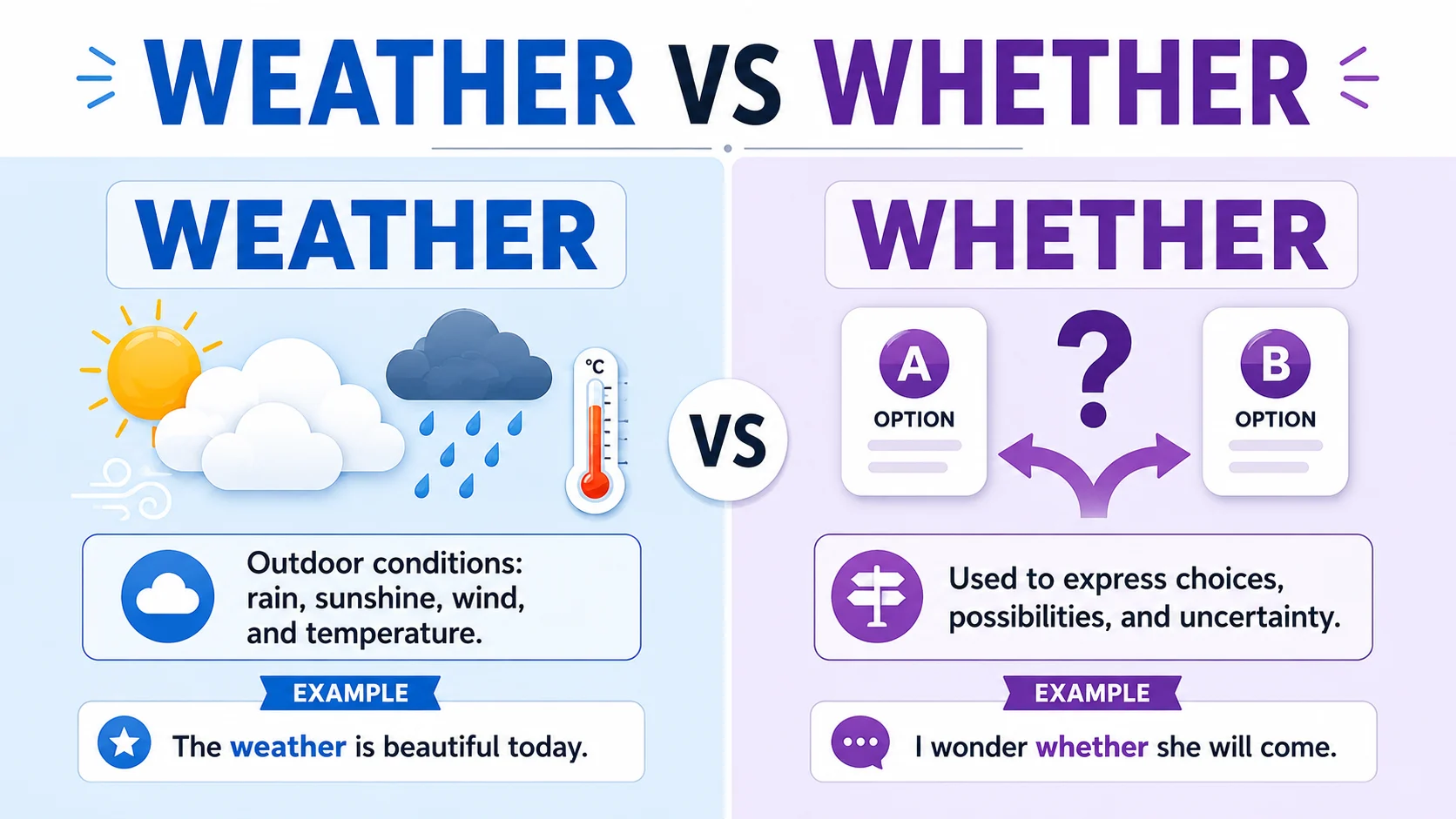
Weather refers to the conditions outside, such as rain, sunshine, wind, and temperature. Whether is used to introduce a choice, express doubt, or show two possible situations. Although these words sound alike, they have different meanings and uses.
Have you ever stopped while writing and wondered whether you should use weather or whether? You are not alone. These two words sound almost the same, but they have very different meanings. Mixing them up is a common spelling and grammar mistake in emails, school assignments, professional documents, and everyday messages.
The main reason for this confusion is pronunciation. Both words are homophones, which means they sound alike but have different spellings and meanings. However, their uses are easy to understand once you learn what each word does in a sentence.
The word weather describes what happens outside. It includes rain, snow, sunshine, clouds, wind, and temperature. On the other hand, whether helps introduce a question, choice, condition, or possibility.
In this guide, you will learn the difference between weather vs whether, their definitions, grammar rules, sentence patterns, and common mistakes. You will also find practical examples, comparison tables, and exercises to help you choose the correct word with confidence.
Quick Answer: Weather vs Whether
The easiest way to understand weather vs whether is to remember what each word describes.
- Weather: Describes outdoor conditions, such as rain, sunshine, snow, wind, and temperature.
- Whether: Introduces a choice, possibility, or indirect question. It often means that something is uncertain or that two options exist.
Examples:
- The weather is cold today.
- I do not know whether it will rain tomorrow.
In the first sentence, weather describes outdoor conditions. In the second sentence, whether introduces uncertainty about rain.
Quick memory trick: If you are talking about rain, sunshine, or temperature, use weather. If you are talking about a choice, decision, or possibility, use whether.
What Is the Difference Between Weather and Whether?
The main difference between weather and whether is their meaning and grammatical function.
Weather is mainly a noun. It describes the state of the atmosphere at a particular place and time. It can also work as a verb when describing how something changes or is affected by outdoor conditions.
Whether is a conjunction. It connects ideas and introduces indirect questions, alternatives, and uncertain situations. It is commonly used when someone needs to consider two or more possibilities.
For example:
Weather:
We stayed home because the weather was terrible.
Here, weather describes the outdoor conditions that caused the decision.
Whether:
We could not decide whether to stay home or go outside.
Here, whether introduces two possible choices.
The words may sound alike, but you cannot use them interchangeably. Replacing one with the other changes the meaning of the sentence and may make it grammatically incorrect.
Weather vs Whether Comparison Table
| Feature | Weather | Whether |
|---|---|---|
| Part of speech | Mainly a noun; also a verb | Conjunction |
| Main meaning | Atmospheric conditions | Choice or possibility |
| Common use | Rain, snow, sunshine, wind | Decisions, doubts, alternatives |
| Refers to | Outdoor conditions | Two or more possibilities |
| Example | The weather is sunny. | I wonder whether she is home. |
| Common phrases | Bad weather, cold weather | Whether or not, whether to |
| Related words | Rain, climate, forecast | If, choice, possibility |
| Memory clue | Think about the sky | Think about a choice |
Definition and Explanation of Weather
The word weather refers to the condition of the atmosphere at a specific place and time. It includes different natural conditions that affect daily life.
These conditions include:
- Temperature
- Rainfall
- Snowfall
- Wind speed
- Humidity
- Cloud cover
- Sunshine
- Storms
- Fog
People use the word weather when talking about what is happening outside or what may happen during the day.
For example:
- The weather is warm this morning.
- We may have heavy rain this evening.
- The weather forecast says it will snow tomorrow.
- Hot weather makes it difficult to work outside.
- The weather changed suddenly during our trip.
In each example, weather refers to atmospheric conditions.
Weather as a Noun
The most common use of weather is as a noun.
A noun names a person, place, thing, or idea. In this case, weather names the atmospheric conditions around us.
Examples:
- The weather is beautiful today.
- We canceled the picnic because of bad weather.
- Cold weather can make driving difficult.
- The weather in Florida is often warm.
- Farmers depend on suitable weather for their crops.
- The weather report predicts strong winds.
- The storm brought dangerous weather to the area.
Notice how the word weather describes conditions in every sentence.
Weather as a Verb
Although many people know weather as a noun, it can also function as a verb.
As a verb, it can mean to withstand, survive, or become affected by exposure to the elements over time.
For example:
- The old wooden house has weathered many storms.
- The paint began to weather after years of exposure to sunlight.
- The mountain rocks have weathered over thousands of years.
- The building weathered the strong winter winds.
It can also be used figuratively to describe surviving a difficult situation.
For example:
The company weathered a difficult financial period.
Here, the company survived a challenging time.
Common Expressions With Weather
The word weather appears in many common English expressions.
| Expression | Meaning | Example |
|---|---|---|
| Bad weather | Unpleasant outdoor conditions | We stayed inside because of bad weather. |
| Good weather | Pleasant outdoor conditions | Good weather made our trip enjoyable. |
| Cold weather | Low temperatures | Cold weather affects my daily routine. |
| Hot weather | High temperatures | Hot weather increases the need for water. |
| Weather forecast | Prediction of future conditions | Check the weather forecast before traveling. |
| Weather conditions | Current atmospheric state | Weather conditions are changing rapidly. |
| Weather report | Information about the weather | I watched the weather report this morning. |
| Weather warning | Notice about dangerous conditions | A weather warning was issued for the region. |
These expressions are useful in daily conversations, news reports, travel plans, and professional writing.
Definition and Explanation of Whether
The word whether is a conjunction. It is used to introduce a choice, possibility, or indirect question.
It often appears when someone is unsure about something or needs to consider different options.
For example:
- I do not know whether he is coming.
- She asked whether the shop was open.
- We must decide whether to travel today.
- Tell me whether you agree with this idea.
- I cannot remember whether I locked the door.
In these sentences, whether connects one part of the sentence to another and introduces an uncertain situation.
Unlike weather, whether does not describe the atmosphere or anything related to rain, sunshine, or temperature.
Whether for Choices
One common use of whether is to introduce a choice between two or more options.
Examples:
- I cannot decide whether to buy a laptop or a tablet.
- She is thinking about whether to accept the job.
- We need to choose whether to stay or leave.
- He asked whether I wanted tea or coffee.
- They discussed whether to build a new office.
In each sentence, there are different possibilities to consider.
Whether for Indirect Questions
Whether is also used in indirect questions. These are questions included within another sentence.
Examples:
- I wonder whether she knows the answer.
- He asked whether the meeting had started.
- Can you tell me whether this road is open?
- We need to find out whether the information is correct.
- She wanted to know whether I had received her email.
An important grammar point is that indirect questions usually follow normal statement word order.
Correct: I wonder whether she is coming.
Incorrect: I wonder whether is she coming.
The second sentence uses question word order inside an indirect question, which is not standard grammar.
Whether or Not
The expression whether or not is used to show that something will happen or remain true regardless of the outcome.
Examples:
- I will attend the meeting whether or not it rains.
- You should complete your work whether or not you feel motivated.
- She will support her friend whether or not others agree.
- We must finish the project whether or not the deadline changes.
This expression is useful when the result does not change the main decision.
Whether Followed by an Infinitive
Whether can appear before an infinitive verb, usually with to.
The common pattern is:
Whether + to + base form of a verb
Examples:
- I cannot decide whether to stay.
- She does not know whether to apply.
- We discussed whether to continue.
- He is unsure whether to accept the offer.
- They must determine whether to invest.
This structure is especially common when talking about decisions.
When Should You Use Weather?
Use weather when your sentence describes atmospheric conditions or the effects of those conditions.
Think about the sky, temperature, rain, snow, wind, and storms. If your sentence discusses these things, weather is usually the correct choice.
Talking About Daily Conditions
People often use weather to describe the conditions outside.
Examples:
- The weather is pleasant today.
- The weather feels colder than yesterday.
- I enjoy warm weather.
- The weather is too hot for outdoor activities.
- We are expecting cloudy weather tomorrow.
Talking About Travel
Weather is important when planning trips, flights, and outdoor activities.
Examples:
- Bad weather delayed our flight.
- We checked the weather before booking the trip.
- The weather was perfect for hiking.
- Heavy weather conditions affected the road.
- Our outdoor plans depend on the weather forecast.
Talking About Farming
Farmers depend on weather conditions to grow crops and manage their fields.
Examples:
- Rainy weather helps certain crops grow.
- Dry weather can damage agricultural production.
- Farmers need accurate weather information.
- Unusual weather patterns can affect harvests.
Talking About Science and Climate
Weather is also used in scientific and environmental discussions.
Examples:
- Scientists study weather patterns.
- Weather changes can affect local ecosystems.
- The weather station records temperature and rainfall.
- Severe weather can cause flooding.
Remember that weather describes short-term atmospheric conditions. It is not exactly the same as climate, which refers to long-term weather patterns.
When Should You Use Whether?
Use whether when you are discussing uncertainty, alternatives, decisions, or indirect questions.
It is especially useful when a person does not know which possibility is true or which option to choose.
Talking About Decisions
Examples:
- I have not decided whether to study medicine or engineering.
- She is considering whether to move abroad.
- We must decide whether to accept the proposal.
- He is unsure whether to change his career.
- They discussed whether to purchase a new house.
Expressing Doubt
Examples:
- I am not sure whether he understands the instructions.
- She wondered whether the information was accurate.
- We do not know whether the train will arrive on time.
- I cannot tell whether this answer is correct.
- He questioned whether the plan would work.
Asking Indirect Questions
Examples:
- Could you tell me whether the office is open?
- I would like to know whether you received my message.
- She asked whether the documents were ready.
- Please confirm whether the payment was successful.
- We need to check whether the website is working.
Discussing Two Possibilities
Examples:
- I do not know whether it is true or false.
- She could not decide whether to laugh or cry.
- We need to determine whether the problem is technical or human.
- The manager asked whether the team was ready or still needed more time.
Weather vs Whether: Advantages and Disadvantages
Weather and whether are not competing products or methods. Therefore, they do not have advantages and disadvantages in the usual sense. However, understanding their different roles offers practical benefits and helps prevent writing mistakes.
Benefits of Using Weather Correctly
Using weather correctly makes descriptions of outdoor conditions clear and accurate.
Its benefits include:
- Clear communication: Readers understand that you are discussing atmospheric conditions.
- Better descriptions: You can explain rain, wind, heat, snow, and storms accurately.
- Useful planning: Weather information helps people make travel and outdoor activity decisions.
- Professional writing: Correct usage improves reports, forecasts, and everyday communication.
- Accurate information: It prevents confusion in scientific and environmental discussions.
A possible limitation is that the word weather is not suitable for introducing choices or indirect questions.
For example:
Incorrect: I do not know weather she is ready.
Correct: I do not know whether she is ready.
Benefits of Using Whether Correctly
Using whether correctly helps you express uncertainty and choices.
Its benefits include:
- Clear decisions: It shows that different options are being considered.
- Better questions: It introduces indirect questions naturally.
- Professional communication: It is useful in emails, reports, and formal discussions.
- Accurate grammar: It connects ideas in a meaningful way.
- Flexible expression: It works in many situations involving doubt or possibilities.
A limitation is that whether cannot replace weather when discussing outdoor conditions.
Incorrect: The whether is cold today.
Correct: The weather is cold today.
Weather vs Whether: Real-World Examples
Understanding definitions is helpful, but real-world examples make the difference easier to remember.
Here are common situations where people use these words.
Everyday Conversation
Situation: Two friends are discussing their weekend plans.
Friend 1: The weather looks beautiful today.
Friend 2: I am not sure whether we should go hiking or visit the beach.
The first person describes outdoor conditions. The second person considers two possible activities.
School and Academic Writing
Weather:
The weather conditions affected the students’ ability to complete the outdoor experiment.
Whether:
The students were asked to determine whether the results supported their hypothesis.
The first sentence discusses atmospheric conditions. The second introduces an academic question.
Workplace Communication
Weather:
Due to severe weather, the outdoor meeting has been postponed.
Whether:
Please confirm whether you will attend the meeting tomorrow.
The first sentence explains a delay. The second requests confirmation.
Travel Planning
Weather:
We checked the weather forecast before booking our tickets.
Whether:
We are deciding whether to travel by train or airplane.
The first sentence relates to travel conditions. The second discusses transportation choices.
Social Media
Weather:
Beautiful weather makes every morning feel special.
Whether:
I cannot decide whether to watch a movie or read a book tonight.
Both words are common in informal digital communication.
News Reporting
Weather:
The storm brought heavy rain and dangerous weather conditions to several areas.
Whether:
Officials have not confirmed whether schools will remain closed tomorrow.
The first sentence reports environmental conditions. The second discusses an uncertain decision.
Business and Customer Service
Weather:
Delivery services may experience delays because of extreme weather.
Whether:
Please let us know whether you would like to change your delivery date.
These examples show how the correct word depends on the meaning of the sentence, not its pronunciation.
Weather vs Whether in Different Sentence Structures
The two words also appear in different grammatical patterns. Learning these patterns can help you use them correctly without having to stop and think every time.
Weather + Be Verb
Weather commonly appears with forms of the verb be.
Examples:
- The weather is warm.
- The weather was terrible.
- The weather will be sunny.
- The weather has been unpredictable.
Weather + Adjective
Weather often appears before descriptive adjectives.
Examples:
- Cold weather
- Warm weather
- Wet weather
- Dry weather
- Humid weather
- Unusual weather
- Severe weather
- Pleasant weather
Weather + Noun
Weather can also describe another noun.
Examples:
- Weather forecast
- Weather report
- Weather station
- Weather conditions
- Weather patterns
- Weather warning
- Weather changes
Whether + Subject + Verb
This is one of the most common structures.
Examples:
- I wonder whether he is home.
- She asked whether the store was open.
- We need to know whether they agree.
- He cannot remember whether he called.
Whether + To + Verb
Use this structure when discussing a decision.
Examples:
- I am unsure whether to continue.
- She has not decided whether to resign.
- They discussed whether to relocate.
- We must determine whether to proceed.
Whether + Or + Alternative
Use whether when presenting two or more possible options.
Examples:
- I cannot decide whether to stay or leave.
- She asked whether I preferred coffee or tea.
- We need to determine whether the answer is correct or incorrect.
Weather vs Whether: Regional and Global Usage
The words weather and whether are used in British English, American English, Canadian English, Australian English, and other major varieties of English.
Their meanings and spellings remain the same across these varieties.
| English variety | Weather | Whether | Main difference |
|---|---|---|---|
| American English | Atmospheric conditions | Choice or possibility | Same |
| British English | Atmospheric conditions | Choice or possibility | Same |
| Canadian English | Atmospheric conditions | Choice or possibility | Same |
| Australian English | Atmospheric conditions | Choice or possibility | Same |
| Indian English | Atmospheric conditions | Choice or possibility | Same |
| Pakistani English | Atmospheric conditions | Choice or possibility | Same |
There is no standard regional spelling difference between these words.
Weather and Whether in American English
In American English, weather is commonly used in daily conversations, forecasts, and news reports.
Examples:
- The weather is getting warmer.
- I wonder whether she is coming.
American English speakers use both words according to their meanings.
Weather and Whether in British English
British English follows the same distinction.
Examples:
- The weather has been rainy all week.
- I cannot decide whether to go out.
The spelling and grammatical functions do not change.
Weather and Whether in Global English
English learners around the world may confuse these words because their pronunciation is very similar.
This confusion is especially common among students who learn English through speaking before they become comfortable with spelling and grammar.
The best solution is to understand their meanings and practice them in complete sentences.
Weather vs Climate: Are They the Same?
Weather and climate are related concepts, but they do not mean the same thing.
Weather describes short-term atmospheric conditions. Climate describes the usual weather patterns of a region over a long period.
For example:
- Weather: It is raining in New York today.
- Climate: The region experiences cold winters and warm summers.
Weather vs Climate Comparison
| Feature | Weather | Climate |
|---|---|---|
| Meaning | Short-term atmospheric conditions | Long-term weather patterns |
| Time period | Minutes, hours, days, or weeks | Usually 30 years or more |
| Changes | Can change quickly | Changes more slowly |
| Example | It is snowing today. | This region has cold winters. |
| Main focus | Current conditions | Long-term patterns |
Understanding this difference also helps you recognize when weather is the correct word.
Weather vs Whether vs If
Another common source of confusion is the difference between whether and if.
Both can introduce situations involving uncertainty. In some sentences, they can be used in similar ways. However, they are not interchangeable in every grammatical structure.
When Whether and If Have Similar Meanings
Both words can introduce indirect yes-or-no questions.
Examples:
- I do not know whether she is coming.
- I do not know if she is coming.
Both sentences are grammatically acceptable.
When to Use Whether Instead of If
Use whether when presenting alternatives, especially with or not or or.
Examples:
- I cannot decide whether to stay or leave.
- She asked whether the shop was open or closed.
- We must decide whether or not to continue.
Use whether before an infinitive with to.
Correct: I cannot decide whether to go.
Incorrect: I cannot decide if to go.
In formal writing, whether is often the clearer choice when introducing an indirect question or an explicit alternative.
Whether vs If Comparison Table
| Feature | Whether | If |
|---|---|---|
| Introduces uncertainty | Yes | Yes |
| Introduces alternatives | Yes | Limited use |
| Used before an infinitive with to | Yes | No |
| Used with or not | Yes | Possible in some positions |
| Used for conditions | No, not in the same sense | Yes |
| Example | I wonder whether he knows. | I wonder if he knows. |
| Conditional example | Not normally used | If it rains, we will stay home. |
Important: If can introduce a condition, while whether introduces uncertainty or alternatives.
Compare:
- If it rains, we will cancel the picnic.
- We do not know whether it will rain.
The first sentence describes a condition. The second describes uncertainty.
Common Mistakes When Using Weather and Whether
Many writers make mistakes because they focus on pronunciation instead of meaning.
Here are some common errors and their corrections.
Using Weather Instead of Whether
Incorrect: I do not know weather he is coming.
Correct: I do not know whether he is coming.
Explanation: The sentence expresses uncertainty about someone’s arrival. Therefore, whether is correct.
Using Whether Instead of Weather
Incorrect: The whether is beautiful today.
Correct: The weather is beautiful today.
Explanation: The sentence describes outdoor conditions, so weather is needed.
Confusing Whether With If
Incorrect: She cannot decide if to accept the offer.
Correct: She cannot decide whether to accept the offer.
Explanation: Use whether before an infinitive with to.
Forgetting the Correct Word in Questions
Incorrect: Can you tell me weather the shop is open?
Correct: Can you tell me whether the shop is open?
Explanation: This is an indirect question, so whether is appropriate.
Using Whether for Outdoor Conditions
Incorrect: Whether conditions are getting worse.
Correct: Weather conditions are getting worse.
Explanation: The sentence refers to atmospheric conditions.
Using Weather for a Choice
Incorrect: I am unsure weather to study or work.
Correct: I am unsure whether to study or work.
Explanation: The sentence presents two possible decisions.
Confusing Weather and Climate
Incorrect: The weather of this region has been hot for the last 30 years.
Better: The climate of this region has been hot for the last 30 years.
Explanation: Long-term atmospheric patterns are described as climate, not daily weather.
Writing Whether as Two Words
Incorrect: I do not know wether she is ready.
Correct: I do not know whether she is ready.
Explanation: Whether has an h after the w and follows the spelling w-h-e-t-h-e-r.
Easy Tricks to Remember Weather vs Whether
You do not need to memorize complicated grammar rules to understand these words. A few simple tricks can help you choose the right one.
Remember the Word Rain
The word weather contains the same beginning sound as wet in many English accents.
Think of rain making the ground wet. This can help you remember that weather relates to outdoor conditions.
For example:
- The weather is rainy.
- The weather is cold.
- The weather is sunny.
This is a memory trick, not the actual definition of the word.
Remember the Word Choice
Think of whether as a word connected to decisions and alternatives.
For example:
- Whether to stay or leave.
- Whether to buy or sell.
- Whether to accept or reject.
Whenever you are considering different options, whether is often the right word.
Ask Yourself One Simple Question
Before writing either word, ask:
Am I talking about outdoor conditions or a choice?
- Outdoor conditions = Weather
- Choice or uncertainty = Whether
This simple question works in most everyday situations.
Replace the Word in Your Sentence
Another useful method is to replace the word with a similar expression.
If you can replace it with atmospheric conditions, use weather.
Example:
The weather is terrible.
The atmospheric conditions are terrible.
The meaning remains clear.
If you can replace it with if or which of the options, whether may be appropriate.
Example:
I wonder whether he is ready.
I wonder if he is ready.
The sentence still makes sense.
However, remember that if and whether do not work in every identical grammatical structure.
Advanced Grammar Rules for Whether
For more confident writing, it is useful to understand a few advanced rules.
Whether at the Beginning of a Sentence
Whether can introduce a clause at the beginning of a sentence.
Examples:
- Whether we win or lose, we will learn something.
- Whether she agrees or not, the decision has been made.
- Whether it rains or shines, the event will continue.
This structure places emphasis on the condition or alternatives being considered.
Whether in Formal Writing
Whether is common in academic, business, and professional writing.
Examples:
- The study examines whether the treatment improves patient outcomes.
- The committee will determine whether the proposal meets the requirements.
- Researchers investigated whether the results were statistically significant.
These sentences show how whether helps introduce a question or possibility within a larger statement.
Whether With a Preposition
In formal English, whether can follow certain prepositions.
For example:
- We discussed the question of whether the plan was practical.
- There is uncertainty about whether the results are accurate.
- The decision depends on whether funding is available.
This structure is useful in academic and professional writing.
Whether With Two Clauses
Whether can introduce two alternative clauses.
Examples:
- Whether you agree or disagree, you should explain your reasons.
- Whether the results are positive or negative, the research will continue.
- Whether he arrives early or late, we will begin the meeting on time.
This structure makes the alternatives clear.
Whether or Not Is Sometimes Optional
In many sentences, the words or not are unnecessary because the meaning is already clear.
For example:
- I do not know whether she will attend.
- I do not know whether or not she will attend.
Both are correct.
The second version gives additional emphasis to the uncertainty. The first is usually shorter and more natural.
Exercises With Answers: Test Your Understanding
Practice is one of the best ways to remember the difference between weather and whether.
Read each sentence and choose the correct word. Try to answer without looking at the solutions first.
Exercise One: Choose Weather or Whether
Fill in each blank with the correct word.
- The ______ is sunny today.
- I do not know ______ he will arrive on time.
- We canceled the match because of bad ______.
- She asked ______ I had completed the assignment.
- The ______ forecast predicts heavy rain.
- I cannot decide ______ to buy a phone or a laptop.
- Cold ______ makes driving more difficult.
- Please tell me ______ you received my email.
- The farmers are waiting for better ______ conditions.
- He wondered ______ the answer was correct.
Exercise Two: Correct the Mistakes
Each sentence contains an incorrect use of weather or whether. Rewrite it correctly.
- I am not sure weather she likes coffee.
- The whether is very cold today.
- We need to decide weather to travel.
- Bad whether delayed the flight.
- Can you tell me weather the office is open?
- The wether forecast says it will snow.
- She does not know weather to accept the job.
- Beautiful whether makes me happy.
- I wonder weather they understand the question.
- Severe whether affected the outdoor event.
Exercise Three: Complete the Sentences
Choose the correct word and complete each sentence.
- I will go outside if the ______ improves.
- She asked me ______ I wanted to join the team.
- We checked the ______ before leaving home.
- They have not decided ______ to move abroad.
- The ______ report mentioned a possible storm.
- I cannot remember ______ I locked the door.
- The flight was delayed because of extreme ______.
- We need to determine ______ the information is accurate.
- The ______ in this region changes quickly.
- He is unsure ______ to accept the invitation.
Exercise Four: Identify the Grammatical Function
Identify whether the bold word is a noun, verb, or conjunction.
- The weather is pleasant.
- She asked whether I was ready.
- The old building has weathered many storms.
- We do not know whether the shop is open.
- The weather forecast is available online.
- The wooden surface has weathered over time.
- I wonder whether he understands.
- The weather changed suddenly.
Answers to the Exercises
Exercise One
| Question | Answer |
|---|---|
| 1 | Weather |
| 2 | Whether |
| 3 | Weather |
| 4 | Whether |
| 5 | Weather |
| 6 | Whether |
| 7 | Weather |
| 8 | Whether |
| 9 | Weather |
| 10 | Whether |
Exercise Two
- I am not sure whether she likes coffee.
- The weather is very cold today.
- We need to decide whether to travel.
- Bad weather delayed the flight.
- Can you tell me whether the office is open?
- The weather forecast says it will snow.
- She does not know whether to accept the job.
- Beautiful weather makes me happy.
- I wonder whether they understand the question.
- Severe weather affected the outdoor event.
Exercise Three
- Weather
- Whether
- Weather
- Whether
- Weather
- Whether
- Weather
- Whether
- Weather
- Whether
Exercise Four
| Question | Answer | Grammatical function |
|---|---|---|
| 1 | Weather | Noun |
| 2 | Whether | Conjunction |
| 3 | Weathered | Verb |
| 4 | Whether | Conjunction |
| 5 | Weather | Noun |
| 6 | Weathered | Verb |
| 7 | Whether | Conjunction |
| 8 | Weather | Noun |
What Your Score Means
Use this simple guide to evaluate your answers.
| Correct answers | Performance |
|---|---|
| 35–38 | Excellent understanding |
| 30–34 | Very good |
| 24–29 | Good, but practice more |
| 18–23 | Review the grammar rules |
| Below 18 | Start again with the basic definitions |
There are 38 questions across the four exercises. If you make mistakes, focus on the meaning of each sentence rather than memorizing individual answers.
Related Words and Comparisons
Understanding similar English words can improve your spelling, vocabulary, and grammar.
Weather and whether belong to a larger group of words that sound alike but have different meanings.
Weather vs Whether vs Wether
There is another word that sounds similar to weather and whether: wether.
A wether is a castrated male sheep or goat. It is a specialized term used mainly in farming and animal-related contexts.
| Word | Meaning | Example |
|---|---|---|
| Weather | Atmospheric conditions | The weather is cold. |
| Whether | Choice or possibility | I wonder whether he is coming. |
| Wether | A castrated male sheep or goat | The farmer raised a wether. |
Although all three words are pronounced similarly in many English accents, their meanings are completely different.
Weather vs Climate vs Forecast
These three terms are closely related, but each has a different purpose.
- Weather: Describes current or short-term atmospheric conditions.
- Climate: Describes long-term weather patterns in a region.
- Forecast: Provides a prediction of future weather conditions.
Examples:
- The weather is cloudy today.
- The climate in this region is generally dry.
- The forecast predicts rain tomorrow.
Whether vs If vs Either
These words can appear in sentences about choices, but their grammatical roles are different.
Whether introduces uncertainty or alternatives.
Example: I do not know whether he is coming.
If introduces a condition or an indirect yes-or-no question.
Example: If he comes, we will start the meeting.
Either refers to one of two available choices.
Example: You can choose either tea or coffee.
Understanding these differences helps prevent common grammar mistakes.
Why Do People Confuse Weather and Whether?
There are several reasons why these words are often mixed up.
Similar Pronunciation
In many English accents, weather and whether are pronounced almost identically.
This makes it difficult to identify the correct spelling through sound alone.
For example, when someone says, “I do not know whether it will rain,” you may hear a word that sounds like weather.
Different Meanings but Similar Sounds
The two words have unrelated meanings, but their pronunciation creates confusion.
One describes the atmosphere, while the other introduces uncertainty.
Writers who focus only on how a word sounds may select the wrong spelling.
Fast Typing
People often make spelling mistakes when writing quickly.
For example, someone may type:
I wonder weather the store is open.
The writer may know the correct word but select the wrong spelling without noticing.
Lack of Grammar Practice
Some learners memorize word meanings but do not practice using them in sentences.
As a result, they may understand both definitions but still confuse the words during writing.
The best way to improve is to practice complete sentences and learn common grammatical patterns.
How to Improve Your Use of Weather and Whether
If you regularly confuse these words, a few simple habits can improve your writing.
Read Your Sentence Again
Before submitting an assignment or sending an email, read your sentence carefully.
Ask yourself whether you are describing outdoor conditions or introducing a possibility.
Learn Common Sentence Patterns
Memorize a few useful examples.
For weather:
- The weather is nice.
- Bad weather caused delays.
- Check the weather forecast.
For whether:
- I wonder whether he knows.
- I cannot decide whether to go.
- Let me know whether you agree.
Use a Spell Checker
Modern writing tools can identify many spelling mistakes. However, they may not always recognize a wrong word when it is spelled correctly.
For example, both weather and whether are correctly spelled words. A basic spell checker may not identify the mistake if the word is grammatically incorrect in context.
Therefore, understanding meaning is more useful than relying entirely on automated tools.
Practice With Your Own Sentences
Write five sentences using weather and five using whether.
For example:
- The weather is warm in summer.
- I wonder whether the train is delayed.
Creating your own examples helps you understand how these words work in real communication.
Frequently Asked Questions About Weather vs Whether
What is the main difference between weather and whether?
Weather describes atmospheric conditions, such as rain, sunshine, wind, and temperature. Whether introduces a choice, possibility, or indirect question. Their meanings and grammatical functions are different.
How do you remember whether to use weather or whether?
Remember that weather relates to outdoor conditions, such as rain and sunshine. Whether relates to choices and uncertainty. Ask yourself whether your sentence discusses the sky or a possibility.
Are weather and whether homophones?
Yes. Weather and whether are homophones in many English accents because they have the same or nearly the same pronunciation but different spellings and meanings.
Is it correct to say weather or not?
No, not when you mean to introduce a choice or express uncertainty. The correct expression is whether or not. For example, “I will attend whether or not it rains.”
Can whether be used at the beginning of a sentence?
Yes. Whether can introduce a clause at the beginning of a sentence. For example, “Whether it rains or shines, we will continue the event.”
Can I use if instead of whether?
Sometimes. Both can introduce indirect yes-or-no questions, such as “I wonder if she is ready” and “I wonder whether she is ready.” However, whether is needed before an infinitive with to, as in “whether to go.”
What is the difference between weather and climate?
Weather describes short-term atmospheric conditions, such as today’s temperature or rainfall. Climate describes the usual weather patterns of a region over a much longer period, generally 30 years or more.
Is whether a noun or a verb?
Whether is a conjunction. It connects ideas and introduces alternatives, possibilities, and indirect questions. It is not used as a noun or a verb in standard English.
Is weather always a noun?
No. Weather is mainly used as a noun, but it can also function as a verb. As a verb, it can mean to withstand difficult conditions or become changed through exposure to the elements.
What is an example of weather and whether in one sentence?
Here is an example: “I do not know whether the weather will improve tomorrow.” Whether introduces uncertainty, while weather describes outdoor conditions.
Which spelling is correct: whether it rains or not or weather it rains or not?
The correct spelling is “whether it rains or not.” The phrase introduces two possibilities and shows that the outcome does not change the main point.
Conclusion: Weather vs Whether
Understanding the difference between weather vs whether is an important part of improving your English spelling and grammar. Although these words sound alike, they serve completely different purposes in a sentence.
Use weather when discussing atmospheric conditions, including rain, sunshine, wind, snow, and temperature. It can also work as a verb when describing how something withstands or changes due to exposure to the elements.
Use whether when introducing uncertainty, choices, alternatives, or indirect questions. Common expressions include “whether or not,” “whether to go,” and “I wonder whether.”
The easiest way to remember the difference is to connect weather with the sky and whether with a choice. Practice writing your own sentences, review the examples in this guide, and complete the exercises to strengthen your understanding.
With regular practice, you will be able to choose the correct spelling naturally. Whether you are writing a school assignment, professional email, social media post, or everyday message, using these words correctly will make your communication clearer and more effective.