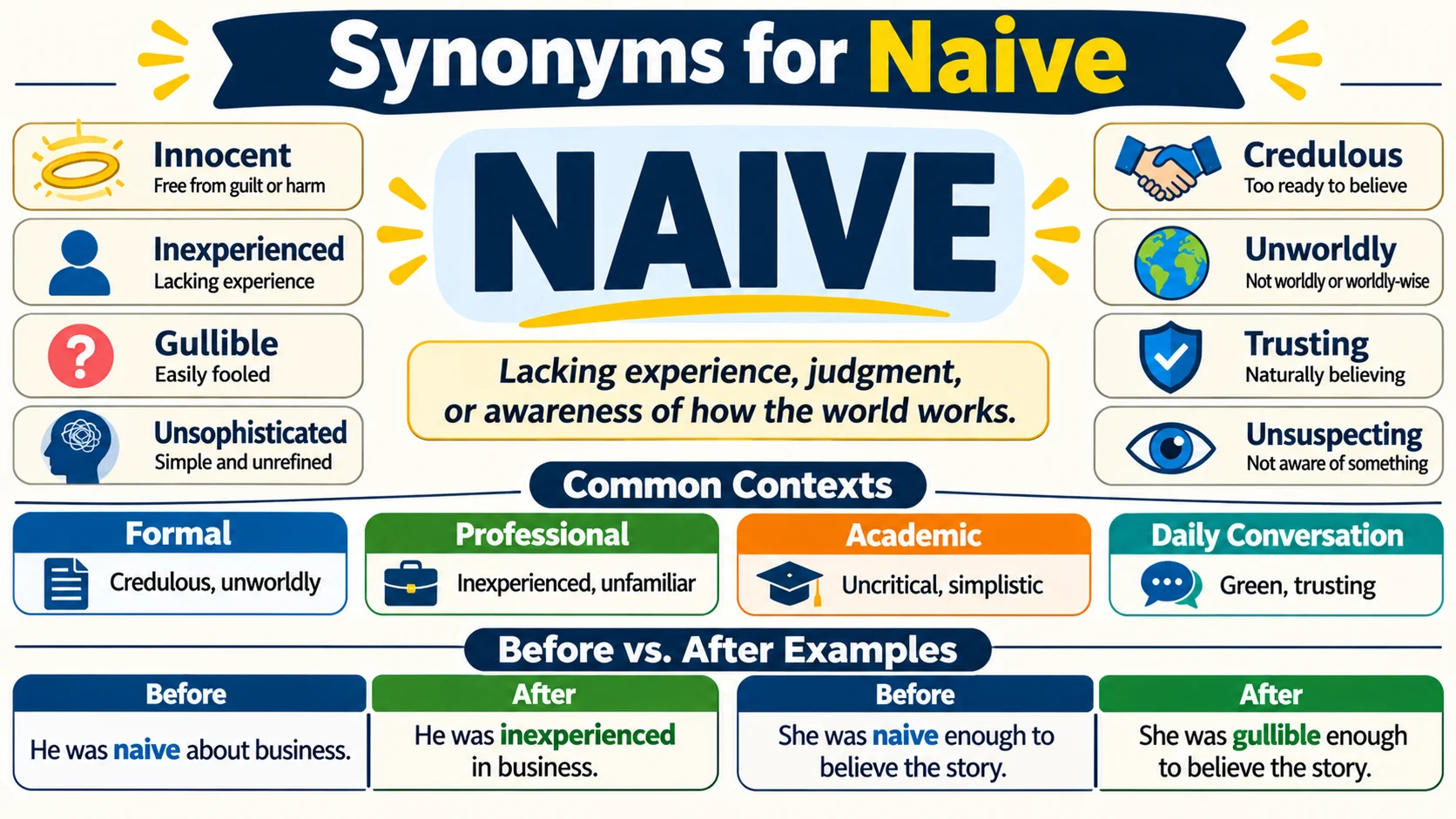
Another word for naive is innocent, inexperienced, gullible, or unsophisticated. The best synonym depends on the context. Use innocent for someone with little awareness of wrongdoing, inexperienced for someone new to a situation, and gullible for someone who easily believes false information. These words describe different aspects of naivety.
What Does Naive Mean?
Definition
The word naive (also spelled naïve) is an adjective that describes someone who lacks experience, judgment, or awareness of how the world works. A naive person may trust others too easily, misunderstand complex situations, or believe things without questioning them.
Naive can describe a person, an idea, a decision, or an expectation. The word is often used when someone has an innocent or overly simple understanding of a situation.
For example:
- She was naive enough to believe the stranger’s story.
- His naive expectations about business led to disappointment.
- The proposal showed a naive understanding of the problem.
Naive does not always mean foolish. Sometimes, it describes a person who is genuinely innocent or simply unfamiliar with a particular situation.
Common Uses
Naive is commonly used in these contexts:
- Lack of experience: A naive employee may not understand workplace politics.
- Excessive trust: A naive person may believe a dishonest salesperson.
- Innocence: A naive child may not understand why someone would lie.
- Unrealistic expectations: A naive investor may expect guaranteed profits.
- Limited understanding: A naive argument may overlook important facts.
Choosing the right synonym depends on which meaning you want to express.
Best Synonyms for Naive
The following words are useful alternatives to naive in American English. Some are close synonyms, while others emphasize a particular aspect of the word.
| Synonym | Meaning | Best Used When | Example |
|---|---|---|---|
| Innocent | Free from wrongdoing or harmful knowledge | Describing purity or lack of awareness | She had an innocent belief in people. |
| Inexperienced | Lacking practical knowledge | Discussing work or new situations | The inexperienced employee needed guidance. |
| Gullible | Easily tricked or deceived | Describing excessive trust | He was gullible enough to believe the scam. |
| Unsophisticated | Lacking worldly knowledge | Describing limited social understanding | Her unsophisticated view of business changed. |
| Unworldly | Unfamiliar with practical realities | Describing someone sheltered | He seemed unworldly in the city. |
| Credulous | Too willing to believe something | Formal writing or critical discussion | The audience was credulous. |
| Childlike | Having the innocence or openness of a child | Positive or affectionate descriptions | Her childlike curiosity was refreshing. |
| Green | New or inexperienced | Casual or workplace conversation | The new assistant was still green. |
| Simple | Lacking complexity or sophistication | Describing an uncomplicated view | His simple understanding missed the details. |
| Trusting | Willing to believe others | Describing a person’s attitude | She was trusting of strangers. |
| Unsuspecting | Unaware of possible danger or deception | Describing someone caught off guard | The unsuspecting customer entered the store. |
| Inexperienced | Not having enough practical knowledge | Professional or academic settings | The inexperienced researcher made an error. |
Best overall alternatives: Innocent, inexperienced, gullible, and unsophisticated.
However, these words are not interchangeable in every sentence. For example, an inexperienced person may be intelligent and careful, while a gullible person is particularly easy to deceive.
Synonyms by Context
Formal Writing
For formal writing, choose words that communicate the exact meaning without sounding insulting.
- Credulous: Too willing to believe something without sufficient evidence.
- Unworldly: Lacking experience of practical life.
- Unsophisticated: Lacking knowledge of complex social or practical matters.
- Inexperienced: Lacking knowledge gained through experience.
Example:
Naive: The committee had a naive understanding of the financial risks.
Formal: The committee had an unsophisticated understanding of the financial risks.
The revised sentence sounds more precise and professional.
Professional Writing
In professional communication, naive can sound judgmental. More neutral alternatives are often better.
| Alternative | Professional Example |
|---|---|
| Inexperienced | The inexperienced team required additional training. |
| New to the field | She was new to the field but eager to learn. |
| Unfamiliar | The manager was unfamiliar with the process. |
| Overly optimistic | The initial forecast was overly optimistic. |
| Lacking practical knowledge | The proposal lacked practical knowledge of market conditions. |
For resumes and performance reviews, inexperienced or unfamiliar is generally more appropriate than gullible or foolish.
Academic Writing
Academic writing benefits from precise language that describes the specific weakness in an argument or assumption.
- Uncritical: Accepting ideas without careful evaluation.
- Unsophisticated: Lacking complexity or depth.
- Uninformed: Based on insufficient knowledge.
- Simplistic: Ignoring important details or complexity.
- Credulous: Accepting claims too readily.
Academic example:
Naive: The study relied on a naive assumption about human behavior.
Academic: The study relied on an oversimplified assumption about human behavior.
Use simplistic or oversimplified when the problem is an idea rather than a person’s experience.
Daily Conversation
For everyday conversations, simple and familiar alternatives work best.
- Innocent
- Green
- Trusting
- Gullible
- Inexperienced
- Childlike
Examples:
“He’s a little naive about relationships.”
“He’s inexperienced when it comes to relationships.”
“She’s too trusting of people she barely knows.”
“Don’t be gullible. That offer sounds suspicious.”
The best everyday synonym depends on whether you mean someone is new, innocent, or easily deceived.
Professional Alternatives for Naive
When writing emails, resumes, reports, or business documents, the goal is to communicate clearly without making a person sound unintelligent.
Here are some useful professional replacements.
1. Inexperienced
Meaning: Lacking practical knowledge or skills gained through experience.
- Tone: Neutral
- Difficulty: Easy
- Usage Frequency: Very Common
- Best For: Resume, email writing, business writing
Business example: The inexperienced team needed additional support during implementation.
Academic example: Inexperienced participants required more detailed instructions.
Daily conversation: I’m inexperienced with this software.
2. Unfamiliar
Meaning: Not having knowledge of something.
- Tone: Neutral
- Difficulty: Easy
- Usage Frequency: Very Common
- Best For: Emails, business communication, academic writing
Business example: The new manager was unfamiliar with the company’s procedures.
Academic example: Students were unfamiliar with the terminology.
Daily conversation: I’m unfamiliar with this neighborhood.
3. Unsophisticated
Meaning: Lacking knowledge or understanding of complex matters.
- Tone: Formal, sometimes critical
- Difficulty: Medium
- Usage Frequency: Common
- Best For: Business writing, essays, reports
Business example: The proposal reflected an unsophisticated understanding of consumer behavior.
Academic example: The model used an unsophisticated approach to data analysis.
Daily conversation: His view of the situation was unsophisticated.
4. Overly Optimistic
Meaning: Expecting a more favorable outcome than circumstances justify.
- Tone: Neutral to critical
- Difficulty: Medium
- Usage Frequency: Common
- Best For: Business emails, reports, marketing analysis
Business example: The company’s overly optimistic revenue projections created financial pressure.
Academic example: The researchers adopted an overly optimistic interpretation of the findings.
Daily conversation: You’re being overly optimistic about how quickly we’ll finish.
Simple Alternatives for Naive
If you want easy words that most readers understand, these are useful choices.
| Simple Word | Meaning | Example |
|---|---|---|
| Innocent | Not aware of wrongdoing | The child was innocent of the situation. |
| Green | New or inexperienced | I’m still green at this job. |
| Trusting | Believing people easily | She’s very trusting. |
| New | Recently introduced to something | He’s new to the business. |
| Unaware | Not knowing about something | She was unaware of the risks. |
| Foolish | Showing poor judgment | It was foolish to believe the claim. |
Remember that foolish is more negative than naive. Use it only when you want to criticize someone’s judgment.
Stronger Alternatives for Naive
Sometimes naive does not fully express the degree of someone’s lack of judgment or awareness.
These stronger alternatives can communicate a more critical meaning.
| Word | Meaning | Example |
|---|---|---|
| Gullible | Easily deceived | He was gullible enough to trust the fake offer. |
| Foolish | Lacking good judgment | It was foolish to ignore the warning. |
| Credulous | Too ready to believe | The credulous audience accepted the claim. |
| Unthinking | Acting without careful consideration | The decision was unthinking and rushed. |
| Unsuspecting | Not expecting deception or danger | The unsuspecting buyer paid the full price. |
| Simple-minded | Lacking intellectual understanding | The term can sound insulting and should be used cautiously. |
Important distinction: Gullible is a strong synonym when naivety involves deception. Foolish is more appropriate when someone makes a poor decision.
Difference Between Similar Synonyms
Several words are often confused with naive. Understanding their differences helps you choose a more accurate alternative.
Naive vs. Innocent
Naive describes a lack of experience or judgment. Innocent often describes someone who has not done anything wrong or lacks awareness of harmful behavior.
Example:
- Naive: He believed the stranger’s unrealistic promise.
- Innocent: The child was innocent of any wrongdoing.
Naive vs. Gullible
Naive often suggests inexperience. Gullible specifically means someone is easily tricked.
Example:
- Naive: She was naive about the challenges of starting a business.
- Gullible: She believed the fake investment offer.
Naive vs. Inexperienced
Inexperienced is neutral and focuses on a lack of practice. Naive can also suggest poor judgment or unrealistic beliefs.
Example:
- Inexperienced: The employee had never managed a team.
- Naive: The employee believed managing a team would be effortless.
Naive vs. Unsophisticated
Unsophisticated describes a lack of complexity, knowledge, or worldly understanding. Naive usually emphasizes inexperience or innocence.
Example:
- Naive: He thought every business deal was fair.
- Unsophisticated: His business strategy lacked complexity.
Naive vs. Childlike
Childlike often describes positive qualities such as curiosity, openness, or wonder. Naive usually emphasizes a lack of experience or awareness.
Example:
- Childlike: Her childlike excitement made everyone smile.
- Naive: Her naive expectations led to disappointment.
Opposite Words of Naive
The antonyms of naive describe someone who has experience, awareness, practical judgment, or the ability to recognize deception.
| Antonym | Meaning | Example |
|---|---|---|
| Experienced | Having practical knowledge | She is an experienced business owner. |
| Sophisticated | Having refined knowledge or understanding | He has a sophisticated view of economics. |
| Worldly | Familiar with practical realities | The worldly traveler recognized the scam. |
| Shrewd | Showing sharp judgment | The shrewd investor avoided the risky deal. |
| Cautious | Careful about potential risks | She was cautious before signing the contract. |
| Skeptical | Unwilling to accept claims without evidence | He was skeptical of the offer. |
| Astute | Able to understand situations accurately | The astute manager noticed the problem. |
The best opposite depends on the meaning. Experienced is the opposite of inexperienced, while skeptical is a useful contrast to gullible.
FAQs About Naive Synonyms
1. What is another word for naive?
Innocent, inexperienced, gullible, and unsophisticated are common synonyms for naive. The best choice depends on whether you mean a lack of experience, innocence, or excessive trust.
2. What is a formal synonym for naive?
Credulous, unsophisticated, and unworldly are formal alternatives. In academic writing, uncritical or simplistic may be more accurate when describing an argument or assumption.
3. What is a professional alternative for naive?
Inexperienced, unfamiliar, and overly optimistic are useful professional alternatives. They communicate the issue without sounding unnecessarily insulting.
4. What is a positive synonym for naive?
Innocent, childlike, and trusting can have positive meanings. These words emphasize openness, honesty, or a lack of harmful intentions rather than poor judgment.
5. What is a negative synonym for naive?
Gullible, foolish, credulous, and simple-minded are negative alternatives. Gullible is particularly useful when someone is easily deceived.
6. Is gullible the same as naive?
No. Naive generally means lacking experience or judgment, while gullible means being easily tricked or deceived. A naive person is not necessarily gullible.
7. What is the opposite of naive?
Experienced, worldly, sophisticated, shrewd, and astute are common opposites. Skeptical is another useful antonym when naive means trusting claims too easily.
8. Can naive be used in academic writing?
Yes. Naive is common in academic writing, especially when describing assumptions, models, or approaches. However, simplistic, uncritical, or uninformed may provide greater precision.
9. What is a simple word for naive?
Innocent, green, trusting, and inexperienced are simple alternatives. Green is informal and usually describes someone who is new to a job or activity.
10. What is a better word than naive for a resume?
Use inexperienced, unfamiliar, or new to the field when describing a lack of professional experience. Avoid gullible or foolish because these words sound negative and unprofessional.
Conclusion
The best synonym for naive depends on the meaning you want to communicate. Innocent works when describing purity or a lack of awareness. Inexperienced is ideal for professional and academic contexts. Gullible emphasizes excessive trust, while unsophisticated describes a limited understanding of complex situations.
For everyday writing, innocent and inexperienced are safe choices. For formal writing, consider credulous or unworldly. For professional communication, unfamiliar or overly optimistic often provides a more precise and respectful alternative.
Choosing the right word improves clarity, tone, and meaning. Instead of replacing naive with the first synonym you find, consider the context and the specific quality you want to describe.