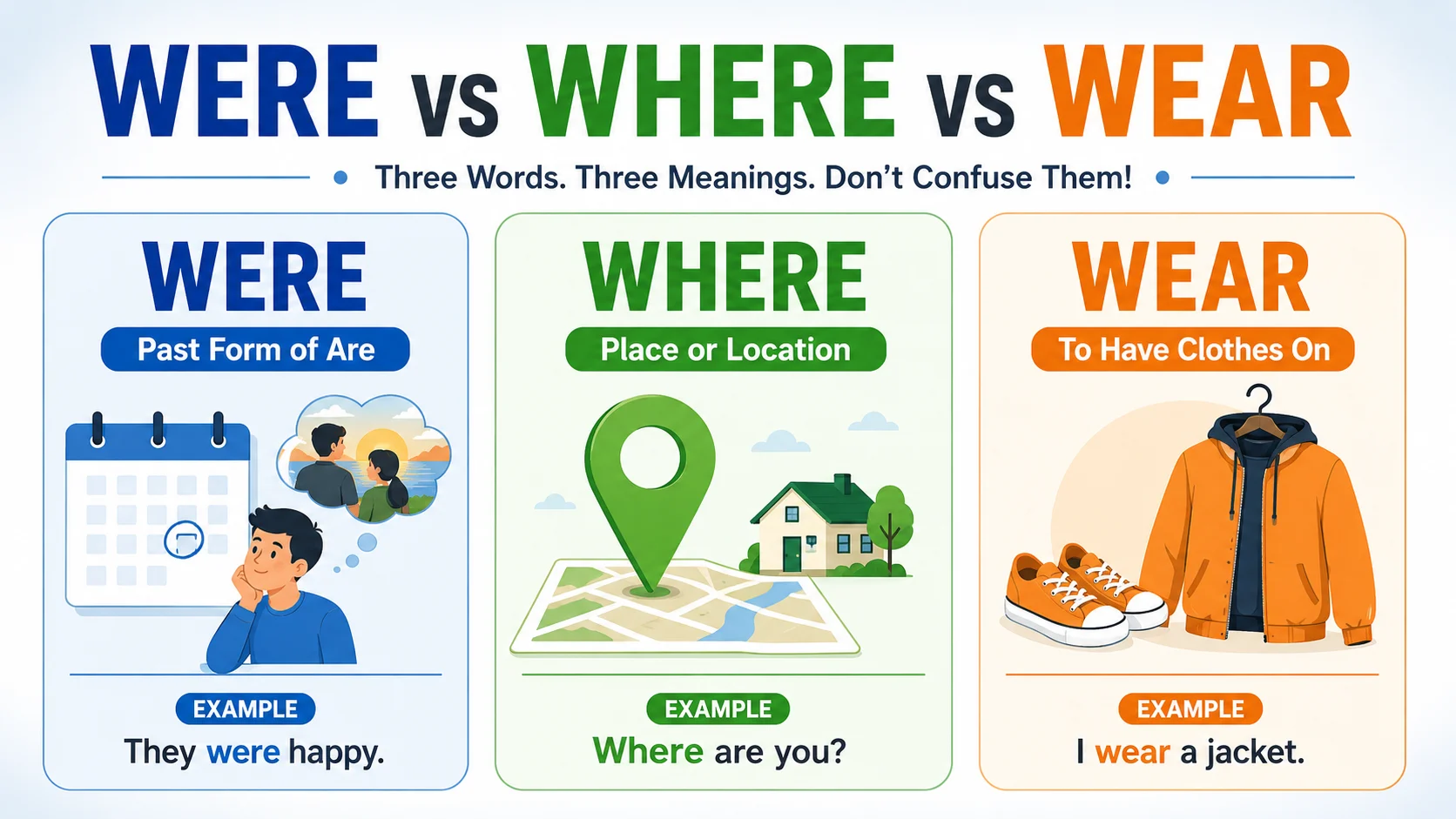
Were, where, and wear sound similar, but they have different meanings and uses. Were is the past tense of are, where asks about a place or location, and wear means to have clothing or accessories on your body. Knowing the difference helps you avoid common spelling and grammar mistakes.
English has many words that sound alike but have very different meanings. Were, where, and wear are three common examples. They can confuse students, writers, and even people who use English every day. Although these words sound similar, you cannot use them in the same way.
The main problem is that people often choose the wrong spelling when writing quickly. For example, someone might write, “Where going to the park,” instead of “We’re going to the park.” Another person might ask, “Were is my phone?” when they actually mean, “Where is my phone?”
These mistakes can change the meaning of a sentence and make writing less clear. The good news is that learning the difference is simple when you understand the role of each word.
In this guide, you will learn what were, where, and wear mean, how to use them in sentences, and how to remember their differences. You will also find comparison tables, everyday examples, common mistakes, practice exercises, and answers to help you use all three words with confidence.
Quick Answer: Were vs Where vs Wear
The easiest way to understand were vs where vs wear is to look at what each word does in a sentence.
| Word | Meaning | Part of Speech | Example |
|---|---|---|---|
| Were | Past form of the verb “be” | Verb | They were happy yesterday. |
| Where | Refers to a place or location | Adverb, pronoun, or conjunction | Where do you live? |
| Wear | To have clothing or accessories on your body | Verb | I wear glasses every day. |
Remember these simple rules:
- Were: Think about the past or a past condition.
- Where: Think about a place or location.
- Wear: Think about clothes, shoes, or accessories.
For example:
- We were tired after the trip.
- Where is your school?
- I wear a jacket in winter.
These three examples show how each word has its own meaning and purpose.
Definition and Explanation of Were, Where, and Wear
To understand these words properly, it helps to study each one separately. Their meanings, grammar roles, and sentence structures are different.
What Does Were Mean?
Were is the past-tense form of the verb “be.” It is commonly used with the pronouns you, we, and they. It is also used with plural nouns.
It describes a past action, condition, feeling, or situation.
In simple words, use “were” when talking about something that was true or happening in the past.
Examples:
- We were at home last night.
- They were excited about the trip.
- You were right about the answer.
- The students were ready for the exam.
- My friends were waiting outside.
In each example, “were” connects the subject to a past condition or situation.
When Should You Use Were?
Use “were” in the following situations.
For past conditions
Use were to describe how someone or something was in the past.
Examples:
- The children were happy.
- We were busy yesterday.
- They were nervous before the interview.
For past locations
Use were when explaining where someone or something was in the past.
Examples:
- We were at the library.
- They were in the classroom.
- You were near the entrance.
Notice that “were” describes the past situation, while “where” asks about the location.
For past continuous sentences
Use were with a verb ending in “-ing” to describe an action that was happening in the past.
Examples:
- They were playing football.
- We were watching a movie.
- You were studying when I called.
The basic structure is:
Subject + were + verb ending in “-ing”
For hypothetical situations
“Were” is also used in certain unreal or imaginary situations.
Examples:
- If I were rich, I would travel the world.
- If she were here, she could help us.
- I wish he were more careful.
This use is especially common in formal English and hypothetical statements.
Were as Part of the Verb “Be”
The verb “be” changes depending on the subject and tense.
| Subject | Present Form | Past Form |
|---|---|---|
| I | Am | Was |
| He | Is | Was |
| She | Is | Was |
| It | Is | Was |
| You | Are | Were |
| We | Are | Were |
| They | Are | Were |
Examples:
- I am happy today.
- I was happy yesterday.
- We are ready now.
- We were ready earlier.
This table makes it easier to see why “were” is used with certain subjects.
What Does Where Mean?
Where is a question word that refers to a place, position, or location.
It is commonly used to ask questions about the place where something happens or where someone or something is located.
In simple words, use “where” when asking about a place.
Examples:
- Where do you live?
- Where is my notebook?
- Where are the children?
- Where did you buy this dress?
- Where should we meet?
In these examples, “where” asks for information about a location.
When Should You Use Where?
Use “where” in several common situations.
To ask about a location
This is the most common use of where.
Examples:
- Where is the hospital?
- Where is your office?
- Where are my keys?
- Where does your brother work?
To describe the place where something happens
Where can also connect two parts of a sentence.
Examples:
- This is the house where I grew up.
- I visited the city where my parents met.
- She works in a building where many people study.
Here, “where” introduces information about a particular place.
To ask about direction or position
Where can also appear in questions about movement or position.
Examples:
- Where are you going?
- Where should I put this box?
- Where did the dog go?
- Where can I find a taxi?
To introduce a place in a longer sentence
Where can connect a main idea with additional information about a location.
Examples:
- We found a quiet place where we could relax.
- The school where I studied has changed.
- This is the restaurant where we had dinner.
Where in Different Sentence Structures
Where can appear at the beginning, middle, or end of a sentence.
| Sentence Structure | Example |
|---|---|
| Beginning | Where is your car? |
| Middle | I know where she lives. |
| Connecting two ideas | This is where we first met. |
| Indirect question | Can you tell me where the station is? |
One important grammar point is that indirect questions usually follow normal statement word order.
Correct: Can you tell me where the station is?
Incorrect: Can you tell me where is the station?
What Does Wear Mean?
Wear is a verb that means to have clothing, shoes, jewelry, or accessories on your body.
It can also describe the use of something that is attached to or carried on the body.
In simple words, use “wear” when talking about clothes or things you put on your body.
Examples:
- I wear a blue shirt.
- She wears glasses.
- They wear uniforms at school.
- He likes to wear black shoes.
- My father wears a watch.
In each example, “wear” describes something that a person has on their body.
When Should You Use Wear?
Use “wear” in different situations involving clothing, appearance, and accessories.
For clothing
Examples:
- I wear jeans every weekend.
- She wears a red dress.
- He wears a warm coat in winter.
- They wear matching shirts.
For shoes and accessories
Examples:
- I wear comfortable shoes.
- She wears gold earrings.
- My brother wears a smartwatch.
- He wears sunglasses outside.
For hairstyles and appearance
Wear can also describe a hairstyle, beard, or other appearance.
Examples:
- He wears his hair long.
- She wears her hair in a bun.
- My grandfather wears a beard.
For makeup and similar products
Examples:
- She wears light makeup.
- I do not wear perfume.
- He wears sunscreen when he goes outside.
For carrying something on the body
Wear can describe items such as a badge or a name tag.
Examples:
- Employees wear identification badges.
- Visitors must wear safety tags.
- Workers wear protective equipment.
Wear Can Have Other Meanings
Although wear commonly refers to clothing, it has additional meanings.
Wear as damage caused by use
Wear can be a noun that describes damage caused by regular use.
Examples:
- The tires show signs of wear.
- There is a lot of wear on these shoes.
- The machine has suffered years of wear.
Wear as gradual reduction
The word can also describe something becoming thinner, weaker, or less effective over time.
Examples:
- Constant use will wear down the surface.
- The paint has started to wear off.
- The repeated pressure wore away the stone.
These meanings are important because “wear” does not always refer to clothing.
Were vs Where vs Wear: Main Differences
The three words may sound alike, but their grammatical functions are different.
| Feature | Were | Where | Wear |
|---|---|---|---|
| Main meaning | Past form of “be” | Place or location | To have clothing on |
| Part of speech | Verb | Adverb, pronoun, conjunction | Verb or noun |
| Main purpose | Describes a past condition | Asks about or identifies a place | Describes clothing or damage |
| Common clue | Yesterday, earlier, last week | Place, location, position | Clothes, shoes, accessories |
| Example | We were late. | Where are you? | I wear boots. |
The Simplest Way to Remember the Difference
You do not need to memorize complicated grammar rules. Just connect each word with one simple idea.
- Were = Past
- Where = Place
- Wear = Clothing
Try these memory tricks:
Were: Think about “was.”
Both were and was are past forms of the verb “be.”
Example: They were happy.
Where: Think about “here.”
Both words are connected with places.
Example: Where is the book? It is here.
Wear: Think about “clothing.”
Both words are connected with things you put on your body.
Example: I wear a jacket.
These simple connections can help you choose the correct word while writing.
Were vs Where vs Wear in Everyday English
Understanding definitions is helpful, but seeing these words in real situations makes them easier to remember.
At School
Students often use these words when talking about lessons, classrooms, and school activities.
Examples:
- We were late for class.
- Where is the science laboratory?
- Students wear uniforms at this school.
Here, “were” describes a past situation, “where” asks about a place, and “wear” describes clothing.
At Work
These words are also common in professional communication.
Examples:
- We were busy during the meeting.
- Where is the conference room?
- Employees wear formal clothes at this event.
Using the correct word makes emails, reports, and workplace messages easier to understand.
While Traveling
Travel conversations often involve locations, past experiences, and clothing.
Examples:
- We were in New York last summer.
- Where is the nearest airport?
- I wear comfortable shoes when traveling.
During Shopping
Shopping is another situation where all three words can appear.
Examples:
- The dresses were on sale yesterday.
- Where can I find the shoe section?
- I wear size eight shoes.
In Daily Conversations
You may use these words without even thinking about them.
Examples:
- They were waiting for us.
- Where are you going?
- What should I wear to dinner?
The last example is especially useful because “wear” often appears when asking about clothing choices.
Were vs Where vs Wear: Sentence Examples
The following examples show how these words work in different sentence patterns.
Examples Using Were
- We were happy to see our family.
- They were playing in the garden.
- You were very helpful yesterday.
- The shops were closed on Sunday.
- My parents were proud of me.
- The children were sleeping.
- We were waiting for the bus.
- The books were on the table.
- They were excited about their holiday.
- I thought you were at home.
Examples Using Where
- Where is your brother?
- Where did you put my phone?
- Do you know where she lives?
- Where can I buy fresh fruit?
- This is the place where we met.
- Where are you going tomorrow?
- Can you show me where the office is?
- Where did you learn English?
- I remember where we parked the car.
- Where should we start?
Examples Using Wear
- I wear a jacket when it is cold.
- She wears glasses while reading.
- They wear uniforms at work.
- He likes to wear comfortable clothes.
- I wear a watch every day.
- My sister wears a beautiful necklace.
- You should wear a helmet while riding a bike.
- Workers wear gloves for safety.
- She does not wear makeup every day.
- I usually wear sneakers when walking.
Were vs Where vs Wear: Advantages and Disadvantages
These words do not have advantages or disadvantages in the way products or technologies do. However, understanding their correct use has clear benefits, while confusing them can create problems.
Benefits of Using the Correct Word
Clear communication
Using the correct word helps readers understand your message without confusion.
For example:
- Correct: Where is my bag?
- Incorrect: Were is my bag?
The correct version clearly asks about a location.
Better grammar
Correct word choice improves sentence structure and helps you write more accurately.
For example:
- Correct: They were at school.
- Incorrect: They where at school.
Professional writing
Spelling and grammar mistakes can make emails, applications, and reports look less polished.
Correct usage helps create a better impression.
Improved reading and writing skills
Learning the difference between similar-sounding words helps you understand English grammar more deeply.
Problems Caused by Incorrect Usage
Confusing the reader
A wrong word can make a sentence difficult to understand.
Example:
- Incorrect: I do not know were she lives.
- Correct: I do not know where she lives.
Changing the meaning
Using one word instead of another may create a different meaning.
Example:
- I was asking what to wear.
- I was asking where to go.
The first sentence is about clothing. The second is about a destination.
Reducing writing quality
Repeated grammar mistakes can affect the quality of schoolwork, professional documents, and online content.
Were vs Where vs Wear: Common Mistakes and Corrections
Many English learners confuse these words because they sound similar. The following mistakes are especially common.
Mistake: Using Were Instead of Where
Incorrect: Were is the nearest bank?
Correct: Where is the nearest bank?
Why?
The sentence asks about a location, so “where” is the correct word.
Mistake: Using Where Instead of Were
Incorrect: We where very tired.
Correct: We were very tired.
Why?
The sentence describes a past condition. Therefore, use “were.”
Mistake: Using Wear Instead of Were
Incorrect: They wear at the party yesterday.
Correct: They were at the party yesterday.
Why?
The sentence describes where people were in the past. It does not describe clothing.
Mistake: Using Where Instead of Wear
Incorrect: I where a black shirt to work.
Correct: I wear a black shirt to work.
Why?
The sentence describes clothing, so “wear” is correct.
Mistake: Confusing Where and Wear in Questions
Incorrect: What should I where to the wedding?
Correct: What should I wear to the wedding?
Why?
The question asks about clothing, not a location.
Mistake: Using Were in a Present-Tense Sentence
Incorrect: They were happy today.
Correct, if describing their current condition: They are happy today.
Why?
“Were” is a past form. Use “are” for a present condition when the subject is “they.”
However, “They were happy today” can also be correct if the speaker is describing an earlier period of the same day.
Mistake: Confusing Wear and Wore
Incorrect: Yesterday, I wear my new shoes.
Correct: Yesterday, I wore my new shoes.
Why?
“Wear” is the present form. “Wore” is its simple past form.
Were, Where, and Wear: Related Words and Comparisons
Learning related words can help you understand the differences more clearly.
Were vs Was
Were and was are both past forms of the verb “be.”
| Were | Was |
|---|---|
| Used with you, we, and they | Used with I, he, she, and it |
| We were tired. | I was tired. |
| They were ready. | She was ready. |
| You were correct. | He was correct. |
Remember that “were” can also be used with “I” in hypothetical statements.
Example: If I were you, I would study more.
Where vs Here
Both words refer to places, but they have different purposes.
| Where | Here |
|---|---|
| Asks about a location | Refers to the current location |
| Where are you? | I am here. |
| Where is the school? | The school is here. |
“Where” asks for information. “Here” identifies a place.
Wear vs Wore
Wear and wore are different forms of the same verb.
| Wear | Wore |
|---|---|
| Present tense | Simple past tense |
| I wear a coat. | I wore a coat yesterday. |
| She wears glasses. | She wore glasses at school. |
| They wear uniforms. | They wore uniforms last year. |
The past participle of wear is “worn.”
Examples:
- I have worn this shirt before.
- She has worn those shoes many times.
Wear vs Put On
These expressions are related, but they do not mean exactly the same thing.
Wear describes having clothing or an accessory on your body.
Put on describes the action of placing clothing or an accessory on your body.
Examples:
- I wear a jacket every winter.
- I put on my jacket before going outside.
The first sentence describes a regular habit. The second describes an action.
Where vs Were vs We’re
Another word that often causes confusion is “we’re.”
“We’re” is a contraction of “we are.”
| Word | Meaning | Example |
|---|---|---|
| Were | Past form of “are” | We were tired. |
| Where | Place or location | Where are we? |
| We’re | We are | We’re ready. |
Examples:
- We were at home yesterday.
- Where are we going?
- We’re going to the park.
Remember that “we’re” contains an apostrophe because it combines two words.
Were vs Where vs Wear vs We’re
These four words are worth learning together because they often appear in similar sentences.
Examples:
- We were late because we’re stuck in traffic.
- Where were you yesterday?
- What should we wear to the event?
- We’re not sure where the meeting is.
Each word has a different grammatical purpose.
Regional and Global Usage of Were, Where, and Wear
Were, where, and wear are used in English-speaking countries around the world. Their basic meanings and spelling remain the same in American English, British English, Canadian English, and Australian English.
However, pronunciation can vary by region and accent.
American English
In American English:
- Were is often pronounced with an unstressed sound similar to “wər” or a stressed sound closer to “wɜr.”
- Where is commonly pronounced “wair.”
- Wear is commonly pronounced “wair.”
In many American accents, where and wear are homophones. This means they sound the same but have different meanings.
British English
In British English:
- Were is commonly pronounced with a sound similar to “wuh” in unstressed speech, although pronunciation varies.
- Where is often pronounced “weuh” or with a similar vowel sound.
- Wear has a similar pronunciation to where in many British accents.
The exact sounds depend on the speaker’s region and accent.
Canadian English
Canadian English generally follows pronunciation patterns that are similar to many American accents.
Where and wear often sound alike, while were usually has a different vowel sound.
Australian English
Australian English also uses all three words with the same basic meanings.
The pronunciation of each word may sound different from American or British English because of the Australian accent.
Does the Meaning Change Between Countries?
No. The spelling and standard meanings of were, where, and wear do not change between these major English varieties.
For example:
- Where are you going?
- We were at school.
- I wear a uniform.
These sentences have the same meanings in the United States, United Kingdom, Canada, and Australia.
The main differences are related to accent, pronunciation, and speech patterns rather than grammar or spelling.
Why Are Were, Where, and Wear So Easy to Confuse?
There are several reasons why people mix up these words.
Similar Pronunciation
The words where and wear sound the same in many English accents. Were may also sound similar, especially when spoken quickly or without stress.
When people rely only on sound, they may choose the wrong spelling.
Different Meanings but Similar Sounds
These words are examples of commonly confused English words.
Their meanings are not connected, but their pronunciation makes them easy to mix up.
Fast Typing
People often type messages quickly without checking their spelling.
For example:
- Where is my bag?
- Were you at home?
- What should I wear?
If someone does not stop to think about the sentence’s meaning, they may select the wrong word.
Limited Grammar Knowledge
Some learners memorize words without learning their grammatical roles.
Knowing that “were” is a verb, “where” is a location word, and “wear” is mainly a verb related to clothing makes the difference easier to understand.
Dependence on Spell-Check Tools
Spell-check tools may not identify these mistakes because all three words are correctly spelled.
For example, a writing tool may accept “Were is your house?” because “were” is a valid English word.
However, it is incorrect in that sentence.
This is why understanding context is more useful than relying only on automatic spelling corrections.
How to Choose Between Were, Where, and Wear
When you are unsure which word to use, follow these simple steps.
Check the Meaning
First, ask yourself what you want to communicate.
- Are you describing something in the past? Use were.
- Are you asking about a place? Use where.
- Are you talking about clothing? Use wear.
Check the Sentence Structure
Look at the words around the confusing word.
Examples:
- They ___ happy yesterday.
- ___ is your house?
- I ___ a blue shirt.
The correct answers are:
- They were happy yesterday.
- Where is your house?
- I wear a blue shirt.
Replace the Word With a Similar Expression
You can also test the sentence by replacing the word.
For “were,” try replacing it with a suitable past form of “be.”
For “where,” try using “at what place.”
For “wear,” try using “have clothing on.”
Examples:
- They were happy. They was happy? The first is correct because “they” takes “were.”
- Where is the office? At what place is the office?
- I wear glasses. I have glasses on.
This simple method helps you understand which word fits.
Were vs Where vs Wear in Questions and Answers
Questions are a useful way to practice these words.
| Question | Correct Answer | Explanation |
|---|---|---|
| Where were you? | I was at home. | Where asks about a place; were describes the past. |
| What should I wear? | Wear a formal shirt. | Wear refers to clothing. |
| Were they happy? | Yes, they were. | Were is a past-tense verb. |
| Where is your school? | It is near my house. | Where asks about location. |
| What did you wear? | I wore a blue dress. | Wear changes to wore in the past. |
| Where were the keys? | They were on the table. | Both words have different functions. |
Notice that “where” and “were” can appear in the same sentence.
For example:
Where were you last night?
- Where asks about the location.
- Were describes the past.
Understanding the role of each word makes longer sentences easier to read and write.
Practice Exercises: Were vs Where vs Wear
The best way to remember these words is to practice using them. Complete the following exercises before checking the answers.
Exercise One: Fill in the Blanks
Choose the correct word: were, where, or wear.
- ______ are you going after school?
- We ______ very happy yesterday.
- I usually ______ comfortable shoes.
- ______ did you put my notebook?
- They ______ playing football in the park.
- What should I ______ to the wedding?
- You ______ absent from class last Monday.
- ______ is the nearest hospital?
- My parents ______ proud of my results.
- I ______ glasses when I read.
Exercise Two: Choose the Correct Word
Select the correct option in each sentence.
- (Were / Where / Wear) is your mobile phone?
- We (were / where / wear) waiting for the bus.
- She likes to (were / where / wear) beautiful dresses.
- (Were / Where / Wear) you at home yesterday?
- I do not know (were / where / wear) he lives.
- The children (were / where / wear) excited.
- What did you (were / where / wear) yesterday?
- (Were / Where / Wear) should I sit?
- They (were / where / wear) tired after the journey.
- My brother does not (were / where / wear) glasses.
Exercise Three: Correct the Mistakes
Each sentence contains an incorrect use of were, where, or wear. Rewrite each sentence correctly.
- Were is your classroom?
- We where very excited about the trip.
- I like to where blue jeans.
- Where you at the office yesterday?
- They wear sleeping when I arrived.
- I do not know were she works.
- What should I were for the interview?
- The students where happy after the exam.
- Where you playing football yesterday?
- She likes to were sunglasses.
Exercise Four: Identify the Correct Meaning
Read each sentence and identify whether the bold word refers to the past, a place, or clothing.
- We were at the beach.
- Where is the library?
- He likes to wear a black jacket.
- They were watching television.
- This is the house where I grew up.
- I wear glasses every day.
Answers to the Practice Exercises
Answers for Exercise One
- Where
- Were
- Wear
- Where
- Were
- Wear
- Were
- Where
- Were
- Wear
Answers for Exercise Two
- Where
- Were
- Wear
- Were
- Where
- Were
- Wear
- Where
- Were
- Wear
Answers for Exercise Three
- Where is your classroom?
- We were very excited about the trip.
- I like to wear blue jeans.
- Were you at the office yesterday?
- They were sleeping when I arrived.
- I do not know where she works.
- What should I wear for the interview?
- The students were happy after the exam.
- Were you playing football yesterday?
- She likes to wear sunglasses.
Answers for Exercise Four
- Were: Past situation.
- Where: Place or location.
- Wear: Clothing.
- Were: Past continuous action.
- Where: A place that is being described.
- Wear: Clothing or an accessory.
Advanced Grammar: Understanding Were, Where, and Wear
Once you understand the basic meanings, it is useful to explore how these words work in more advanced sentences.
Were in Conditional Sentences
“Were” is often used in hypothetical statements. These sentences describe situations that are imaginary, unlikely, or contrary to reality.
Examples:
- If I were the manager, I would change the schedule.
- If she were taller, she could reach the shelf.
- If they were here, we could begin the meeting.
In these sentences, “were” does not necessarily describe a real past event. It expresses an imagined situation.
This is sometimes called the subjunctive mood.
Where in Relative Clauses
“Where” can introduce a relative clause that gives more information about a place.
Examples:
- This is the restaurant where we celebrated our anniversary.
- I visited the village where my grandfather was born.
- She showed me the room where the meeting takes place.
In these examples, “where” connects information about a location.
Wear in Different Verb Tenses
Wear changes form depending on the tense.
| Tense | Form | Example |
|---|---|---|
| Present simple | Wear / Wears | I wear glasses. |
| Present continuous | Am/Is/Are wearing | She is wearing a coat. |
| Simple past | Wore | He wore a suit. |
| Past continuous | Was/Were wearing | They were wearing uniforms. |
| Present perfect | Have/Has worn | I have worn this before. |
| Past perfect | Had worn | She had worn the dress before. |
| Future | Will wear | I will wear a jacket. |
This table shows why “wear” should not always be used in its original form.
For example:
- Present: I wear a jacket.
- Past: I wore a jacket.
- Future: I will wear a jacket.
Can Were and Wear Appear Together?
Yes. These words can appear in the same sentence because they have different grammatical functions.
Examples:
- They were wearing their school uniforms.
- We were wearing warm clothes during the trip.
- You were wearing the same shoes yesterday.
In these examples, “were” is a helping verb, while “wearing” is the present participle of “wear.”
Can Where and Wear Appear Together?
Yes. These words can also appear in the same sentence.
Examples:
- Where can I wear this dress?
- I know where you wear your uniform.
- Where should we wear our safety equipment?
“Where” asks about a location or situation. “Wear” describes having clothing or equipment on the body.
Can All Three Words Appear in One Sentence?
Yes. Here is an example:
Where were you when they were deciding what to wear?
This sentence contains:
- Where: Asks about a location.
- Were: Describes a past situation.
- Wear: Refers to clothing.
Another example:
Where were the students when they were told to wear their uniforms?
Learning to identify each word’s function makes sentences like these much easier to understand.
FAQs About Were vs Where vs Wear
What is the difference between were, where, and wear?
Were is the past tense of “are” and describes a past condition. Where refers to a place or location. Wear means to have clothing or accessories on your body.
Is it were or where when asking about a place?
Use “where” when asking about a place. For example, “Where is your house?” is correct because the question asks about a location.
Is it wear or where when talking about clothes?
Use “wear” when talking about clothes. For example, “I wear a jacket in winter” is correct because it describes clothing.
How do you remember were vs where vs wear?
Remember three simple connections: were means past, where means place, and wear means clothing. These keywords can help you choose the correct spelling.
Are where and wear pronounced the same?
In many English accents, yes. Where and wear are homophones, which means they have the same pronunciation but different meanings and spellings.
Are were and where homophones?
Not usually. Their vowel sounds are different in many English accents. However, pronunciation varies, and some speakers may pronounce them more similarly.
Can were and where be used in the same sentence?
Yes. For example, “Where were you yesterday?” Where asks about a location, while were describes a past situation.
What is the past tense of wear?
The simple past tense of wear is “wore.” For example, “I wore a blue shirt yesterday.” The past participle is “worn.”
Is were a past-tense verb?
Yes. Were is a past form of the verb “be.” It is commonly used with you, we, they, and plural nouns. For example, “They were happy.”
Can wear be used as a noun?
Yes. Wear can be a noun that refers to damage caused by regular use. For example, “The shoes show signs of wear.”
What is the difference between where and were in a question?
Where asks about a place, while were is a past-tense verb. For example, “Where were you?” uses both words correctly because each has a different role.
Why do people confuse were, where, and wear?
People confuse these words because they have similar sounds, especially in everyday speech. Fast typing and limited knowledge of their grammatical roles can also cause mistakes.
Which word should I use: were or wear?
Use were when describing a past condition or action. Use wear when talking about clothing or accessories. For example, “They were tired” and “They wear uniforms.”
What is the difference between were and we’re?
Were is the past form of “are.” We’re is a contraction of “we are.” For example, “We were busy yesterday” and “We’re busy today.”
Can I use where to describe a location in the past?
Yes. Where can ask about or describe a past location. For example, “Where were you last night?” asks someone about a place in the past.
Conclusion
Understanding the difference between were vs where vs wear is simple when you focus on their meanings and grammatical roles. Although these words sound similar, each one has a different purpose in English.
Use were when talking about a past condition, situation, or action. Use where when asking about or describing a place or location. Use wear when talking about clothing, shoes, accessories, or damage caused by regular use.
Remember the simple rule: were means past, where means place, and wear means clothing. Practice these words in everyday sentences, pay attention to the context, and read your writing before sharing it. Do not depend only on spell-check tools because they may not recognize a wrong word when it is correctly spelled.
With regular practice, you can avoid common mistakes and improve your English writing. Whether you are writing a school assignment, a professional email, or a casual message, choosing the correct word will make your sentences clearer and more accurate.