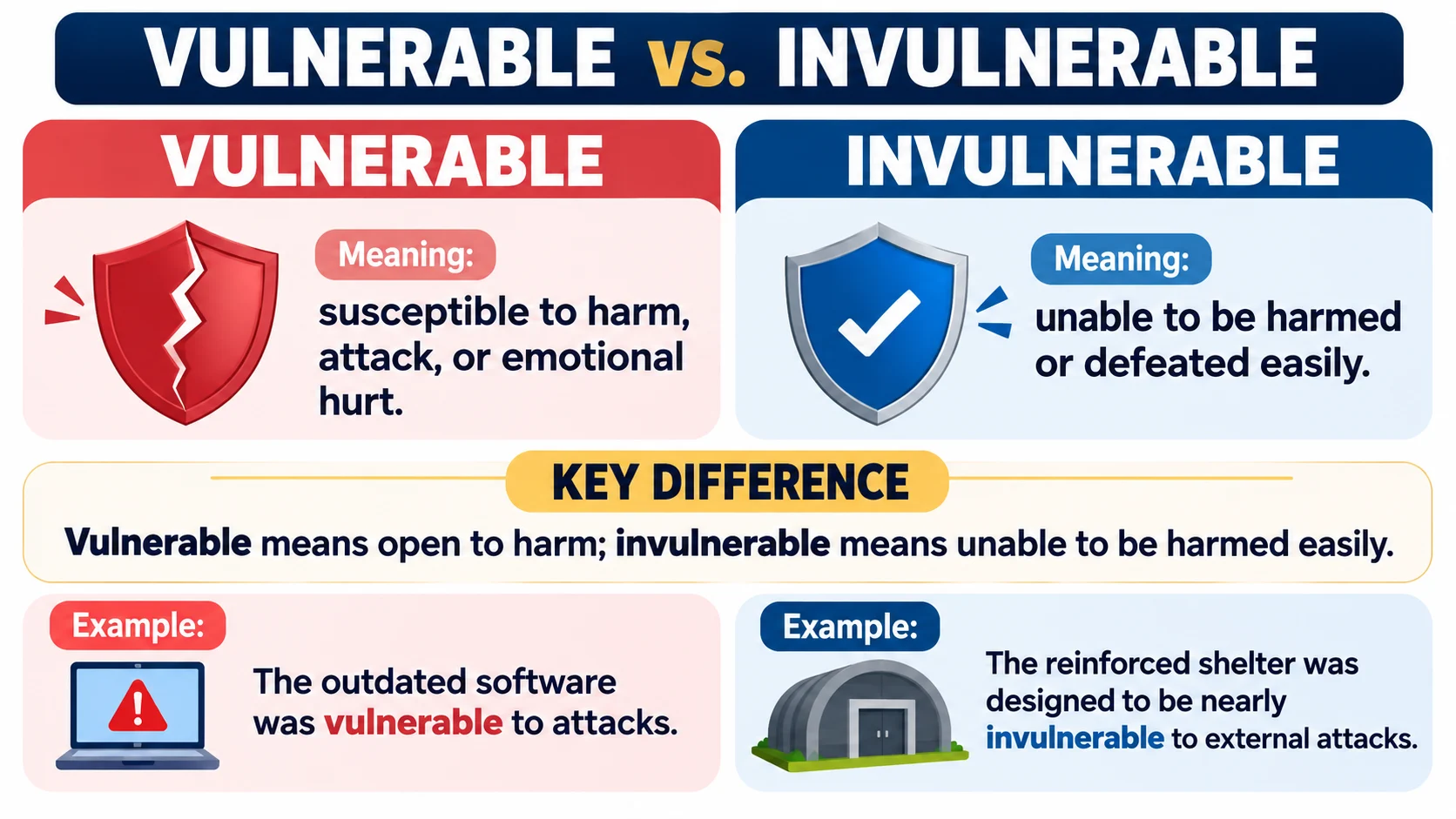
The strongest direct antonym of vulnerable is invulnerable, meaning impossible or extremely difficult to harm, damage, or defeat. Vulnerable describes someone or something that is susceptible to physical harm, emotional hurt, criticism, or attack. Depending on context, other opposites include secure, protected, resilient, and resistant.
Part of speech: Adjective
Primary opposite: Invulnerable
Vulnerable means susceptible to physical harm, emotional injury, attack, criticism, or other forms of damage. Its strongest direct opposite is invulnerable, which describes someone or something that cannot be harmed or defeated easily.
For example, a computer system vulnerable to cyberattacks is exposed to potential threats. An invulnerable system, by contrast, would be impossible to compromise. In everyday English, however, secure or protected may communicate the intended meaning more naturally without suggesting absolute immunity.
Cambridge Dictionary identifies invulnerable as the opposite of vulnerable.
Direct and Strong Antonyms
These adjectives express genuine opposition to vulnerability, although they differ in strength and application.
| Antonym | Tone or Nuance | Example Sentence |
|---|---|---|
| Invulnerable | Strongest direct opposite; implies immunity to harm | The reinforced shelter was designed to be nearly invulnerable to external attacks. |
| Insusceptible | Formal; not easily affected by a particular influence | The material is insusceptible to corrosion under normal conditions. |
| Unsusceptible | Formal or technical; not readily affected by something | The organism appeared unsusceptible to the particular treatment. |
| Unexposed | Emphasizes not being subjected to a threat or harmful influence | The confidential files remained unexposed to unauthorized users. |
Invulnerable is the most useful starting point for general vocabulary questions. The other terms are more restricted and usually work best in specific contexts.
For example, insusceptible to persuasion means not easily influenced, while unexposed to danger means not placed in contact with a threat. Neither necessarily means completely invulnerable in every respect.
Contextual and Subtle Opposites
The best opposite of vulnerable depends on what makes a person, object, or situation susceptible to harm. These contextual alternatives often sound more natural than invulnerable.
| Context | Best Opposite | Why It Fits |
|---|---|---|
| Physical safety | Protected | Emphasizes having safeguards against injury or attack. |
| Personal security | Secure | Suggests freedom from immediate danger or insecurity. |
| Emotional challenges | Resilient | Highlights the ability to recover from setbacks. |
| Cybersecurity | Resistant | Describes the ability to withstand attacks or harmful influences. |
| Persuasion or manipulation | Uninfluenced | Emphasizes not being swayed by another person’s influence. |
| Financial risk | Stable | Suggests being less likely to suffer disruption or loss. |
| Public criticism | Well-defended | Emphasizes having a strong position or effective supporting arguments. |
These are contextual opposites, not interchangeable direct antonyms.
Physical Vulnerability
When vulnerable describes exposure to physical danger, protected, secure, and invulnerable can express different degrees of safety.
Example: “The hikers were vulnerable to freezing temperatures.”
A natural opposite is: “The hikers were protected from the freezing temperatures by suitable clothing and shelter.”
Here, protected works better than invulnerable because it describes actual safeguards without claiming that the hikers cannot be harmed.
Emotional Vulnerability
In relationships, vulnerable can describe being emotionally exposed, sensitive, or open to hurt. The appropriate opposite depends on the intended message.
Example: “He felt vulnerable after sharing his personal struggles.”
Possible alternative: “He felt emotionally secure after receiving reassurance from his friends.”
Emotionally secure emphasizes confidence and reassurance. Resilient would instead emphasize the ability to cope with emotional difficulties.
Importantly, being emotionally open is not the same as being weak. A person can express vulnerability while remaining confident and resilient.
Workplace and Business Vulnerability
In professional settings, a company, argument, or decision may be vulnerable to criticism, financial loss, or operational failure.
Example: “The company was vulnerable to supply chain disruptions.”
A suitable opposite is: “The company had a resilient supply chain with multiple reliable suppliers.”
Resilient highlights the ability to withstand and recover from disruption. Secure would emphasize protection, while stable would focus on consistency and reduced uncertainty.
Technical and Security Contexts
When describing software, networks, or equipment, vulnerable usually means susceptible to damage, exploitation, or attack.
Example: “The outdated software was vulnerable to unauthorized access.”
A more precise contrast is: “The updated software was resistant to unauthorized access.”
Resistant does not guarantee complete protection. Use invulnerable only when the intended meaning supports an exceptionally strong claim.
Words That Seem Opposite But Are Not
Common Grammatical or Semantic Confusions
1. Strong
Strong can contrast with vulnerable when vulnerability means physical weakness or an inability to withstand pressure. However, strength does not automatically provide protection against every threat.
Example: “The athlete was physically strong but vulnerable to a serious knee injury.”
A strong person can still face emotional, financial, or physical risks. Therefore, strong is a related contrast rather than a universal antonym.
2. Independent
Independent means not relying on another person or thing for support, control, or resources. It does not necessarily mean safe from harm.
Example: “The independent business was still vulnerable to rising operating costs.”
Independence may reduce certain risks, but it does not eliminate vulnerability. For this reason, independent is not a direct antonym of vulnerable.
Subtle Tone Differences
Choosing the right word changes how readers interpret a situation.
- Invulnerable makes a very strong claim that something cannot be harmed or defeated.
- Secure emphasizes safety, confidence, or protection from threats.
- Protected points to safeguards, support, or preventive measures.
- Resilient emphasizes recovery and the capacity to withstand difficulties.
- Resistant means able to withstand or oppose a particular influence.
Consider these sentences:
“The network is invulnerable to attacks” suggests an exceptionally strong level of protection.
“The network is resistant to attacks” describes its ability to withstand attacks without promising complete immunity.
“The network is secure” offers a broader statement about its protection.
For accurate professional writing, choose the word that reflects the actual level and type of protection rather than automatically replacing vulnerable with the strongest-sounding opposite.
Frequently Asked Questions
1. What is the direct antonym of vulnerable?
The direct antonym of vulnerable is invulnerable. It describes someone or something that cannot be harmed or defeated easily. In ordinary situations, secure, protected, or resistant may be more precise, depending on the kind of risk involved.
2. What is the opposite of vulnerable in an emotional context?
In emotional contexts, emotionally secure is often a natural opposite when vulnerability refers to feeling exposed or uncertain. Resilient is appropriate when the emphasis is on recovering from emotional setbacks. Neither term means that a person never experiences hurt.
3. How can I use an antonym of vulnerable in a sentence?
Choose an antonym that matches the intended meaning. For example, write, “The files are protected by strong access controls,” instead of “The files are vulnerable to unauthorized access.” Use resistant for the ability to withstand threats and secure to emphasize safety.
Practical Word Choice
- Identify the intended meaning. Determine whether vulnerable refers to physical danger, emotional exposure, security weaknesses, or financial risk.
- Match the context and strength. Choose invulnerable for the strongest opposition, protected for safeguards, secure for safety, or resilient for recovery from difficulties.
Final Thoughts
The most direct antonym of vulnerable is invulnerable, but the most useful opposite in a sentence may be secure, protected, resistant, or resilient. Each word describes a different relationship to risk, harm, or adversity.
For clear American English, focus on what makes the person or situation vulnerable in the first place. The more precisely you identify that meaning, the easier it becomes to select an accurate opposite.
Which antonym of vulnerable would you use in your own sentence, and what situation would it describe?