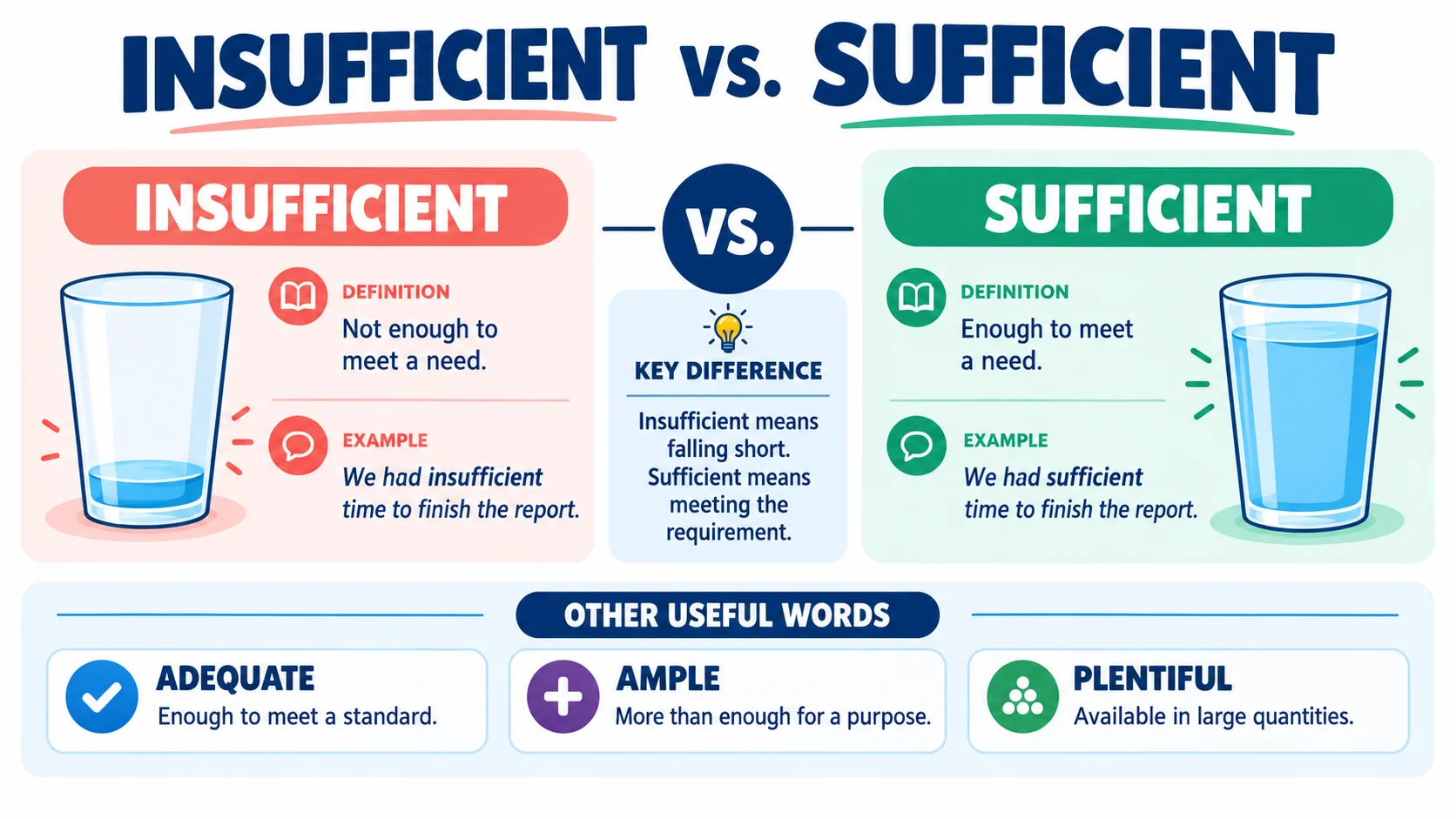
The strongest opposite of insufficient is sufficient, meaning enough to meet a particular need, requirement, or standard. Other useful antonyms include adequate, ample, and plentiful, depending on context. Use sufficient for a direct opposite, adequate for meeting requirements, and ample when emphasizing more than enough.
- Part of Speech: Adjective
- Primary Opposite: Sufficient
- Definition of Insufficient: Not enough in quantity, quality, degree, or amount to meet a particular need or requirement.
- Why Sufficient Fits: Both words describe whether something meets a need. Insufficient means not enough, while sufficient means enough for the purpose.
For example, “The evidence was insufficient to support the claim” means the evidence did not meet the required standard. “The evidence was sufficient to support the claim” expresses the opposite meaning.
Although sufficient is the clearest direct antonym, adequate, ample, and plentiful can be more suitable in specific contexts.
Direct and Strong Antonyms
The best antonym depends on whether you want to emphasize meeting a requirement, having enough resources, or possessing more than enough.
| Antonym | Tone or Nuance | Example Sentence |
|---|---|---|
| Sufficient | Direct, neutral, precise | We have sufficient evidence to proceed. |
| Adequate | Meets a required standard | The classroom has adequate lighting for students. |
| Enough | Simple, conversational | We have enough food for everyone. |
| Ample | More than enough for a purpose | The team had ample time to prepare. |
| Plentiful | Available in large quantities | Fresh vegetables are plentiful at the farmers market. |
| Abundant | Available in very large quantities | The region has abundant natural resources. |
| Plenty | Informal, emphasizes a generous amount | There is plenty of room in the back seat. |
Sufficient is the strongest general-purpose antonym because it directly reverses the meaning of insufficient. Adequate is also a close opposite, but it emphasizes whether something meets a particular standard rather than whether the amount is simply enough.
The remaining choices add specific shades of meaning. Ample, plentiful, and abundant often suggest a comfortable or generous supply, so they may be stronger than the original meaning requires.
Contextual and Subtle Opposites
The word insufficient appears in conversations about money, evidence, time, staffing, education, and many other subjects. The most natural opposite changes with the situation.
| Context | Best Opposite | Why It Fits |
|---|---|---|
| Money or funding | Sufficient | Indicates enough money to cover costs. |
| Evidence or proof | Sufficient | Meets the standard needed to support a conclusion. |
| Time for a task | Ample | Emphasizes having plenty of time. |
| Staff or supplies | Adequate | Indicates that needs can be met. |
| Food or natural resources | Plentiful | Emphasizes availability in large quantities. |
| Skills or qualifications | Adequate | Indicates that someone meets the required standard. |
| Space or storage | Ample | Suggests more than enough room. |
Consider these examples:
- Money: “The budget was insufficient to cover repairs.” A suitable opposite is “The budget was sufficient to cover repairs.”
- Workplace: “We had insufficient staff to handle the calls.” You could write, “We had adequate staff to handle the calls.”
- Scheduling: “There was insufficient time to review the report.” A natural contrast is, “There was ample time to review the report.”
- Supplies: “Water supplies were insufficient during the drought.” The opposite could be, “Water supplies were plentiful after the rainy season.”
These are contextual choices, not interchangeable replacements. For example, plentiful works well for physical resources but may sound unnatural when describing whether legal evidence meets a specific standard.
Words That Seem Opposite But Are Not
Common Grammatical or Semantic Confusions
Excessive is not a direct antonym of insufficient. It means more than is reasonable, necessary, or desirable. Although it contrasts with insufficiency in some situations, it often describes an undesirable excess.
For example:
- “The company allocated insufficient funds for training.”
- “The company allocated excessive funds for training.”
The second sentence suggests overspending, not merely having enough money.
Deficient is also not an antonym. It means lacking something necessary or failing to meet a standard. It is closer in meaning to insufficient.
For example, “The report was deficient in detail” means it lacked necessary information. Replacing deficient with sufficient reverses that meaning, but replacing it with excessive introduces a different idea.
Subtle Tone Differences
The distinctions between sufficient, adequate, and ample matter in professional and everyday writing.
- Sufficient means enough for a particular purpose. “The documentation was sufficient for approval.”
- Adequate means meeting the necessary standard, sometimes without suggesting exceptional quality. “The temporary workspace was adequate for the project.”
- Ample emphasizes a generous amount. “We allowed ample time for questions.”
In other words, something can be adequate without being impressive, and something sufficient does not necessarily mean abundant.
For academic writing, sufficient evidence is often more precise than ample evidence when discussing whether a claim meets a standard. In casual conversation, enough is usually simpler and more natural.
Frequently Asked Questions
What is the direct antonym of insufficient?
The direct antonym of insufficient is sufficient. It describes an amount, level, or supply that meets a particular need or requirement. For example, sufficient funding covers the planned expenses, while insufficient funding falls short.
What is the difference between insufficient and inadequate?
Both words describe something that falls short of a need or standard. Insufficient often emphasizes quantity or degree, while inadequate frequently emphasizes suitability, quality, or whether something meets expectations. Their meanings overlap, so the best choice depends on the sentence.
What is the best opposite of insufficient in formal writing?
Sufficient is usually the clearest choice in formal writing because it directly reverses the meaning. Use adequate when discussing whether something meets a standard, and ample when you want to emphasize a generous amount of time, space, or resources.
Practical Word Choice
- Identify the intended meaning. Decide whether insufficient refers to quantity, quality, time, resources, or meeting a standard.
- Match the context and tone. Choose sufficient for a direct opposite, adequate for meeting requirements, or ample for more than enough.
Final Thoughts
The clearest antonym of insufficient is sufficient because the two adjectives express opposite meanings. Other useful alternatives include adequate, enough, ample, plentiful, and abundant, each with its own emphasis.
Context determines which word sounds most natural. A report may contain sufficient evidence, a team may have adequate staffing, and a project may have ample time. Choosing precisely helps readers understand whether something merely meets a need or exceeds it.
When you write, focus on the specific requirement being met rather than choosing an opposite simply because it appears in a thesaurus. Which sentence would you use an antonym of insufficient in?