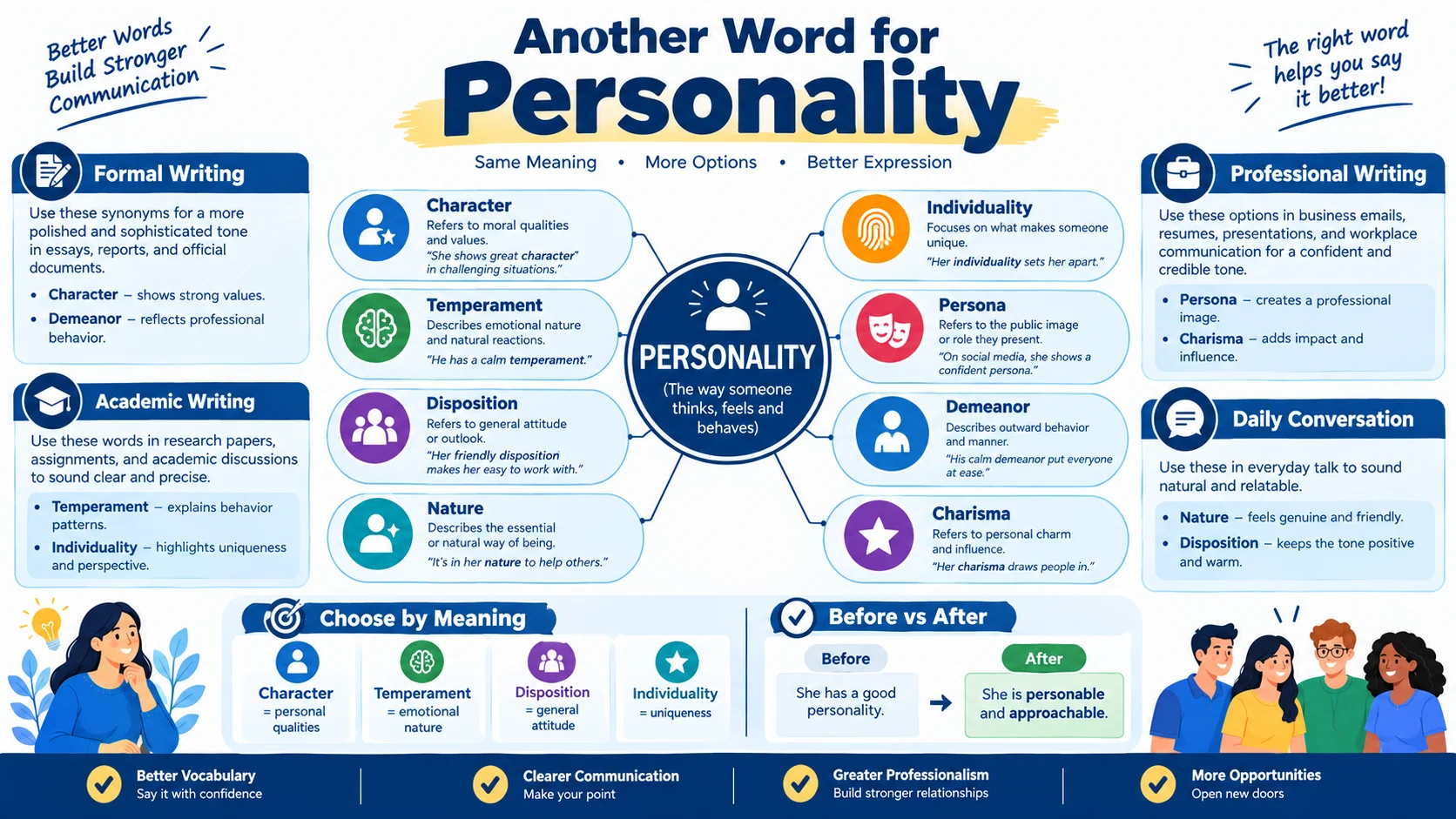
Another word for personality is character, temperament, disposition, nature, individuality, persona, or demeanor. The best synonym depends on context. Use character for personal qualities, temperament for emotional tendencies, individuality for uniqueness, and persona for the image someone presents to others.
Definition
Personality refers to the distinctive combination of qualities, behaviors, attitudes, emotions, and characteristics that make a person who they are. Depending on the context, another word for personality can be character, temperament, disposition, individuality, nature, persona, or character traits.
The best replacement depends on what you mean. For example, character often emphasizes moral qualities, while temperament focuses more on emotional behavior and individuality highlights what makes someone unique.
Common Uses
The word personality is commonly used when describing how someone behaves, interacts with others, or expresses themselves.
For example:
- She has a friendly personality.
- His personality makes him an excellent leader.
- The candidate’s confident personality impressed the interview panel.
- Her creative personality comes through in her writing.
- The character has a mysterious personality.
In professional writing, a more precise synonym can make your sentence clearer. Instead of saying someone has a “good personality,” you might describe them as approachable, personable, confident, outgoing, thoughtful, or charismatic.
Best Synonyms for Personality
| Synonym | Meaning | Best Used When | Example |
|---|---|---|---|
| Character | A person’s qualities and moral nature | Describing deeper personal qualities | Her strong character helped her overcome the challenge. |
| Temperament | A person’s typical emotional nature | Discussing moods and reactions | He has a calm temperament. |
| Disposition | A person’s usual attitude or mood | Formal descriptions of behavior | She has a cheerful disposition. |
| Nature | The basic qualities or tendencies of a person | General descriptions | His patient nature makes him easy to work with. |
| Individuality | Qualities that make someone distinct | Emphasizing uniqueness | Her individuality makes her creative work memorable. |
| Persona | The image or identity someone presents | Public, professional, or social image | The actor created a confident public persona. |
| Demeanor | The way someone appears or behaves | Describing outward behavior | His professional demeanor reassured the clients. |
| Character traits | Specific qualities that describe a person | Detailed personality descriptions | Her character traits include honesty and patience. |
Synonyms by Context
Formal Writing
In formal writing, choose a synonym that identifies the specific aspect of personality you want to describe.
Character is useful when discussing someone’s qualities, especially integrity, courage, honesty, or moral strength.
The experience revealed her strong character.
Disposition works well when describing someone’s general attitude or emotional tendency.
The manager’s positive disposition created a welcoming environment.
Temperament is more appropriate when discussing emotional responses or behavioral tendencies.
The study examined how temperament influences social behavior.
Nature is a flexible option for describing someone’s inherent tendencies.
His analytical nature contributed to his success as a researcher.
Professional Writing
Professional communication often benefits from replacing the broad word personality with a more specific quality.
Good alternatives include:
- Demeanor for professional behavior
- Communication style for interpersonal interaction
- Leadership style for management behavior
- Disposition for general attitude
- Character for reliability and integrity
- Interpersonal style for workplace interactions
- Presence for the impression someone creates
For example, instead of:
She has a strong personality.
You could write:
She has a confident professional presence.
This version tells the reader more about the quality being discussed.
Academic Writing
Academic writing usually benefits from precise terms rather than vague descriptions.
Useful alternatives include temperament, character traits, behavioral patterns, individual differences, disposition, psychological traits, and personality characteristics.
For example:
Researchers examined personality differences among participants.
could become:
Researchers examined individual differences in temperament and behavioral traits among participants.
The second sentence is more specific and may be better suited to research writing.
Daily Conversation
In everyday American English, natural alternatives include character, nature, vibe, attitude, demeanor, and personality traits.
For example:
I really like her personality.
You could say:
I really like her vibe.
Or:
I love her outgoing nature.
The best choice depends on whether you want to sound casual, descriptive, or more precise.
Professional Alternatives for Personality
When describing someone in a resume, cover letter, performance review, or business document, avoid vague phrases such as “great personality” when a specific quality would be stronger.
Personable
Meaning: Friendly and easy to interact with.
Best used for: Customer service, teamwork, sales, networking
Tone: Professional and positive
Difficulty: Easy
Usage Frequency: Common
Best for: Resume, Email Writing, Business Writing
Business Example:
She is a personable account manager who builds strong client relationships.
Academic Example:
The researcher maintained a personable approach during participant interviews.
Daily Conversation Example:
He’s really personable and easy to talk to.
Demeanor
Meaning: A person’s outward behavior or manner.
Best used for: Professional behavior and first impressions
Tone: Formal
Difficulty: Medium
Usage Frequency: Common
Best for: Resume, Business Writing, Email Writing
Business Example:
Her calm demeanor helped resolve the customer complaint.
Professional Presence
Meaning: The confident and appropriate impression someone creates in a professional setting.
Best used for: Workplace communication and resumes
Tone: Professional
Difficulty: Medium
Usage Frequency: Common
Best for: Resume, Business Writing, Marketing Copy
Business Example:
His strong professional presence makes him effective during client presentations.
Simple Alternatives for Personality
If you want an easy, natural replacement, consider:
- Character
- Nature
- Attitude
- Temperament
- Behavior
- Vibe
- Traits
- Way of being
For example:
She has a warm personality.
Simple alternatives include:
She has a warm nature.
She has a friendly character.
She has a welcoming vibe.
However, these words are not exact substitutes in every sentence. Vibe, for example, usually describes the feeling someone gives others rather than their complete personality.
Stronger Alternatives for Personality
When you want a more expressive word, consider:
- Character for depth and personal qualities
- Individuality for uniqueness
- Charisma for compelling personal appeal
- Persona for a deliberately presented identity
- Temperament for emotional tendencies
- Disposition for a person’s general mood
- Demeanor for visible behavior
Charisma is especially useful when someone naturally attracts attention or influences others.
Her charisma made her an effective public speaker.
It should not replace personality when you simply mean someone’s overall set of traits.
Difference Between Similar Synonyms
Although these words are related, they have important differences.
Personality vs. Character
Personality describes a person’s overall behavioral and psychological qualities.
Character often focuses more deeply on qualities such as honesty, integrity, courage, and moral strength.
She has an outgoing personality.
She has strong character.
Personality vs. Temperament
Personality is broader. It can include social behavior, preferences, attitudes, and traits.
Temperament mainly describes someone’s natural emotional tendencies.
His personality is outgoing and creative.
His temperament is calm and patient.
Personality vs. Disposition
Disposition usually describes a person’s general mood or attitude.
She has a cheerful disposition.
This is narrower than the broader word personality.
Personality vs. Persona
Persona refers to the identity or image a person presents to other people.
The celebrity maintains a confident public persona.
A persona may be different from someone’s private personality.
Personality vs. Demeanor
Demeanor describes how a person appears or behaves outwardly.
His serious demeanor made him seem intimidating.
It does not necessarily describe his complete personality.
Personality vs. Individuality
Individuality emphasizes what makes a person different or distinctive.
Her individuality is reflected in her unconventional style.
It is a strong choice when uniqueness is the main idea.
Opposite Words
There is no single perfect opposite of personality, because personality is a broad concept. However, depending on the intended meaning, related contrasts may include:
- Anonymity
- Impersonality
- Uniformity
- Conformity
- Dullness
- Facelessness
For example, impersonality can contrast with a warm or expressive personality, while conformity can contrast with strong individuality.
FAQs
What is another word for personality?
Common alternatives for personality include character, temperament, disposition, nature, individuality, persona, demeanor, and character traits. The best choice depends on context. Use character for deeper personal qualities, temperament for emotional tendencies, and individuality for uniqueness.
What is a formal synonym for personality?
Formal alternatives include character, disposition, temperament, demeanor, nature, and individual characteristics. In academic or professional writing, choose the term that describes the specific quality you mean rather than replacing personality automatically.
What is a professional alternative for personality?
Professional alternatives include professional presence, demeanor, interpersonal style, communication style, disposition, character, and professional qualities. For a resume, a specific quality such as personable, confident, adaptable, or collaborative is usually stronger than simply saying “good personality.”
What word can replace personality?
The best replacement depends on meaning. Character works for personal qualities, temperament for emotional tendencies, disposition for general attitude, persona for public image, demeanor for outward behavior, and individuality for uniqueness.
What is another word for a good personality?
Depending on the quality, you can use personable, friendly, approachable, charismatic, warm, outgoing, pleasant, thoughtful, or engaging. Choose the word that identifies what makes the person’s personality positive.
What is another word for a strong personality?
Possible alternatives include assertive nature, confident character, forceful presence, commanding demeanor, or charismatic personality. The best option depends on whether “strong” means confident, influential, assertive, or dominant.
What is another word for a unique personality?
Useful alternatives include individuality, distinctive character, unique nature, originality, and distinctive persona. Individuality is usually the simplest choice when emphasizing what makes someone different from others.
What is another word for personality traits?
You can use character traits, personal qualities, individual characteristics, behavioral traits, or personal attributes. In academic contexts, personality characteristics and individual differences may also be appropriate.
Is character the same as personality?
Not exactly. Personality is the broader term for a person’s characteristic patterns of thinking, feeling, and behaving. Character often focuses more specifically on qualities such as honesty, integrity, courage, and moral values.
What is a casual word for personality?
In casual American English, vibe is often used when describing the feeling someone gives you. Other informal options include nature, attitude, style, or energy. However, these words do not always mean exactly the same thing as personality.
Conclusion
The best another word for personality depends on the specific meaning you want to communicate. Character is ideal for deeper personal qualities, temperament describes emotional tendencies, disposition refers to general attitude, demeanor focuses on outward behavior, persona describes a public image, and individuality emphasizes uniqueness.
For everyday conversation, personality remains the most natural and flexible choice. In professional and academic writing, however, a more precise synonym can make your message clearer and more credible. Instead of searching for a synonym that merely sounds different, choose the word that communicates the exact quality you mean.