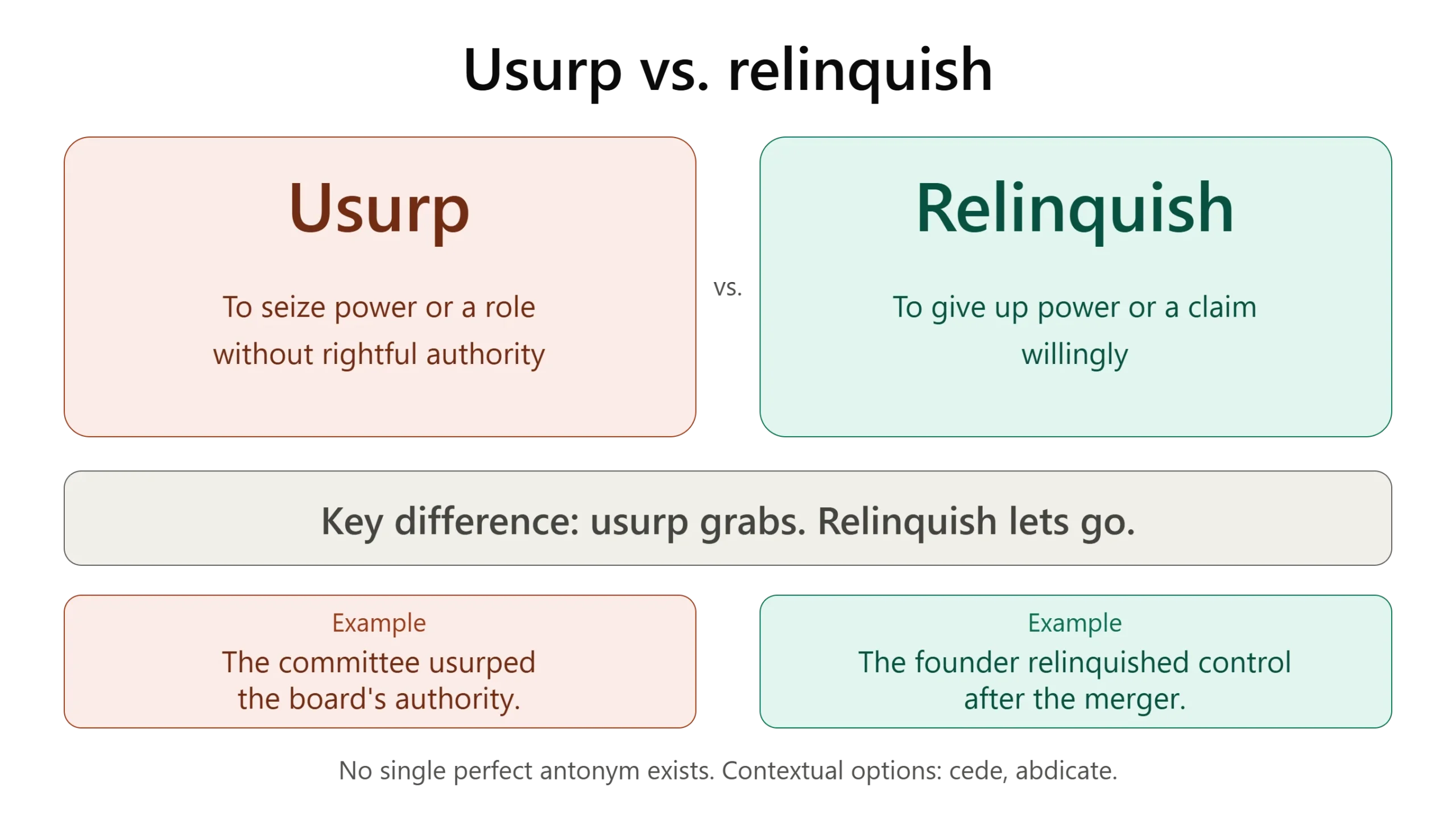
The opposite of usurp is relinquish when usurp means to seize power, a position, or a right unlawfully. Usurp is taking what is not yours to take, so relinquish, cede, or abdicate describe giving it up willingly. No single perfect antonym exists, so the best choice depends on context.
Part of speech: Verb (transitive)
Primary opposite: Relinquish
Usurp means to seize or hold a position, power, or right without legal authority, often by force. It also covers taking over a role that belongs to someone else, as in “The new committee usurped the board’s authority.”
When usurp means to take power that is not rightfully yours, relinquish is the strongest contextual opposite. Usurp grabs. Relinquish lets go, and it does so willingly.
One caution matters here. Usurp has no single, perfect one-word antonym, because it carries two ideas at once: taking something, and taking it wrongfully. Most opposites reverse only one of those ideas, so the best choice depends on which part of the meaning you want to flip.
Direct and Strong Antonyms
These words come closest to a true reverse of usurp, since each describes giving up the power, title, or claim that a usurper grabs. Because no perfect antonym exists, treat them as the closest opposites rather than exact mirrors.
| Antonym | Tone or Nuance | Example Sentence |
|---|---|---|
| Relinquish | Neutral to formal; the broadest, most flexible choice | “After the merger, the founder relinquished control of the company.” |
| Cede | Formal; hands over territory, power, or rights, often by agreement | “The state agreed to cede authority over school funding to the county.” |
| Abdicate | Formal; giving up a throne, office, or duty | “The king abdicated in favor of his daughter.” |
| Renounce | Formal; a deliberate, often public refusal of a claim | “She renounced her claim to the family estate.” |
Abdicate also works for duties, but in that use it often implies neglect, as in “abdicating responsibility.”
Contextual and Subtle Opposites
Usurp has two main senses. The first is seizing power, a throne, or an office. The second is taking over a role, task, or authority that belongs to someone else. Each sense calls for a different opposite, and the options below are contextual, not direct antonyms.
| Context | Best Opposite | Why It Fits |
|---|---|---|
| Seizing a throne or high office | Abdicate, cede | The holder gives up the position voluntarily |
| Taking over a coworker’s decision | Defer to | Respects the person who rightfully owns the call |
| Power taken, then corrected | Restore, reinstate | Returns authority to its rightful holder |
| Power passed on legitimately | Confer, bestow | A lawful grant, the reverse of an unlawful grab |
Notice that restore and confer oppose the wrongfulness of usurping rather than the act of taking. A workplace example shows the difference. “The VP usurped the project lead’s role by approving the budget herself” is answered by “The VP deferred to the project lead on the budget.” A historical example works the same way. “The regent usurped the crown” is answered by “The council restored the crown to the rightful heir.”
Words That Seem Opposite But Are Not
Common Grammatical or Semantic Confusions
Inherit. Inherit means to receive something legitimately, usually from a predecessor. It contrasts with usurp on legitimacy, since an heir has a lawful claim and a usurper does not. But both words describe gaining a position. “She inherited the family restaurant” and “She usurped the family restaurant” differ in right, not in direction. Inherit is a related contrast, not an antonym.
Defend. A person who defends authority is the usurper’s adversary, as in “The council defended the mayor’s authority against the takeover attempt.” Defending resists usurping, yet the two words are not mirror meanings. Defend names a protective act, while usurp names a taking. Opposing parties are not the same as opposite words.
Subtle Tone Differences
Choosing among the opposites changes the strength and formality of a sentence.
Relinquish is plain and flexible: “She relinquished her seat on the committee.” Cede sounds political and often suggests negotiation: “The party ceded ground in the final talks.” Abdicate carries weight, and with duties it can imply blame: “The principal abdicated responsibility for the problem.” Renounce is declarative and often public: “The senator publicly renounced the endorsement.”
Usurp itself is strongly negative, since it signals illegitimacy. Its opposites are mostly neutral, so a sentence with relinquish or cede rarely carries the same moral charge unless the context adds it.
Frequently Asked Questions
What is the direct opposite of usurp?
Usurp has no single, perfect antonym. The closest direct opposite is relinquish, which means to give up power or a claim willingly. Cede and abdicate work well in formal settings, so choose by what is being given up.
Is inherit the opposite of usurp?
No. Inherit means to receive something legitimately, usually from a predecessor, while usurp means to seize it wrongfully. They contrast in legitimacy, but both involve gaining something, so inherit is a related contrast rather than an antonym.
What word is the opposite of usurp in a workplace sentence?
When someone takes over a decision that belongs to another person, defer to is a natural contextual opposite. In “The director deferred to the safety team on the schedule,” authority stays with its rightful owner.
Practical Word Choice
- Identify the intended meaning first. Ask whether usurp means seizing a title or taking over a task. A throne points toward abdicate or cede, while a work duty points toward defer to.
- Match the tone, strength, and formality. Use relinquish for neutral writing, cede for formal or political settings, and abdicate when you want weight or blame. Save renounce for a claim that is deliberately refused.
Final Thoughts
The key distinction is that usurp takes wrongfully, while its opposites give up or return power willingly or rightfully. Relinquish is the most dependable general opposite, and cede and abdicate serve narrower settings.
Context matters because usurp has no mirror image. Some opposites reverse the taking, and others reverse the wrongfulness. A word that suits a royal court may sound strange in a team meeting.
Before you commit to a word, swap it into your sentence and ask who holds the power afterward. If the answer is the rightful holder, you chose well. What is your own example of someone who usurped authority, or gave it up willingly?