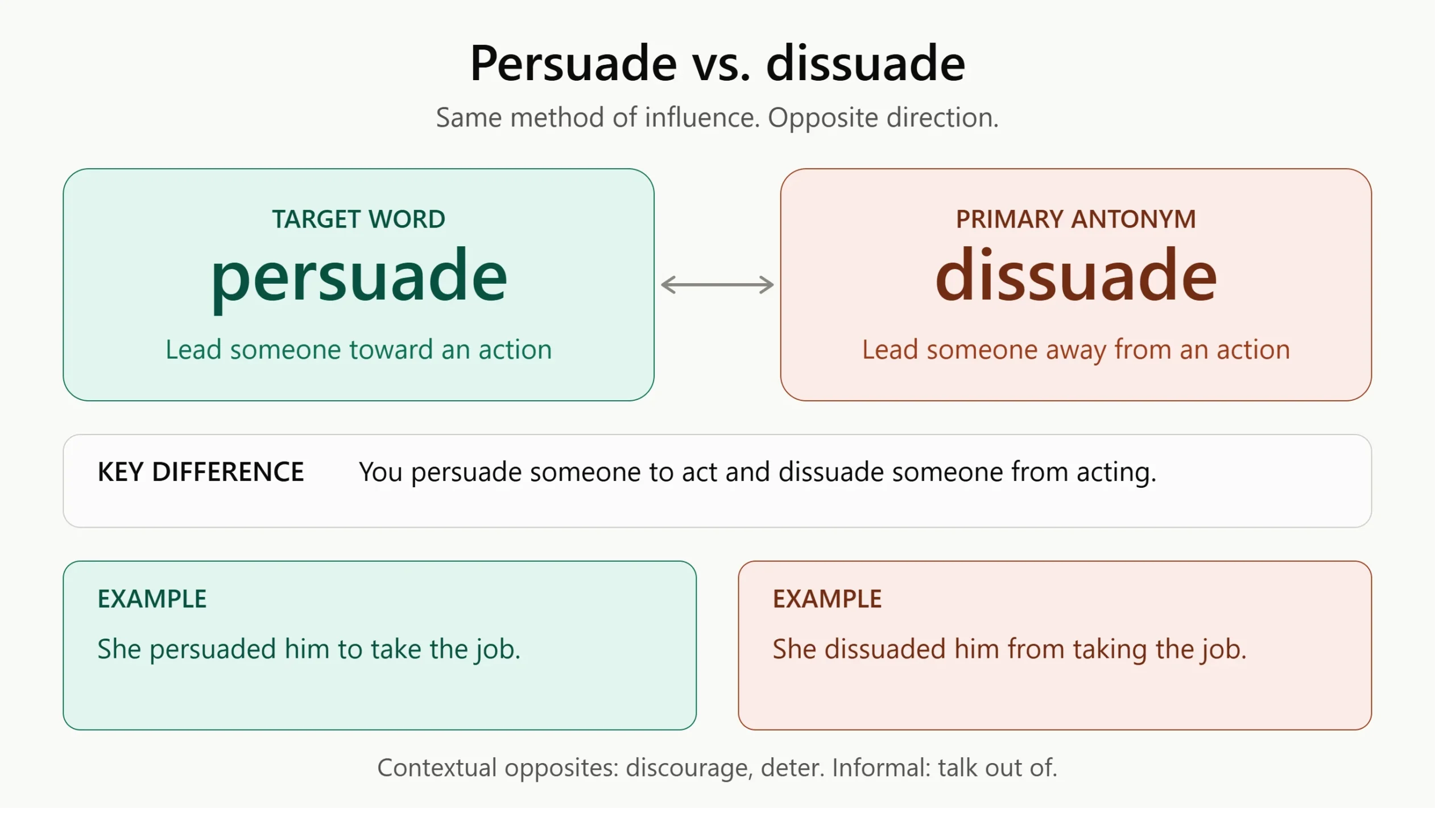
The opposite of persuade is dissuade. To persuade means to move someone to do or believe something through reasoning or appeal, while to dissuade means to convince someone not to do something. Deter and discourage work as contextual opposites when the goal is to stop or weaken an action rather than prompt it.
Part of speech: verb
Primary opposite: dissuade
When persuade means to win someone over to a course of action, dissuade is the strongest direct opposite. To persuade is to lead a person to do or believe something through reasons, appeals, or incentives. To dissuade is to lead a person away from an action by those same means.
The two verbs mirror each other in grammar and method. You persuade someone to do something, and you dissuade someone from doing it. Compare “She persuaded him to take the job” with “She dissuaded him from taking the job.” Only the direction changes, which is why dissuade is a true opposite and not just a loose association.
One caution applies. Persuade can also mean convincing someone of a belief, as in “I persuaded her the plan was safe.” No single antonym is firmly established for that sense, and dissuade fits best when an action is at stake.
Direct and Strong Antonyms
Persuade has one clearly established direct opposite and one everyday equivalent.
| Antonym | Tone or Nuance | Example Sentence |
|---|---|---|
| Dissuade | Neutral to formal; the standard direct opposite, usually followed by “from” | Her mentor dissuaded her from quitting before the product launch. |
| Talk out of | Informal and conversational; the everyday reverse of “talk into” | I tried to talk my brother out of buying a used motorcycle. |
Quality matters more than length here. Padding this list with weaker words would blur the meaning.
Contextual and Subtle Opposites
The best opposite changes with what the speaker is actually describing. The labels below show which choices are direct and which are contextual.
| Context | Best Opposite | Why It Fits |
|---|---|---|
| Convincing someone not to act | Dissuade (direct) | Reverses the outcome while keeping the same method of influence |
| Casual conversation | Talk out of (direct, informal) | Mirrors “talk into” in everyday speech |
| Weakening confidence or willingness | Discourage (contextual) | Lowers motivation without requiring a change of mind |
| Stopping action through expected cost | Deter (contextual) | Relies on consequences rather than appeal |
| Convincing someone of a belief | No settled single antonym | Dissuade works only when an action or plan is involved |
Discourage and deter deserve a closer look. Discourage lowers someone’s confidence or willingness: “The long hours discouraged many applicants.” Deter works through the expected cost: “Higher fines may deter drivers from speeding.”
For the belief sense, “disabuse” (to free someone from a mistaken idea) contrasts with persuade, but it is a related contrast, not an exact antonym.
Words That Seem Opposite But Are Not
Coerce. Coerce feels like the opposite because it sounds harsh, but it aims at the same result as persuade: getting someone to act. Only the method differs. “Management coerced employees into signing by hinting at layoffs” describes pressure, while “management persuaded employees to sign” describes appeal. That is a contrast in method, not outcome.
Resist. Resist describes the response of the person being influenced, not the action of the influencer. “He resisted every attempt to persuade him to sell” shows a failed persuasion, but resist cannot replace persuade in a sentence with the same subject. The two words describe opposite sides of one exchange, which is different from being antonyms.
Subtle Tone Differences
Strength and formality separate the contextual choices. Dissuade suggests good-faith reasoning and suits professional writing: “Legal counsel dissuaded the founders from signing the agreement as written.”
Discourage is milder and often emotional. A coach might discourage a player from rushing back after an injury, but the player may still make up their own mind.
Deter is the strongest and most official. It appears in policy, security, and legal contexts: “Cameras at the intersection deter red-light running.” Nobody is reasoning with anyone there. The expected penalty does the work.
Talk out of is warm and informal: “Her friends talked her out of texting her ex.” It would feel out of place in a formal report.
Frequently Asked Questions
What is the direct antonym of persuade?
Dissuade is the direct antonym of persuade. It means to convince someone not to do something, using reasons or appeals. Persuade moves a person toward an action, and dissuade moves a person away from it, usually with the preposition from.
What is the opposite of persuade when it means convincing someone of a belief?
No single antonym is firmly established when persuade means to convince someone of a belief. Dissuade fits best when an action is involved. For ideas, “disabuse” or “talk out of believing” come close, but they are related contrasts.
Which word should I use for stopping someone from acting?
Use dissuade when reasoning changes someone’s plan, as in “dissuaded him from resigning.” Use deter when fear of consequences stops the action, and talk out of in casual speech. Match the word to how the change happens.
Practical Word Choice
1. Identify the intended meaning. Ask whether the sentence is about an action or a belief. If someone is being steered away from an action, dissuade is the safest choice. If the focus is a belief, rephrase with “talk out of believing” rather than forcing an antonym.
2. Match context, tone, strength, and formality. Use dissuade in professional writing, deter for consequences, discourage for lowered motivation, and talk out of in conversation.
Final Thoughts
The key distinction is direction. Persuade pulls someone toward a choice by influence, and dissuade pulls them away by the same kind of influence. That shared method is what makes the pair a genuine opposition.
Context matters because the other options change how the shift happens. Discourage drains willingness, deter threatens a cost, and talk out of keeps things casual. Each shifts the strength and tone of the sentence.
Before you reach for a word, decide what actually changes the person’s mind. Has someone successfully dissuaded you from something recently, and how did they do it?