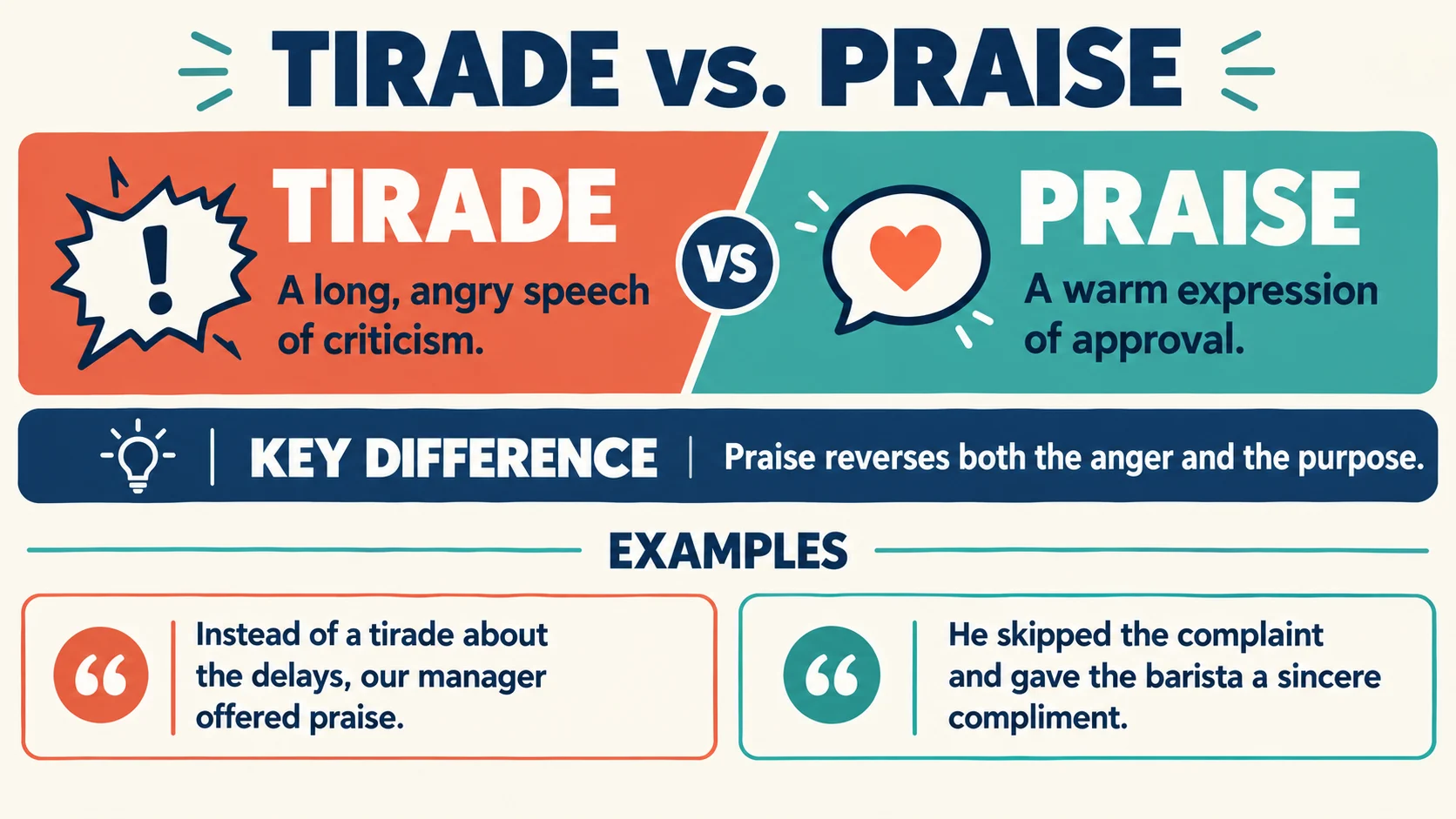
The strongest opposite of tirade is praise. A tirade is a long, angry speech of criticism or accusation, so praise, a warm expression of approval, reverses both the tone and the purpose. English has no single dictionary-established antonym, but commendation, tribute, and a calm, kind remark also work depending on context.
Part of Speech: Noun
Primary Opposite: Praise (a contextual opposite)
A tirade is a prolonged, bitter outburst aimed at a person, group, or situation. When tirade means an angry verbal attack, praise is the strongest opposite. It flips the emotion from hostility to approval and flips the speaker’s goal from condemning to commending.
One caveat matters here. Standard dictionaries do not pair tirade with a single antonym. Praise is the closest functional opposite, not a perfect mirror image. That is why the words below are best understood as strong opposites that depend on context.
Direct and Strong Antonyms
Tirade is a noun for a kind of speech, so its best opposites are also nouns for speech or writing. These are the closest options, ranked roughly by how well they reverse the meaning.
| Antonym | Tone or Nuance | Example Sentence |
|---|---|---|
| Praise | Warm, general, everyday | Instead of a tirade about the delays, our manager offered praise for how the team handled them. |
| Commendation | Formal, official | The mayor read a commendation for the volunteers at Tuesday’s council meeting. |
| Tribute | Ceremonial, heartfelt | Her retirement party opened with a moving tribute from former students. |
| Compliment | Brief, personal, casual | He skipped the complaint and gave the barista a sincere compliment. |
Praise leads because it matches a tirade in scale. Both can be sustained and emotional. Compliment is gentler and shorter, so it contrasts with a tirade in length as well as feeling.
Contextual and Subtle Opposites
The best opposite shifts with what you want to reverse. A tirade has three features: anger, criticism, and length. Different opposites target different features.
| Context | Best Opposite (Contextual) | Why It Fits |
|---|---|---|
| Angry criticism of a person | Praise | Replaces hostility with approval |
| Formal or public speaking | Tribute or commendation | Honors someone instead of attacking them |
| Heated, out of control exchange | Calm discussion | Reverses the loss of composure |
| Short, mild response to a problem | Gentle remark | Reverses the intensity and length |
Notice that calm discussion and gentle remark oppose the manner of a tirade, not its negativity. A calm discussion can still be critical. Use these only when the point is self-control rather than approval.
Because tirade names a degree of intensity, its opposites are also gradable. A mild compliment sits far from a tirade, while a glowing tribute sits at the opposite extreme.
Words That Seem Opposite But Are Not
Two terms often get offered as opposites, but neither holds up.
Critique. A critique is a structured evaluation, and it can be positive or negative. A teacher’s critique of an essay may list weaknesses without any anger or excess. It contrasts with a tirade in manner but remains a form of evaluation, so it is a related contrast, not an antonym.
Silence. Silence is the absence of speech. A tirade is loud and sustained, so silence feels like a contrast. But silence says nothing about approval or disapproval. A person can stay silent out of fury or out of contentment. Opposition requires a reversed meaning, not just a missing one.
Likewise, constructive criticism is sometimes called the opposite of a tirade. It is better described as a calmer, more useful version of the same activity.
Subtle Tone Differences
Choosing among the opposites is mostly a matter of formality and strength.
Praise suits nearly any setting. “The coach’s praise after the loss surprised everyone” works in conversation or in a news story.
Commendation sounds official. It fits performance reviews, awards, and public records. “The officer received a commendation for her quick response” would feel stiff in a text to a friend.
Tribute carries emotional weight and often appears at ceremonies or memorials. It suggests respect built over time, which makes it a poor fit for a quick thank you.
Compliment is the lightest choice. It works well when you want a small, friendly contrast to an earlier complaint, as in “After the argument, her only comment was a compliment on his cooking.”
Frequently Asked Questions
What is the opposite of a tirade?
Praise is the closest opposite of a tirade. A tirade is a long, angry speech of criticism, while praise expresses approval and admiration. English has no single dictionary-listed antonym, so commendation or tribute may fit better in formal situations.
Is compliment the opposite of tirade?
Not exactly. A compliment is a brief, positive remark, while a tirade is long, angry, and critical. They contrast in tone and length, so compliment works as a contextual opposite in casual speech, but it is not a direct antonym.
Which word should I use for the opposite meaning of tirade in a sentence?
Match the setting. Use praise in everyday writing, tribute for ceremonies, commendation for official recognition, and calm discussion when the point is manner rather than approval. Choose the word that reverses the specific quality you want to contrast.
Practical Word Choice
Identify the intended meaning. Ask what you are reversing. If it is anger and negativity, choose praise. If it is lack of control, choose calm discussion or gentle remark.
Match the context, tone, strength, and formality. Use commendation for official records, tribute for ceremonies, and compliment for quick, friendly moments. A mismatch can make a sentence sound stiff or flat.
Final Thoughts
Tirade has no tidy one-word antonym, and that is the key to using its opposites well. Praise comes closest because it reverses both the anger and the criticism, but commendation, tribute, compliment, and calm discussion each reverse a different part of the meaning.
That is why context matters so much. The same tirade can be answered with a formal tribute in one setting and a quiet, gentle remark in another. Decide which feature you want to contrast, then pick the word that does exactly that.
A useful final habit is to test your choice by swapping it into the sentence and checking whether the contrast still feels natural. Have you ever replaced a tirade with an unexpected kind word? Share your example in the comments.