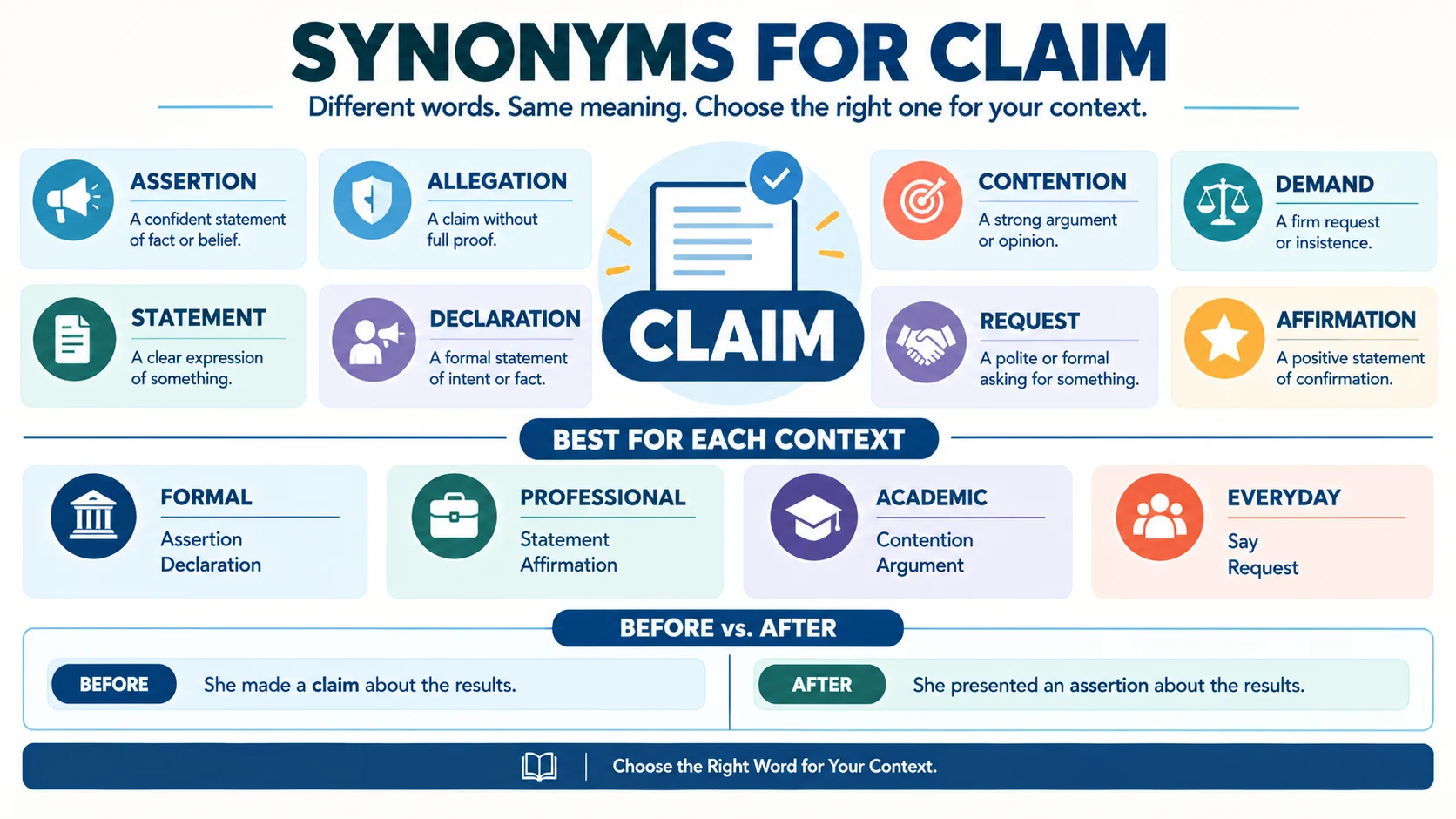
Another word for claim depends on its meaning and context. Common synonyms include assertion, statement, allegation, declaration, contention, demand, request, and maintain. Use assertion when expressing something as true, allegation when making an unproven accusation, and demand when seeking something you believe you deserve.
What Does Claim Mean?
Definition
The word claim has several meanings in American English. It can refer to stating that something is true, asking for something as a right, or making an assertion that may need evidence or verification.
As a noun, claim describes a statement, demand, or right to something. As a verb, it means to assert something, request something, or declare ownership.
Examples:
- She made a claim about the company’s financial performance.
- He claims that he completed the assignment.
- The customer filed an insurance claim after the accident.
- They claimed ownership of the property.
Common Uses
The meaning of claim changes depending on how it is used.
| Context | Meaning | Example |
|---|---|---|
| General communication | State something as true | She claims she saw the incident. |
| Legal writing | Assert a legal right | He filed a claim against the company. |
| Insurance | Request compensation | Submit a claim for vehicle damage. |
| Academic writing | Present an argument | The researcher makes a central claim. |
| Business | State a product’s benefits | The company claims its service saves time. |
| Everyday conversation | Say something belongs to you | I claim the last piece of pizza. |
Best Synonyms for Claim
The following synonyms offer different meanings, tones, and levels of formality. The best replacement depends on whether you are expressing an opinion, making an accusation, or requesting something.
| Synonym | Meaning | Best Used When | Example |
|---|---|---|---|
| Assertion | A statement presented as true | Formal arguments | Her assertion needs evidence. |
| Statement | Something expressed verbally or in writing | General communication | He released a public statement. |
| Allegation | An unproven accusation | Legal or investigative contexts | The allegation is under investigation. |
| Declaration | A formal announcement | Official communication | She made a declaration of ownership. |
| Contention | An argument or position | Academic discussions | His contention challenges the theory. |
| Argument | A reasoned position | Essays and debates | The argument supports the proposal. |
| Insistence | A firm statement or demand | Strong opinions | Her insistence surprised everyone. |
| Demand | A forceful request | Rights and expectations | The workers made a demand for better pay. |
| Request | An act of asking for something | Polite communication | He submitted a request for compensation. |
| Maintain | To continue asserting something | Formal and academic writing | Researchers maintain that the results are reliable. |
| Assert | To state something confidently | Professional communication | She asserted her position clearly. |
| Proclaim | To announce publicly | Speeches and announcements | The organization proclaimed its success. |
| Affirm | To confirm or state positively | Formal writing | The witness affirmed the statement. |
| Contend | To argue or maintain a position | Academic writing | The author contends that education matters. |
| Plea | An earnest request | Legal or emotional situations | She made a plea for assistance. |
Synonyms for Claim by Context
Different situations require different alternatives. A word that works in an academic paper may sound unnatural in a casual conversation.
Formal Writing
For formal writing, choose words that communicate a position clearly and precisely.
- Assertion: A statement presented as fact or truth.
- Declaration: A formal announcement or statement.
- Affirmation: A positive confirmation.
- Contention: A position supported by reasoning.
- Proposition: An idea or statement presented for consideration.
Example:
Original: The author makes a claim about economic development.
Improved: The author presents an assertion about economic development.
Professional Writing
In business communication, the right alternative depends on whether you are discussing evidence, responsibility, ownership, or compensation.
Useful alternatives include:
- Statement: For official communication.
- Assertion: For presenting a business position.
- Request: For asking for approval or compensation.
- Demand: For communicating a firm requirement.
- Declaration: For formal announcements.
Business example:
Original: The customer made a claim regarding the damaged product.
Improved: The customer submitted a request for compensation regarding the damaged product.
Academic Writing
Academic writing requires precise language, especially when discussing research, evidence, and arguments.
Consider these alternatives:
- Argument: A position supported by reasoning.
- Contention: A debatable position.
- Assertion: A statement that requires support.
- Proposition: An idea presented for examination.
- Thesis: The central argument of an academic paper.
Academic example:
Original: The study makes a claim about climate change.
Improved: The study presents an argument about climate change.
Daily Conversation
In everyday communication, simple and familiar words are usually more natural.
Try these alternatives:
- Say: To express something.
- State: To communicate information.
- Insist: To express something firmly.
- Ask for: To request something.
- Declare: To announce something.
Daily example:
Original: He claims that he knows the answer.
Improved: He says that he knows the answer.
Professional Alternatives for Claim
If you are writing a business email, report, resume, or professional document, these alternatives can make your communication more precise.
| Alternative | Best Used For | Tone | Difficulty |
|---|---|---|---|
| Assert | Presenting a position | Confident | Medium |
| State | Communicating information | Neutral | Easy |
| Maintain | Supporting an ongoing position | Formal | Medium |
| Affirm | Confirming information | Professional | Medium |
| Declare | Making an official statement | Formal | Medium |
| Contend | Presenting an argument | Academic | Advanced |
| Request | Seeking something formally | Polite | Easy |
Resume example:
Instead of writing:
“I claim responsibility for managing customer accounts.”
Write:
“I managed customer accounts and maintained accurate client records.”
This version is stronger because it describes an actual responsibility rather than simply asserting it.
Email example:
Instead of:
“I claim that the payment was processed.”
Write:
“Our records indicate that the payment was processed.”
The revised sentence sounds more professional and evidence-based.
Simple Alternatives for Claim
If you want to avoid complicated vocabulary, these everyday alternatives are easy to understand.
| Simple Word | Meaning | Example |
|---|---|---|
| Say | Express something | She says the information is correct. |
| Tell | Communicate information | He told me about the problem. |
| State | Express something clearly | The report states the results. |
| Ask | Request something | She asked for a refund. |
| Demand | Ask forcefully | They demanded an explanation. |
| Show | Provide evidence | The results show improvement. |
| Explain | Make something clear | He explained his position. |
These alternatives are especially useful in emails, conversations, school assignments, and general writing.
Stronger Alternatives for Claim
Sometimes, claim sounds too neutral. A stronger alternative can communicate confidence, urgency, or disagreement.
| Stronger Alternative | Meaning | Example |
|---|---|---|
| Insist | State something firmly | She insists that she followed the rules. |
| Assert | Declare something confidently | He asserted his legal rights. |
| Proclaim | Announce publicly and confidently | The leader proclaimed a new policy. |
| Demand | Request something forcefully | Employees demanded fair treatment. |
| Allege | Accuse someone without established proof | The report alleges financial misconduct. |
| Maintain | Continue supporting a position | The company maintains its innocence. |
| Assert ownership | State a right to possess something | They asserted ownership of the land. |
Be careful when choosing stronger words. For example, allege often suggests an accusation that has not yet been proven, while assert does not necessarily involve wrongdoing.
Difference Between Similar Synonyms
Although many words can replace claim, they are not interchangeable in every sentence.
Claim vs. Assertion
A claim can refer to a statement, a legal right, or a request for something. An assertion specifically refers to a statement presented as true.
- Claim: She made a claim for insurance compensation.
- Assertion: She made an assertion about the company’s performance.
Claim vs. Allegation
A claim can be neutral, while an allegation usually refers to an accusation that has not been proven.
- Claim: The company claims that its product is safe.
- Allegation: The company faces allegations of misleading customers.
Claim vs. Argument
A claim is a statement or position. An argument provides reasoning or evidence to support a position.
- Claim: Exercise improves concentration.
- Argument: Regular exercise improves concentration because it supports overall brain health.
Claim vs. Demand
A claim may express an entitlement or request, whereas a demand communicates a stronger expectation.
- Claim: He filed a claim for compensation.
- Demand: He demanded immediate compensation.
Claim vs. Statement
A statement is a broad term for something communicated. A claim generally expresses a position, right, or assertion that may require support.
- Statement: The manager issued a statement.
- Claim: The manager claimed that the project was completed.
Opposite Words for Claim
The antonym of claim depends on whether it is being used as a noun or verb.
| Opposite Word | Meaning | Example |
|---|---|---|
| Deny | State that something is not true | He denied the accusation. |
| Retract | Take back a previous statement | She retracted her claim. |
| Disclaim | Reject responsibility or ownership | The company disclaimed liability. |
| Renounce | Formally give up a right or position | He renounced his claim to the property. |
| Withdraw | Remove a request or statement | They withdrew their claim. |
| Disavow | Publicly reject an association or position | The organization disavowed the statement. |
Important distinction: There is no single perfect antonym for every meaning of claim. For example, deny can oppose asserting something, while renounce can oppose claiming ownership or a right.
FAQs About Synonyms for Claim
1. What is another word for claim?
Common alternatives include assertion, statement, allegation, declaration, contention, demand, and request. The best choice depends on the context.
2. What is a formal synonym for claim?
Assertion, declaration, contention, affirmation, and proposition are formal alternatives. Use assertion when presenting a statement as true and contention when expressing an arguable position.
3. What is a professional alternative for claim?
Professional alternatives include state, assert, maintain, affirm, and request. In business writing, choose the word that accurately describes the action.
4. What is another word for claim in academic writing?
Argument, assertion, contention, proposition, and thesis are useful academic alternatives. Argument is appropriate when discussing a position supported by evidence.
5. What is a simple word for claim?
Say, state, ask, tell, and request are simple alternatives. Their meanings vary depending on whether claim refers to speaking or asking for something.
6. What is a stronger word for claim?
Assert, insist, proclaim, allege, and demand can communicate a stronger meaning. However, each has a different tone and implication.
7. What is another word for making a claim?
Useful alternatives include making an assertion, presenting an argument, stating a position, expressing an opinion, and advancing a proposition.
8. What is the difference between a claim and an allegation?
A claim can be a neutral statement or request, while an allegation generally refers to an accusation that has not been established as true.
9. What is the opposite of claim?
Depending on the context, opposites include deny, retract, disclaim, renounce, and withdraw.
10. What is another word for a legal claim?
Depending on the legal context, alternatives include demand, cause of action, legal assertion, petition, and request for relief. These terms have specific legal meanings and should not be substituted without checking the context.
Conclusion
Choosing the right synonym for claim depends on what you want to communicate. Use assertion for a statement presented as true, allegation for an unproven accusation, contention for an arguable position, and demand for a forceful request. For everyday communication, simpler alternatives such as say, state, and ask often work better.
The most effective writing does not simply replace words with more complicated vocabulary. It selects language that communicates the intended meaning accurately.