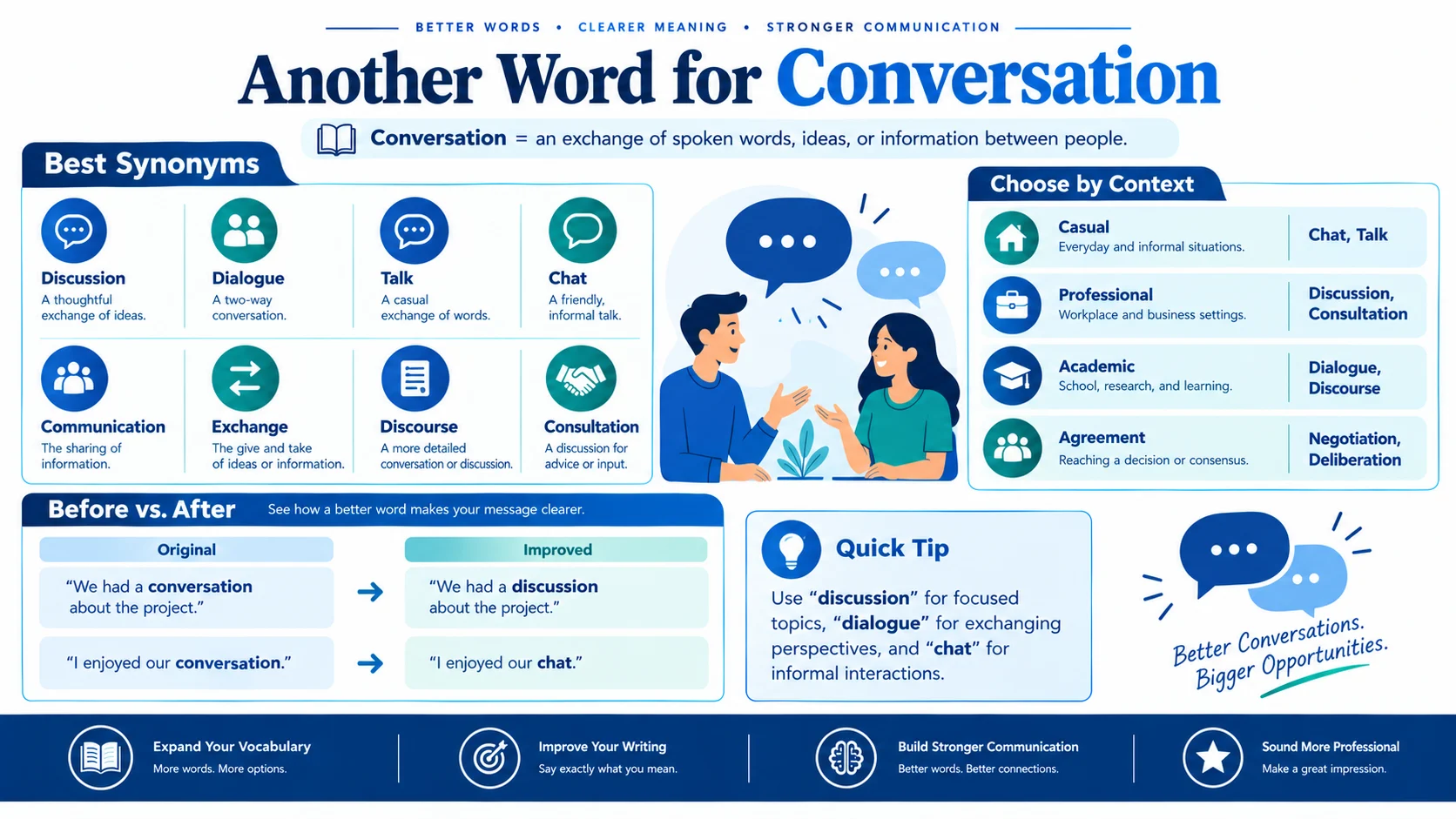
Another word for conversation is discussion, which refers to an exchange of ideas, opinions, or information between people. Other useful synonyms include dialogue, chat, talk, exchange, communication, and discourse. The best alternative depends on the context. Use discussion for professional settings, dialogue for meaningful exchanges, and chat for informal interactions.
What Does Conversation Mean?
Definition
A conversation is an exchange of spoken words, ideas, opinions, or information between two or more people. Conversations can be casual, professional, educational, personal, or formal.
For example, friends might have a conversation about their weekend plans, while coworkers might have a conversation about an upcoming project.
The word can also describe a meaningful exchange in which people listen, respond, ask questions, and share perspectives. Depending on the context, alternatives such as discussion, dialogue, chat, and communication may express slightly different meanings.
Common Uses
The word conversation appears in many situations:
- Everyday communication: A conversation between friends or family members.
- Professional settings: A conversation with a manager about workplace expectations.
- Academic settings: A conversation about research findings or literary themes.
- Conflict resolution: A conversation intended to resolve a disagreement.
- Public discussions: A conversation about social issues, policies, or current events.
- Digital communication: An online conversation through messaging apps or social platforms.
Choosing the right synonym helps communicate the tone, purpose, and depth of an interaction.
Best Synonyms for Conversation
The following words are useful alternatives, but they are not interchangeable in every sentence.
| Synonym | Meaning | Best Used When | Example |
|---|---|---|---|
| Discussion | Exchange of ideas about a subject | Work, education, or serious topics | We had a discussion about the proposal. |
| Dialogue | Exchange of thoughts or opinions | Meaningful exchanges or conflict resolution | Open dialogue helped resolve the disagreement. |
| Talk | General exchange of spoken words | Everyday communication | We had a talk after dinner. |
| Chat | Friendly, informal conversation | Casual interactions | I had a quick chat with my coworker. |
| Communication | Sharing information, thoughts, or feelings | Broad professional or personal contexts | Clear communication prevents confusion. |
| Exchange | Sharing ideas, information, or remarks | Brief or reciprocal interactions | We had an exchange of ideas. |
| Discourse | Extended communication about a subject | Academic or intellectual writing | The article examines public discourse. |
| Dialogue session | A planned opportunity for people to exchange views | Meetings or organized events | The organization hosted a dialogue session. |
| Consultation | Discussion intended to obtain advice or guidance | Professional services or decision-making | The client scheduled a consultation. |
| Meeting | An organized gathering for discussion | Business and workplace settings | The meeting covered the new strategy. |
| Debate | Discussion involving opposing arguments | Controversial or disputed topics | The debate focused on education reform. |
| Interview | Structured questions and answers | Hiring, journalism, or research | The interview explored her experience. |
| Negotiation | Discussion aimed at reaching an agreement | Business deals or conflict resolution | The negotiation continued for two hours. |
| Deliberation | Careful consideration through discussion | Important decisions | The committee’s deliberation took several days. |
| Banter | Playful, lighthearted conversation | Friendly teasing or humor | Their banter entertained everyone. |
| Small talk | Casual conversation about ordinary topics | Social introductions and networking | We made small talk before the presentation. |
Synonyms for Conversation by Context
Formal Writing
Formal writing often requires words that communicate the purpose and seriousness of an interaction.
The strongest alternatives include dialogue, discourse, deliberation, consultation, and discussion.
Examples:
- Original: The conversation addressed the ethical implications of the research.
- Formal: The discussion addressed the ethical implications of the research.
- Academic: The discourse examined the ethical implications of the research.
These alternatives have different shades of meaning. Discussion is neutral and broadly useful. Discourse often refers to a wider body of communication or a sustained exchange about a topic. Deliberation emphasizes careful consideration before making a decision.
Professional Writing
In the workplace, the best replacement depends on whether people are sharing information, making decisions, or seeking advice.
Useful professional alternatives include:
- Discussion: General workplace exchanges about ideas or issues.
- Consultation: A conversation intended to obtain expert advice or input.
- Meeting: An organized gathering with a defined purpose.
- Negotiation: An exchange intended to reach an agreement.
- Communication: The broader process of sharing information.
Business example:
Original: We had a conversation about the project timeline.
Revised: We had a discussion about the project timeline.
If the exchange involved an expert providing guidance, consultation may be more accurate. If the participants were working toward an agreement, negotiation would be a better fit.
Academic Writing
Academic writers often use dialogue, discussion, discourse, and exchange when describing the sharing of ideas.
Examples:
- Original: The conversation between researchers focused on climate policy.
- Revised: The discussion between researchers focused on climate policy.
- Alternative: The dialogue between researchers explored different perspectives on climate policy.
In research writing, discussion is particularly useful for describing an analysis of findings. Dialogue emphasizes interaction between participants or viewpoints, while discourse can describe communication within a broader academic or social context.
Academic example: “The study contributes to the ongoing discussion about language acquisition.”
This sentence sounds natural because discussion refers to an existing body of debate or scholarly exchange.
Daily Conversation
In everyday American English, simple alternatives often sound more natural than formal vocabulary.
| Instead of Conversation | Use | Example |
|---|---|---|
| Formal conversation | Talk | We need to have a talk. |
| Friendly conversation | Chat | I had a nice chat with Sarah. |
| Brief conversation | Quick exchange | We had a quick exchange before class. |
| Casual introductory conversation | Small talk | We made small talk while waiting. |
| Serious conversation | Discussion | We had a serious discussion about our plans. |
| Playful conversation | Banter | Their friendly banter made everyone laugh. |
For casual writing, talk and chat are usually the most natural choices.
Professional Alternatives for Conversation
Some synonyms work particularly well in business emails, resumes, reports, and professional communication.
1. Discussion
Meaning: An exchange of ideas, opinions, or information about a topic.
Best used for: Meetings, project planning, problem-solving, and reports.
Tone: Neutral and professional.
Difficulty: Easy.
Usage frequency: Very common.
Best for: Email writing, essay writing, business writing, and marketing copy.
- Business example: Our discussion helped clarify the project’s objectives.
- Academic example: The discussion section interprets the research findings.
- Daily conversation example: We had a discussion about our vacation plans.
2. Dialogue
Meaning: An exchange of ideas, opinions, or information between people or groups.
Best used for: Collaboration, relationship-building, conflict resolution, and public issues.
Tone: Professional, constructive, or thoughtful.
Difficulty: Medium.
Usage frequency: Common.
Best for: Business writing, academic essays, professional communication, and marketing copy.
- Business example: Open dialogue between departments improved collaboration.
- Academic example: The article explores dialogue between competing philosophical traditions.
- Daily conversation example: Honest dialogue helped us understand each other.
3. Communication
Meaning: The process of sharing or exchanging information, ideas, or feelings.
Best used for: Describing an overall process rather than one specific conversation.
Tone: Neutral and professional.
Difficulty: Easy.
Usage frequency: Very common.
Best for: Resumes, business writing, professional emails, and marketing copy.
- Business example: Effective communication helped the team meet its deadline.
- Academic example: The study examines communication between teachers and students.
- Daily conversation example: Good communication makes relationships stronger.
Resume tip: Instead of writing “Participated in conversations with clients,” consider “Communicated with clients to understand their needs.” The revised version describes an action and its purpose more clearly.
4. Consultation
Meaning: A discussion in which someone seeks advice, information, or professional guidance.
Best used for: Client services, medical appointments, business advice, and expert input.
Tone: Formal and professional.
Difficulty: Medium.
Usage frequency: Common.
Best for: Business writing, professional emails, service descriptions, and formal reports.
- Business example: The initial consultation identified the client’s priorities.
- Academic example: The researchers held a consultation with subject-matter specialists.
- Daily conversation example: I booked a consultation to discuss my options.
Simple Alternatives for Conversation
If you want clear and natural language, consider these words:
Talk: A general, flexible alternative.
Example: “We had a conversation about the problem” becomes “We had a talk about the problem.”
Chat: A relaxed or friendly exchange.
Example: “I enjoyed our conversation” becomes “I enjoyed our chat.”
Discussion: A more focused exchange about a particular subject.
Example: “The conversation covered the budget” becomes “The discussion covered the budget.”
Exchange: A reciprocal interaction, sometimes brief.
Example: “Their conversation lasted only a minute” could become “Their exchange lasted only a minute,” particularly if they traded a few remarks.
Small talk: Casual communication about ordinary topics, often used to make social interaction more comfortable.
Example: “We made small talk before the interview.”
Stronger Alternatives for Conversation
When a sentence needs more precision, select a synonym that reflects what the participants were doing.
- Debate: Use when people present opposing arguments.
- Negotiation: Use when participants seek an agreement.
- Deliberation: Use when people carefully consider options before deciding.
- Discourse: Use for extended communication about a subject, particularly in academic or social analysis.
- Consultation: Use when advice or professional input is central.
- Dialogue: Use when the exchange of perspectives or mutual understanding is important.
Examples:
- Conversation about a disputed policy → Debate about a disputed policy.
- Conversation to settle contract terms → Negotiation over contract terms.
- Conversation before a major decision → Deliberation before the decision.
- Conversation with a specialist → Consultation with a specialist.
These words are more specific, not automatically better. Use them only when their meanings fit the situation.
Difference Between Similar Synonyms
Understanding the distinctions between common synonyms prevents awkward word choices.
| Word | Main Difference | Example |
|---|---|---|
| Conversation | General exchange between people | We had a conversation after work. |
| Discussion | Focused exchange about a subject | We had a discussion about the budget. |
| Dialogue | Exchange emphasizing interaction between perspectives | The dialogue encouraged mutual understanding. |
| Chat | Informal and friendly exchange | We had a quick chat. |
| Communication | Broad process of sharing information | Clear communication is essential. |
| Debate | Exchange involving opposing arguments | The debate addressed school funding. |
| Discourse | Extended or broader communication about a topic | Public discourse shaped the debate. |
| Negotiation | Exchange aimed at reaching an agreement | The negotiation resulted in a compromise. |
Conversation vs. Discussion
A conversation can be casual and cover several subjects. A discussion usually focuses on a particular issue, question, or topic.
Example: Friends may have a conversation over lunch, then have a discussion about where to travel.
Conversation vs. Dialogue
Conversation is the general term. Dialogue often emphasizes an exchange between different viewpoints, people, or groups. It can also refer to spoken lines between characters in a book, play, or movie.
Conversation vs. Communication
Conversation is one form of communication. Communication also includes written messages, gestures, visual signals, and other ways of transmitting information.
Opposite Words for Conversation
Conversation does not have one exact antonym in every context. Depending on the intended meaning, the following words express a lack of communication or an opposing condition.
| Opposite or Contrast | Meaning | Example |
|---|---|---|
| Silence | Absence of sound or speech | Silence followed the announcement. |
| Solitude | State of being alone | She enjoyed solitude after a busy day. |
| Isolation | Separation from others | Isolation reduced opportunities for interaction. |
| Monologue | Extended speech by one person rather than an exchange | The presentation became a monologue. |
| Disconnection | Lack of connection or communication | Disconnection between teams delayed the project. |
| Miscommunication | Failure to communicate information accurately | Miscommunication caused unnecessary confusion. |
A monologue is not the opposite of conversation in every situation, but it contrasts with the back-and-forth exchange that defines a typical conversation.
FAQs
1. What is the best synonym for conversation?
Discussion is a strong general alternative, especially when people exchange ideas about a specific topic. Talk and chat are better for casual situations.
2. What is a formal synonym for conversation?
Dialogue, discourse, deliberation, and consultation can work in formal contexts. The best choice depends on whether the interaction involves exchanging views, examining an issue, making a decision, or seeking advice.
3. What is a professional alternative for conversation?
Discussion is usually the most versatile professional alternative. Use consultation for expert advice and negotiation when people are trying to reach an agreement.
4. What word can replace conversation in an essay?
Use discussion, dialogue, exchange, or discourse. For a research paper, discussion is often the clearest option, while discourse may fit a broader analysis of communication.
5. Is dialogue the same as conversation?
They overlap, but dialogue often emphasizes an exchange between viewpoints or participants. Conversation is a broader term for spoken interaction between people.
6. What is another word for a casual conversation?
Chat, talk, small talk, and banter are useful alternatives. Use banter when the interaction includes playful remarks or friendly teasing.
7. What is another word for a serious conversation?
Discussion, dialogue, and talk are common options. Deliberation is appropriate when the conversation involves carefully considering an important decision.
8. What is a synonym for conversation in business?
Discussion, meeting, consultation, and negotiation are useful choices. Select the term that accurately describes the purpose of the interaction.
9. What is the difference between conversation and communication?
Conversation is an exchange between people, usually through spoken language. Communication is broader and includes speech, writing, gestures, and other ways of sharing information.
10. What is the opposite of conversation?
There is no single exact opposite. Silence contrasts with speaking, monologue contrasts with reciprocal exchange, and disconnection describes a lack of communication.
Conclusion
The best word to replace conversation depends on the setting, tone, and purpose of the interaction. Choose discussion for focused exchanges, dialogue for sharing perspectives, chat for casual interactions, and communication for the broader process of sharing information. Use consultation, debate, or negotiation when the interaction has a more specific purpose.
For professional and academic writing, prioritize accuracy over complexity. A well-chosen synonym should clarify what happened, not simply make a sentence sound more sophisticated.