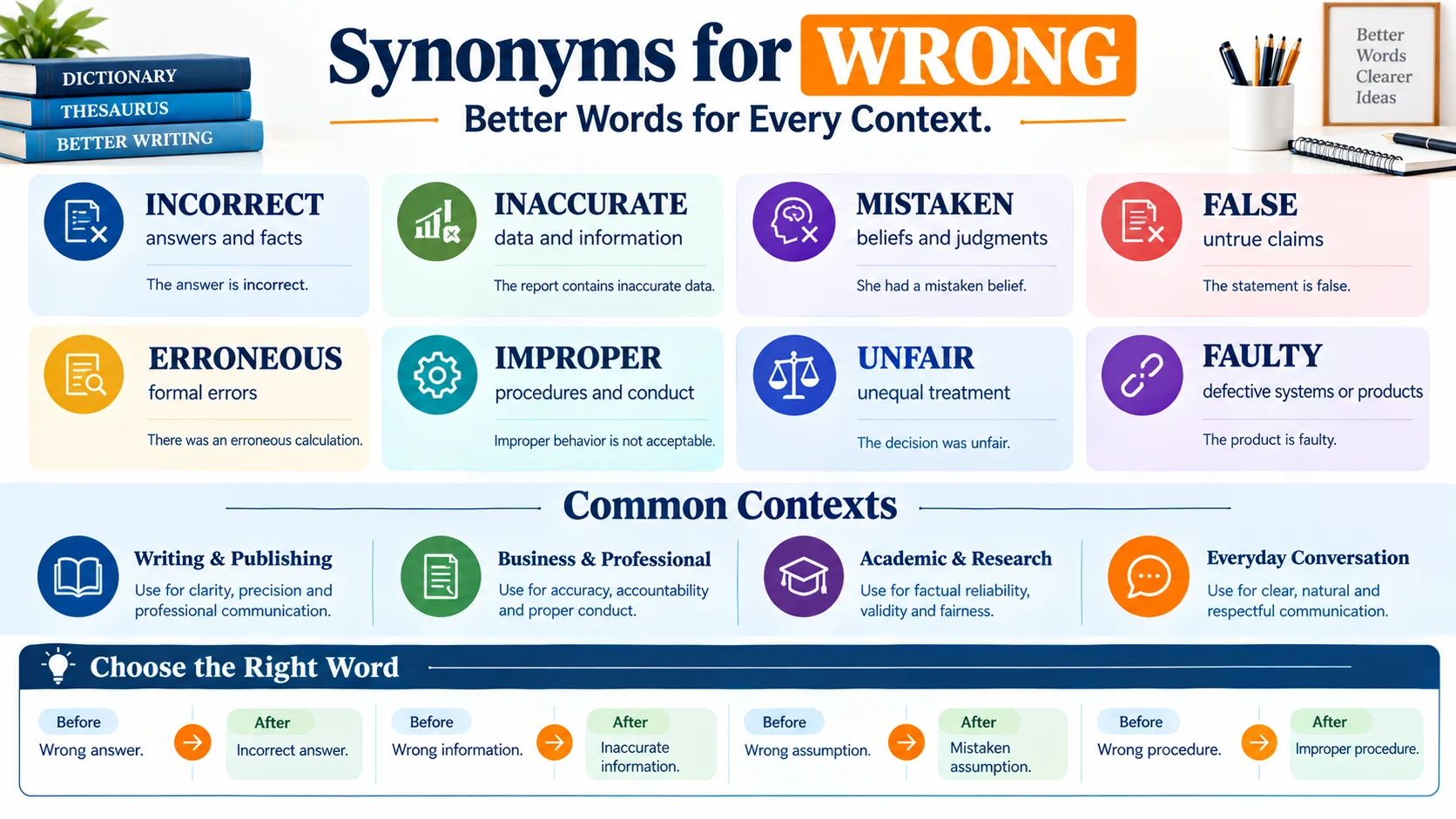
If you are looking for synonyms for wrong, the best alternative depends on what you mean. Common choices include incorrect, inaccurate, mistaken, false, improper, inappropriate, unfair, unjust, faulty, invalid, misguided, and erroneous. For everyday writing, incorrect or mistaken usually works well. For professional or academic writing, inaccurate, erroneous, or invalid may be more precise.
What Does Wrong Mean?
Definition
The word wrong has several meanings in American English. It can describe something that is incorrect, inaccurate, inappropriate, unfair, immoral, unsuitable, or not functioning properly.
For example:
- Your answer is wrong.
- I took the wrong bus.
- That was the wrong decision.
- The machine is wrong or malfunctioning.
- It is wrong to treat someone unfairly.
Because wrong covers many different ideas, choosing a more specific synonym can make your writing clearer.
Common Uses
The correct replacement depends on the situation.
If you mean an incorrect answer, use incorrect.
If you mean information that contains errors, use inaccurate.
If you mean a person made an error, use mistaken.
If you mean something violates a rule, use improper or unacceptable.
If you mean something is morally unacceptable, use unjust, unethical, or immoral, depending on the context.
If you mean something does not work correctly, use faulty or defective.
Best Synonyms for Wrong
| Synonym | Meaning | Best Used When | Example |
|---|---|---|---|
| Incorrect | Not correct | Answers, facts, information | Your answer is incorrect. |
| Inaccurate | Not factually precise | Data, reports, statements | The report contains inaccurate information. |
| Mistaken | Based on an error | Beliefs, assumptions, judgments | I was mistaken about the deadline. |
| False | Not true | Claims, statements, information | The claim is false. |
| Erroneous | Containing an error | Formal or academic writing | The calculation was erroneous. |
| Improper | Not appropriate or acceptable | Conduct, procedures, behavior | The employee followed an improper procedure. |
| Inappropriate | Unsuitable for a situation | Behavior, comments, language | That comment was inappropriate. |
| Unfair | Not treating people equally | Decisions, treatment, situations | The policy seems unfair. |
| Unjust | Morally or legally unfair | Laws, treatment, decisions | The ruling was considered unjust. |
| Faulty | Defective or unreliable | Machines, systems, reasoning | The device has a faulty component. |
| Invalid | Not legally, logically, or officially acceptable | Arguments, documents, results | The assumption is invalid. |
| Misguided | Based on poor judgment or understanding | Decisions, actions, beliefs | It was a misguided attempt to help. |
Synonyms by Context
Formal Writing
For formal writing, avoid using wrong when a more precise word is available.
Good formal alternatives include:
- Incorrect
- Inaccurate
- Erroneous
- Invalid
- Improper
- Unjustified
- Misguided
For example:
The original conclusion was incorrect.
A more formal version could be:
The original conclusion was erroneous.
Erroneous is especially useful when discussing an error in reasoning, calculation, information, or judgment.
Professional Writing
In business communication, precision matters. The best synonym depends on the problem.
Use inaccurate for incorrect data:
The financial report contains inaccurate figures.
Use improper for procedures or conduct:
The information was obtained through an improper process.
Use incorrect for straightforward mistakes:
The customer was given an incorrect invoice.
Use faulty for equipment or systems:
The technician identified a faulty connection.
Academic Writing
Academic writing usually benefits from precise alternatives to wrong.
Instead of:
The student’s answer was wrong.
You might write:
The student’s answer was incorrect.
For an argument:
The assumption is unfounded.
For reasoning:
The conclusion is invalid.
For research data:
The reported figures are inaccurate.
For an academic interpretation:
The interpretation appears misguided.
The key is to explain how something is wrong rather than simply labeling it wrong.
Daily Conversation
In casual conversation, simple alternatives usually sound more natural.
Try:
- Incorrect
- Mistaken
- Not right
- Off
- False
- Unfair
- Bad
- Inaccurate
For example:
I think you have the wrong address.
Could become:
I think you have the incorrect address.
However, in casual speech, wrong is often the most natural choice. Replacing every instance of wrong with a more formal synonym can make everyday conversation sound unnecessarily stiff.
Professional Alternatives for Wrong
When writing an email, report, resume, or workplace message, consider these alternatives:
Incorrect: Best for straightforward errors.
Inaccurate: Best for information, measurements, statistics, or records.
Erroneous: Best for formal discussions of mistakes.
Improper: Best for procedures, conduct, or methods that do not follow accepted standards.
Invalid: Best for arguments, assumptions, documents, results, or claims that do not meet a particular standard.
Unjustified: Best when a conclusion or decision lacks sufficient evidence.
For example, instead of:
The previous information was wrong.
A professional version could be:
The previous information was inaccurate.
This sounds more specific and less blunt.
Simple Alternatives for Wrong
If you need an easy synonym, choose words that most readers immediately understand.
Incorrect
Meaning: Not correct.
Tone: Neutral.
Difficulty: Easy.
Usage Frequency: Very Common.
Best For: Emails, essays, schoolwork, everyday writing.
Examples:
- Business: The invoice contains an incorrect amount.
- Academic: The answer is incorrect.
- Daily conversation: That information is incorrect.
Mistaken
Meaning: Based on an error or misunderstanding.
Tone: Neutral and often softer than wrong.
Difficulty: Easy.
Usage Frequency: Very Common.
Best For: Conversations, emails, personal statements.
Example:
I was mistaken about the meeting time.
This is often preferable when discussing a person’s error because it sounds less harsh.
False
Meaning: Not true.
Tone: Direct.
Difficulty: Easy.
Usage Frequency: Very Common.
Best For: Claims, statements, accusations, and factual information.
Example:
The statement is false.
Use false when the issue is truth rather than simply correctness.
Stronger Alternatives for Wrong
Some synonyms communicate a stronger or more specific criticism.
Erroneous
Meaning: Containing or resulting from an error.
Tone: Formal.
Difficulty: Advanced.
Usage Frequency: Common in formal writing.
Best For: Academic writing, reports, research, technical documents.
Example:
The analysis was based on an erroneous assumption.
Unjust
Meaning: Unfair or morally wrong.
Tone: Strong.
Difficulty: Medium.
Usage Frequency: Common.
Best For: Laws, decisions, treatment, social issues.
Example:
The workers argued that the policy was unjust.
Unethical
Meaning: Contrary to accepted moral or professional standards.
Tone: Strong and formal.
Difficulty: Medium.
Usage Frequency: Common.
Best For: Business, professional conduct, research, and workplace discussions.
Example:
The company was criticized for unethical practices.
Defective
Meaning: Having a fault that prevents something from working properly.
Tone: Technical.
Difficulty: Medium.
Usage Frequency: Common.
Best For: Products, equipment, parts, and manufacturing.
Example:
The customer returned the product because it was defective.
Difference Between Similar Synonyms
Not every synonym for wrong means exactly the same thing.
Wrong vs. Incorrect:
Wrong is broader and more conversational. Incorrect specifically means something is not correct.
Wrong vs. Inaccurate:
Inaccurate suggests that information, measurements, or descriptions are not factually precise.
Wrong vs. Mistaken:
Mistaken often describes a person’s belief, assumption, judgment, or understanding.
Wrong vs. False:
False means something is not true. A statement can be false, while an answer can be incorrect.
Wrong vs. Improper:
Improper suggests that something violates an accepted procedure, standard, rule, or expectation.
Wrong vs. Unfair:
Unfair specifically concerns unequal, unreasonable, or unjust treatment.
Wrong vs. Erroneous:
Erroneous is more formal and usually refers to an error in information, reasoning, calculation, or judgment.
Wrong vs. Faulty:
Faulty usually describes something defective, unreliable, or poorly designed, although it can also describe reasoning.
Choosing the right synonym therefore depends on the exact type of “wrong” you want to describe.
Quick Word Selection Guide
| If you mean… | Use… |
|---|---|
| An incorrect answer | Incorrect |
| Bad or inaccurate data | Inaccurate |
| A person’s mistaken belief | Mistaken |
| A statement that is not true | False |
| A formal error | Erroneous |
| A bad procedure | Improper |
| Unsuitable behavior | Inappropriate |
| Unequal treatment | Unfair |
| Moral or legal unfairness | Unjust |
| A defective product | Faulty or defective |
| An unacceptable argument | Invalid |
| Poor judgment | Misguided |
| A conclusion without evidence | Unjustified |
Opposite Words
Common antonyms for wrong include:
- Correct
- Right
- Accurate
- True
- Proper
- Appropriate
- Fair
- Just
- Valid
- Sound
- Suitable
- Effective
The opposite depends on the meaning of wrong. For example, the opposite of incorrect is correct, while the opposite of unfair is fair.
FAQs
What is another word for wrong?
Common alternatives for wrong include incorrect, inaccurate, mistaken, false, erroneous, improper, inappropriate, unfair, unjust, faulty, invalid, and misguided. The best choice depends on whether you mean an error, false information, inappropriate behavior, unfair treatment, or a defective object.
What is a formal synonym for wrong?
Erroneous is one of the strongest formal synonyms for wrong when describing an error. Other choices include incorrect, inaccurate, invalid, improper, unjustified, and misguided, depending on the context.
What is a professional word for wrong?
Incorrect and inaccurate are useful professional alternatives. Inaccurate works particularly well for data and information, while incorrect works well for answers, records, instructions, and straightforward mistakes.
What is a softer word for wrong?
Mistaken is often softer than wrong, especially when referring to a person’s judgment or belief. For example, “I was mistaken” generally sounds less confrontational than “I was wrong.”
What is a stronger word for wrong?
Depending on the context, stronger alternatives include false, erroneous, unjust, unethical, invalid, and improper. Each carries a different meaning, so the strongest-sounding word is not always the most accurate one.
What is another word for a wrong answer?
The most natural alternatives are incorrect answer, inaccurate answer, or mistaken answer. In most academic situations, incorrect is the clearest choice.
What is another word for wrong information?
Use inaccurate information, false information, or incorrect information. Choose false when the information is untrue, and inaccurate when it contains factual errors or lacks precision.
What is another word for doing something wrong?
Depending on the situation, you can use making a mistake, acting improperly, behaving inappropriately, acting unfairly, or making an error.
Can incorrect and wrong be used interchangeably?
Often, yes. However, wrong has a broader range of meanings. Incorrect specifically focuses on something that is not correct, while wrong can also describe morality, fairness, suitability, direction, or functionality.
What is the best synonym for wrong?
There is no single best synonym for every situation. Incorrect is a strong general replacement, but inaccurate, mistaken, false, improper, unfair, erroneous, or faulty may be more precise depending on what you mean.
Conclusion
The best synonym for wrong depends on the meaning you want to communicate. Use incorrect for answers and straightforward errors, inaccurate for unreliable information, mistaken for personal errors or misunderstandings, and false for statements that are not true. For formal writing, erroneous and invalid can provide greater precision. When the issue involves behavior or fairness, words such as improper, inappropriate, unfair, unjust, or unethical may be more appropriate. Choosing a precise synonym makes your writing clearer, more professional, and easier for readers to understand.