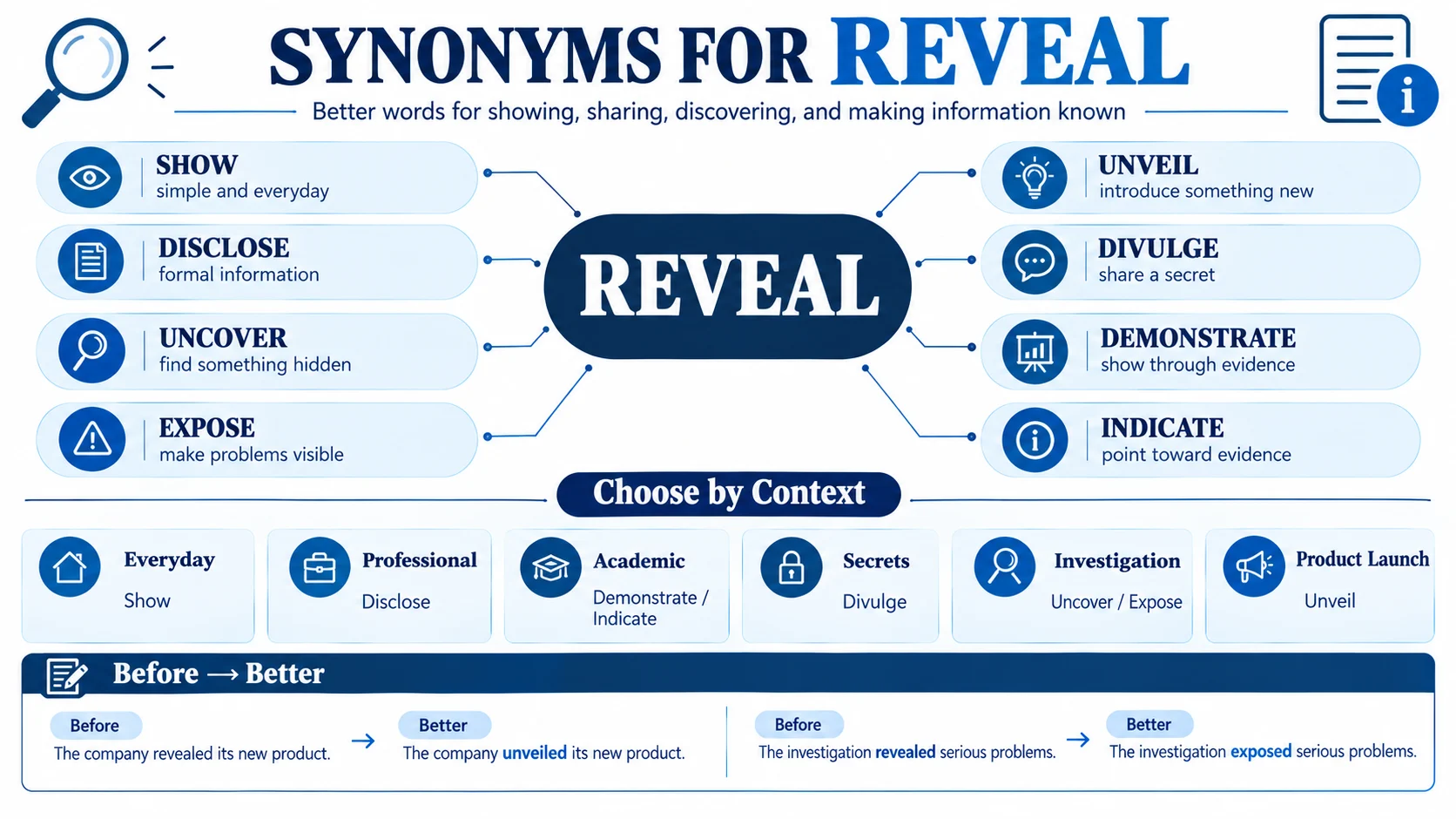
If you need another word for reveal, the best choice depends on what you are describing. Common synonyms include disclose, uncover, expose, unveil, divulge, show, announce, demonstrate, indicate, and discover. Some work best in formal writing, while others fit everyday conversation, business communication, or academic writing.
What Does Reveal Mean?
Definition
Reveal means to make something known, visible, or understood that was previously hidden, secret, unknown, or unclear.
The word can describe physical discovery, sharing confidential information, showing emotions, presenting new information, or making something previously unseen visible.
For example:
- The company revealed its new product.
- She refused to reveal the details.
- The investigation revealed several problems.
- His expression revealed his disappointment.
The meaning stays similar, but the best synonym changes depending on the situation.
Common Uses
Reveal is commonly used when someone:
- Shares secret information
- Makes something hidden visible
- Announces previously unknown information
- Discovers or uncovers facts
- Shows emotions or intentions
- Presents something publicly for the first time
Best Synonyms for Reveal
| Synonym | Meaning | Best Used When | Example |
|---|---|---|---|
| Disclose | Make private information known | Formal or professional situations | The company disclosed its financial results. |
| Uncover | Find something hidden | Investigations or discoveries | Reporters uncovered the truth. |
| Expose | Make something hidden or wrong visible | Problems, wrongdoing, or secrets | The investigation exposed serious errors. |
| Unveil | Present something publicly for the first time | Products, plans, or announcements | The company unveiled its latest model. |
| Divulge | Share information that was meant to remain private | Secrets or confidential details | He refused to divulge the information. |
| Show | Make something visible or clear | Everyday language | The results show a major improvement. |
| Announce | Publicly communicate information | News, decisions, or events | The organization announced its new policy. |
| Demonstrate | Make something clear through evidence or action | Academic or professional writing | The results demonstrate the effectiveness of the method. |
| Indicate | Point toward or suggest something | Evidence and analysis | The data indicate a significant change. |
| Discover | Find something previously unknown | New information or facts | Scientists discovered a new pattern. |
Synonyms by Context
Formal Writing
For formal writing, stronger alternatives to reveal include disclose, demonstrate, indicate, uncover, and divulge.
Disclose is especially useful when discussing information that is private, confidential, financial, or legally relevant.
Example:
The organization was required to disclose its financial information.
Demonstrate works when evidence makes a fact or conclusion clear.
The findings demonstrate the importance of early intervention.
Indicate is useful when evidence suggests something without directly proving it.
The results indicate a possible relationship between the two variables.
Professional Writing
In business communication, your choice should match the type of information being presented.
Use unveil for a new product, campaign, strategy, or initiative:
The company will unveil its new marketing strategy next quarter.
Use disclose for confidential or regulated information:
The organization disclosed the results of its internal review.
Use announce when the focus is on publicly communicating news:
The CEO announced the company’s expansion plans.
Use share when the tone should feel straightforward and approachable:
We are pleased to share the results of our latest survey.
Academic Writing
Academic writing usually benefits from precise alternatives rather than repeatedly using reveal.
Good choices include:
- Demonstrate for evidence-supported conclusions
- Indicate for evidence that points toward a finding
- Identify for recognizing a specific factor
- Establish for supporting a conclusion
- Uncover for discovering previously unknown information
- Suggest when evidence points toward a possible explanation
For example:
The study revealed a significant difference between the groups.
Could become:
The study demonstrated a significant difference between the groups.
Or:
The findings indicated a significant difference between the groups.
The second version is particularly useful when the evidence suggests rather than definitively proves the conclusion.
Daily Conversation
For casual conversations, simple words usually sound more natural.
Instead of:
Don’t reveal the surprise.
You might say:
Don’t tell anyone about the surprise.
Instead of:
She revealed her plans.
You could say:
She shared her plans.
Instead of:
He revealed the truth.
You could say:
He finally told us what happened.
Simple alternatives often sound more natural than formal synonyms in everyday speech.
Professional Alternatives for Reveal
When writing emails, reports, resumes, proposals, or business documents, consider these alternatives:
Disclose
Meaning: Make private or confidential information known.
Tone: Formal and professional.
Best for: Business writing, legal documents, financial reporting, compliance.
Example:
The company disclosed the results of its annual review.
Unveil
Meaning: Introduce or present something publicly for the first time.
Tone: Professional and promotional.
Best for: Marketing copy, product launches, presentations, announcements.
Example:
The brand unveiled its redesigned website.
Demonstrate
Meaning: Show something clearly through evidence or action.
Tone: Formal and analytical.
Best for: Reports, resumes, academic writing, business writing.
Example:
The project demonstrated strong improvements in customer engagement.
Indicate
Meaning: Point toward or provide evidence of something.
Tone: Formal and neutral.
Best for: Research, reports, analysis, data interpretation.
Example:
The survey results indicate growing customer demand.
Simple Alternatives for Reveal
If you want an easy, natural replacement, try:
- Show
- Tell
- Share
- Give away
- Let someone know
- Make known
- Bring out
- Point out
For example:
Original:
The report revealed several problems.
Simple:
The report showed several problems.
Original:
She revealed the secret.
Simple:
She told us the secret.
Original:
The results revealed a major difference.
Simple:
The results showed a major difference.
These alternatives are particularly useful when writing for a broad audience.
Stronger Alternatives for Reveal
Some synonyms carry a stronger or more specific meaning.
Expose
Meaning: Make something hidden, especially something wrong, harmful, or embarrassing, visible.
Tone: Strong.
Best for: Scandals, wrongdoing, weaknesses, hidden problems.
The investigation exposed serious security failures.
Uncover
Meaning: Find or bring hidden information to light.
Tone: Investigative.
Best for: Research, journalism, investigations, discoveries.
The journalists uncovered previously unknown evidence.
Divulge
Meaning: Reveal information that is supposed to remain private.
Tone: Formal.
Best for: Secrets and confidential information.
The employee refused to divulge confidential details.
Unmask
Meaning: Expose someone’s true identity, nature, or intentions.
Tone: Dramatic or investigative.
The investigation unmasked the person behind the scheme.
Difference Between Similar Synonyms
Not every synonym for reveal can replace it in every sentence.
Reveal vs. Disclose
Reveal is broad and can be used in casual or formal contexts.
Disclose usually suggests deliberately making private, confidential, or official information known.
- The movie revealed the ending.
- The company disclosed its financial information.
Reveal vs. Uncover
Reveal can mean making information known.
Uncover usually emphasizes discovering something that was hidden.
- The report revealed new information.
- Investigators uncovered new evidence.
Reveal vs. Expose
Expose often has a negative or critical implication.
- The study revealed a trend.
- The investigation exposed corruption.
The second sentence suggests wrongdoing or something problematic.
Reveal vs. Unveil
Unveil commonly refers to formally introducing something new.
- The research revealed an unexpected result.
- The company unveiled a new product.
Reveal vs. Divulge
Divulge specifically emphasizes sharing information that is private or secret.
- The evidence revealed the truth.
- She refused to divulge the password.
Reveal vs. Show
Show is the simplest and broadest alternative.
It is usually the safest choice for casual writing, but it may sound less precise in academic or professional contexts.
Synonym Analysis at a Glance
| Word | Tone | Difficulty | Frequency | Best For |
|---|---|---|---|---|
| Show | Neutral | Easy | Very Common | Everyday writing |
| Share | Friendly | Easy | Very Common | Emails, conversation |
| Disclose | Formal | Medium | Common | Business, legal writing |
| Uncover | Investigative | Medium | Common | Journalism, research |
| Expose | Strong | Medium | Common | Problems, wrongdoing |
| Unveil | Promotional | Medium | Common | Marketing, announcements |
| Divulge | Formal | Advanced | Less Common | Secrets, confidential information |
| Demonstrate | Academic | Medium | Very Common | Research, reports |
| Indicate | Analytical | Medium | Very Common | Academic and professional writing |
| Unmask | Dramatic | Advanced | Less Common | Identity or hidden motives |
Business Examples
Reveal:
The company revealed its plans for expansion.
Disclose:
The company disclosed its expansion plans to investors.
Unveil:
The company unveiled its new expansion strategy at the conference.
Each sentence is grammatically correct, but the emphasis changes.
Reveal is general.
Disclose emphasizes formal communication.
Unveil emphasizes a public introduction.
Academic Examples
Instead of repeatedly writing:
The study revealed several important findings.
You could write:
The study identified several important findings.
The results demonstrated a strong relationship between the variables.
The data indicated a significant change.
Researchers uncovered previously overlooked evidence.
Choosing the more precise verb makes academic writing clearer and less repetitive.
Daily Conversation Examples
In everyday speech, natural alternatives usually work better:
- Tell: She finally told me the truth.
- Show: The results showed what went wrong.
- Share: He shared his plans with his friends.
- Give away: Don’t give away the ending.
- Let me know: Let me know what you find out.
The most sophisticated synonym is not always the best synonym. The right word is the one that matches your audience and intended meaning.
Opposite Words
Common opposites of reveal include:
- Hide
- Conceal
- Cover
- Suppress
- Withhold
- Keep secret
- Obscure
- Mask
For example:
The report revealed the information.
Opposite:
The report withheld the information.
Or:
She revealed the truth.
Opposite:
She concealed the truth.
FAQs
What is another word for reveal?
Common alternatives include show, disclose, uncover, expose, unveil, divulge, announce, demonstrate, indicate, and discover. The best choice depends on whether you are discussing information, secrets, evidence, products, emotions, or discoveries.
What is a formal synonym for reveal?
Disclose is one of the most useful formal synonyms for reveal, especially when referring to confidential, financial, legal, or official information.
What is a professional alternative for reveal?
Professional alternatives include disclose, demonstrate, indicate, unveil, announce, and identify. Choose based on the specific meaning you want to communicate.
What word can replace reveal in academic writing?
Useful academic alternatives include demonstrate, indicate, identify, establish, uncover, and suggest. The best option depends on whether your sentence describes evidence, discovery, or interpretation.
What is a synonym for reveal a secret?
Good choices include disclose, divulge, expose, tell, share, and let someone know. Divulge is particularly associated with sharing confidential information.
What is a synonym for reveal the truth?
Possible alternatives include uncover the truth, expose the truth, disclose the truth, bring the truth to light, and make the truth known.
What is a synonym for reveal a product?
For product launches, unveil is often a natural choice. You can also use introduce, launch, present, or announce, depending on the sentence.
Is expose the same as reveal?
Not exactly. Expose usually carries a stronger meaning and often suggests bringing wrongdoing, flaws, danger, or something unpleasant into public view. Reveal is more neutral.
Is unveil a synonym for reveal?
Yes, but unveil is more specific. It commonly describes formally presenting something new or previously hidden to the public, especially products, plans, campaigns, or artwork.
What is the simplest synonym for reveal?
Show is usually the simplest general synonym. Depending on context, tell and share may also sound more natural.
Conclusion
The best synonym for reveal depends on what you are trying to communicate. Use show for simple everyday language, disclose for confidential or formal information, uncover for discoveries, expose for hidden problems or wrongdoing, and unveil for new products or public presentations. In academic writing, demonstrate and indicate can provide greater precision. Rather than replacing every instance of “reveal” with the same synonym, consider the meaning, tone, audience, and context of your sentence. A precise synonym makes your writing sound more natural, professional, and purposeful.