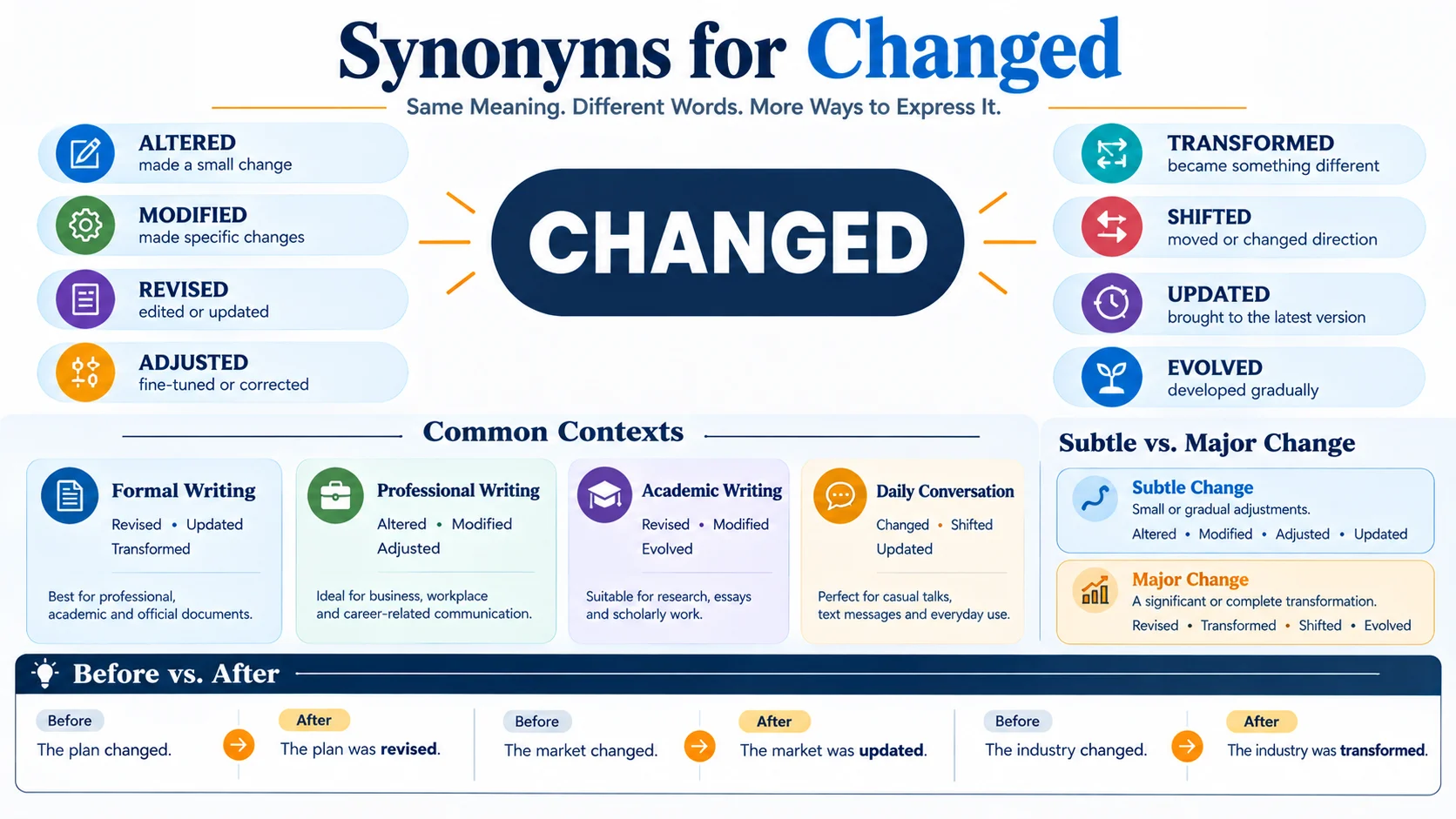
Another word for changed is altered, modified, revised, adjusted, shifted, updated, transformed, or evolved. The best synonym depends on the context. Use revised for documents, adjusted for small changes, shifted for direction or priorities, and transformed for major changes.
What Does Changed Mean?
Definition
Changed means that something became different from its previous condition, appearance, form, position, behavior, or situation. It can also mean that someone modified, replaced, adjusted, or updated something.
The best synonym depends on what kind of change you mean. For example, altered suggests modification, revised often refers to improving or updating something, while transformed suggests a major or noticeable change.
Common Uses
You might use changed to describe:
- A change in appearance: “Her style changed.”
- A modification: “He changed the document.”
- An improvement: “The policy was revised.”
- A major transformation: “The experience transformed her.”
- A change in position: “The schedule shifted.”
- An adjustment: “We changed the settings.”
- A replacement: “She changed her appointment.”
- A development over time: “His attitude evolved.”
Because changed has so many meanings, there is no single synonym that works perfectly in every sentence.
Best Synonyms for Changed
| Synonym | Meaning | Best Used When | Example |
|---|---|---|---|
| Altered | Made different | Something was modified | The design was altered. |
| Modified | Changed slightly or technically | Features, systems, plans, or objects are adjusted | The software was modified. |
| Revised | Changed after review | Documents, plans, policies, or ideas are improved | She revised the proposal. |
| Adjusted | Changed to improve fit or accuracy | Settings, amounts, schedules, or conditions | We adjusted the deadline. |
| Transformed | Changed dramatically | A major change has occurred | The renovation transformed the building. |
| Shifted | Moved or changed direction | Opinions, priorities, positions, or conditions | Public priorities shifted. |
| Updated | Made more current | Information, software, records, or policies | The website was updated. |
| Evolved | Developed gradually | Ideas, relationships, systems, or situations change over time | The project evolved significantly. |
| Converted | Changed from one form or use to another | Formats, systems, beliefs, or purposes change | The file was converted to PDF. |
| Replaced | Put something else in its place | One thing substitutes for another | The old system was replaced. |
| Remodeled | Changed the structure or appearance | Buildings, rooms, or physical spaces | They remodeled the kitchen. |
| Reformed | Changed to improve a system or practice | Institutions, policies, or organizations | The agency reformed its procedures. |
Synonyms by Context
Formal Writing
For formal writing, choose words that explain how the change happened rather than simply repeating changed.
Useful alternatives include:
Altered, modified, revised, adjusted, transformed, reformed, restructured, replaced, updated, and amended.
Examples:
- “The committee revised the proposal.”
- “The organization restructured its operations.”
- “The regulations were amended.”
- “The original design was modified.”
Revised is especially useful when something was reviewed and then changed. Amended works well for formal documents, rules, laws, agreements, and policies.
Professional Writing
In business communication, precision matters. Instead of saying that a plan “changed,” you can identify the type of change.
- Updated: information or systems were brought up to date.
- Adjusted: something was fine-tuned.
- Modified: specific elements were changed.
- Revised: a document or plan was reconsidered.
- Restructured: an organization or process was substantially reorganized.
- Shifted: priorities, strategies, or markets moved in a different direction.
For example:
“Our marketing strategy changed.”
can become:
“Our marketing strategy shifted to focus on digital channels.”
The second sentence tells the reader more about the nature of the change.
Academic Writing
Academic writing benefits from specific language.
Good alternatives include:
Altered, modified, revised, transformed, shifted, evolved, adapted, increased, decreased, expanded, and declined.
Examples:
- “The researchers modified the experimental procedure.”
- “The participant’s response changed over time.”
- “The participant’s response shifted over time.”
- “The theory evolved as new evidence emerged.”
When describing research, avoid replacing changed automatically. If the data actually increased or decreased, use the more precise term.
Daily Conversation
In everyday English, simple alternatives usually sound more natural.
Try:
Switched, changed up, adjusted, moved, shifted, updated, replaced, or became different.
Examples:
- “I switched my appointment to Friday.”
- “She changed up her routine.”
- “We adjusted the plan.”
- “His attitude shifted after the conversation.”
Professional Alternatives for Changed
If you’re writing a resume, cover letter, business email, report, or LinkedIn profile, stronger wording can make the sentence more specific.
Instead of:
“Changed the company’s marketing strategy.”
Consider:
“Revised the company’s marketing strategy.”
Instead of:
“Changed the workflow.”
Consider:
“Streamlined the workflow.”
Instead of:
“Changed the organizational structure.”
Consider:
“Restructured the organizational structure.”
Instead of:
“Changed the process to make it faster.”
Consider:
“Optimized the process to improve efficiency.”
The right replacement depends on the actual action. Don’t use a stronger-sounding word if it changes the original meaning.
Simple Alternatives for Changed
If you want easy words that most readers will understand, use:
- Altered
- Adjusted
- Switched
- Updated
- Modified
- Moved
- Shifted
- Replaced
- Revised
- Became different
For general writing, altered, adjusted, modified, and switched are especially useful because they are familiar and flexible.
Stronger Alternatives for Changed
Sometimes changed is too vague. A more powerful word can communicate the scale or direction of the change.
Transformed
Use transformed when something became substantially different.
Example:
“The new technology transformed the industry.”
Restructured
Use restructured when the organization, system, or arrangement was reorganized.
Example:
“The company restructured its sales department.”
Revolutionized
Use revolutionized only when the change was extremely significant and had a broad effect.
Example:
“Digital communication revolutionized the publishing industry.”
Overhauled
Use overhauled when something was thoroughly examined and significantly improved or changed.
Example:
“The team overhauled the company’s outdated website.”
Evolved
Use evolved when change happened gradually over time.
Example:
“The company’s strategy evolved as customer needs changed.”
Difference Between Similar Synonyms
The most important thing to remember is that synonyms are often similar, not identical.
Changed vs. Altered
Changed is general. Altered usually emphasizes that something was modified from its original state.
- “The schedule changed.”
- “The schedule was altered.”
Both work, but altered sounds more deliberate.
Changed vs. Modified
Modified normally suggests that specific parts were adjusted while the basic thing remains recognizable.
- “The software was modified.”
- “The software was transformed.”
Modified suggests a more limited change, while transformed suggests a much larger one.
Changed vs. Revised
Revised is especially appropriate when something is reviewed and then changed.
- Revised essay
- Revised proposal
- Revised policy
- Revised plan
It is less natural for describing an accidental change in appearance.
Changed vs. Adjusted
Adjusted usually means making a small or controlled change.
- “I adjusted the settings.”
- “We adjusted the schedule.”
It often suggests fine-tuning rather than completely replacing something.
Changed vs. Transformed
Transformed describes a major change in form, appearance, function, or condition.
Compare:
“The room changed.”
with:
“The renovation transformed the room.”
The second sentence communicates a much more substantial difference.
Changed vs. Shifted
Shifted often describes movement in direction, focus, position, attitude, or priority.
For example:
“The company’s priorities shifted.”
This is more precise than simply saying the priorities changed.
Opposite Words
Common antonyms for changed include:
- Unchanged
- Stable
- Constant
- Preserved
- Maintained
- Retained
- Remained
- Fixed
- Unaltered
- Consistent
The correct opposite depends on the meaning. If changed means “modified,” unchanged or unaltered is usually the clearest opposite. If it means “developed,” a word such as remained stable may be more appropriate.
How to Choose the Right Synonym
Ask yourself what actually happened.
Did something become slightly different?
Use altered or modified.
Was something reviewed and improved?
Use revised.
Was a small correction made?
Use adjusted.
Did something become dramatically different?
Use transformed.
Did priorities or opinions move in another direction?
Use shifted.
Was something made more current?
Use updated.
Did something develop gradually?
Use evolved.
Was one thing substituted for another?
Use replaced or switched.
This approach produces clearer writing than simply searching for the most complicated synonym.
FAQs
What is another word for changed?
Common alternatives for changed include altered, modified, revised, adjusted, shifted, updated, transformed, evolved, switched, and replaced. The best choice depends on the type and degree of change.
What is a formal synonym for changed?
Altered, modified, revised, amended, restructured, and transformed can work as formal alternatives. Revised is particularly useful for documents, plans, and written material.
What is a professional alternative for changed?
Professional alternatives include revised, adjusted, modified, updated, restructured, optimized, and shifted. Choose the word that accurately describes the action.
What word can replace changed in a resume?
Depending on the accomplishment, you can use improved, optimized, streamlined, revised, transformed, restructured, increased, reduced, or implemented. A specific action verb is usually stronger than a generic replacement.
What is a simple synonym for changed?
Simple synonyms include altered, adjusted, switched, updated, modified, and shifted.
What is a stronger word for changed?
Transformed, overhauled, revolutionized, restructured, and dramatically altered can describe substantial changes. Use them only when the change was genuinely significant.
Is changed and altered the same?
They can have the same general meaning, but altered usually emphasizes that something was deliberately modified from its original form.
What is the difference between changed and revised?
Changed is broad, while revised usually means something was reviewed and then modified, often to improve or correct it.
What is the difference between changed and transformed?
Changed can describe any difference. Transformed normally indicates a major or fundamental change.
What is the opposite of changed?
Common opposites include unchanged, unaltered, stable, constant, maintained, and preserved.
Conclusion
There are many useful synonyms for changed, but the best word depends on the context. Use altered for a general modification, modified for a specific adjustment, revised for reviewed material, adjusted for fine-tuning, shifted for movement in direction or priorities, and transformed for major change. In professional and academic writing, choosing a precise alternative can make your sentence clearer and more informative. Instead of automatically replacing changed, first identify what actually happened, then select the word that communicates that meaning accurately.