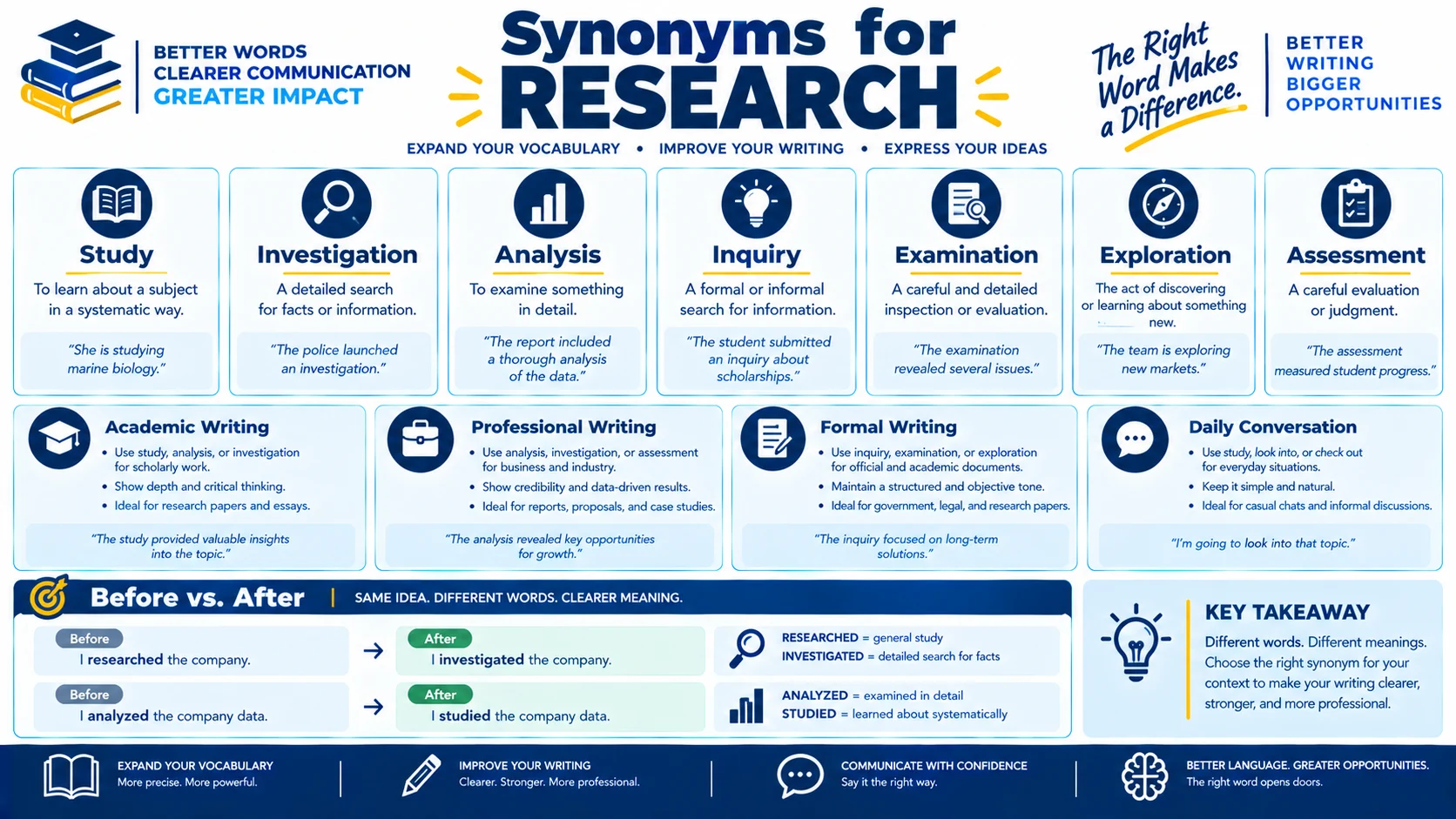
A good synonym for research is study, but the best alternative depends on context. Other useful synonyms include investigation, analysis, inquiry, examination, exploration, assessment, evaluation, and review. For academic writing, “study” works well, while “analysis” suits data-focused and professional contexts.
What Does Research Mean?
Definition
Research means the systematic process of collecting, studying, analyzing, and evaluating information to discover facts, answer questions, or develop a deeper understanding of a subject.
As a noun, research refers to the investigation itself:
The team conducted research on consumer behavior.
As a verb, research means to investigate a topic carefully:
She researched the company before applying for the position.
The best synonym depends on what kind of research you mean. In academic writing, investigation, study, and analysis may work well. In business writing, analysis, market study, and assessment can sound more precise. In everyday conversation, looking into, checking, or exploring may feel more natural.
Common Uses
The word research appears frequently in:
- Academic papers and dissertations
- Scientific studies
- Business reports
- Market research
- Journalism
- Product development
- Historical investigation
- Medical and technical writing
- Online information gathering
Best Synonyms for Research
| Synonym | Meaning | Best Used When | Example |
|---|---|---|---|
| Study | Detailed examination of a subject | Academic or general contexts | The study examined sleep patterns. |
| Investigation | Careful examination to discover facts | Formal, legal, or serious contexts | The investigation revealed several problems. |
| Analysis | Detailed examination of information | Business, academic, or technical writing | The analysis identified important trends. |
| Inquiry | An effort to obtain information or answers | Formal or professional contexts | The inquiry focused on customer complaints. |
| Examination | Close inspection or consideration | Academic and formal writing | The examination of the data produced useful findings. |
| Exploration | Investigation of an unfamiliar subject | Ideas, topics, or possibilities | Her exploration of the topic led to new questions. |
| Investigation | Systematic search for facts | Problems, events, or claims | Researchers conducted an investigation into the issue. |
| Survey | Collection of information from people or data | Public opinion or market research | The company conducted a customer survey. |
| Assessment | Evaluation of quality, value, or condition | Professional and business contexts | The assessment evaluated the project’s risks. |
| Evaluation | Judging something based on evidence | Programs, products, or results | The evaluation measured the program’s effectiveness. |
| Review | Careful examination of existing information | Literature, documents, or performance | The literature review covered recent studies. |
| Examination | Detailed consideration or inspection | Formal and academic contexts | The examination considered several factors. |
Study
Meaning: A detailed examination or investigation of a particular subject.
Best Used For: Academic papers, scientific work, education, and general discussion.
Tone: Neutral and professional
Difficulty: Easy
Usage Frequency: Very Common
Best for: Resume writing, essay writing, academic writing, business writing.
Academic example:
Researchers conducted a study of childhood language development.
Business example:
The company commissioned a study of customer preferences.
Daily conversation:
I’m doing a little study before I buy the laptop.
Investigation
Meaning: A systematic attempt to discover facts or understand what happened.
Best Used For: Problems, incidents, claims, legal matters, and serious inquiries.
Tone: Formal
Difficulty: Medium
Usage Frequency: Common
Business example:
The company launched an investigation into the data breach.
Academic example:
The investigation examined the relationship between exercise and concentration.
Daily conversation:
I did some investigation before choosing the apartment.
Analysis
Meaning: A detailed examination of information, data, or ideas.
Best Used For: Business reports, research papers, statistics, technical documents, and data-driven writing.
Tone: Professional and analytical
Difficulty: Medium
Usage Frequency: Very Common
Business example:
Our analysis showed a significant change in customer behavior.
Academic example:
The analysis of the results supported the original hypothesis.
Daily conversation:
I did some analysis of the reviews before ordering it.
Inquiry
Meaning: A formal or careful request for information or an investigation into a matter.
Best Used For: Formal correspondence, public matters, professional contexts, and official investigations.
Tone: Formal
Difficulty: Advanced
Usage Frequency: Common
Business example:
The inquiry examined the company’s hiring practices.
Academic example:
The research inquiry focused on how students adapt to online learning.
Daily conversation:
I made an inquiry about the course requirements.
Exploration
Meaning: A process of examining a subject, idea, or possibility in order to learn more about it.
Best Used For: New ideas, creative subjects, emerging topics, and broad investigations.
Tone: Neutral to sophisticated
Difficulty: Medium
Usage Frequency: Common
Example:
The article offers an exploration of modern workplace culture.
Synonyms by Context
Formal Writing
For formal documents, stronger alternatives to research include:
- Investigation
- Inquiry
- Examination
- Analysis
- Evaluation
- Assessment
- Study
For example:
Basic:
The report presents research into workplace safety.
More formal:
The report presents an investigation into workplace safety.
However, these words are not always interchangeable. Investigation often suggests finding facts about a particular issue, while research can describe a much broader process.
Professional Writing
In business settings, choose a word that explains the actual activity.
Use analysis when information or data is being examined.
The team completed an analysis of quarterly sales.
Use assessment when judging quality, risk, performance, or condition.
The consultant conducted a risk assessment.
Use survey when information is collected from respondents.
We conducted a customer survey.
Use review when existing documents, evidence, or performance are being examined.
Management completed a review of the current strategy.
Academic Writing
Academic alternatives include:
- Study
- Investigation
- Analysis
- Examination
- Inquiry
- Literature review
- Empirical study
Research remains one of the most natural choices in academic writing because it can describe the overall process, field of study, or body of work.
For example:
Previous research suggests that sleep affects memory.
Replacing research with investigation would change the nuance:
Previous investigations suggest that sleep affects memory.
The second sentence sounds more specific and may imply particular investigations rather than research as a broader body of evidence.
Daily Conversation
In casual English, research can often be replaced with simpler expressions:
- Look into
- Check
- Find out about
- Learn about
- Explore
- Look up
- Dig into
Formal:
I researched the restaurant before making a reservation.
Casual:
I looked into the restaurant before making a reservation.
For everyday communication, these alternatives can sound more natural than formal terms such as inquiry or investigation.
Professional Alternatives for Research
If you are writing a resume, report, email, or business document, consider these alternatives:
Analysis works well when you examined data.
Conducted market analysis to identify customer trends.
Investigation works when you systematically examined a problem.
Conducted an investigation into operational inefficiencies.
Assessment works when you evaluated something.
Performed an assessment of project risks.
Evaluation works when you measured effectiveness or value.
Completed an evaluation of training outcomes.
Study works when you performed a structured examination.
Conducted a study of customer satisfaction.
The most effective professional alternative is usually the one that describes the actual task rather than simply replacing research with a more sophisticated word.
Simple Alternatives for Research
If your goal is clear, easy-to-understand English, use:
- Study
- Look into
- Check
- Learn about
- Find out
- Explore
- Look up
- Examine
For example:
Instead of:
I conducted research into the product.
Simple:
I looked into the product.
Instead of:
She conducted research before purchasing a car.
Simple:
She checked the options before purchasing a car.
These alternatives are especially useful in conversational writing, blogs, instructions, and general-audience content.
Stronger Alternatives for Research
Some alternatives make the investigation sound more specific or intensive.
Investigation can suggest a serious search for facts.
Examination emphasizes close and careful inspection.
Analysis emphasizes interpreting information.
Inquiry emphasizes asking questions or seeking answers.
Evaluation emphasizes judging effectiveness, quality, or value.
Assessment emphasizes determining a condition, level, risk, or performance.
Exploration emphasizes discovering or considering a topic.
Instead of automatically choosing the strongest-sounding word, match the synonym to the action you actually performed.
Difference Between Similar Synonyms
Research vs. Study
Research often describes a systematic process of discovering or developing knowledge. Study can refer to a specific investigation or the act of examining something.
Researchers conducted research on climate patterns.
The study examined climate patterns in coastal regions.
Research vs. Analysis
Research may include collecting information, conducting experiments, reviewing sources, and gathering evidence. Analysis specifically emphasizes examining and interpreting information.
Research vs. Investigation
Investigation often implies searching for facts about a particular problem, event, or claim. Research has a broader meaning and is commonly associated with academic and scientific knowledge.
Research vs. Inquiry
Inquiry emphasizes seeking answers or information. It is often more formal than everyday expressions such as looking into.
Research vs. Review
A review generally examines existing information rather than necessarily producing new research.
For example, a literature review summarizes and evaluates previous scholarly work.
Opposite Words
Research does not have one perfect opposite, but depending on context, contrasting ideas may include:
- Ignorance
- Guesswork
- Speculation
- Assumption
- Neglect
- Disregard
For example, if someone makes a decision without investigating the available evidence, guesswork or assumption may contrast with research.
However, these are contextual opposites rather than strict dictionary antonyms.
FAQs
What is another word for research?
Common alternatives for research include study, investigation, analysis, inquiry, examination, exploration, assessment, evaluation, and review. The best choice depends on whether you are discussing academic work, data analysis, business evaluation, or casual information gathering.
What is a formal synonym for research?
Formal synonyms include investigation, inquiry, examination, analysis, evaluation, and assessment. In academic writing, study and investigation are especially common alternatives.
What is a professional alternative for research?
Professional alternatives include analysis, assessment, evaluation, investigation, study, and review. Choose the word that accurately describes the work you performed.
What word can replace research on a resume?
Depending on the task, use analyzed, investigated, evaluated, assessed, examined, studied, or reviewed. Action verbs can make resume statements more specific and concise.
What is another word for research in academic writing?
Useful academic alternatives include study, investigation, analysis, examination, inquiry, and scholarly investigation.
What is a simple word for research?
Simple alternatives include study, check, look into, learn about, find out, and explore.
Is analysis the same as research?
No. Analysis is often one part of research. Research may involve gathering information, designing a study, collecting evidence, analyzing results, and drawing conclusions.
Is study a synonym for research?
Yes, study can be a synonym for research when referring to a systematic examination of a subject. However, study can also have broader meanings.
What is another word for researching?
Depending on the context, alternatives include investigating, studying, examining, analyzing, exploring, evaluating, assessing, and looking into.
What is another word for research findings?
Depending on the context, you can use results, findings, conclusions, discoveries, observations, or outcomes. These terms have slightly different meanings, so the specific context matters.
Conclusion
The best synonym for research depends on what you are actually doing. Study is versatile and common, investigation suggests a focused search for facts, analysis emphasizes interpreting information, assessment focuses on evaluation, and exploration works well for discovering ideas or unfamiliar subjects.
For academic and professional writing, precision matters more than choosing the most complicated word. A clear, context-specific alternative will usually communicate your meaning better than a thesaurus-style replacement.