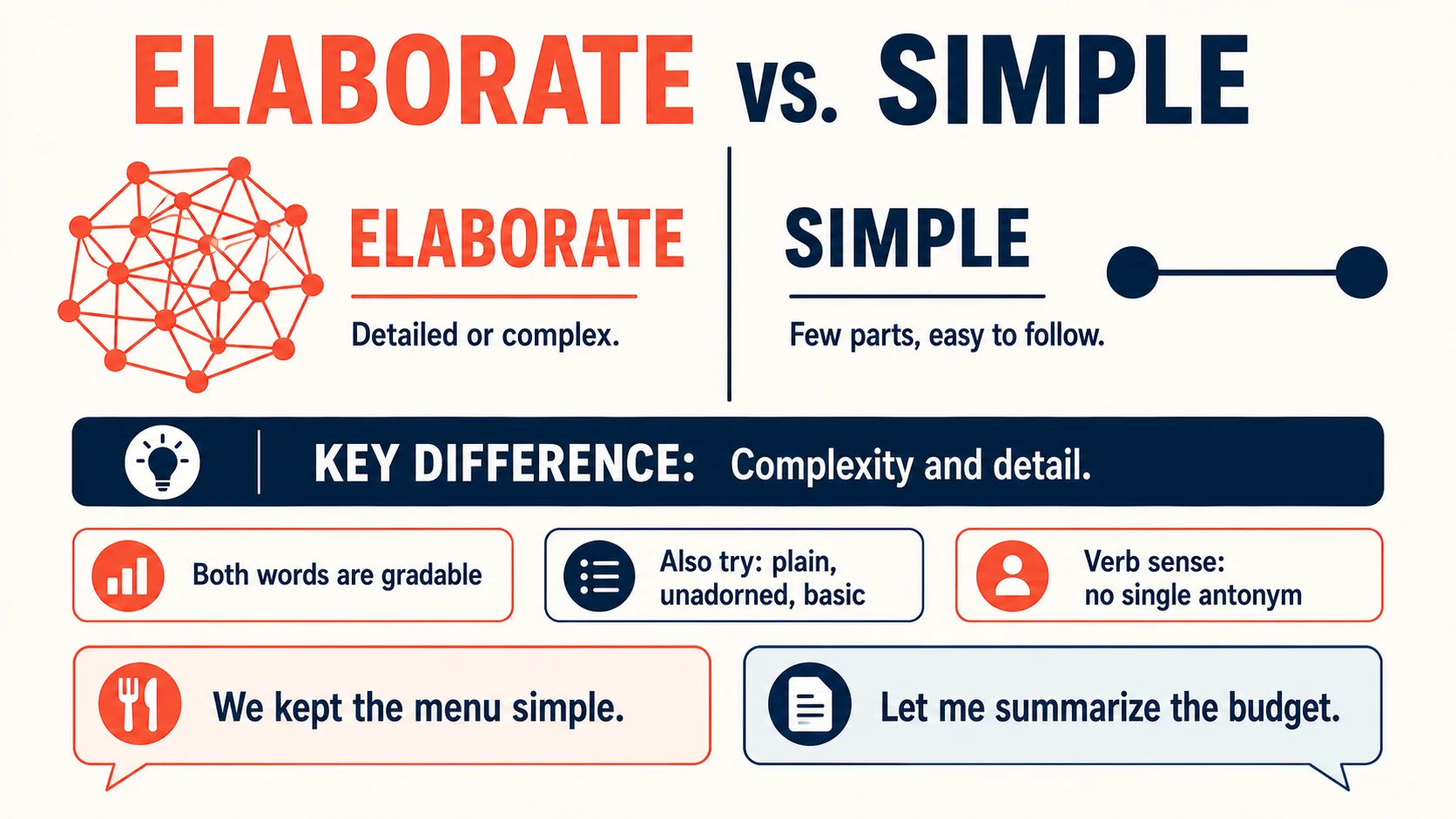
When elaborate means detailed or complex, the strongest opposite is simple. Plain, basic, and unadorned also work depending on tone. When elaborate is a verb meaning to add detail, no single antonym exists, but summarize and condense are the closest contextual opposites.
Part of speech: adjective and verb
Primary opposite: simple (for the adjective)
Elaborate leads a double life. As an adjective, it describes something detailed, intricate, and carefully planned, like an elaborate wedding or an elaborate excuse. As a verb, it means to add detail or explain further, as in “Could you elaborate on that?”
When elaborate means detailed or complex, simple is the strongest direct opposite. Both words are gradable, so a plan can be fairly simple or wildly elaborate, with many steps in between. Simple also works across the widest range of contexts, from design to planning to explanation.
The verb is different. English has no single established antonym for it, so the best opposite depends on what you want to contrast.
Direct and Strong Antonyms
These words oppose the adjective sense of elaborate: detailed, complex, or heavily decorated.
| Antonym | Tone or Nuance | Example Sentence |
|---|---|---|
| simple | Neutral and the most versatile | “We kept the menu simple: three entrees and one dessert.” |
| plain | Stronger, suggests no decoration | “She chose a plain gold band over anything jeweled.” |
| unadorned | Formal, often used for design or writing | “The chapel’s unadorned walls gave the room a quiet dignity.” |
| basic | Casual, suggests the bare minimum | “The hotel offers a basic breakfast, nothing fancy.” |
Each of these sits at the low end of the same scale where elaborate sits at the high end. Choose based on how much emphasis you want, not just on meaning.
Contextual and Subtle Opposites
The best opposite shifts with the meaning of elaborate in your sentence. The words below are contextual opposites, not direct antonyms.
| Context | Best Opposite | Why It Fits |
|---|---|---|
| Complicated plans or systems | straightforward | Describes a process with few steps and no surprises |
| Showy or ornate style | understated, minimalist | Suggests deliberate restraint rather than a lack of effort |
| Verb: adding detail in speech | summarize | Reduces a point to its essentials |
| Verb: expanding written material | condense | Compresses content while keeping the main ideas |
Take the adjective first. A “straightforward” plan is the natural contrast to an elaborate one when the issue is complexity. “Understated” fits when the issue is style, because it implies someone chose restraint on purpose.
Now the verb. Summarize and condense work as opposites only in specific situations. If a colleague says, “Let me elaborate on the budget,” the opposite action might be “Let me summarize the budget.” Nobody would call summarize a dictionary antonym of elaborate in every sentence, and that honest limit matters. Treat these as helpful contrasts, not guaranteed pairs.
Here is the verb in action: “Instead of elaborating on every clause, the lawyer summarized the contract in two sentences.”
Words That Seem Opposite But Are Not
Easy
Many writers assume easy is the opposite of elaborate. It is not. Easy describes how much effort something takes, while elaborate describes how much detail or complexity something contains. A design can be simple and still hard to build.
“The cabinet looked simple, but building it was not easy.”
Crude
Crude describes rough or unrefined quality, not a lack of detail. Something can be elaborate and crude at the same time, so the two words measure different things.
“The costume was elaborate but crude, with layers of glued-on sequins.”
Subtle Tone Differences
Even among genuine opposites, small differences change how a sentence lands.
Simple versus plain. Simple often reads as a compliment, while plain can sound dull. “A simple black dress” suggests good taste. “A plain black dress” may suggest it lacks interest.
Basic. In everyday American speech, basic can sound dismissive, especially when applied to people or taste. “The software is basic” is a neutral description. Calling someone’s outfit basic can sound like an insult.
Unadorned. This word belongs mostly to formal writing, design criticism, and literature. In a text to a friend, it sounds stiff.
Understated. This word almost always praises. It tells the reader that restraint was intentional and effective. “Her understated speech made the news land harder.”
Summarize versus condense. Summarize focuses on the main points. Condense focuses on making the whole thing shorter. “The editor condensed the chapter” implies most ideas survived, while “The editor summarized the chapter” implies only the key points did.
Frequently Asked Questions
What is the direct opposite of elaborate?
When elaborate means detailed or complex, the direct opposite is simple. Plain, unadorned, and basic are close alternatives with different tones. No single antonym is accepted for every meaning, so context decides which word fits best.
What is the opposite of elaborate in “elaborate on a point”?
The verb has no established antonym. In practice, writers contrast it with summarize or condense, which reduce detail instead of adding it. These are contextual opposites that work in specific sentences, not universal antonyms.
Should I use plain or simple to describe a minimalist design?
Use simple if you want a neutral or positive tone, and plain if you want to stress the absence of decoration. For a clearly admiring tone, understated or minimalist may fit better than either one.
Practical Word Choice
1. Identify the intended meaning. Ask whether you are contrasting a detailed thing, a complicated process, a decorative style, or the act of adding detail. Each one points to a different opposite.
2. Match the context, tone, strength, and formality. Use simple in most settings, unadorned in formal writing, basic in casual speech, and understated when you want to praise restraint.
Final Thoughts
The core distinction is straightforward. When elaborate describes detail or complexity, simple is the strongest opposite. When it describes the act of adding detail, the best contrast comes from words like summarize and condense, and those are contextual choices rather than true antonyms.
Context matters because elaborate covers several ideas at once: complexity, decoration, and explanation. A word that opposes one of those ideas may miss the others completely, which is why easy and crude fail as substitutes.
Before you choose an opposite, say the sentence aloud with the word in place. If it sounds natural and keeps your meaning, you have probably found the right one. What is your favorite example of a plan, a design, or an explanation that went from elaborate to simple?