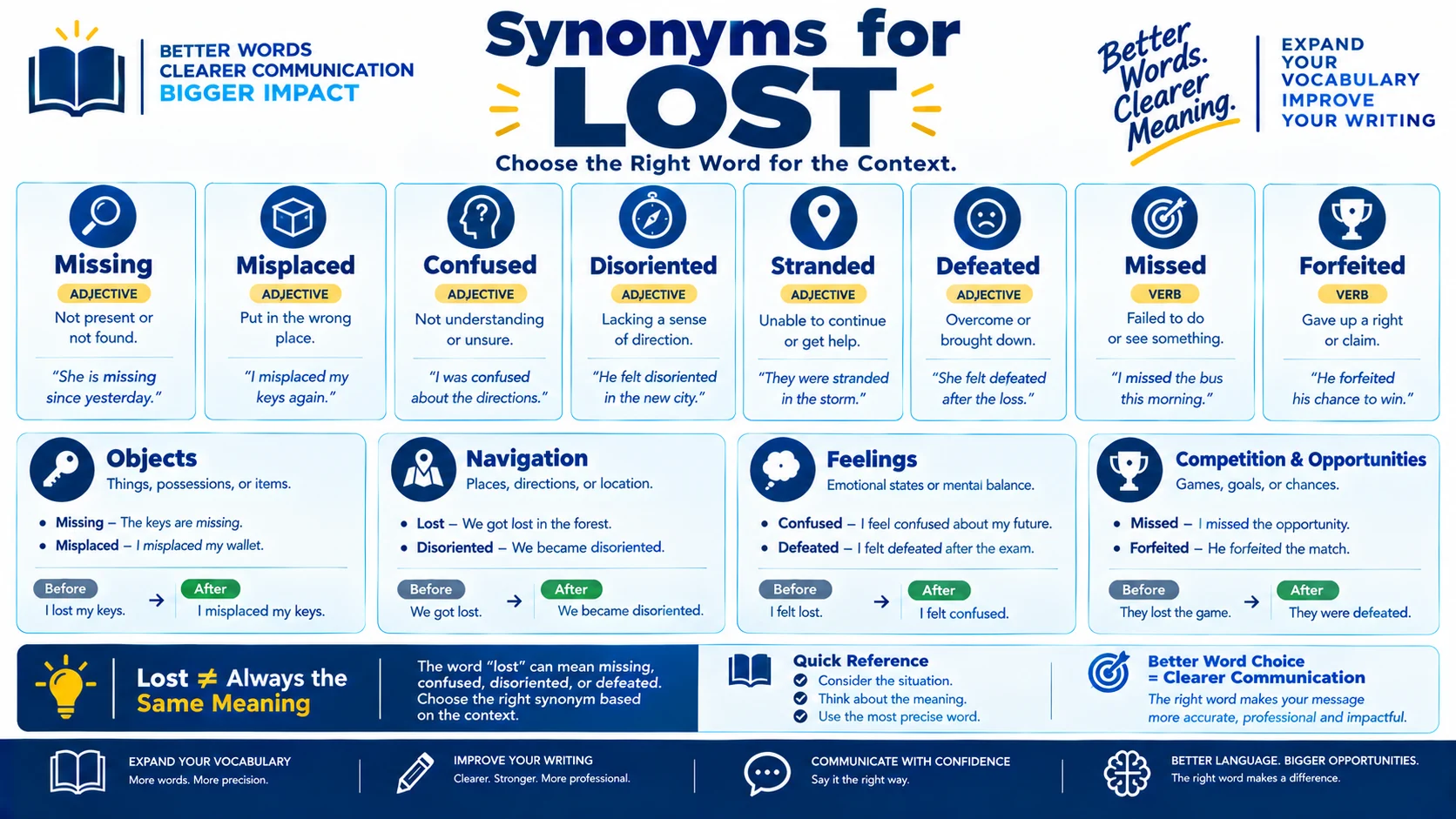
Another word for lost depends on the meaning. Useful synonyms include missing, misplaced, confused, bewildered, defeated, stranded, gone, unaware, wasted, and unsuccessful. For example, use missing for something that cannot be found, confused for uncertainty, and stranded when someone cannot leave a place.
What Does Lost Mean?
Definition
The word lost is the past tense and past participle of lose. It can describe something that cannot be found, someone who does not know where they are, a person who feels confused, or something that has been wasted or no longer exists.
The correct synonym depends heavily on context.
For example:
- “I lost my keys.” → misplaced
- “We got lost in the city.” → disoriented
- “She felt lost after graduation.” → uncertain or confused
- “The team lost the game.” → was defeated
- “The opportunity was lost.” → missed or forfeited
- “The document is lost.” → missing
Because lost has several meanings, replacing it with the same synonym in every sentence can change the meaning or make the sentence sound unnatural.
Common Uses
The word lost commonly describes:
- Something that cannot be found.
- A person who does not know where they are.
- Someone who feels confused or uncertain.
- Something that has disappeared or is no longer available.
- A defeat in a competition or contest.
- Time, money, or opportunities that have been wasted.
- Information or communication that was not understood or received.
Best Synonyms for Lost
| Synonym | Meaning | Best Used When | Example |
|---|---|---|---|
| Missing | Not present or unable to be found | Objects, people, information | My passport is missing. |
| Misplaced | Put somewhere and unable to locate | Objects | I misplaced my keys. |
| Gone | No longer present or available | Casual conversation | My old files are gone. |
| Absent | Not present | Formal or professional writing | Several documents were absent from the file. |
| Confused | Unable to understand or decide | Thoughts or situations | I felt confused by the instructions. |
| Disoriented | Unsure of location or surroundings | Navigation or unfamiliar places | He became disoriented in the unfamiliar building. |
| Bewildered | Very confused or puzzled | Stronger emotional confusion | She looked bewildered by the sudden change. |
| Stranded | Unable to leave or continue | Travel and emergencies | We were stranded at the airport. |
| Defeated | Having lost a contest or battle | Sports and competitions | The team was defeated in the final. |
| Unsuccessful | Failing to achieve a desired result | Projects, attempts, applications | The first attempt was unsuccessful. |
| Missed | Failed to catch, use, or take advantage of something | Opportunities, events, transportation | He missed an important opportunity. |
| Forfeited | Gave up or lost a right or opportunity | Formal contexts | The company forfeited its deposit. |
| Wasted | Used without a useful result | Time, money, resources | Years were wasted on an ineffective strategy. |
| Forgotten | No longer remembered | Memories, facts, obligations | The old tradition was forgotten. |
| Uncertain | Not sure about something | Decisions and future plans | She was uncertain about her next step. |
Synonyms by Context
Formal Writing
In formal writing, choose a synonym that explains how something was lost rather than simply replacing the word.
Good choices include:
- Missing
- Absent
- Misplaced
- Forfeited
- Unrecoverable
- Unavailable
Example:
Instead of:
The original document was lost.
You could write:
The original document was misplaced.
If the document can no longer be recovered, unrecoverable may be more precise.
Formal writing benefits from precision. Lost is broad, while a specific alternative can tell the reader exactly what happened.
Professional Writing
In business communication, words such as missing, unavailable, unsuccessful, forfeited, delayed, and misplaced often sound more precise.
Business example:
The company lost an important client.
Possible alternatives include:
The company failed to retain an important client.
or:
The company lost an important client.
The original sentence may actually be preferable when the meaning is already clear. A synonym should improve precision, not simply make the sentence more complicated.
Academic Writing
Academic writing often benefits from words such as misplaced, absent, omitted, unavailable, unsuccessful, or uncertain, depending on the context.
Academic example:
Several variables were lost during data collection.
A more precise version could be:
Several variables were missing from the final dataset.
Here, missing communicates the problem more clearly than lost.
Daily Conversation
Everyday speech tends to favor simple alternatives such as:
- Missing
- Gone
- Misplaced
- Confused
- Mixed up
- Stranded
Daily conversation example:
“I lost my phone.”
You could say:
“I misplaced my phone.”
However, “I lost my phone” is usually more natural when you do not know where the phone is.
Professional Alternatives for Lost
When writing a resume, email, report, or workplace document, consider the exact situation.
For a Lost Opportunity
Use:
- Missed
- Forfeited
- Surrendered
- Overlooked
Example:
The company missed a major growth opportunity.
For Lost Information
Use:
- Missing
- Unavailable
- Omitted
- Unrecoverable
Example:
Several records were unavailable during the audit.
For a Lost Customer
Use:
- Departed
- Churned
- No longer retained
Example:
The business experienced an increase in customer churn.
In technical or business contexts, churned is more specific than simply saying customers were lost.
Simple Alternatives for Lost
If you want an easy word that most readers will understand, choose from:
- Missing
- Gone
- Confused
- Misplaced
- Forgotten
- Missed
These words work well in everyday conversation, basic writing, and general explanations.
Example:
I lost my keys.
Simple alternatives:
I misplaced my keys.
My keys are missing.
My keys are gone.
The best option depends on whether you know what happened to them.
Stronger Alternatives for Lost
Some alternatives communicate a stronger or more specific meaning.
Bewildered
Use bewildered when someone is extremely confused.
She was bewildered by the complicated instructions.
Disoriented
Use disoriented when someone is unsure about their location or surroundings.
After leaving the subway station, I felt disoriented.
Stranded
Use stranded when someone cannot leave a location or continue a journey.
The travelers were stranded after the flight was canceled.
Forfeited
Use forfeited when someone loses a right, opportunity, possession, or benefit because of an action or condition.
He forfeited his chance to participate.
Defeated
Use defeated when a person or team loses a competition, contest, or conflict.
The defending champions were defeated in the semifinal.
Difference Between Similar Synonyms
Not every synonym for lost means exactly the same thing.
Lost vs. Missing:
Lost can mean something was misplaced, while missing simply means it is not present or cannot currently be found.
Lost vs. Misplaced:
Misplaced usually suggests that an object was put somewhere unintentionally. If you say “I misplaced my wallet,” you imply that you may eventually find it.
Lost vs. Confused:
Lost can describe mental uncertainty, but confused directly describes difficulty understanding something.
Lost vs. Disoriented:
Disoriented is more specific when someone does not know where they are or cannot understand their surroundings.
Lost vs. Defeated:
Defeated specifically describes losing a competition, battle, contest, or struggle.
Lost vs. Wasted:
Wasted suggests that something such as time, money, energy, or resources was used without a worthwhile result.
Lost vs. Stranded:
Stranded means unable to leave or continue, often because transportation, resources, or circumstances prevent movement.
Synonym Analysis
Missing
Meaning: Not present or unable to be found.
Best Used For: Objects, people, records, information.
Tone: Neutral.
Difficulty: Easy.
Usage Frequency: Very Common.
Best For: Email writing, essays, business writing, daily conversation.
Misplaced
Meaning: Put somewhere unintentionally and difficult to locate.
Best Used For: Personal belongings and documents.
Tone: Neutral and precise.
Difficulty: Easy.
Usage Frequency: Common.
Best For: Emails, professional writing, daily conversation.
Disoriented
Meaning: Confused about one’s location, surroundings, or situation.
Best Used For: Navigation and unfamiliar environments.
Tone: Formal or descriptive.
Difficulty: Medium.
Usage Frequency: Common.
Best For: Academic writing, professional writing, detailed descriptions.
Defeated
Meaning: Having been beaten in a contest or conflict.
Best Used For: Sports, competitions, campaigns, and conflicts.
Tone: Neutral to formal.
Difficulty: Easy.
Usage Frequency: Very Common.
Best For: Business writing, academic writing, sports reporting.
Opposite Words
The opposite of lost depends on its meaning.
| Meaning of Lost | Possible Opposite |
|---|---|
| Unable to find something | Found |
| Unsure of location | Oriented |
| Confused | Certain |
| Defeated | Victorious |
| Missing | Present |
| Wasted | Used effectively |
| Unsuccessful | Successful |
| Unavailable | Available |
For example, the opposite of “I lost my keys” is “I found my keys,” while the opposite of “I felt lost” might be “I felt confident” or “I knew what to do.”
FAQs
What is another word for lost?
Common alternatives include missing, misplaced, gone, confused, disoriented, stranded, defeated, missed, and uncertain. The best word depends on whether lost refers to an object, location, emotion, competition, opportunity, or resource.
What is a formal synonym for lost?
Formal alternatives include missing, absent, unavailable, forfeited, unrecoverable, and unsuccessful. The appropriate choice depends on the context.
What is a professional alternative for lost?
Professional alternatives include missing, unavailable, forfeited, unsuccessful, omitted, and misplaced. In business writing, a precise term is usually better than a generic replacement.
What word can replace lost in an essay?
Depending on the sentence, you can use missing, misplaced, uncertain, unsuccessful, omitted, unavailable, or forfeited. Always choose the word that preserves the original meaning.
What is another word for lost opportunity?
Useful alternatives include missed opportunity, forfeited opportunity, overlooked opportunity, or unrealized opportunity.
What is another word for lost money?
Depending on the situation, you could use wasted money, forfeited funds, financial loss, or money that was spent unsuccessfully.
What is another word for lost in thought?
Possible alternatives include preoccupied, distracted, absorbed, daydreaming, or deep in thought.
What is another word for lost and confused?
Words such as disoriented, bewildered, uncertain, puzzled, and confused may work, depending on whether the problem involves location, understanding, or decision-making.
What is another word for lost in a place?
Disoriented, unfamiliar, turned around, or unable to find one’s way can replace lost, depending on the sentence.
Is missing the same as lost?
Not exactly. Missing means something or someone is not present or cannot be found. Lost often suggests that something has been separated from its owner, misplaced, or cannot be located, although the two words can overlap.
Conclusion
The best synonym for lost depends on what you mean. Use missing when something cannot be found, misplaced when an object was put somewhere unintentionally, disoriented when someone cannot understand their surroundings, and defeated when someone loses a competition. For lost opportunities, missed or forfeited may be more precise.
Rather than replacing lost automatically, identify the exact meaning first. A precise synonym makes your writing clearer, more natural, and more effective.