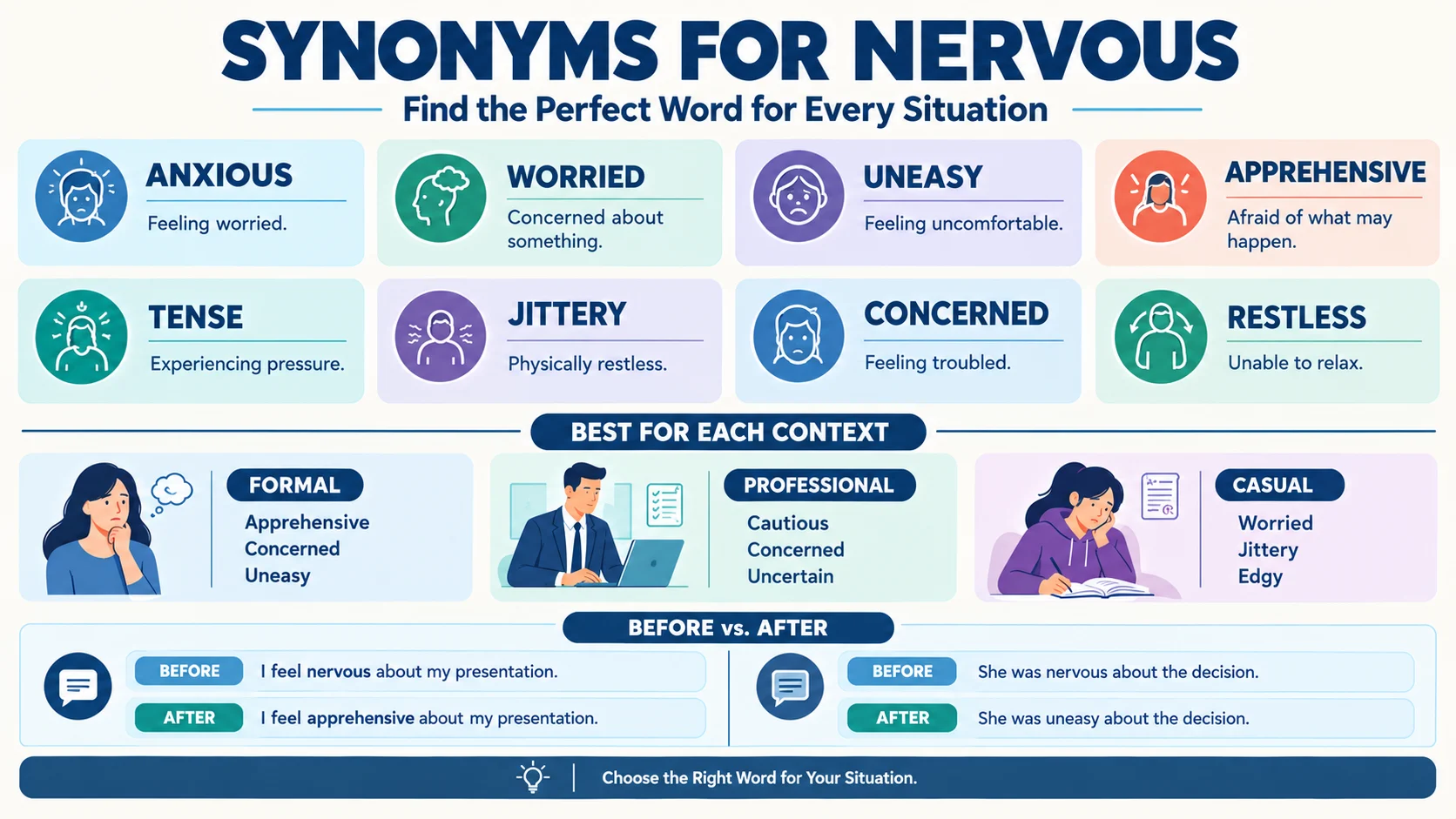
Common synonyms for nervous include anxious, worried, uneasy, apprehensive, tense, jittery, restless, and concerned. The best replacement depends on the situation. Use anxious for general worry, apprehensive for fear about something approaching, uneasy for discomfort, and jittery for physical nervousness.
Choosing the right word for nervous can make your writing more precise and natural. Whether you are describing anxiety before an important meeting, uncertainty about a decision, or excitement mixed with fear, several alternatives can communicate the feeling more accurately.
Some words express mild concern, while others suggest intense fear, physical tension, or emotional discomfort. Understanding these differences helps you choose appropriate language for professional emails, academic essays, conversations, and creative writing.
What Does Nervous Mean?
Definition
Nervous is an adjective that describes a person who feels worried, anxious, uncomfortable, or afraid about something that may happen. It can also describe physical signs of anxiety, such as shaking, sweating, restlessness, or difficulty concentrating.
Part of speech: Adjective
Pronunciation: NUR-vuhs
Common meanings:
- Feeling worried or uncertain about something.
- Experiencing fear before an important event.
- Showing physical signs of anxiety or tension.
- Feeling uncomfortable in an unfamiliar situation.
Common Uses
The word nervous appears in several everyday situations:
- Before an event: She felt nervous before her job interview.
- During uncertainty: I am nervous about the final decision.
- In unfamiliar situations: He gets nervous when speaking to strangers.
- Physical reactions: My hands become nervous and shaky before presentations.
The meaning can change slightly depending on the context. For example, nervous before an examination usually means anxious, while nervous movements may suggest restlessness or agitation.
Best Synonyms for Nervous
The following words are useful alternatives, but they are not interchangeable in every sentence.
| Synonym | Meaning | Best Used When | Example |
|---|---|---|---|
| Anxious | Experiencing worry or fear | General anxiety | She felt anxious before the interview. |
| Worried | Thinking about possible problems | Everyday concerns | He was worried about his results. |
| Uneasy | Feeling uncomfortable or uncertain | Something feels wrong | I felt uneasy about the situation. |
| Apprehensive | Worried about something approaching | Future events | She was apprehensive about moving abroad. |
| Tense | Mentally or physically strained | Pressure or stress | Everyone felt tense before the announcement. |
| Jittery | Nervous and unable to stay still | Physical nervousness | I felt jittery before going on stage. |
| Restless | Unable to relax or remain still | Agitation | He became restless while waiting. |
| Concerned | Feeling troubled about something | Serious or thoughtful situations | The manager was concerned about delays. |
| Fearful | Experiencing fear | Stronger anxiety | The child was fearful of the storm. |
| Troubled | Experiencing emotional distress | Personal difficulties | She looked troubled after the meeting. |
| Edgy | Easily irritated or nervous | Informal situations | He seemed edgy before the results. |
| Fidgety | Making small, restless movements | Visible nervous behavior | The student became fidgety during the test. |
| Intimidated | Feeling less confident because of someone or something | Challenging situations | I felt intimidated by the interview panel. |
| Distressed | Experiencing significant emotional discomfort | Serious problems | She was distressed by the news. |
| Skittish | Easily frightened or startled | Sudden fear or uncertainty | The new employee seemed skittish. |
Important Synonym Analysis
1. Anxious
- Meaning: Feeling worried, uneasy, or fearful about something.
- Best used for: General anxiety and anticipation.
- Tone: Neutral to emotional.
- Difficulty: Easy.
- Usage frequency: Very Common.
- Best for: Emails, essays, conversations, and business writing.
Examples:
- Business: The team was anxious about the upcoming presentation.
- Academic: Students often feel anxious before major examinations.
- Daily conversation: I am anxious about tomorrow.
2. Apprehensive
- Meaning: Having concern or fear about something that may happen.
- Best used for: Uncertain future situations.
- Tone: Formal and thoughtful.
- Difficulty: Advanced.
- Usage frequency: Common.
- Best for: Professional emails, essays, and formal communication.
Examples:
- Business: The employees were apprehensive about the organizational changes.
- Academic: Participants were apprehensive about the potential consequences.
- Daily conversation: I am apprehensive about traveling alone.
3. Uneasy
- Meaning: Feeling uncomfortable, uncertain, or slightly worried.
- Best used for: Situations that create discomfort without necessarily causing strong fear.
- Tone: Neutral.
- Difficulty: Medium.
- Usage frequency: Common.
- Best for: Essays, emails, business communication, and conversations.
Examples:
- Business: Investors felt uneasy about the sudden market changes.
- Academic: The findings left researchers uneasy about the results.
- Daily conversation: Something about this place makes me uneasy.
4. Jittery
- Meaning: Feeling physically nervous, restless, or shaky.
- Best used for: Visible nervousness and temporary anxiety.
- Tone: Informal.
- Difficulty: Medium.
- Usage frequency: Common.
- Best for: Daily conversations and creative writing.
Examples:
- Business: I felt jittery before presenting my proposal.
- Academic: Participants reported feeling jittery before the experiment.
- Daily conversation: Too much coffee makes me jittery.
Synonyms by Context
Formal Writing
Formal writing benefits from precise alternatives that communicate concern without sounding overly conversational.
Consider these words:
- Apprehensive
- Concerned
- Uneasy
- Anxious
- Distressed
- Troubled
Example:
Informal: The committee was nervous about the proposed changes.
Formal: The committee was apprehensive about the proposed changes.
Apprehensive is particularly appropriate because it communicates concern about a future decision.
Professional Writing
In workplace communication, the best alternative depends on whether you want to express uncertainty, concern, or pressure.
Useful professional alternatives include:
- Concerned
- Cautious
- Anxious
- Uneasy
- Uncertain
- Apprehensive
Example:
Instead of: I am nervous about the upcoming client meeting.
Write: I have some concerns about the upcoming client meeting.
This version sounds more professional because it communicates a specific concern rather than simply describing an emotional reaction.
Academic Writing
Academic writing often requires language that describes psychological states accurately.
Appropriate alternatives include:
- Anxious
- Apprehensive
- Fearful
- Uneasy
- Distressed
- Tense
Example:
Basic: Students became nervous before the examination.
Academic: Students experienced heightened anxiety before the examination.
The second sentence is more suitable for research because it describes the emotional condition more precisely.
Daily Conversation
Everyday conversations usually sound more natural with simple and familiar alternatives.
Try these words:
- Worried
- Anxious
- Shaky
- Jittery
- Edgy
- Fidgety
- Uneasy
Examples:
- I am worried about my interview.
- She looks a little anxious.
- I feel shaky before speaking in public.
- He gets jittery when he drinks too much coffee.
Professional Alternatives for Nervous
If you are writing an email, resume, report, or business document, consider replacing nervous with a more specific expression.
| Professional Alternative | Best Application | Example |
|---|---|---|
| Concerned | Workplace issues | I am concerned about the project timeline. |
| Apprehensive | Future uncertainty | We are apprehensive about the transition. |
| Cautious | Careful decision-making | The team remains cautious about the proposal. |
| Uncertain | Lack of confidence or clarity | I am uncertain about the expected outcome. |
| Uneasy | Discomfort about a situation | Management felt uneasy about the changes. |
| Under pressure | Work-related stress | The team was under pressure before the deadline. |
What is a professional alternative for nervous?
Concerned is often the best professional alternative when describing worry about a workplace issue. However, apprehensive works better when expressing fear about an upcoming event, and cautious describes careful behavior rather than an emotional state.
Simple Alternatives for Nervous
If you want easy words that readers understand immediately, choose familiar alternatives.
| Simple Word | Example |
|---|---|
| Worried | I am worried about my exam. |
| Scared | She is scared of speaking publicly. |
| Shaky | My voice becomes shaky when I am nervous. |
| Upset | He seemed upset about the situation. |
| Tense | Everyone was tense before the announcement. |
| Unsure | I am unsure about my decision. |
| Uncomfortable | She felt uncomfortable in the unfamiliar environment. |
These words work well in text messages, everyday conversations, and simple writing.
Stronger Alternatives for Nervous
Sometimes nervous does not communicate the intensity of an emotion. Stronger alternatives can help describe more serious emotional reactions.
| Stronger Alternative | Meaning | Example |
|---|---|---|
| Terrified | Extremely frightened | She was terrified before the accident. |
| Panicked | Overwhelmed by sudden fear | He panicked when he lost his passport. |
| Frightened | Experiencing fear | The child was frightened by the noise. |
| Distressed | Deeply troubled or upset | She was distressed by the unexpected news. |
| Agitated | Emotionally disturbed or restless | He became agitated during the argument. |
| Overwhelmed | Unable to manage emotional pressure | I felt overwhelmed by the responsibilities. |
Remember that these words describe different emotional experiences. For example, terrified suggests much stronger fear than nervous, while agitated emphasizes emotional disturbance or restlessness.
Difference Between Similar Synonyms
Although many words can replace nervous, their meanings are slightly different. Understanding these distinctions prevents awkward or inaccurate word choices.
| Word | Main Difference | Example |
|---|---|---|
| Nervous | General feeling of anxiety or worry | I am nervous about the interview. |
| Anxious | Stronger focus on worry or anticipation | She is anxious about her future. |
| Worried | Concern about a possible problem | He is worried about his health. |
| Apprehensive | Fear or concern about something upcoming | They are apprehensive about the decision. |
| Uneasy | General discomfort or uncertainty | I feel uneasy about his explanation. |
| Tense | Mental or physical strain | The atmosphere was tense. |
| Fearful | More directly associated with fear | She was fearful of the consequences. |
| Jittery | Physical restlessness or shakiness | I feel jittery before presentations. |
Nervous vs. Anxious: Nervous often describes temporary feelings before a particular event. Anxious can describe both temporary worry and more persistent anxiety.
Nervous vs. Worried: Nervous often involves anticipation or physical reactions, while worried focuses more on concern about a possible problem.
Nervous vs. Apprehensive: Apprehensive specifically suggests concern about something that may happen in the future.
Nervous vs. Uneasy: Uneasy describes a general feeling of discomfort that may not have an obvious cause.
Nervous vs. Tense: Nervous emphasizes anxiety, while tense emphasizes mental or physical strain.
Opposite Words of Nervous
Antonyms of nervous describe confidence, calmness, emotional stability, or freedom from worry.
| Antonym | Meaning | Example |
|---|---|---|
| Calm | Free from agitation | She remained calm during the interview. |
| Relaxed | Free from tension | He felt relaxed before the presentation. |
| Confident | Certain about your abilities | She was confident about her performance. |
| Composed | Emotionally controlled | The speaker remained composed. |
| Assured | Confident and certain | He sounded assured during the meeting. |
| Fearless | Not afraid | The fearless explorer continued forward. |
| Comfortable | Feeling at ease | I felt comfortable speaking with them. |
The best opposite depends on the intended meaning. Calm contrasts with emotional agitation, while confident contrasts with uncertainty or a lack of self-assurance.
FAQs
1. What is another word for nervous?
Anxious is one of the most common alternatives for nervous. Other options include worried, uneasy, apprehensive, tense, jittery, and concerned.
2. What is a formal synonym for nervous?
Apprehensive, concerned, uneasy, and distressed are useful formal alternatives. The best choice depends on the level and type of concern being described.
3. What is a professional alternative for nervous?
Concerned is often appropriate in workplace communication. Apprehensive and cautious are also useful when discussing uncertainty or upcoming decisions.
4. What is a simple word for nervous?
Worried, scared, shaky, and tense are simple alternatives that work well in everyday conversations.
5. What is a stronger word for nervous?
Terrified, panicked, frightened, and distressed express stronger emotional reactions than nervous.
6. What is another word for nervous and excited?
Anxious, jittery, and apprehensive can describe a mixture of excitement and nervousness. On edge is another natural informal expression.
7. What is a synonym for nervous in academic writing?
Anxious, apprehensive, distressed, and uneasy are useful academic alternatives. The expression heightened anxiety may also work when describing an emotional response in research.
8. What is the difference between nervous and anxious?
Nervous often describes temporary worry about a particular situation. Anxious can describe similar feelings but may also refer to more persistent or intense worry.
9. What is a synonym for nervous in a sentence?
In the sentence “She felt nervous before the presentation,” you could replace nervous with anxious, apprehensive, or uneasy, depending on the intended meaning.
10. What are some casual ways to say nervous?
Casual alternatives include jittery, shaky, edgy, fidgety, and on edge. These expressions are especially useful in everyday conversations.
Conclusion
The best synonyms for nervous depend on the emotion, situation, and tone you want to communicate. Anxious and worried are excellent everyday alternatives, while apprehensive and concerned work well in formal and professional writing. For physical nervousness, choose jittery or fidgety. When describing stronger emotions, consider frightened, distressed, or panicked.
Rather than replacing nervous with the first synonym you find, consider what the sentence actually means. A precise word makes your writing clearer, more natural, and more effective.