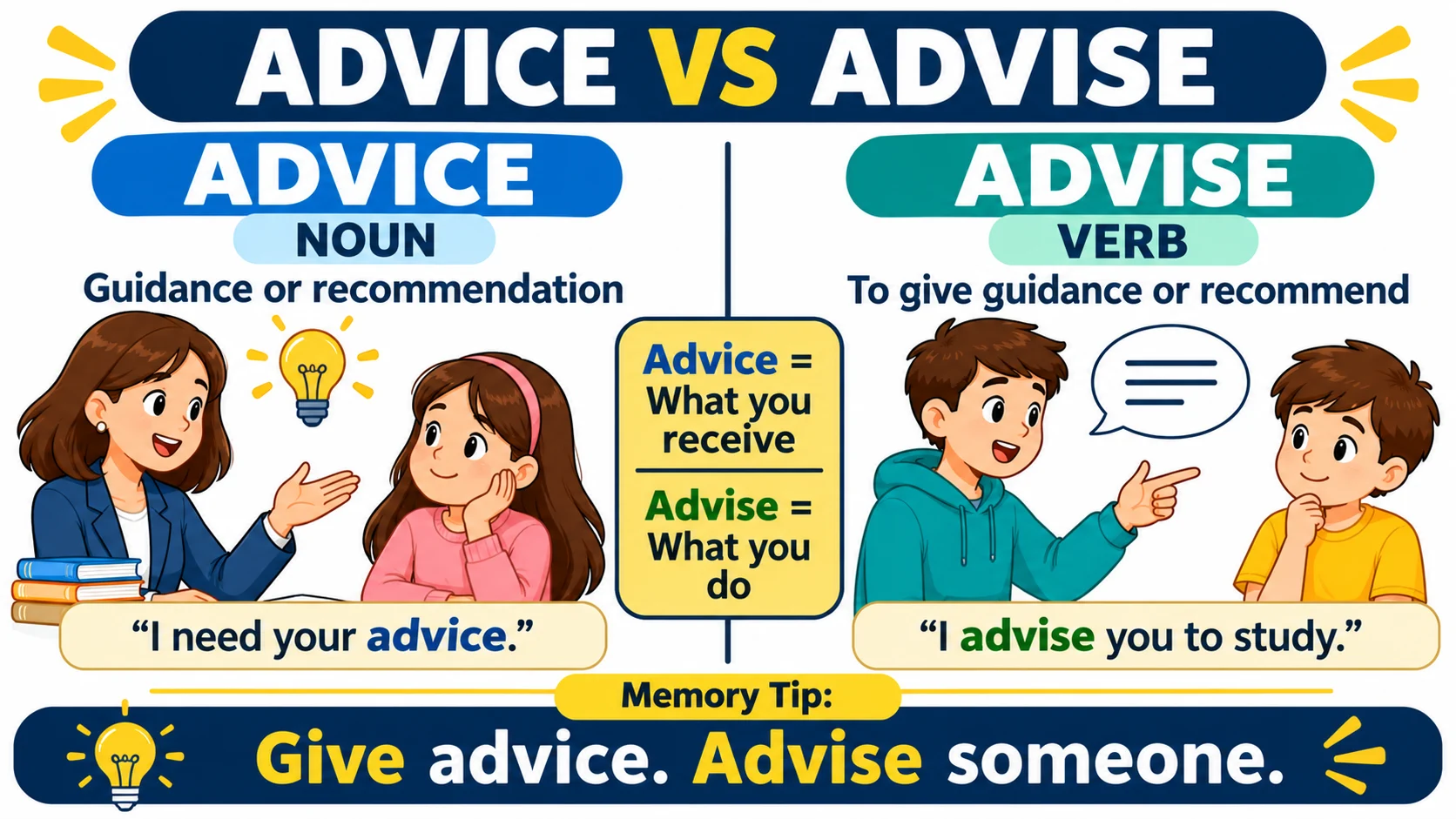
Advice is a noun that means a suggestion, guidance, or recommendation. Advise is a verb that means to give someone advice or recommend what they should do. For example, you can give advice or advise someone.
Have you ever wondered whether to write advice or advise? You are not alone. These two words look almost the same. They also have very similar meanings. However, they do not have the same role in a sentence.
Many people mix them up in emails, school assignments, work messages, and daily conversations. For example, should you write, “Can you give me some advice?” or “Can you give me some advise?” The first sentence is correct.
The difference is simple once you understand it. Advice is a noun, while advise is a verb. One refers to the guidance you receive. The other describes the action of giving that guidance.
Learning the difference between advice vs advise can help you write more clearly and avoid common grammar mistakes. It can also make your professional emails, academic work, and everyday messages sound more natural.
In this guide, you will learn their meanings, pronunciation, grammar rules, sentence patterns, and practical examples. You will also find common mistakes, comparisons, and exercises to help you remember the difference.
Quick Answer: Advice vs Advise
The main difference between advice vs advise is their part of speech.
- Advice: A noun that means guidance, suggestions, or recommendations.
- Advise: A verb that means to give guidance or recommend something.
Consider these examples:
| Advice | Advise |
|---|---|
| I need your advice. | Please advise me. |
| Her advice was helpful. | She advised me to wait. |
| He gave me good advice. | He advised me to study. |
Easy memory trick: Advice is something you give or receive. Advise is what you do when you give it.
Advice vs Advise: Overview
Before exploring the grammar rules, look at this quick comparison.
| Feature | Advice | Advise |
|---|---|---|
| Part of speech | Noun | Verb |
| Meaning | Guidance or recommendation | To give guidance |
| Pronunciation | /ədˈvaɪs/ | /ədˈvaɪz/ |
| Ending sound | S sound | Z sound |
| Countability | Usually uncountable | Not applicable |
| Plural form | Usually no plural | Advise, advises |
| Past tense | Not applicable | Advised |
| Present participle | Not applicable | Advising |
| Common phrase | Give advice | Advise someone |
| Example | I need advice. | I advise you to wait. |
The biggest difference is grammatical. Advice names a thing or idea. Advise describes an action.
What Does Advice Mean?
Advice is a noun that refers to an opinion, suggestion, or recommendation given to help someone make a decision.
People give advice when they want to help others solve problems, avoid mistakes, or choose a better path.
For example:
- My teacher gave me useful advice.
- I need advice about my career.
- Her advice helped me make the right choice.
- Thank you for your advice.
In each sentence, advice refers to guidance rather than an action.
Definition of Advice
According to its common English meaning, advice is an opinion or recommendation about what someone should do.
It can relate to almost any part of life, including:
- Education
- Health
- Relationships
- Career decisions
- Business
- Personal development
- Money management
- Daily problems
For example, a teacher may give advice about studying. A doctor may offer advice about healthy habits. A friend may give advice about a personal problem.
The advice itself is the recommendation. The person giving it performs the action of advising.
Is Advice a Noun?
Yes. Advice is always used as a noun in standard English.
A noun names a person, place, thing, or idea. Advice names the idea of guidance or a recommendation.
Here are some examples:
- Your advice means a lot to me.
- I received some helpful advice.
- She asked her father for advice.
- His advice changed my decision.
- We followed the expert’s advice.
You can identify advice by asking:
What did the person give, receive, or follow?
If the answer is guidance or a recommendation, advice is the correct word.
Is Advice Countable or Uncountable?
Advice is an uncountable noun in standard English.
This means you generally cannot add an “s” to make it plural. You should also avoid using “a” or “an” directly before advice.
Incorrect:
- She gave me an advice.
- I received three advices.
- He shared many useful advices.
Correct:
- She gave me some advice.
- I received three pieces of advice.
- He shared several useful suggestions.
When you want to count individual recommendations, use expressions such as:
- A piece of advice
- Two pieces of advice
- Several pieces of advice
- Some helpful advice
- A few suggestions
Example:
Incorrect: My mother gave me five advices.
Correct: My mother gave me five pieces of advice.
This rule is important in academic and professional writing.
Different Types of Advice
Advice can take different forms depending on the situation.
| Type | Meaning | Example |
|---|---|---|
| Personal advice | Guidance about personal matters | My friend gave me relationship advice. |
| Professional advice | Guidance related to work | I need professional career advice. |
| Medical advice | Recommendations about health | Follow your doctor’s advice. |
| Financial advice | Guidance about money | She received financial advice. |
| Educational advice | Guidance about learning | My teacher gave me study advice. |
| Legal advice | Guidance about legal matters | He contacted a lawyer for legal advice. |
| Business advice | Suggestions about business decisions | The manager shared useful business advice. |
The meaning stays the same in every situation. Advice is guidance that helps someone decide what to do.
What Does Advise Mean?
Advise is a verb that means to give someone a recommendation, suggestion, or guidance.
It describes the action of helping someone understand what they should do.
For example:
- I advise you to work harder.
- The doctor advised him to rest.
- My teacher advises students to read daily.
- She advised me against buying that car.
In these sentences, advise describes an action performed by someone.
Definition of Advise
Advise means to offer guidance, recommend an action, or suggest a particular choice.
It is commonly used when someone shares knowledge or experience to help another person.
For example:
A doctor may advise a patient to exercise. A teacher may advise a student to prepare for an exam. A manager may advise an employee to improve their communication skills.
In each case, the person is performing an action.
Is Advise a Verb?
Yes. Advise is a verb.
A verb describes an action, event, or state. Since advise describes the act of giving guidance, it functions as a verb.
Consider these examples:
- I advise you to save money.
- My parents advised me to study.
- The lawyer will advise the company.
- She advises young students.
- We are advising customers about the new policy.
Notice how the form changes depending on the tense and subject.
Different Forms of Advise
Advise follows regular verb patterns.
| Verb Form | Word | Example |
|---|---|---|
| Base form | Advise | I advise you to wait. |
| Third-person singular | Advises | She advises her students. |
| Past tense | Advised | He advised me yesterday. |
| Past participle | Advised | I have advised him before. |
| Present participle | Advising | She is advising the team. |
These forms help you use advise correctly in different situations.
Advise in the Present Tense
Use advise when someone gives guidance in the present.
Examples:
- I advise people to exercise regularly.
- My teacher advises me to practice English.
- The doctor advises patients to eat healthy food.
Advise in the Past Tense
Use advised when the action happened in the past.
Examples:
- My father advised me to save money.
- The teacher advised us to study harder.
- She advised him to change his job.
Advise in the Future Tense
Use will advise when someone will give guidance later.
Examples:
- I will advise you after reviewing the information.
- The lawyer will advise the client tomorrow.
- Our manager will advise the team about the new rules.
Advise in the Continuous Tense
Use advising when the action is happening over a period of time.
Examples:
- She is advising a new employee.
- The doctor is advising patients about healthy habits.
- They are advising students about university choices.
Advice vs Advise: The Main Grammar Difference
The easiest way to understand advice vs advise is to remember that one is a noun and the other is a verb.
However, understanding their grammatical roles will help you use them correctly in more complex sentences.
Noun vs Verb
A noun identifies something. A verb describes an action.
Compare:
Advice: I need your advice.
Here, advice is the thing that you need.
Advise: Please advise me.
Here, advise describes the action you want someone to perform.
Another comparison:
- The teacher gave me advice.
- The teacher advised me.
Both sentences describe a similar situation. However, their grammatical structures are different.
How to Identify Advice in a Sentence
Advice often appears after words such as:
- Give
- Get
- Receive
- Need
- Ask for
- Follow
- Take
- Seek
- Offer
Examples:
| Word or Phrase | Example |
|---|---|
| Give advice | My father gave me advice. |
| Get advice | I got advice from my teacher. |
| Receive advice | She received useful advice. |
| Need advice | We need your advice. |
| Ask for advice | He asked for career advice. |
| Follow advice | They followed the doctor’s advice. |
| Seek advice | You should seek professional advice. |
These common combinations can help you recognize advice as a noun.
How to Identify Advise in a Sentence
Advise often appears in sentence structures where someone recommends an action.
Common patterns include:
Advise + someone
- I advise you.
- She advised him.
- The manager advised us.
Advise + someone + to + verb
- I advise you to wait.
- My teacher advised me to practice.
- The doctor advised him to rest.
Advise + against + noun or -ing form
- I advise against this decision.
- She advised against selling the house.
- The lawyer advised against signing the agreement.
Advise + that + clause
- I advise that we wait.
- The doctor advised that he take a rest.
- They advised that the meeting be postponed.
These structures make it easier to recognize advise as a verb.
Advice vs Advise Pronunciation
Although advice and advise look almost identical, they have a different final sound.
This difference is important when speaking English.
| Word | Pronunciation | Final Sound |
|---|---|---|
| Advice | /ədˈvaɪs/ | S |
| Advise | /ədˈvaɪz/ | Z |
Both words have the same first syllable and similar vowel sounds. The main difference appears at the end.
How to Pronounce Advice
Advice sounds like “ad-VICE.”
The final sound is similar to the “s” in:
- Ice
- Rice
- Nice
- Price
Example:
“I need your advice.”
The final sound in advice is unvoiced. Your vocal cords do not vibrate when you produce it.
How to Pronounce Advise
Advise sounds like “ad-VIZE.”
The final sound is similar to the “z” in:
- Size
- Wise
- Prize
- Rise
Example:
“I advise you to practice.”
The final sound is voiced. Your vocal cords vibrate when you produce it.
Easy Pronunciation Trick
Place your fingers gently on your throat.
Now say:
- Advice
- Advise
When saying advise, you should feel a small vibration at the end. When saying advice, the final sound does not have that same vibration.
This simple exercise can help you hear and produce the difference.
Advice vs Advise: Comparison Table
Here is a detailed comparison of both words.
| Comparison Point | Advice | Advise |
|---|---|---|
| Grammar | Noun | Verb |
| Basic meaning | Guidance | To give guidance |
| Function | Names a recommendation | Describes recommending |
| Pronunciation | Ad-VICE | Ad-VIZE |
| Final sound | S | Z |
| Countable | No, generally uncountable | Not applicable |
| Past form | No verb tense | Advised |
| Common structure | Give advice | Advise someone |
| Example | I need advice. | I advise you. |
| Common error | An advice | I advice you |
The key is to understand what your sentence needs.
If you need a noun, use advice. If you need a verb, use advise.
Advice vs Advise: Advantages and Disadvantages of Each Word
Advice and advise do not compete with each other. Both are useful words with different grammatical purposes.
However, understanding when to use each one can improve your writing.
Advantages of Using Advice
Advice is useful when you want to talk about guidance or recommendations.
Its advantages include:
- It clearly identifies a suggestion or recommendation.
- It works in personal and professional conversations.
- It is suitable for academic and formal writing.
- It can describe general or specific guidance.
- It works with many common expressions.
Examples:
- I appreciate your advice.
- She gave me valuable advice.
- We need expert advice before making this decision.
Limitations of Using Advice
Advice has some grammatical restrictions.
- It is an uncountable noun.
- You should not normally write “advices.”
- You should not use “a” directly before it.
- It cannot replace a verb in a sentence.
For example:
Incorrect: I advice you to study.
Correct: I advise you to study.
Advantages of Using Advise
Advise is useful when describing the action of giving guidance.
Its advantages include:
- It clearly describes a recommendation.
- It works in different verb tenses.
- It is suitable for professional communication.
- It can be used in formal and everyday English.
- It supports different sentence structures.
Examples:
- I advise you to prepare early.
- The doctor advised him to exercise.
- Our team advises customers on technical issues.
Limitations of Using Advise
Advise also has some grammatical rules.
- It must function as a verb.
- It needs the correct tense.
- It should not replace the noun advice.
- Its final sound is different from advice.
Incorrect: Thank you for your advise.
Correct: Thank you for your advice.
Advice vs Advise in Real-World Examples
The best way to understand the difference is to see how people use these words in everyday situations.
Advice vs Advise in Daily Conversation
People often use advice and advise when discussing personal problems or decisions.
Examples:
- Can you give me some advice?
- I advise you to stay calm.
- Her advice helped me solve the problem.
- My brother advised me to save money.
- I need your advice about my future.
In casual conversations, advice usually appears after words such as need, give, and follow. Advise appears when someone recommends an action.
Advice vs Advise in Professional Emails
Both words are common in business communication.
Advice is used when asking for or referring to guidance.
Examples:
- I would appreciate your advice on this matter.
- Thank you for your valuable advice.
- We need your advice before moving forward.
Advise is used when requesting or providing an action.
Examples:
- Please advise me on the next steps.
- Kindly advise whether the proposal is acceptable.
- Our department will advise you about the process.
Professional Email Example
Consider this email:
Subject: Request for Guidance
Dear Mr. Smith,
I would appreciate your advice regarding the upcoming project. Please advise me on the best way to organize the tasks and meet the deadline.
Thank you for your time and support.
Best regards,
John
Notice how both words appear naturally in the same message.
Advice refers to the guidance. Advise requests the action of providing that guidance.
Advice vs Advise in Education
Students and teachers use both words regularly.
Examples:
- My teacher gave me useful advice.
- The professor advised me to improve my research.
- I need advice about choosing a university.
- My academic counselor advises students about career options.
- She followed her teacher’s advice.
These examples show how both words work in educational settings.
Advice vs Advise in Healthcare
Healthcare professionals use advice when discussing recommendations and advise when describing the action of giving recommendations.
Examples:
- Follow your doctor’s advice.
- The doctor advised the patient to rest.
- I need medical advice.
- The nurse advised him to drink more water.
- Patients should seek professional advice when needed.
Advice vs Advise in Business
In business, both words are useful for making decisions.
Examples:
- The company needs financial advice.
- The consultant advised the business owner to reduce expenses.
- We received useful marketing advice.
- The manager advised the team to improve productivity.
- She asked for legal advice before signing the contract.
Advice vs Advise in Relationships
People often ask for advice when dealing with personal or family matters.
Examples:
- I need advice about my friendship.
- My sister advised me to be patient.
- His advice helped me understand the situation.
- She advised her friend to speak honestly.
- Thank you for advising me during a difficult time.
Advice vs Advise: Regional and Global Usage
Advice and advise are used in standard English across different English-speaking regions.
Their meanings and grammatical roles do not change between American, British, Canadian, and Australian English.
However, spelling, pronunciation, and common expressions may vary slightly by region.
American English
In American English, advice is a noun and advise is a verb.
Examples:
- I need your advice.
- I advise you to call the office.
- She gave me some helpful advice.
Both words are common in schools, offices, and daily communication.
British English
British English follows the same grammar rules.
Examples:
- He asked for financial advice.
- The teacher advised the students to revise.
- Thank you for your advice.
The distinction between the noun and verb remains the same.
Canadian English
Canadian English also uses advice and advise according to their standard grammatical functions.
Examples:
- I received good advice from my manager.
- She advised me to apply early.
Australian English
Australian English follows the same distinction.
Examples:
- My friend gave me some advice.
- The doctor advised him to rest.
Global English Usage
English learners around the world often confuse these words because their spelling is similar.
This is common among learners whose first language does not distinguish the final S and Z sounds in the same way.
The best solution is to learn their grammar roles instead of relying only on pronunciation.
| Region | Advice | Advise |
|---|---|---|
| United States | Noun | Verb |
| United Kingdom | Noun | Verb |
| Canada | Noun | Verb |
| Australia | Noun | Verb |
| International English | Noun | Verb |
Important: There is no standard regional variation in which advice becomes a verb or advise becomes a noun.
Common Mistakes When Using Advice and Advise
Many writing mistakes happen because people focus on how the words look rather than how they function.
Here are the most common errors and their corrections.
Using Advise Instead of Advice
Incorrect: I need your advise.
Correct: I need your advice.
Why?
The sentence needs a noun after “your.” Advice is the noun that refers to guidance.
Using Advice Instead of Advise
Incorrect: I advice you to work harder.
Correct: I advise you to work harder.
Why?
The sentence describes an action. Therefore, it needs the verb advise.
Writing “An Advice”
Incorrect: She gave me an advice.
Correct: She gave me some advice.
Why?
Advice is an uncountable noun. It does not normally take the article “an.”
Writing “Advices”
Incorrect: My teacher gave me many advices.
Correct: My teacher gave me many pieces of advice.
Why?
Advice does not normally have a plural form in standard English.
Confusing Advised and Advice
Incorrect: My parents advice me to study.
Correct: My parents advised me to study.
Why?
The sentence describes something that happened in the past. The correct past-tense verb is advised.
Using Advise After “Thank You For”
Incorrect: Thank you for your advise.
Correct: Thank you for your advice.
Why?
The word after “your” identifies the guidance received. Therefore, the noun advice is required.
Confusing Advice With a Suggestion
Advice and suggestion have related meanings, but they are not always interchangeable.
For example:
- She gave me some advice.
- She made a suggestion.
Both sentences describe helpful input. However, advice often refers to guidance about what someone should do, while a suggestion may simply introduce an idea or possibility.
Advice vs Advise: How to Remember the Difference
Remembering the difference becomes easy when you connect each word with its grammatical role.
Here are some simple memory tricks.
Remember That Advice Is a Noun
Think of advice as something you can give, receive, ask for, or follow.
Examples:
- Give advice.
- Receive advice.
- Ask for advice.
- Follow advice.
The word names the guidance itself.
Remember That Advise Is a Verb
Think of advise as an action.
Examples:
- I advise you.
- She advises me.
- They advised us.
- He is advising them.
The word describes what someone does.
Use the S and Z Sound Trick
The final sound can also help:
- Advice ends with an S sound.
- Advise ends with a Z sound.
Remember:
Advice = Guidance
Advise = Give Guidance
Use the Sentence Replacement Trick
If you are unsure which word to use, replace it with another word.
Try replacing advice with “guidance.”
Example:
I need your advice.
I need your guidance.
The sentence still makes sense. Therefore, advice is correct.
Now replace advise with “recommend.”
Example:
I advise you to wait.
I recommend that you wait.
The sentence still makes sense. Therefore, advise is correct.
This is a simple way to check your writing.
Advice vs Advise and Related Words
Advice and advise are part of a larger group of English words related to guidance and recommendations.
Learning these words can help you expand your vocabulary.
Advisor vs Adviser
Advisor and adviser are nouns that describe a person who gives advice.
Both spellings are correct in standard English.
Examples:
- She is my financial advisor.
- He works as a college adviser.
- The company hired an experienced business advisor.
The two forms have the same basic meaning.
| Word | Part of Speech | Meaning |
|---|---|---|
| Advice | Noun | Guidance |
| Advise | Verb | To give guidance |
| Advisor | Noun | A person who gives advice |
| Adviser | Noun | A person who gives advice |
| Advisable | Adjective | Worth recommending |
Advisable vs Advice
Advisable is an adjective. It means sensible, wise, or recommended in a particular situation.
Examples:
- It is advisable to arrive early.
- Saving money is advisable.
- It is advisable to read the instructions first.
Compare:
- I need your advice.
- It is advisable to wait.
Advice names guidance. Advisable describes something that is worth doing.
Advised vs Advice
Advised is the past tense and past participle of advise.
Examples:
- My teacher advised me to study.
- I have advised him before.
- She was advised to take a break.
Advice remains a noun.
Compare:
- I followed her advice.
- She advised me to follow the rules.
Advisory vs Advice
Advisory can function as a noun or adjective.
As a noun, it can refer to an official notice or warning.
Example:
– The government issued a weather advisory.
As an adjective, it describes something related to giving guidance.
Example:
– The company offers advisory services.
Advice refers to guidance itself.
Advice vs Advise vs Suggest
Advice, advise, and suggest are closely related. However, they do not have identical grammatical structures.
| Word | Part of Speech | Meaning | Example |
|---|---|---|---|
| Advice | Noun | Guidance | I need your advice. |
| Advise | Verb | Give guidance | I advise you to wait. |
| Suggest | Verb | Put forward an idea | I suggest waiting. |
When to Use Suggest
Use suggest when you want to introduce an idea or possible action.
Examples:
- I suggest taking a break.
- She suggested a new plan.
- He suggested that we leave early.
When to Use Advise
Use advise when you want to give guidance or recommend what someone should do.
Examples:
- I advise you to take a break.
- She advised me to follow the plan.
- He advised us to leave early.
The difference is often subtle.
Advise can sound more like guidance based on knowledge or experience. Suggest may simply introduce an idea for consideration.
Advice vs Advise in Formal and Informal Writing
Both words work in formal and informal English. The choice depends on the sentence structure, not the level of formality.
Formal Writing
Formal writing often uses both words in professional and academic settings.
Examples:
- I would appreciate your advice regarding this matter.
- The committee advised the organization to review its policies.
- Please seek legal advice before signing the document.
- The consultant advised the company to reconsider its strategy.
Informal Writing
Informal writing also uses both words.
Examples:
- I need some advice.
- What would you advise me to do?
- My friend gave me great advice.
- I advised him to take a break.
Which Word Sounds More Professional?
Neither word is automatically more professional.
However, both can sound professional when used correctly.
Compare:
- We need your advice on the project.
- Please advise us on the project.
The first asks for guidance as a noun. The second asks someone to perform the action of giving guidance.
Both are appropriate in professional communication.
Advanced Grammar Rules for Advice vs Advise
Once you understand the basic difference, you can explore some more advanced grammar patterns.
These structures are especially useful for professional writers, students, and English learners.
Advise Someone to Do Something
One of the most common structures is:
Advise + object + to + base verb
Examples:
- I advise you to read the instructions.
- The doctor advised him to rest.
- She advised her brother to apply for the job.
The person receiving the advice appears between advise and the infinitive.
Advise Someone Against Something
Use this structure when recommending that someone avoid an action.
Advise + object + against + noun or gerund
Examples:
- I advised him against the decision.
- She advised me against buying that phone.
- The lawyer advised the client against signing the contract.
Notice that the word against is followed by a noun or an -ing form.
Advise That Something Should Happen
Advise can also introduce a clause.
Examples:
- I advise that you review the report.
- The doctor advised that he should rest.
- The committee advised that the policy be changed.
In formal English, the verb in a that-clause may use the base form.
For example:
“The doctor advised that he rest.”
This is a correct formal construction, particularly in American English.
Advice With Prepositions
Advice commonly appears with different prepositions.
| Expression | Example |
|---|---|
| Advice on | I need advice on my career. |
| Advice about | She gave me advice about studying. |
| Advice from | I received advice from my teacher. |
| Advice for | This is useful advice for beginners. |
| Advice to | He gave advice to the students. |
Learning these combinations can make your sentences sound more natural.
The Difference Between “Advise Me” and “Give Me Advice”
Both expressions are correct.
- Please advise me.
- Please give me advice.
The first uses a verb. The second uses a noun.
However, “Please advise me” is often more formal, especially in business emails.
Advice vs Advise: Practical Sentence Examples
Here are more examples to help you understand how these words work in different sentence patterns.
| No. | Sentence | Correct Word |
|---|---|---|
| 1 | I need your ___ about my career. | Advice |
| 2 | I ___ you to study daily. | Advise |
| 3 | My father gave me useful ___. | Advice |
| 4 | The doctor ___ him to rest. | Advised |
| 5 | Can you ___ me about this issue? | Advise |
| 6 | Thank you for your valuable ___. | Advice |
| 7 | She always ___ her students. | Advises |
| 8 | I followed his ___. | Advice |
| 9 | The lawyer will ___ the client. | Advise |
| 10 | He asked me for some ___. | Advice |
More Everyday Examples
Using advice:
- Your advice is important to me.
- I always value my mother’s advice.
- We need advice from an expert.
- He ignored my advice.
- Good advice can prevent mistakes.
- She asked for advice before making a decision.
Using advise:
- I advise you to think carefully.
- The manager advised us to work together.
- My teacher advises me to practice writing.
- The doctor will advise the patient.
- They advised against traveling during the storm.
- I would advise you to check the details.
Advice vs Advise: Exercises With Answers
Practice is one of the best ways to remember the difference between these words.
Complete the following exercises before checking the answers.
Exercise 1: Choose Advice or Advise
Fill in each blank with the correct word.
- I need your ______ about my studies.
- My teacher will ______ me before the exam.
- She gave me some useful ______.
- I ______ you to save money.
- The doctor ______ him to exercise.
- Thank you for your valuable ______.
- Can you ______ me on this issue?
- My parents always give me good ______.
- The manager will ______ the employees.
- He followed his father’s ______.
Exercise 2: Choose the Correct Sentence
Select the grammatically correct sentence.
1.
A. I need your advise.
B. I need your advice.
2.
A. She advised me to wait.
B. She advice me to wait.
3.
A. He gave me an advice.
B. He gave me some advice.
4.
A. Please advice me.
B. Please advise me.
5.
A. My teacher gave me many advices.
B. My teacher gave me many pieces of advice.
6.
A. I appreciate your advice.
B. I appreciate your advise.
7.
A. The doctor advised him to rest.
B. The doctor advice him to rest.
8.
A. She advises students about their careers.
B. She advice students about their careers.
Exercise 3: Correct the Mistakes
Rewrite the following sentences correctly.
- Please give me an advice.
- I advice you to work harder.
- Thank you for your advise.
- My father gave me three advices.
- The teacher advice the students.
- She advised me for taking a break.
- He needs your advise about his job.
- I will advice you tomorrow.
Exercise 4: Identify the Part of Speech
Identify whether the highlighted word is a noun or a verb.
- I need your advice.
- She advised me to wait.
- My father gave me useful advice.
- The manager will advise the team.
- We followed the doctor’s advice.
- My teacher advises students every day.
Answers and Explanations
Exercise 1: Correct Answers
| No. | Answer |
|---|---|
| 1 | Advice |
| 2 | Advise |
| 3 | Advice |
| 4 | Advise |
| 5 | Advised |
| 6 | Advice |
| 7 | Advise |
| 8 | Advice |
| 9 | Advise |
| 10 | Advice |
Exercise 2: Correct Answers
| No. | Correct Option |
|---|---|
| 1 | B |
| 2 | A |
| 3 | B |
| 4 | B |
| 5 | B |
| 6 | A |
| 7 | A |
| 8 | A |
Exercise 3: Corrected Sentences
- Please give me some advice.
- I advise you to work harder.
- Thank you for your advice.
- My father gave me three pieces of advice.
- The teacher advises the students.
- She advised me to take a break.
- He needs your advice about his job.
- I will advise you tomorrow.
Exercise 4: Correct Answers
| No. | Word | Part of Speech |
|---|---|---|
| 1 | Advice | Noun |
| 2 | Advised | Verb |
| 3 | Advice | Noun |
| 4 | Advise | Verb |
| 5 | Advice | Noun |
| 6 | Advises | Verb |
What These Exercises Teach You
These exercises highlight four important rules:
- Advice is a noun.
- Advise is a verb.
- Advice is generally uncountable.
- Advise changes according to tense and subject.
If you remember these rules, you can avoid most common mistakes.
Advice vs Advise: Frequently Asked Questions
What is the main difference between advice and advise?
Advice is a noun that means guidance or a recommendation. Advise is a verb that means to give someone guidance or recommend an action.
Is advice a noun or a verb?
Advice is a noun. It refers to guidance, suggestions, or recommendations given to someone.
Example: My teacher gave me helpful advice.
Is advise a noun or a verb?
Advise is a verb. It describes the action of giving someone guidance or recommending something.
Example: I advise you to practice every day.
Should I write “please advise” or “please advice”?
The correct expression is “please advise.” Advise is a verb because you are asking someone to give guidance or information.
Example: Please advise me on the next steps.
Is it correct to say “an advice”?
No. Advice is an uncountable noun in standard English. Use “some advice” or “a piece of advice” instead.
Correct: She gave me a piece of advice.
Can advice be plural?
Advice does not normally have a plural form in standard English. Avoid writing “advices.” If you want to count recommendations, use “pieces of advice.”
Example: He gave me two pieces of advice.
How do you pronounce advice and advise?
Advice is pronounced /ədˈvaɪs/, with an S sound at the end. Advise is pronounced /ədˈvaɪz/, with a Z sound at the end.
What is the past tense of advise?
The past tense of advise is advised.
Example: My teacher advised me to prepare for the test.
What is the difference between advice, advise, and advisor?
Advice is a noun meaning guidance. Advise is a verb meaning to give guidance. Advisor is a noun describing a person who provides advice.
Example: My advisor advised me to follow the advice of my professor.
Is “I need your advice” correct?
Yes. This sentence is grammatically correct because advice is a noun and follows the possessive word “your.”
Incorrect: I need your advise.
Correct: I need your advice.
Is “Thank you for your advise” correct?
No. The correct sentence is “Thank you for your advice.” The sentence needs a noun after “your,” so advice is the right choice.
What is the difference between advice and suggestion?
Advice is guidance about what someone should do. A suggestion is an idea or possible action that someone offers for consideration.
Example: My father gave me advice about my career. My friend suggested a new study plan.
What does “please advise” mean in an email?
“Please advise” is a formal way to ask someone for guidance, information, or a recommendation.
Example: Please advise whether the meeting time is suitable.
Which is correct: advise me or advice me?
“Advise me” is correct because advise is a verb. Advice is a noun and cannot normally be used as an action word.
Example: Please advise me about the application process.
Are advice and advise used differently in American and British English?
No. American and British English follow the same grammatical distinction. Advice is a noun, and advise is a verb in both varieties.
Conclusion
Understanding the difference between advice vs advise is simple when you remember their grammatical roles. Advice is a noun that means guidance, suggestions, or recommendations. Advise is a verb that describes the action of giving that guidance.
You can use advice in sentences such as “I need your advice” or “She gave me useful advice.” Use advise in sentences such as “I advise you to wait” or “The doctor advised him to rest.”
Also, remember that advice is an uncountable noun. Avoid expressions such as “an advice” and “many advices.” Instead, use “some advice” or “pieces of advice.”
For better writing, pay attention to the role each word plays in a sentence. If you are talking about guidance, choose advice. If you are describing the act of recommending something, choose advise.
The simplest rule is this: You give advice, but you advise someone. Remember this distinction, practice the examples, and you will use both words correctly in everyday conversations, academic assignments, and professional writing.