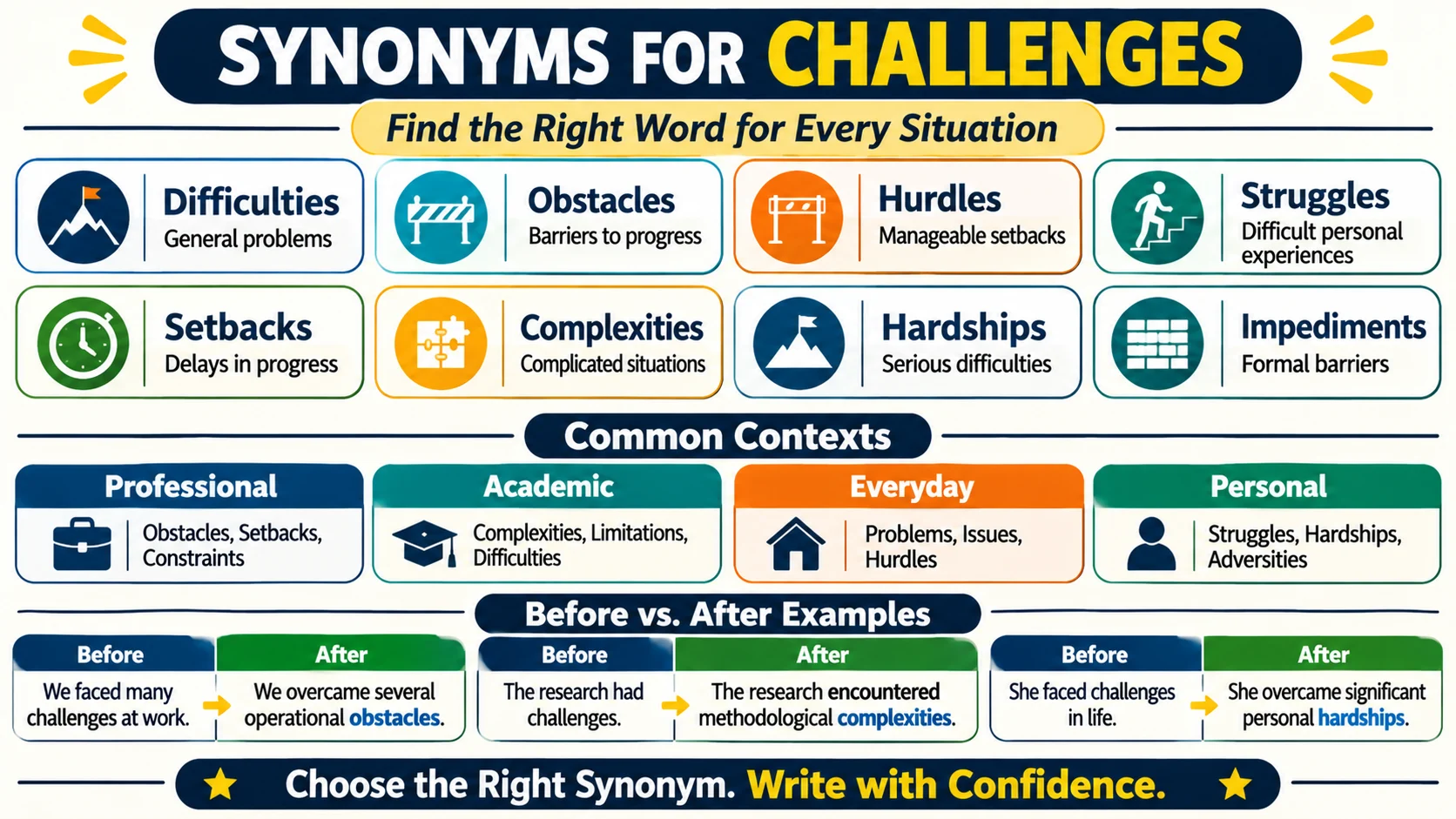
Another word for challenges is difficulties, obstacles, hurdles, problems, or struggles. The best synonym depends on the context. Use “obstacles” for barriers to progress, “difficulties” for general problems, “hurdles” for manageable setbacks, and “demands” for situations requiring effort or skill. In professional writing, “complexities” and “opportunities” can also work.
What Does Challenges Mean?
Definition
The word “challenges” is the plural form of the noun “challenge.” It refers to difficult tasks, demanding situations, problems, or obstacles that require effort, skill, determination, or problem-solving.
As a verb, “challenges” can also mean questions the validity of something, confronts someone, or invites a person to prove their ability.
The word can have a negative or positive meaning. A challenge may describe a serious difficulty, but it can also represent an opportunity for personal growth, professional development, or achievement.
Common Uses
“Challenges” commonly appears in these contexts:
- Workplace: Difficult tasks, business problems, or project obstacles.
- Education: Academic difficulties or demanding assignments.
- Personal life: Emotional struggles, hardships, or life problems.
- Business: Market barriers, competition, and operational issues.
- Technology: Technical difficulties, system limitations, or complex problems.
- Personal development: Opportunities to grow, learn, and improve.
For example, “The company faced several challenges during expansion” describes business difficulties, while “She enjoys new challenges” refers to demanding experiences that provide motivation.
Best Synonyms for Challenges
The following table highlights useful alternatives and explains when to choose each one.
| Synonym | Meaning | Best Used When | Example |
|---|---|---|---|
| Difficulties | Situations that are hard to manage | General writing | We faced several difficulties. |
| Obstacles | Barriers preventing progress | Goals and projects | Funding was a major obstacle. |
| Hurdles | Problems that must be overcome | Work and daily life | The team overcame several hurdles. |
| Problems | Issues requiring solutions | Everyday communication | We identified three problems. |
| Struggles | Difficult experiences involving effort | Personal or emotional contexts | Her financial struggles continued. |
| Barriers | Things that prevent access or progress | Business and social issues | Cost remains a barrier. |
| Setbacks | Events that delay progress | Projects and personal goals | The delay was a temporary setback. |
| Hardships | Serious or prolonged difficulties | Personal and social contexts | They endured financial hardships. |
| Complications | Additional problems making something harder | Medical, technical, or business writing | Unexpected complications arose. |
| Demands | Requirements involving effort or skill | Professional settings | The role has significant demands. |
| Complexities | Difficult aspects of a complicated situation | Academic and professional writing | We examined the project’s complexities. |
| Trials | Difficult experiences testing ability or patience | Emotional or literary writing | The family endured many trials. |
| Adversities | Difficult circumstances requiring resilience | Formal and motivational writing | She succeeded despite adversity. |
| Issues | Matters that need attention | Business and casual writing | We discussed the main issues. |
| Responsibilities | Duties requiring attention or effort | Workplace and personal life | Leadership brings new responsibilities. |
Important Synonym Analysis
1. Difficulties
- Meaning: Situations that require extra effort or are hard to manage.
- Best Used For: General problems, personal experiences, and workplace situations.
- Tone: Neutral.
- Difficulty: Easy.
- Usage Frequency: Very Common.
- Best For: Emails, essays, business writing, and daily conversation.
Business example: “The department experienced difficulties during the transition.”
Academic example: “Students may encounter difficulties when learning advanced concepts.”
Daily conversation example: “I’m having some difficulties with my new phone.”
2. Obstacles
- Meaning: Things that prevent or delay progress toward a goal.
- Best Used For: Projects, ambitions, business growth, and problem-solving.
- Tone: Neutral to formal.
- Difficulty: Medium.
- Usage Frequency: Common.
- Best For: Resumes, essays, professional communication, and marketing copy.
Business example: “We identified several obstacles to market expansion.”
Academic example: “Limited resources presented obstacles to the research.”
Daily conversation example: “Don’t let small obstacles stop you.”
3. Hurdles
- Meaning: Difficulties that must be overcome before progress can continue.
- Best Used For: Manageable setbacks, project milestones, and everyday problems.
- Tone: Conversational and professional.
- Difficulty: Easy.
- Usage Frequency: Very Common.
- Best For: Emails, business writing, marketing, and daily conversation.
Business example: “The team overcame several regulatory hurdles.”
Academic example: “Time management remains a major hurdle for students.”
Daily conversation example: “We have a few hurdles to get through.”
4. Complexities
- Meaning: Complicated aspects of a situation that require careful understanding.
- Best Used For: Technical, academic, and professional discussions.
- Tone: Formal and analytical.
- Difficulty: Advanced.
- Usage Frequency: Common.
- Best For: Academic writing, business reports, and professional emails.
Business example: “The merger introduced several operational complexities.”
Academic example: “The study explores the complexities of human behavior.”
Daily conversation example: “I didn’t realize the situation had so many complexities.”
Synonyms by Context
Formal Writing
Formal writing benefits from precise alternatives that communicate the seriousness or nature of a difficulty.
Best formal synonyms include:
- Adversities
- Difficulties
- Complications
- Obstacles
- Complexities
- Constraints
- Impediments
Examples:
- Original: “The project faced many challenges.”
- Formal: “The project encountered several significant impediments.”
- Formal: “The research revealed substantial complexities.”
- Formal: “The organization overcame numerous adversities.”
Use “impediments” when something blocks progress. Use “constraints” when limitations such as time, funding, or resources restrict an activity.
Professional Writing
In professional communication, the best synonym depends on whether you are describing a problem, a limitation, or an opportunity.
| Situation | Recommended Word | Example |
|---|---|---|
| Project delay | Setbacks | We experienced temporary setbacks. |
| Business problem | Issues | We are addressing the main issues. |
| Growth limitation | Barriers | Cost remains a barrier to expansion. |
| Difficult task | Demands | The role involves significant demands. |
| Complex process | Complexities | We reviewed the process complexities. |
| Resume achievement | Obstacles | I successfully overcame operational obstacles. |
For a professional email, “issues” and “difficulties” usually sound natural.
For a resume, use stronger and more achievement-oriented language.
Resume example:
“Resolved operational obstacles and improved team efficiency by 25%.”
Only include measurable results when they are accurate.
Academic Writing
Academic writing requires words that communicate the exact nature of a problem.
Useful alternatives include:
- Complexities
- Limitations
- Difficulties
- Constraints
- Impediments
- Problems
- Research gaps
Examples:
- “The study examined the complexities of climate change.”
- “The research identified methodological limitations.”
- “The experiment encountered technical difficulties.”
- “Resource constraints affected the research process.”
“Limitations” is especially useful when discussing the boundaries of a study. “Complexities” describes interconnected or complicated aspects of a subject.
Daily Conversation
For everyday conversations, simple words are usually more natural than formal synonyms.
Common alternatives include:
- Problems
- Difficulties
- Hurdles
- Struggles
- Issues
- Hard times
Examples:
- “I’m facing some challenges at work.”
- “I’m having some problems at work.”
- “We’ve had a few hurdles lately.”
- “She’s going through a difficult time.”
In casual conversation, “problems” and “difficulties” are often the easiest replacements.
Professional Alternatives for Challenges
When writing a resume, cover letter, business report, or workplace email, choose words that match the situation.
| Original Phrase | Professional Alternative |
|---|---|
| Faced challenges | Overcame obstacles |
| Business challenges | Operational issues |
| Technical challenges | Technical complexities |
| Financial challenges | Financial constraints |
| Project challenges | Project setbacks |
| Leadership challenges | Management demands |
| Market challenges | Market barriers |
| Personal challenges | Personal difficulties |
Better Resume Examples
Instead of writing:
“Faced challenges while managing a team.”
Write:
“Overcame operational obstacles while leading a cross-functional team.”
Instead of:
“Handled challenges in customer service.”
Write:
“Resolved customer service issues and improved client satisfaction.”
Instead of:
“Worked through challenges during the project.”
Write:
“Addressed project constraints and delivered results within the established timeline.”
Simple Alternatives for Challenges
If you want to make your writing easier to understand, use common words.
| Simple Word | Example |
|---|---|
| Problems | We solved several problems. |
| Hard things | Learning a new skill can involve hard things. |
| Difficulties | She faced difficulties at school. |
| Issues | We discussed the main issues. |
| Trouble | He had trouble completing the task. |
| Struggles | They experienced financial struggles. |
For general audiences, “problems,” “difficulties,” and “issues” are the most practical alternatives.
Stronger Alternatives for Challenges
Sometimes “challenges” sounds too mild. If the situation involves serious hardship, choose a stronger word.
| Stronger Word | Meaning | Example |
|---|---|---|
| Adversities | Serious difficulties | She overcame significant adversities. |
| Hardships | Painful or difficult circumstances | The family endured severe hardships. |
| Ordeals | Extremely difficult experiences | The recovery was a long ordeal. |
| Struggles | Difficult experiences involving effort | He faced personal struggles. |
| Crises | Urgent and serious problems | The organization faced multiple crises. |
| Trials | Experiences testing patience or strength | They endured difficult trials. |
Be careful with intensity. A minor workplace issue should not be described as a “crisis” unless the situation truly warrants it.
Difference Between Similar Synonyms
Although many words can replace “challenges,” they do not all express the same meaning.
Challenges vs. Difficulties
“Challenges” often suggests a demanding task that can be overcome. “Difficulties” emphasizes the trouble involved.
- Challenge: “Learning programming is a rewarding challenge.”
- Difficulty: “I had difficulties understanding the programming concepts.”
Challenges vs. Obstacles
A challenge is a demanding situation. An obstacle is something that blocks progress.
- Challenge: “Building a successful business is challenging.”
- Obstacle: “Limited funding was an obstacle to business growth.”
Challenges vs. Problems
“Problems” usually refers to issues requiring solutions. “Challenges” can also describe positive opportunities for growth.
- Challenge: “I enjoy taking on new challenges.”
- Problem: “We need to fix this problem.”
Challenges vs. Hurdles
“Hurdles” usually describes individual difficulties that must be overcome. “Challenges” can refer to the entire demanding situation.
- Challenge: “The project was challenging.”
- Hurdle: “Getting approval was the biggest hurdle.”
Challenges vs. Struggles
“Struggles” often suggests personal effort, emotional difficulty, or prolonged hardship.
- Challenge: “The assignment was a challenge.”
- Struggle: “She struggled to balance work and family responsibilities.”
Opposite Words
The antonym of “challenges” depends on its meaning.
| Opposite Word | Meaning | Example |
|---|---|---|
| Ease | Lack of difficulty | The task was completed with ease. |
| Simplicity | The quality of being simple | The simplicity of the process helped. |
| Advantages | Favorable conditions | The new system offers several advantages. |
| Opportunities | Favorable chances for progress | The changes created new opportunities. |
| Solutions | Answers to problems | The team developed effective solutions. |
| Comfort | A state of ease | She worked in comfort. |
“Ease” is a direct opposite when challenges refer to difficulty. “Opportunities” may be a contextual opposite when challenges are viewed as problems rather than growth experiences.
FAQs
What is another word for challenges?
Common alternatives include difficulties, obstacles, hurdles, problems, struggles, and issues. The best choice depends on the context.
What is a formal synonym for challenges?
Formal synonyms include adversities, impediments, complexities, constraints, and difficulties. “Impediments” works well when describing barriers to progress.
What is a professional alternative for challenges?
Professional alternatives include obstacles, issues, setbacks, complexities, and constraints. Use the word that best describes the situation.
What is a simple word for challenges?
“Problems,” “difficulties,” and “issues” are simple and widely understood alternatives.
What is a stronger word for challenges?
“Hardships,” “adversities,” “ordeals,” and “crises” are stronger alternatives. Their intensity varies, so choose carefully.
What is another word for challenges in a resume?
Use “obstacles,” “setbacks,” “constraints,” or “difficult situations.” For example, “Overcame operational obstacles to improve performance.”
What is another word for challenges in academic writing?
“Complexities,” “limitations,” “difficulties,” and “constraints” are useful academic alternatives.
Can challenges mean opportunities?
Yes. In some contexts, challenges are demanding experiences that create opportunities for learning and growth. For example, “I welcome new challenges” often expresses a positive attitude.
What is the difference between challenges and obstacles?
A challenge is a demanding situation or task. An obstacle is a barrier that prevents or delays progress.
What is the opposite of challenges?
“Ease” is a common opposite when challenges refer to difficulty. Other contextual opposites include simplicity, comfort, and advantages.
Conclusion
The best synonym for “challenges” depends on the meaning, tone, and purpose of your writing. “Difficulties” is a reliable general alternative, “obstacles” emphasizes barriers to progress, and “hurdles” describes manageable problems. For professional writing, consider “constraints,” “setbacks,” or “complexities.” For serious personal situations, “hardships” and “adversities” may be more appropriate.
Choosing precise synonyms makes your writing clearer, more natural, and more effective. Rather than replacing “challenges” with the same word every time, select an alternative that accurately communicates the situation.