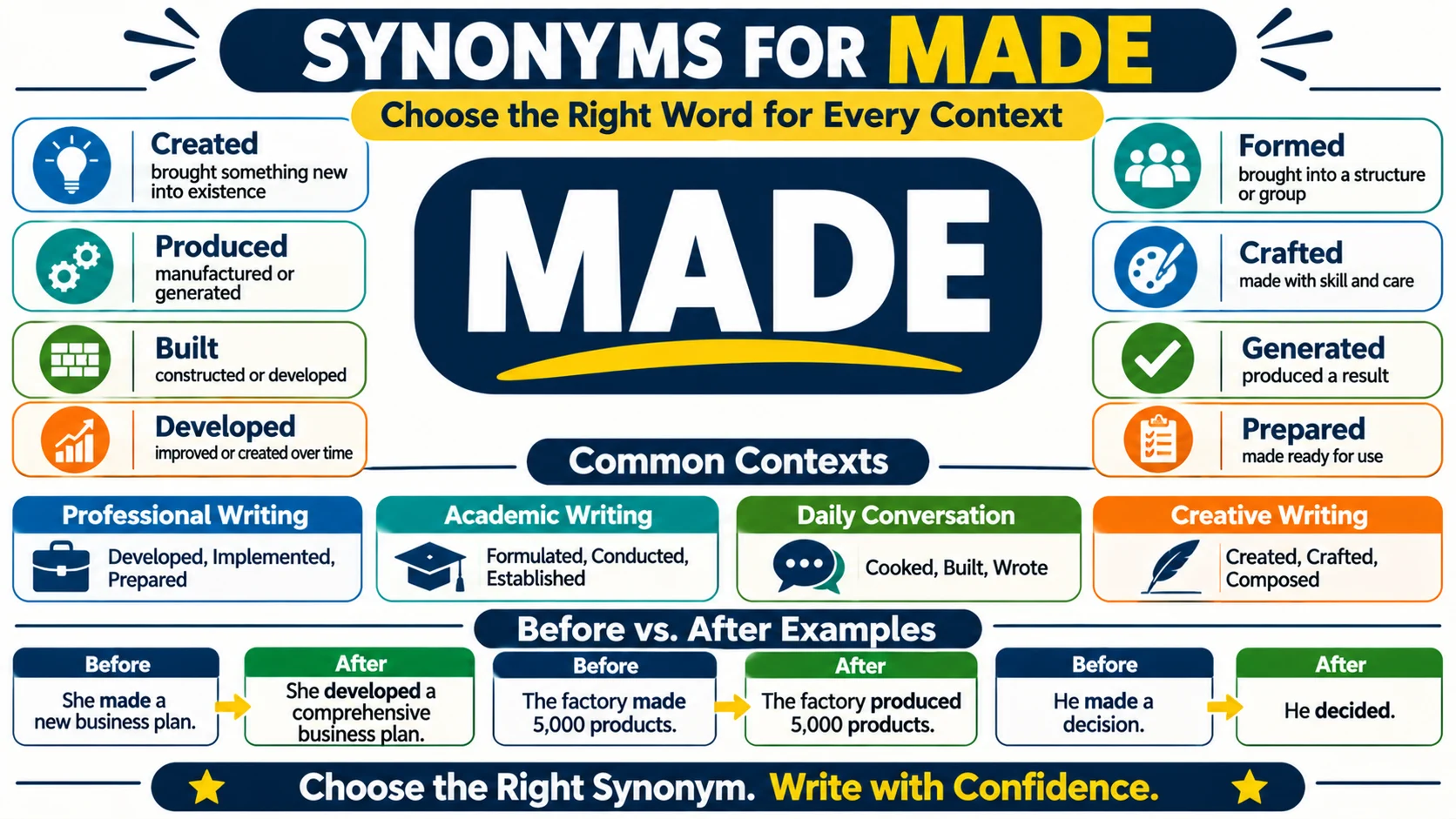
Another word for made is created, produced, built, developed, or formed. The best synonym depends on the context. Use “created” for something original, “produced” for goods or results, “built” for structures, and “developed” for ideas, skills, or systems. “Made” is the past tense of “make.”
What Does Made Mean?
Definition
The word made is the past tense and past participle of the verb make. It means to create, produce, prepare, construct, form, or cause something to happen.
Made is a highly common word in American English. It appears in everyday conversations, business communication, academic writing, marketing, and professional documents.
The exact meaning changes depending on the sentence.
For example:
- She made a beautiful painting. (Created)
- The company made 5,000 products. (Produced)
- They made a new building. (Built)
- His speech made everyone happy. (Caused)
- She made a decision. (Reached)
Common Uses of Made
The word “made” is used in several ways:
Creation: Made a painting, made a design, made a story.
Production: Made a product, made a machine, made a batch.
Construction: Made a house, made a bridge, made a road.
Preparation: Made dinner, made coffee, made a cake.
Achievement: Made progress, made an improvement, made a discovery.
Causation: Made someone laugh, made a difference, made an impact.
Understanding the intended meaning helps you choose a more precise synonym.
Best Synonyms for Made
The following alternatives are useful for different situations. Not every synonym can replace “made” in every sentence.
| Synonym | Meaning | Best Used When | Example |
|---|---|---|---|
| Created | Brought something new into existence | Original ideas, art, content | She created a new design. |
| Produced | Manufactured or generated something | Products, results, content | The factory produced 500 units. |
| Built | Constructed or developed something | Buildings, systems, relationships | They built a strong team. |
| Developed | Improved or created over time | Skills, plans, software | He developed a new application. |
| Formed | Brought something into a shape or group | Organizations, structures, opinions | They formed a partnership. |
| Constructed | Built by assembling parts | Buildings, models, frameworks | The engineers constructed a bridge. |
| Crafted | Made with care and skill | Art, messages, products | She crafted a compelling story. |
| Generated | Produced or caused something | Revenue, ideas, energy | The campaign generated leads. |
| Prepared | Made ready for use | Food, reports, presentations | I prepared the presentation. |
| Composed | Created by arranging elements | Music, writing, messages | He composed a short poem. |
| Designed | Planned how something should look or work | Products, websites, systems | They designed a user-friendly website. |
| Established | Created something that becomes recognized or stable | Businesses, rules, relationships | She established a successful company. |
| Assembled | Put separate parts together | Equipment, furniture, teams | We assembled the new desk. |
| Devised | Invented a plan or method | Strategies, solutions | The team devised a new strategy. |
| Caused | Made something happen | Results, reactions, changes | The news caused concern. |
Synonyms for Made by Context
Formal Writing
In formal writing, choose alternatives that communicate the exact action without sounding repetitive.
- Created: Suitable for original work, ideas, or content.
- Established: Appropriate for institutions, systems, and standards.
- Constructed: Useful for physical structures and carefully organized models.
- Generated: Best for outcomes, data, and measurable results.
- Formulated: Appropriate for plans, theories, and policies.
Example:
Original: The researchers made a new theory.
Improved: The researchers formulated a new theory.
“Formulated” is more precise because it emphasizes the process of developing an organized idea.
Professional Writing
Professional communication benefits from specific, action-oriented vocabulary.
| Original Phrase | Professional Alternative |
|---|---|
| Made a report | Prepared a report |
| Made a decision | Reached a decision |
| Made a plan | Developed a plan |
| Made an improvement | Implemented an improvement |
| Made a contribution | Contributed |
| Made a product | Developed or produced a product |
| Made an agreement | Reached an agreement |
Business Example:
Original: Our team made a new marketing strategy.
Improved: Our team developed a new marketing strategy.
The alternative sounds more professional and communicates the process of planning and creating the strategy.
Academic Writing
Academic writing often requires precision and clarity.
Useful synonyms include:
- Developed: For theories, methods, and research frameworks.
- Established: For findings, relationships, and conclusions.
- Formulated: For hypotheses, questions, and models.
- Conducted: For research, experiments, and studies.
- Generated: For data, results, and evidence.
Academic Example:
Original: The researchers made an experiment to test the hypothesis.
Improved: The researchers conducted an experiment to test the hypothesis.
“Conducted” is the correct choice because it describes carrying out an experiment rather than creating one.
Daily Conversation
In everyday American English, simple and natural words usually work best.
| Original | Natural Alternative |
|---|---|
| I made dinner. | I cooked dinner. |
| She made a cake. | She baked a cake. |
| He made a drawing. | He drew a picture. |
| They made a house. | They built a house. |
| I made a mistake. | I messed up. |
| She made me laugh. | She got me laughing. |
Daily Conversation Example:
Original: I made some coffee this morning.
Improved: I brewed some coffee this morning.
“Brewed” is more specific, but “made coffee” remains completely natural in everyday conversation.
Professional Alternatives for Made
When writing a resume, business email, report, or professional profile, replacing “made” with a stronger verb can improve clarity.
Best Resume Synonyms
| Weak Resume Phrase | Stronger Alternative |
|---|---|
| Made a new process | Developed a new process |
| Made sales reports | Prepared sales reports |
| Made a team | Formed a team |
| Made a successful campaign | Executed a successful campaign |
| Made improvements | Implemented improvements |
| Made a new system | Designed a new system |
| Made more revenue | Generated additional revenue |
Resume Example:
Weak: Made a new customer service process that helped the company.
Strong: Developed a customer service process that improved response efficiency.
Choose a synonym that reflects what you actually did. Strong action verbs should not exaggerate your responsibilities or achievements.
Best Alternatives for Business Emails
- Created: For new documents, materials, or ideas.
- Prepared: For reports, presentations, and meeting materials.
- Developed: For strategies, plans, and solutions.
- Implemented: For changes that were put into action.
- Generated: For leads, revenue, or measurable outcomes.
Email Example:
“I have made the required changes to the proposal.”
A more professional version:
“I have implemented the required changes to the proposal.”
Use “implemented” when the changes have actually been applied.
Simple Alternatives for Made
If you want easy words that most readers understand, choose these alternatives:
| Simple Synonym | Example |
|---|---|
| Did | She made her homework. → She did her homework. |
| Built | They made a house. → They built a house. |
| Cooked | He made dinner. → He cooked dinner. |
| Wrote | She made a letter. → She wrote a letter. |
| Created | He made a drawing. → He created a drawing. |
| Put together | We made a bookshelf. → We put together a bookshelf. |
| Got | She made a good result. → She got a good result. |
Some phrases need more than a simple word replacement.
For example, “made a mistake” can become “made an error,” but “did a mistake” is not standard American English. The correct phrase is “made a mistake.”
Stronger Alternatives for Made
Sometimes “made” sounds too general. A stronger synonym can explain the action more clearly.
| Made Phrase | Stronger Alternative |
|---|---|
| Made a discovery | Discovered |
| Made an invention | Invented |
| Made a decision | Decided |
| Made a suggestion | Suggested |
| Made an argument | Argued |
| Made an announcement | Announced |
| Made a contribution | Contributed |
| Made an improvement | Improved |
| Made a calculation | Calculated |
| Made a comparison | Compared |
Example:
Original: The scientist made a discovery.
Improved: The scientist discovered a new method.
The second sentence is more direct and avoids unnecessary wording.
Difference Between Similar Synonyms
Some synonyms for “made” are closely related but have different meanings.
Made vs. Created
“Made” is a general word. “Created” emphasizes bringing something new into existence.
- She made a table. (General)
- She created a unique artwork. (Original work)
Made vs. Produced
“Produced” is often used for manufacturing, generating, or delivering results.
- The company made a product.
- The company produced 10,000 products.
The second sentence emphasizes quantity and production.
Made vs. Built
“Built” usually refers to constructing something or developing it gradually.
- They made a website.
- They built a website.
Both are correct, but “built” may suggest assembling or developing the website’s structure.
Made vs. Developed
“Developed” emphasizes growth, improvement, or a process over time.
- She made a plan.
- She developed a long-term business plan.
The second phrase suggests more planning and refinement.
Made vs. Formed
“Formed” means bringing something into a particular shape, structure, or group.
- They made a group.
- They formed a committee.
“Formed” is more precise when people organize themselves into a group.
Opposite Words for Made
The opposite of “made” depends on its meaning.
| Made Meaning | Opposite |
|---|---|
| Created | Destroyed |
| Built | Demolished |
| Produced | Consumed |
| Formed | Dissolved |
| Prepared | Unprepared |
| Developed | Undeveloped |
| Established | Disbanded |
| Caused | Prevented |
For example, “built” and “demolished” are opposites when referring to a structure. However, “created” and “destroyed” are broader opposites.
There is no single antonym that works for every use of “made.”
FAQs
1. What is another word for made?
Another word for made is created, produced, built, developed, or formed. The best option depends on what was made and how it was made.
2. What is a formal synonym for made?
Formal alternatives include created, constructed, formulated, established, and generated. “Formulated” is especially useful for theories, plans, and hypotheses.
3. What is a professional alternative for made?
Professional alternatives include developed, prepared, implemented, produced, and generated. For example, “made a report” can become “prepared a report.”
4. What is a simple word for made?
Simple alternatives include did, built, cooked, wrote, and created. The correct choice depends on the action.
5. What is another word for made in a resume?
Use action verbs such as developed, created, implemented, generated, designed, and established. Choose a verb that accurately describes your contribution.
6. What is another word for made up?
“Made up” can mean invented, fabricated, composed, or constituted. For example, “She made up a story” can become “She invented a story.”
7. What is another word for made by?
Depending on context, “made by” can be replaced with created by, produced by, manufactured by, designed by, or developed by.
8. What is another word for made a difference?
Useful alternatives include influenced, improved, changed, impacted, and contributed to. “Contributed to” is often suitable for professional writing.
9. What is another word for made a decision?
The most direct alternative is “decided.” You can also use “reached a decision” or “determined,” depending on the sentence.
10. What word can replace made in academic writing?
Academic alternatives include formulated, developed, conducted, established, and generated. Select the word based on whether you are describing a theory, experiment, finding, or result.
Conclusion
The best synonyms for “made” include created, produced, built, developed, formed, crafted, generated, and prepared. Each word has a different meaning and works best in a particular context.
For everyday conversation, “made” is often the simplest and most natural choice. In academic writing, professional documents, and resumes, more specific verbs can improve clarity and make your writing stronger.
Instead of replacing “made” with the same synonym every time, consider the action, purpose, and audience. The right word will make your sentence more precise, natural, and effective.