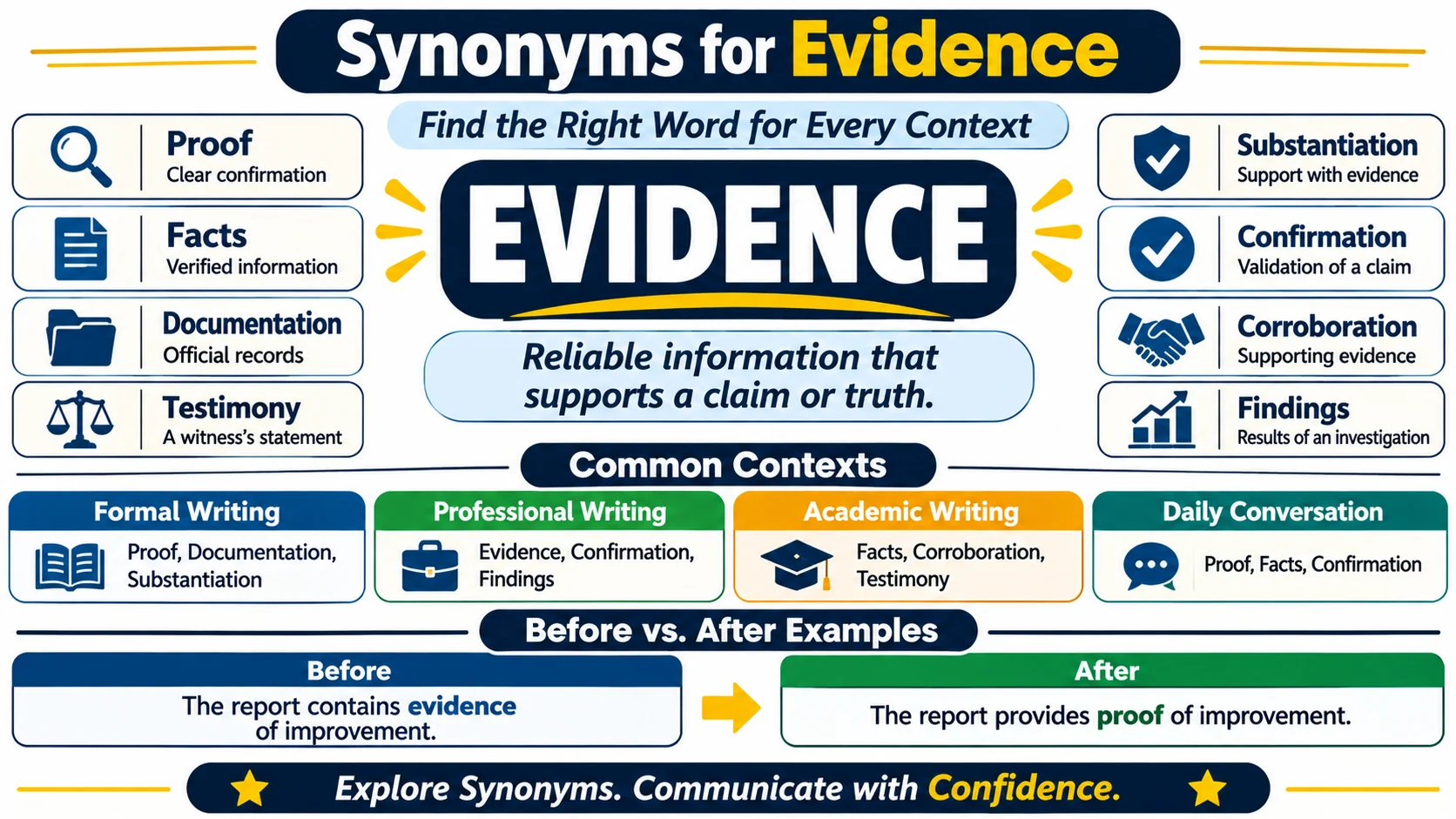
The best synonym for evidence is proof when something has been firmly established, while data, testimony, documentation, and indication fit more specific situations. Choose proof for certainty, data for measurable facts, testimony for spoken accounts, and sign or indication when the support is lighter and only suggestive.
What Does Evidence Mean?
Definition
Evidence is information, material, or a fact that helps show whether a claim is true or false. It can be a document, a measurement, a witness statement, a physical object, or even a pattern that points toward a conclusion. The word does not promise certainty. It describes support, and that support can be strong, weak, or somewhere in between.
Common Uses
People use evidence in courtrooms, laboratories, classrooms, newsrooms, and offices. A lawyer presents evidence to a jury. A researcher cites evidence to back up a finding. A manager asks for evidence before approving a budget. In everyday talk, someone might say there is no evidence that a rumor is true, which simply means nothing credible supports it.
Because evidence covers so many situations, no single synonym fits all of them. The right replacement depends on how strong the support is, who is giving it, and what kind of writing you are doing.
Best Synonyms for Evidence
| Synonym | Meaning | Best Used When | Example |
|---|---|---|---|
| Proof | Evidence strong enough to settle a question | The conclusion is certain | The receipt was proof of purchase. |
| Data | Collected facts and figures | You can measure or count the support | The data shows a 12 percent rise in sales. |
| Testimony | A spoken or written statement from a witness | Someone is giving a firsthand account | Her testimony placed him at the scene. |
| Documentation | Records that back up a claim | Paper or digital records exist | We keep documentation of every approval. |
| Confirmation | Support that verifies something already suspected | You are checking an earlier claim | The lab sent confirmation of the results. |
| Indication | A sign that points toward a conclusion | The support is suggestive, not final | There is every indication that demand will grow. |
| Sign | A noticeable signal | You want a simple, everyday word | Rising prices are a sign of inflation. |
| Grounds | The basis for a belief or action | You are explaining a justification | They had grounds for an appeal. |
| Support | Material that strengthens a claim | The claim needs backing | The study offers support for the theory. |
| Substantiation | Proof that establishes a claim as valid | Formal or legal writing | The claim lacked substantiation. |
| Corroboration | Additional evidence that backs up earlier evidence | A second source agrees with the first | Two reports offered corroboration. |
| Exhibit | An item presented as evidence | Legal or formal presentations | The prosecution entered the letter as an exhibit. |
| Findings | Results of an investigation or study | Reporting research outcomes | The findings contradict earlier work. |
| Clue | A small piece of evidence that guides an inquiry | Investigations and puzzles | The footprint was the first clue. |
| Trace | A slight remaining sign | Evidence is faint or leftover | Investigators found no trace of tampering. |
Synonyms by Context
Formal Writing
Formal writing favors precision. Substantiation, corroboration, and documentation sound measured and credible. A sentence such as “The committee requested substantiation of the claim” reads more carefully than “The committee wanted evidence,” though both are correct. Use these words when accuracy matters more than speed.
Professional Writing
In workplace emails, reports, and proposals, data, documentation, and support are the safest choices. They are clear without sounding stiff. You might write, “Please send documentation of the expense” or “The data supports our hiring plan.” Avoid drifting into legal vocabulary like exhibit unless the situation truly calls for it.
Academic Writing
Students and researchers should lean on findings, data, and support, and use corroboration when a second study confirms a first. A thesis statement is stronger when you name the kind of evidence you mean, such as survey data, archival documentation, or expert testimony. Naming the type shows the reader you understand your sources.
Daily Conversation
In casual speech, sign, clue, and proof work best. Nobody says “substantiation” at a dinner table. You might say, “Is there any proof he called?” or “That’s a good sign.” Keep it short and natural.
Professional Alternatives for Evidence
When you need a polished word for business settings, start with documentation, data, or confirmation. Documentation fits anything recorded, such as contracts, invoices, and meeting notes. Data fits anything measured, such as sales figures or survey results. Confirmation fits situations where you are verifying something that was already claimed, such as a delivery date or a payment.
For a stronger professional tone, supporting materials works well as a phrase: “Please attach supporting materials to your request.” It is clear, courteous, and avoids sounding like an accusation, which the bare word evidence can sometimes do.
Simple Alternatives for Evidence
If you want plain language, use proof, sign, clue, or reason. These are short words that almost everyone understands. “What’s your proof?” is easier to read than “What is your substantiation?” Simple words are also better for headlines, social posts, and writing aimed at younger readers or English learners.
Stronger Alternatives for Evidence
Sometimes evidence feels too mild. When the support is overwhelming, proof, confirmation, and verification carry more weight. When you want to stress that the support is hard to argue with, phrases such as hard proof or solid confirmation add force. On the other end, if you want to soften the claim, use indication or sign, which admit that the support is not final.
Difference Between Similar Synonyms
Proof vs. Evidence
Evidence is what you offer. Proof is what you have once the evidence is convincing enough. A single fingerprint may be evidence, but it only becomes proof when other facts settle the question. Using proof too early can overstate your case.
Data vs. Evidence
Data is raw information, such as numbers, measurements, and records. Evidence is data (or anything else) used to support a specific claim. A spreadsheet of sales figures is data. The same figures used to argue that a campaign worked are evidence.
Testimony vs. Documentation
Testimony comes from a person who says what they saw, heard, or know. Documentation comes from records. Testimony can change with memory or perspective, while documentation stays fixed, which is why courts and employers often want both.
Indication vs. Sign
Both suggest something without proving it. Indication is slightly more formal and often used in reports. Sign is more common in speech. “All indications point to a delay” suits a memo, while “That’s a good sign” suits a conversation.
Synonym Analysis for Key Words
Proof
Meaning: Evidence that firmly establishes something as true. Tone: Confident and direct. Difficulty: Easy. Usage frequency: Very common. Best for: Daily writing, essays, and marketing copy. Business example: Send us proof of shipment and we will process the refund. Academic example: The experiment provided proof that the compound is stable. Daily conversation example: I need proof before I believe that story.
Data
Meaning: Facts and figures gathered through measurement or research. Tone: Neutral and analytical. Difficulty: Easy. Usage frequency: Very common. Best for: Business writing, resumes, and essays. Business example: Our data shows customers prefer the shorter checkout. Academic example: The data collected over three years supports the hypothesis. Daily conversation example: What does the data say about the weather this weekend?
Testimony
Meaning: A statement given by a witness or expert. Tone: Formal and serious. Difficulty: Medium. Usage frequency: Common. Best for: Essay writing and formal reports. Business example: The consultant’s testimony influenced the board’s decision. Academic example: Historians weighed eyewitness testimony against official records. Daily conversation example: Her testimony was the reason everyone believed him.
Documentation
Meaning: Written or recorded material that supports a claim. Tone: Professional and careful. Difficulty: Medium. Usage frequency: Common. Best for: Resumes, email writing, and business writing. Business example: Please submit documentation of your travel expenses by Friday. Academic example: The paper relies on archival documentation from the 1930s. Daily conversation example: Do you have any documentation for the warranty?
Corroboration
Meaning: Additional evidence that confirms earlier evidence. Tone: Formal and precise. Difficulty: Advanced. Usage frequency: Less common. Best for: Academic and legal writing. Business example: The audit offered corroboration of the finance team’s numbers. Academic example: The second study provided corroboration for the original results. Daily conversation example: I’d like some corroboration before I repeat that.
Opposite Words
The opposite of evidence is not a single word, because it depends on what is missing. When there is no support at all, words such as speculation, conjecture, guesswork, and supposition fit. When something actively works against a claim, disproof, refutation, and contradiction are better choices. Rumor and hearsay sit in between, since they pass along claims without reliable support.
FAQs
What is another word for evidence?
Proof is the most common replacement, especially when the support is strong. Data, testimony, documentation, and indication are better when you need to be specific about the kind of support.
What is a formal synonym for evidence?
Substantiation, corroboration, and documentation are formal options. They suit legal, academic, and official writing where precision matters.
What is a professional alternative for evidence?
In business, documentation, data, confirmation, and supporting materials are the most natural choices. They sound credible without sounding confrontational.
What word can replace evidence in an essay?
Use findings, data, support, or corroboration, depending on what you are citing. Naming the exact kind of source, such as survey data or expert testimony, usually reads better than repeating the word evidence.
Is proof the same as evidence?
No. Evidence is the material that supports a claim, while proof is the result when that material is strong enough to settle the matter.
What is a simple word for evidence?
Sign, clue, and proof are easy, everyday options that work in casual writing and speech.
Conclusion
Evidence is a flexible word, but it is not always the most precise one. Proof signals certainty, data points to measurement, testimony points to a person, documentation points to records, and sign or indication admits that the support is only suggestive. Pick the word that matches how strong the support really is and who your reader is, and your writing will be clearer and more credible.