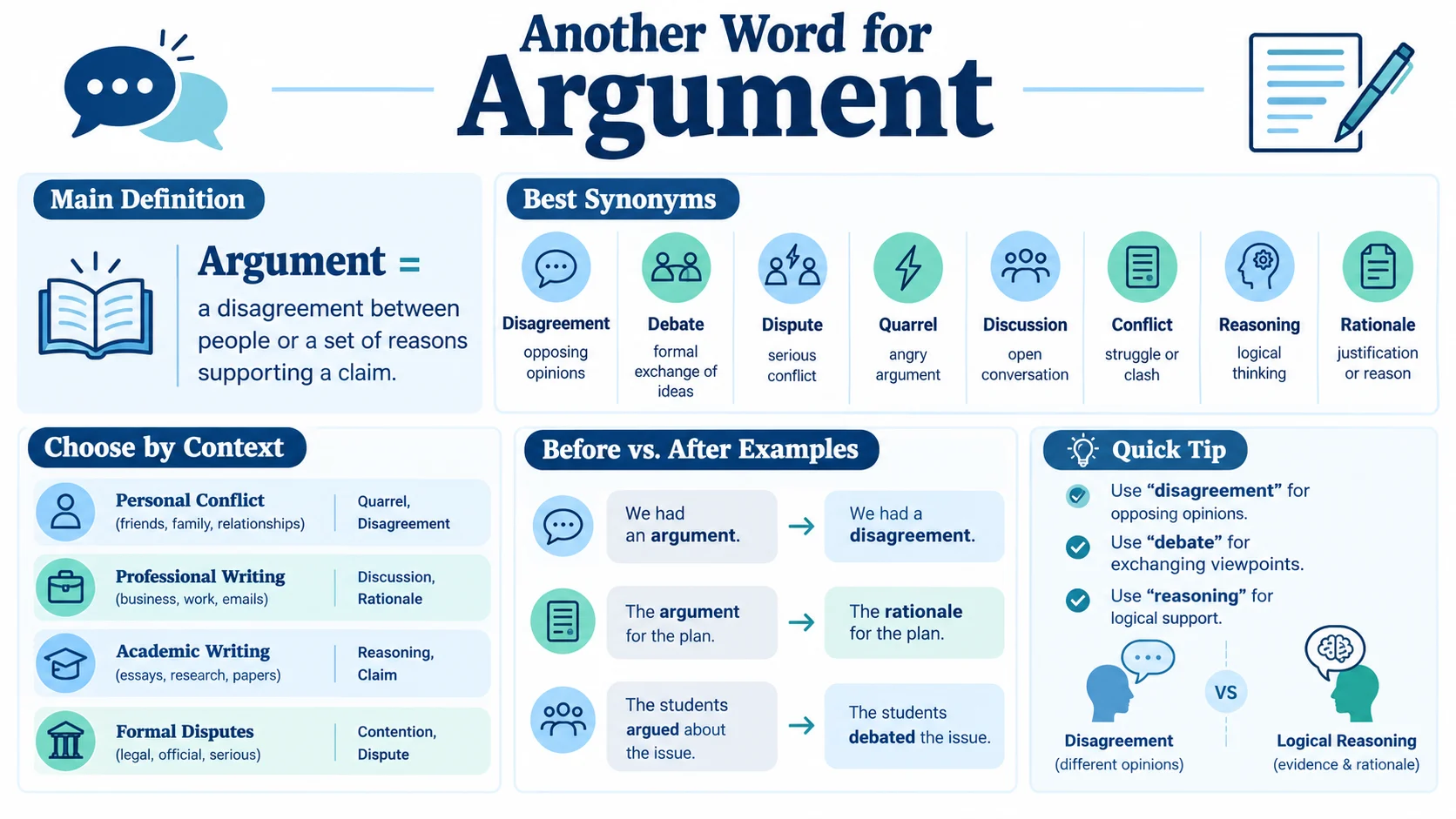
Another word for argument is disagreement, especially when two people have different opinions. Other synonyms include dispute, debate, quarrel, discussion, conflict, and controversy. The best replacement depends on context. Use debate for an exchange of ideas, dispute for a serious disagreement, and quarrel for a heated personal conflict.
What Does Argument Mean?
Definition
An argument is a disagreement between people who have different opinions, beliefs, or interests. The word can also mean a set of reasons or evidence used to support a claim or persuade someone.
For example, “They had an argument about money” describes a disagreement. In contrast, “Her argument was supported by research” refers to a reasoned explanation intended to establish a point.
Understanding these two meanings is important when choosing a synonym. Words such as quarrel and dispute usually describe disagreement, while reasoning and case can replace argument when it means a logical explanation.
Common Uses
The word argument appears in several contexts:
- Personal relationships: A disagreement between friends, partners, or family members.
- Professional settings: A dispute about responsibilities, decisions, or workplace policies.
- Academic writing: A claim supported by evidence and logical reasoning.
- Public discussions: A debate about political, social, or ethical issues.
- Legal situations: A dispute or a presentation of reasons before a court.
- Everyday conversations: A difference of opinion that may be calm or heated.
The right synonym depends on the situation, the intensity of the disagreement, and whether the word refers to a conflict or a logical point.
Best Synonyms for Argument
The following words offer different ways to describe an argument without changing the intended meaning.
| Synonym | Meaning | Best Used When | Example |
|---|---|---|---|
| Disagreement | A difference of opinion | General conversations | We had a disagreement about the budget. |
| Dispute | A serious or formal disagreement | Business or legal matters | The two companies settled their dispute. |
| Debate | A structured exchange of opposing views | Academic or public discussions | The students held a debate about technology. |
| Quarrel | An angry personal disagreement | Relationships and family situations | The siblings had a quarrel. |
| Discussion | An exchange of ideas or information | Neutral conversations | We had a discussion about the proposal. |
| Conflict | A clash between opposing interests or positions | Workplace or personal tensions | The conflict delayed the project. |
| Controversy | Public disagreement or strong differences of opinion | Public issues and media | The decision sparked controversy. |
| Altercation | A sudden, often heated confrontation | Formal reporting | A verbal altercation occurred outside the office. |
| Feud | A prolonged disagreement or hostility | Ongoing personal or group conflicts | The families continued their feud. |
| Debate | An examination of competing ideas | Formal reasoning and public speaking | The debate focused on education reform. |
| Clash | A strong difference in opinions or interests | Direct opposition | Their views clashed during the meeting. |
| Difference of opinion | A difference in what people believe | Polite or diplomatic communication | We have a difference of opinion on the issue. |
| Row | An angry disagreement, especially in British English | Informal descriptions | They had a row over the decision. |
| Exchange | A verbal interaction that may involve opposing views | Neutral or professional descriptions | A tense exchange followed the announcement. |
| Reasoning | Logical thinking used to support a conclusion | Academic or analytical writing | Her reasoning supported the conclusion. |
| Case | A set of reasons supporting a position | Persuasive writing or legal contexts | He presented a strong case for reform. |
Quick tip: Choose disagreement for a neutral difference of opinion, debate for an exchange of ideas, quarrel for a personal argument, and reasoning when referring to logical support for a claim.
Synonyms for Argument by Context
Formal Writing
Formal writing benefits from precise language that describes the type of disagreement without sounding emotional or vague.
Useful alternatives include dispute, controversy, difference of opinion, and contention.
Examples:
- Original: The argument concerned the interpretation of the law.
- Revised: The dispute concerned the interpretation of the law.
- Original: The argument raised questions about the policy.
- Revised: The controversy raised questions about the policy.
Use contention when referring to a claim or position that someone maintains, particularly in formal reasoning. It does not always mean an angry disagreement.
Professional Writing
In the workplace, the word argument can sound confrontational. A more neutral synonym can make emails, reports, and performance reviews sound professional.
Consider these alternatives:
- Disagreement: When colleagues have different opinions.
- Discussion: When people exchange ideas or try to resolve an issue.
- Dispute: When a disagreement involves a significant issue or competing claims.
- Difference of opinion: When you want to express disagreement diplomatically.
Business example
Original: The managers had an argument about the new strategy.
Professional alternative: The managers had a disagreement about the new strategy.
More diplomatic alternative: The managers discussed different perspectives on the new strategy.
The second revision is especially useful when you want to focus on collaboration rather than conflict.
Academic Writing
In academic writing, argument often refers to a central claim supported by evidence, not a verbal fight. Replacing it with disagreement may change the meaning.
Useful alternatives include claim, position, thesis, reasoning, and case.
Examples:
- Original: The author’s argument is supported by historical evidence.
- Revised: The author’s claim is supported by historical evidence.
- Original: The essay develops an argument about climate policy.
- Revised: The essay develops a case for changes to climate policy.
Use thesis for a central proposition, claim for a statement that requires support, and reasoning for the logical process connecting evidence to a conclusion.
Daily Conversation
In everyday American English, disagreement, fight, quarrel, and discussion are common alternatives, but they communicate different levels of intensity.
| Situation | Best Alternative | Example |
|---|---|---|
| Different opinions | Disagreement | We had a disagreement about dinner. |
| Angry personal exchange | Fight | They had a fight over the misunderstanding. |
| Calm exchange of ideas | Discussion | We had a discussion about our plans. |
| Serious competing claims | Dispute | They are having a dispute over the property. |
| Public exchange of views | Debate | We watched a debate about education. |
In casual speech, fight can mean a verbal disagreement, although it can also refer to physical violence. Use argument or disagreement when you want to avoid that ambiguity.
Professional Alternatives for Argument
The best professional alternative depends on your message and the relationship between the people involved.
Disagreement
Meaning: A difference in opinions, beliefs, or judgments.
Best used for: Workplace communication, emails, reports, and meetings.
Tone: Neutral.
Difficulty: Easy.
Usage frequency: Very common.
Best for: Email writing, business writing, professional reports, and everyday communication.
- Business example: The team reached a disagreement over the project timeline.
- Academic example: The researchers expressed disagreement about the interpretation of the findings.
- Daily conversation example: We had a disagreement, but we worked it out.
Dispute
Meaning: A serious disagreement, often involving rights, facts, money, or responsibilities.
Best used for: Contracts, business negotiations, legal matters, and formal reports.
Tone: Formal and serious.
Difficulty: Medium.
Usage frequency: Common.
Best for: Business writing, formal emails, reports, and legal communication.
- Business example: The company resolved a payment dispute with its supplier.
- Academic example: The article examines a dispute over the interpretation of the evidence.
- Daily conversation example: They are in a dispute over who owns the equipment.
Discussion
Meaning: An exchange of ideas, opinions, or information.
Best used for: Meetings, collaborative projects, feedback, and problem-solving.
Tone: Neutral and constructive.
Difficulty: Easy.
Usage frequency: Very common.
Best for: Email writing, business writing, academic essays, and marketing copy.
- Business example: The team held a discussion about the upcoming launch.
- Academic example: The discussion section explains the study’s implications.
- Daily conversation example: We had a discussion about our weekend plans.
Debate
Meaning: A structured or active exchange of opposing views.
Best used for: Academic assignments, public speaking, policy discussions, and persuasive writing.
Tone: Analytical or formal.
Difficulty: Easy.
Usage frequency: Very common.
Best for: Essay writing, academic presentations, professional discussions, and public communication.
- Business example: The board held a debate about the proposed investment.
- Academic example: The essay contributes to the debate about renewable energy.
- Daily conversation example: We had a friendly debate about the best movie of the year.
Simple Alternatives for Argument
If you want an easy word that most readers understand immediately, consider these options:
Fight: Best for an angry or heated disagreement. Example: They had a fight over the missed appointment.
Disagreement: Best for a neutral difference of opinion. Example: We had a disagreement about the schedule.
Discussion: Best when people exchange views without necessarily fighting. Example: Let’s have a discussion about the problem.
Debate: Best when people defend different opinions. Example: They debated which option was better.
Difference of opinion: Best when you want to sound polite. Example: We have a difference of opinion, but we respect each other.
Stronger Alternatives for Argument
Some synonyms convey greater intensity, hostility, or seriousness than the word argument.
- Altercation: A sudden, heated confrontation, usually verbal but sometimes physical.
- Feud: A continuing conflict between people, families, or groups.
- Clash: A strong disagreement involving opposing views or interests.
- Confrontation: A direct encounter in which disagreement or tension is addressed.
- Brawl: A physical fight involving multiple people, rather than an ordinary verbal argument.
- Contention: A disputed claim or point of disagreement, especially in formal contexts.
Examples:
- Mild: The coworkers had a disagreement about the deadline.
- More serious: The coworkers had a heated dispute about the deadline.
- Ongoing: The disagreement developed into a prolonged feud.
Choose a stronger word only when the circumstances justify it. Calling a brief difference of opinion a feud exaggerates the situation.
Difference Between Similar Synonyms
Several words related to argument overlap in meaning, but they are not interchangeable in every sentence.
| Word | Key Difference | Example |
|---|---|---|
| Argument | A disagreement or a set of reasons supporting a claim | Her argument relies on evidence. |
| Debate | An exchange of competing ideas | The debate lasted an hour. |
| Dispute | A serious disagreement over a claim or issue | The payment dispute remains unresolved. |
| Discussion | A conversation about a subject | The discussion covered several solutions. |
| Quarrel | An angry personal disagreement | The couple had a quarrel. |
| Conflict | A broader clash of interests, goals, or values | The conflict affected the entire team. |
| Controversy | Public disagreement or debate over an issue | The policy created controversy. |
| Reasoning | The logical process supporting a conclusion | The reasoning behind the decision was clear. |
Argument vs. Debate
An argument may be a heated disagreement or a logical case supporting a claim. A debate usually involves presenting and examining opposing viewpoints. A debate can be calm and organized, while an argument can be emotional or informal.
Argument vs. Discussion
A discussion does not require disagreement. People may discuss a plan while sharing the same goals. An argument typically involves competing positions or reasons, although the tone can range from calm to hostile.
Argument vs. Conflict
An argument is often a specific exchange of words or reasons. Conflict is broader and can involve incompatible goals, ongoing tension, or competing interests without a direct verbal confrontation.
Opposite Words for Argument
There is no single antonym that fits every meaning of argument. The best opposite depends on whether you mean disagreement or a reasoned claim.
| Opposite or Contrast | Meaning | Example |
|---|---|---|
| Agreement | Shared opinion or acceptance | We reached an agreement about the schedule. |
| Harmony | A state of cooperation or peaceful relations | The team worked together in harmony. |
| Consensus | General agreement within a group | The committee reached a consensus. |
| Understanding | Mutual awareness or agreement | They developed a better understanding. |
| Cooperation | Working together toward a shared goal | Cooperation helped resolve the problem. |
| Accord | A formal or mutual agreement | The parties reached an accord. |
When argument means a logical case, its opposite is less straightforward. Depending on the sentence, you might contrast a supported argument with an unsupported assertion or faulty reasoning.
FAQs
1. What is the best synonym for argument?
Disagreement is the best general synonym when argument means a difference of opinion. Use debate for an exchange of ideas, dispute for a serious disagreement, and reasoning when argument means logical support for a claim.
2. What is a formal synonym for argument?
Dispute, contention, and controversy are useful formal alternatives when discussing disagreement. For a logical argument in academic writing, consider claim, case, or reasoning.
3. What is a professional alternative for argument?
Disagreement is a clear, professional choice. Discussion is more constructive, while dispute is appropriate for serious issues involving competing claims or responsibilities.
4. What word can replace argument in an essay?
Use claim, case, thesis, or reasoning when discussing a position supported by evidence. Use debate or disagreement when referring to opposing viewpoints.
5. Is argument the same as disagreement?
Not always. A disagreement involves different opinions, while an argument can also mean a set of reasons supporting a conclusion. An argument may be a disagreement, but it can also be a logical explanation.
6. What is a stronger word for argument?
Altercation, clash, confrontation, and feud can express greater intensity or hostility. Choose according to the situation because each word has a distinct meaning.
7. What is a polite word for argument?
Difference of opinion is a diplomatic alternative. Discussion also works when you want to emphasize exchanging ideas instead of focusing on conflict.
8. What is the opposite of argument?
Agreement, consensus, and harmony are common contrasts when argument means disagreement. The best choice depends on the sentence.
9. Can debate replace argument in every sentence?
No. Debate usually suggests an exchange of opposing viewpoints. It may replace argument in some contexts, but it cannot always replace argument when the word means a logical case or an angry personal quarrel.
10. What is another word for a heated argument?
Quarrel, altercation, confrontation, and heated dispute can describe an intense disagreement. Brawl should generally be reserved for a physical fight.
Conclusion
The best alternative to argument depends on the situation. Choose disagreement for a neutral difference of opinion, debate for competing ideas, dispute for a serious disagreement, and discussion for a constructive exchange. When describing an argument in academic writing, claim, case, and reasoning may communicate your meaning more accurately.
For clear American English, focus on what the word needs to express rather than selecting the most complicated synonym. The right word makes your writing more precise, professional, and natural.