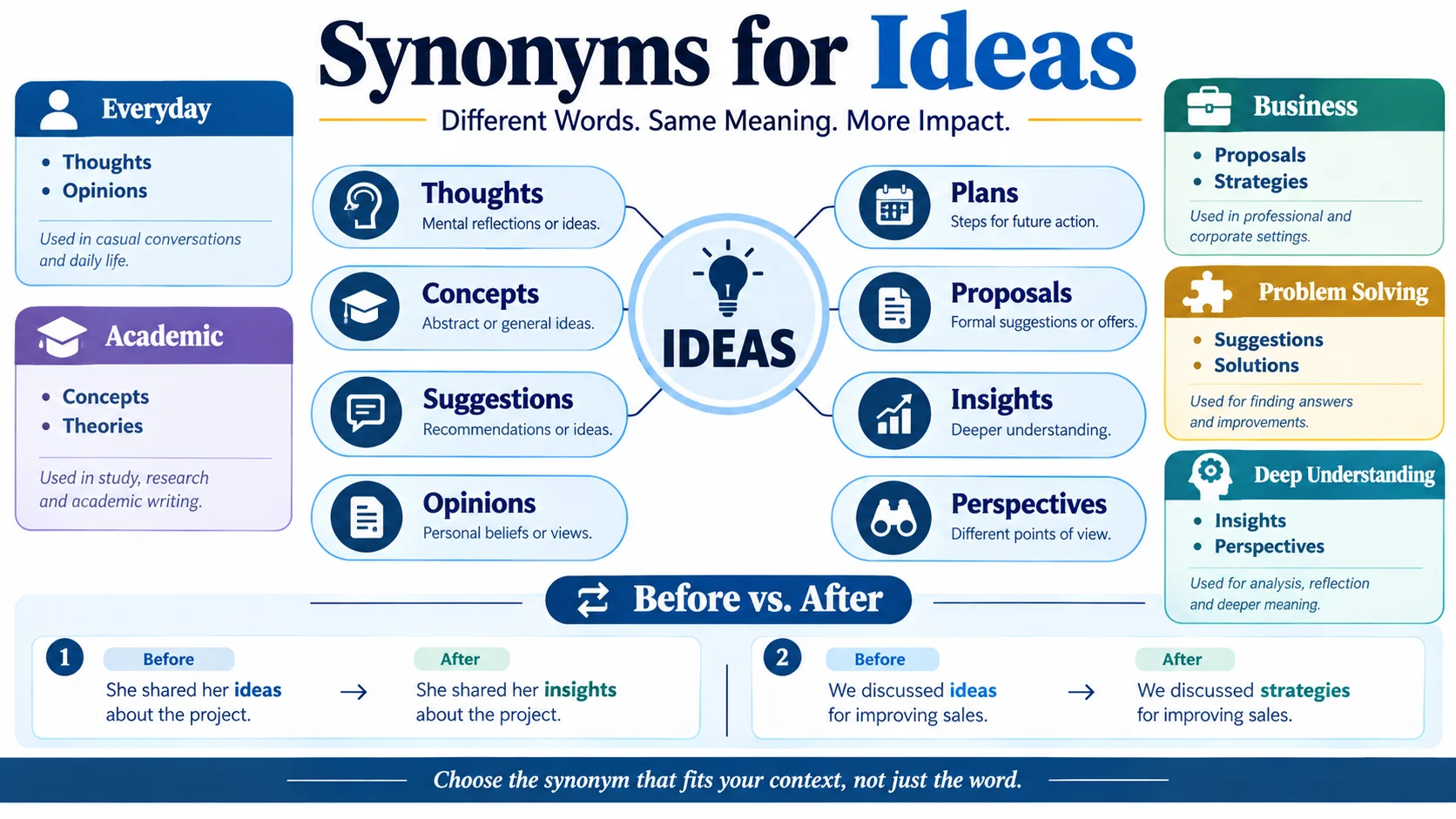
If you need another word for ideas, the best choice depends on what you mean. Common synonyms include thoughts, concepts, notions, opinions, suggestions, plans, proposals, insights, theories, and perspectives. Use thoughts for mental activity, concepts for abstract ideas, suggestions for possible actions, and proposals for formal plans.
What Does Ideas Mean?
Definition
Ideas is the plural form of idea. It generally refers to thoughts, concepts, plans, opinions, suggestions, or mental impressions that exist in someone’s mind.
The word is extremely flexible. An idea can be a quick thought, a creative possibility, a personal belief, a proposed solution, or a detailed plan.
For example:
- She had several ideas for the new website.
- His ideas about education were interesting.
- We need some fresh ideas for the campaign.
- The professor explained several important ideas in the lecture.
Because ideas has such a broad meaning, choosing a more precise synonym can make your writing clearer and more natural.
Common Uses
You may use ideas when talking about:
- Thoughts or mental activity
- Creative concepts
- Personal opinions
- Suggestions
- Future plans
- Academic concepts
- Business strategies
- Possible solutions
- Beliefs or viewpoints
- Themes in writing
The right synonym depends on which of these meanings you want to emphasize.
Best Synonyms for Ideas
| Synonym | Meaning | Best Used When | Example |
|---|---|---|---|
| Thoughts | Things formed in the mind | Personal or casual thinking | She shared her thoughts about the book. |
| Concepts | General or abstract ideas | Academic and professional writing | The course covers basic marketing concepts. |
| Notions | General or sometimes vague ideas | Informal or descriptive writing | He had a strange notion about success. |
| Opinions | Personal judgments or beliefs | Discussions and viewpoints | Everyone expressed their opinions. |
| Views | Personal ways of thinking | Formal or professional discussion | Her views on leadership are practical. |
| Suggestions | Ideas offered for consideration | Advice and problem solving | He gave several suggestions for improvement. |
| Plans | Ideas about future actions | Projects and organization | We discussed our plans for next year. |
| Proposals | Formal plans presented for consideration | Business and official settings | The committee reviewed three proposals. |
| Insights | Deep or useful understanding | Research, analysis, and professional writing | Her insights helped explain the results. |
| Theories | Organized explanations or possibilities | Academic and scientific contexts | Researchers considered several theories. |
| Perspectives | Particular ways of viewing something | Academic and professional writing | The article presents different perspectives. |
| Approaches | Ways of dealing with a problem | Work and problem solving | We considered several approaches. |
Synonyms by Context
Formal Writing
In formal writing, replace ideas with a more specific term when possible.
Concepts works well for abstract principles or topics.
The textbook introduces several important concepts.
Perspectives is useful when discussing different ways of viewing an issue.
The study considers several perspectives on education.
Proposals fits formal plans submitted for consideration.
The board reviewed several proposals.
Principles works when the ideas represent fundamental rules or beliefs.
The paper examines the principles behind effective communication.
Professional Writing
Business writing often benefits from words that indicate action or purpose.
Use proposals for formal plans.
The company evaluated three proposals for expanding its services.
Use strategies for organized approaches to achieving a goal.
The marketing team developed new strategies for customer retention.
Use recommendations when the ideas are intended to guide a decision.
The consultant provided several recommendations.
Use solutions when the ideas are specifically intended to solve a problem.
The team discussed possible solutions to the delivery issue.
Academic Writing
In academic writing, ideas can be too general. More precise alternatives include:
- Concepts for abstract subjects
- Arguments for positions supported by reasoning
- Theories for organized explanations
- Perspectives for different viewpoints
- Themes for recurring subjects or messages
- Interpretations for explanations of meaning
- Principles for foundational rules
Example:
The essay explores several important ideas about social change.
A more precise version could be:
The essay explores several important concepts about social change.
Daily Conversation
For everyday speech, simple words usually sound more natural.
Use thoughts when talking about what someone thinks.
What are your thoughts on the new restaurant?
Use suggestions when asking for possible choices.
Do you have any suggestions for dinner?
Use plans when talking about future activities.
What are your plans for the weekend?
Use opinions when asking what someone personally believes.
What’s your opinion on the new policy?
Professional Alternatives for Ideas
If you’re writing an email, report, resume, presentation, or business document, these alternatives can sound more precise:
Proposals: Use for formal plans submitted for approval.
Strategies: Use for organized methods designed to achieve a goal.
Recommendations: Use for advice based on evaluation or experience.
Solutions: Use for ideas that address a specific problem.
Approaches: Use for methods or ways of handling an issue.
Initiatives: Use for organized actions intended to achieve a particular objective.
Perspectives: Use when discussing viewpoints or ways of understanding an issue.
For example, instead of:
We discussed several ideas to improve customer service.
You could write:
We discussed several strategies to improve customer service.
Simple Alternatives for Ideas
For everyday English, these words are easy and natural:
- Thoughts
- Plans
- Suggestions
- Opinions
- Views
- Notions
- Plans
- Ways
Examples:
I have some thoughts about the project.
Do you have any suggestions?
What are your plans?
I understand your view.
Among these, thoughts is one of the most flexible choices when ideas means things that someone is thinking.
Stronger Alternatives for Ideas
Sometimes you need a word that gives the sentence more specific meaning.
Insights suggests deeper understanding.
Her insights changed the way we approached the problem.
Innovations suggests new ideas that introduce something different or useful.
The company is known for its innovations.
Strategies suggests carefully planned methods.
The team developed new strategies for growth.
Visions can describe ambitious ideas about a desired future.
The founder shared her vision for the company.
Theories suggests structured explanations that can be examined or tested.
Several theories attempt to explain the results.
These words should not automatically replace ideas. They add meaning, so choose them only when that meaning is intended.
Difference Between Similar Synonyms
Ideas vs Thoughts
Ideas can refer to thoughts, plans, suggestions, or concepts. Thoughts usually focuses more directly on mental activity.
She shared her thoughts about the movie.
This sounds more personal than:
She shared her ideas about the movie.
Ideas vs Concepts
Ideas is a broad everyday word. Concepts usually refers to abstract or organized ideas.
The teacher explained the main concepts clearly.
Ideas vs Opinions
An opinion is a personal judgment or belief. Not every idea is an opinion.
She presented several ideas for the project.
She expressed her opinion about the project.
Ideas vs Suggestions
A suggestion is an idea offered for someone to consider.
I have an idea for the website.
I have a suggestion for improving the website.
Ideas vs Plans
A plan is usually more developed and action-oriented than an idea.
We have several ideas for the event.
We have detailed plans for the event.
Ideas vs Insights
An insight is a useful or deeper understanding. It is more specific than the broad word idea.
Her research provided valuable insights into consumer behavior.
Synonym Analysis
Thoughts
Meaning: Mental activity, reflections, or things someone thinks about.
Best used for: Personal writing and everyday conversation.
Tone: Neutral and natural.
Difficulty: Easy
Usage Frequency: Very Common
Best for: Resume: Sometimes | Email: Yes | Essay: Yes | Marketing: Yes | Business: Yes
Concepts
Meaning: General or abstract ideas.
Best used for: Academic, educational, and professional writing.
Tone: Formal and precise.
Difficulty: Medium
Usage Frequency: Common
Best for: Resume: Yes | Email: Yes | Essay: Excellent | Marketing: Yes | Business: Yes
Suggestions
Meaning: Ideas offered for consideration.
Best used for: Advice, recommendations, and problem solving.
Tone: Neutral and helpful.
Difficulty: Easy
Usage Frequency: Very Common
Best for: Resume: Yes | Email: Excellent | Essay: Yes | Marketing: Yes | Business: Excellent
Proposals
Meaning: Formal plans or ideas presented for consideration.
Best used for: Business, organizations, projects, and official communication.
Tone: Formal and professional.
Difficulty: Medium
Usage Frequency: Common
Best for: Resume: Excellent | Email: Excellent | Essay: Yes | Marketing: Yes | Business: Excellent
Insights
Meaning: Clear or deep understanding of something.
Best used for: Research, analysis, business, and professional writing.
Tone: Professional and analytical.
Difficulty: Medium
Usage Frequency: Common
Best for: Resume: Excellent | Email: Yes | Essay: Excellent | Marketing: Excellent | Business: Excellent
Opposite Words
There is no single perfect opposite of ideas because the word has several meanings. Depending on context, possible contrasts include:
- Reality: What actually exists rather than what is imagined
- Facts: Information established as true
- Proof: Evidence supporting a claim
- Uncertainty: Lack of a definite conclusion
- Ignorance: Lack of knowledge
- Inaction: Lack of action or planning
- Disagreement: A conflicting opinion or position
For example, if idea means a proposed possibility, reality may provide a useful contrast. If it means an opinion, disagreement may be the more relevant opposite.
FAQs
What is another word for ideas?
Common alternatives include thoughts, concepts, notions, opinions, views, suggestions, plans, proposals, insights, theories, and perspectives. The best choice depends on the intended meaning.
What is a formal synonym for ideas?
Concepts, proposals, perspectives, theories, principles, and recommendations are useful formal alternatives. Choose the word that matches the specific meaning.
What is a professional alternative for ideas?
In professional writing, use proposals, strategies, recommendations, approaches, solutions, initiatives, or perspectives when they accurately describe the situation.
What word can replace ideas in an essay?
Useful choices include concepts, arguments, themes, perspectives, interpretations, theories, and points. The best option depends on what the essay is discussing.
What is another word for creative ideas?
Depending on context, you can use inspiration, innovations, concepts, visions, creative thoughts, or brainstorms.
What is another word for good ideas?
You could use useful suggestions, valuable insights, strong concepts, practical recommendations, effective solutions, or promising proposals.
What is another word for new ideas?
Useful alternatives include fresh concepts, innovations, new approaches, original thoughts, new perspectives, and creative solutions.
What is another word for ideas in business?
Common business alternatives include proposals, strategies, initiatives, recommendations, solutions, approaches, and concepts.
What is another word for ideas in academic writing?
Concepts, theories, arguments, perspectives, interpretations, principles, and themes can replace ideas when their meanings fit.
Is “thoughts” a synonym for “ideas”?
Yes, thoughts can be a synonym for ideas when both refer to things formed or considered in the mind. However, thoughts often sounds more personal or informal.
Conclusion
The best synonym for ideas depends on the meaning you want to communicate. Use thoughts for personal thinking, concepts for abstract or academic subjects, suggestions for possible actions, opinions for personal judgments, plans for future actions, proposals for formal plans, and insights for deeper understanding.
Choosing a precise synonym does more than avoid repetition. It tells the reader exactly what kind of idea you mean, making your writing clearer, more natural, and more effective.