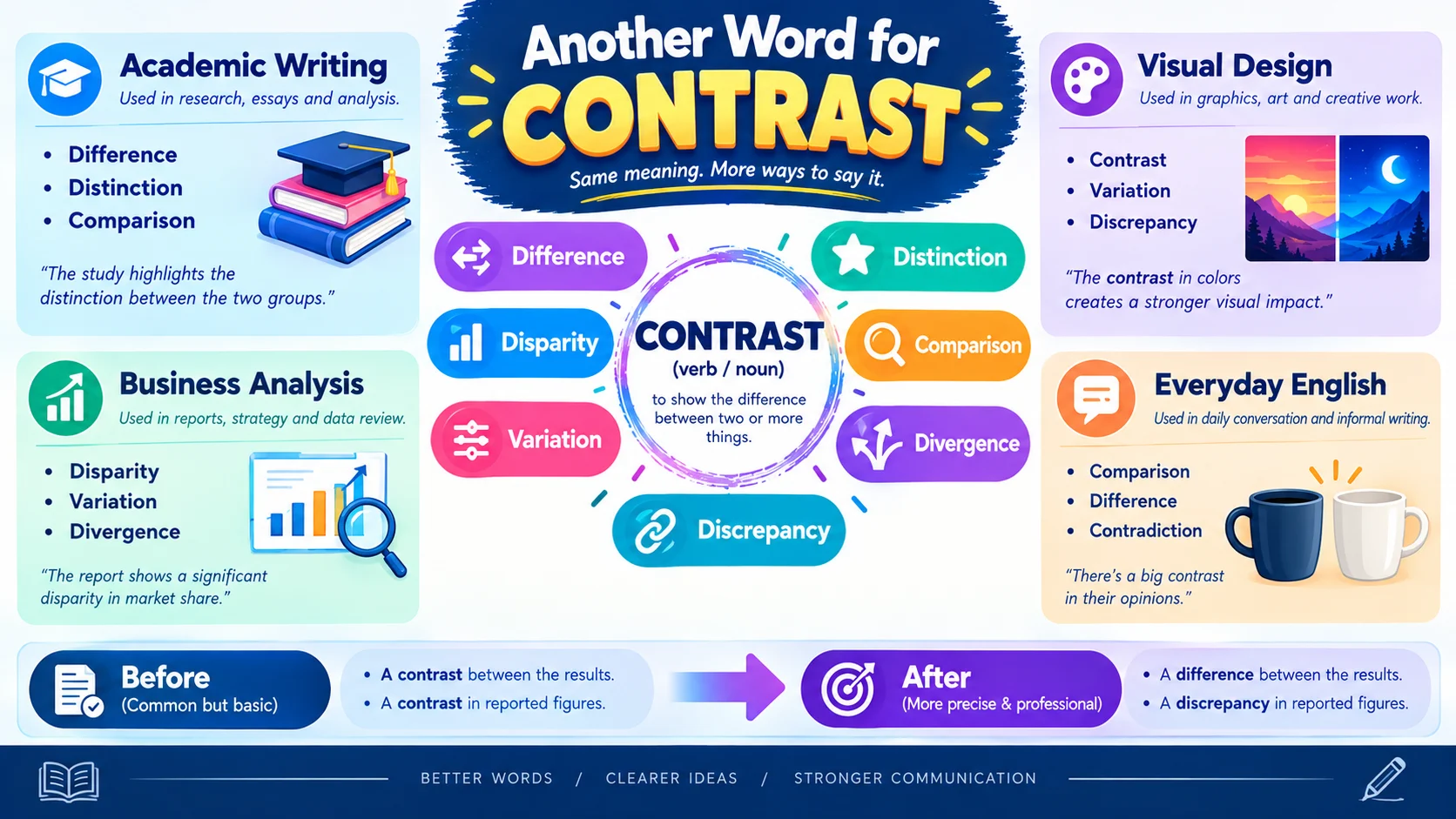
Another word for contrast depends on the context. Common synonyms include difference, distinction, comparison, disparity, variation, divergence, and opposition. Use difference for general comparisons, distinction when separating ideas or categories, disparity for a significant gap, and opposition when two things directly conflict. The best alternative depends on what you want to emphasize.
What Does Contrast Mean?
Definition
The word contrast can function as both a noun and a verb in American English. As a noun, it describes a difference between two or more things, especially when the differences are noticeable. As a verb, it means to compare things to highlight how they differ.
For example:
- There is a clear contrast between the two designs.
- The report highlights the contrast between urban and rural communities.
- The bright colors contrast with the dark background.
- The teacher asked students to contrast two historical periods.
Unlike a simple comparison, which may examine similarities and differences, contrast focuses primarily on differences.
Common Uses
The word contrast appears in several contexts:
- Academic writing: Highlighting differences between theories, texts, or research findings.
- Business communication: Comparing products, strategies, results, or performance.
- Visual design: Describing differences in color, brightness, size, or shape.
- Everyday conversation: Pointing out differences between people, places, or experiences.
- Statistics and social issues: Describing gaps or inequalities between groups.
- Literature and rhetoric: Emphasizing differences to strengthen an idea or argument.
Choosing the right synonym helps communicate whether you mean a general difference, a measurable gap, a comparison, or direct opposition.
Best Synonyms for Contrast
| Synonym | Meaning | Best Used When | Example |
|---|---|---|---|
| Difference | A way in which things are unlike | General comparisons | The difference between the plans is clear. |
| Distinction | A meaningful difference between things | Categories, concepts, and definitions | The distinction between facts and opinions matters. |
| Comparison | An examination of similarities or differences | Academic and business analysis | The comparison revealed several important differences. |
| Disparity | A significant difference or unequal gap | Income, access, results, or opportunities | The study examined the disparity in wages. |
| Variation | A change or difference within a group | Data, patterns, and designs | The results showed variation across age groups. |
| Divergence | A movement or difference away from a shared point | Opinions, trends, and strategies | The teams showed a divergence in priorities. |
| Opposition | A state of being contrary or in conflict | Conflicting ideas or positions | The proposal faced opposition from residents. |
| Discrepancy | A difference between figures or details that should agree | Reports, records, and measurements | We found a discrepancy in the financial records. |
| Differentiation | The process of identifying or creating differences | Education, marketing, and classification | Brand differentiation helped the company stand out. |
| Polarity | A state of having two opposite sides or positions | Strongly opposing views or qualities | The debate revealed the polarity of public opinion. |
| Incongruity | A lack of harmony or consistency | Unusual combinations or mismatched elements | The formal setting created an incongruity with his casual outfit. |
| Distinction in tone | A noticeable difference in style or feeling | Writing, speech, and communication | The distinction in tone changed how readers understood the message. |
Synonyms by Context
Formal Writing
For formal writing, distinction, disparity, divergence, discrepancy, and variation are useful alternatives.
Distinction works when separating two ideas that may seem similar.
Example: The author explains the distinction between correlation and causation.
Disparity is appropriate when a significant gap exists between groups, outcomes, or resources.
Example: The report identifies a disparity in access to educational opportunities.
Discrepancy is more precise when two pieces of information do not agree.
Example: The researchers investigated a discrepancy between the initial measurements and the final results.
These words are more specific than contrast, but they are not interchangeable in every sentence.
Professional Writing
In business communication, useful alternatives include difference, comparison, differentiation, disparity, and divergence.
Comparison works when evaluating products, strategies, or results.
Business example: The comparison of the two marketing campaigns revealed different conversion rates.
Differentiation is especially useful when explaining how a company or product stands apart from competitors.
Business example: Product differentiation helped the company attract a new customer segment.
Disparity can describe a gap in performance or resources.
Business example: The manager investigated the disparity between projected and actual sales.
For resumes and reports, select a term that explains the specific difference rather than relying on a broad word.
Academic Writing
Academic writing often uses distinction, variation, divergence, disparity, and comparison.
Distinction helps clarify concepts.
Academic example: The paper draws a distinction between short-term effects and long-term outcomes.
Variation is useful for describing differences within a dataset or population.
Academic example: The researchers observed variation in test scores across the participating schools.
Divergence describes results, opinions, or trends that move apart.
Academic example: The findings revealed a divergence between the two theoretical approaches.
When writing an essay, remember that compare generally asks you to examine similarities and differences, while contrast specifically directs attention to differences.
Daily Conversation
In everyday English, difference, opposite, gap, and comparison are often the most natural alternatives.
Examples:
- Instead of “There is a strong contrast,” say “There is a big difference.”
- Instead of “The contrast between them is obvious,” say “They’re very different.”
- Instead of “The contrast in prices is surprising,” say “The price gap is surprising.”
- Instead of “The colors contrast,” say “The colors look very different.”
Simple alternatives often improve clarity, particularly in casual conversations and accessible writing.
Professional Alternatives for Contrast
For professional communication, the right alternative depends on whether you are identifying a difference, measuring a gap, or explaining how something stands apart.
Distinction
Meaning: A meaningful difference between two things.
Best Used For: Definitions, business strategies, research concepts, and professional explanations.
Tone: Formal and precise
Difficulty: Medium
Usage Frequency: Common
Best For: Resume, Email Writing, Essay Writing, Business Writing
- Business example: Identified the distinction between customer needs and customer preferences.
- Academic example: The study established a distinction between the two theoretical models.
- Daily conversation example: I understand the distinction now.
Disparity
Meaning: A noticeable or significant difference, often involving inequality.
Best Used For: Financial performance, wages, opportunities, and social outcomes.
Tone: Formal
Difficulty: Advanced
Usage Frequency: Common
Best For: Essay Writing, Academic Writing, Business Writing
- Business example: The team analyzed the disparity between regional sales figures.
- Academic example: The research examined disparities in access to healthcare.
- Daily conversation example: There’s a big disparity between their salaries.
Comparison
Meaning: An examination of two or more things to identify similarities or differences.
Best Used For: Evaluations, research, reports, and decision-making.
Tone: Neutral to formal
Difficulty: Easy
Usage Frequency: Very Common
Best For: Resume, Email Writing, Essay Writing, Marketing Copy, Business Writing
- Business example: Conducted a comparison of competing products to support purchasing decisions.
- Academic example: The comparison revealed differences in the two methods.
- Daily conversation example: I made a quick comparison before choosing one.
Divergence
Meaning: A difference or separation between ideas, opinions, trends, or directions.
Best Used For: Strategy, research, forecasts, and changing patterns.
Tone: Formal
Difficulty: Advanced
Usage Frequency: Common
Best For: Essay Writing, Academic Writing, Business Writing
- Business example: The divergence in regional strategies required further discussion.
- Academic example: The data showed a divergence in outcomes between the two groups.
- Daily conversation example: Their opinions began to diverge over time.
Simple Alternatives for Contrast
If you want an easy replacement, consider these words:
- Difference: A general way in which things are unlike.
- Gap: A measurable or noticeable separation.
- Opposite: Something contrary to another thing.
- Comparison: An examination of two or more things.
- Change: A shift from one state or condition to another.
- Variation: A difference within a group or pattern.
- Mismatch: A lack of agreement or compatibility.
- Disagreement: A difference in opinions or beliefs.
For example, “The contrast between the two products is clear” could become “The difference between the two products is clear.”
However, change is not a direct synonym in every context. It refers to a shift over time rather than necessarily a difference between two things.
Stronger Alternatives for Contrast
Sometimes a more precise word makes your writing more effective.
Disparity emphasizes a substantial gap, especially in resources, opportunities, or outcomes.
Discrepancy highlights inconsistent information, figures, or records.
Divergence describes ideas, trends, or opinions moving in different directions.
Opposition emphasizes direct conflict between ideas, positions, or forces.
Differentiation highlights the process of making something distinct from alternatives.
Incongruity emphasizes a mismatch between things that do not seem to fit together.
For example, “The contrast between the two reports raised concerns” could become “The discrepancy between the two reports raised concerns” if the reports contain conflicting figures. The more specific term communicates the exact problem.
Difference Between Similar Synonyms
Contrast vs. Difference: Difference is a broad term for anything that makes things unlike. Contrast emphasizes differences that become noticeable when things are considered together.
Contrast vs. Comparison: Comparison examines similarities and differences. Contrast focuses on differences.
Contrast vs. Distinction: Distinction usually identifies a meaningful difference between concepts or categories. Contrast emphasizes the differences between things being examined.
Contrast vs. Disparity: Disparity often suggests a substantial or unequal gap. Contrast can describe differences without implying inequality.
Contrast vs. Discrepancy: Discrepancy means an inconsistency between details that might be expected to agree. Contrast does not necessarily imply an error or inconsistency.
Contrast vs. Opposition: Opposition suggests conflict or direct contradiction. Contrast can describe two things that differ without being in conflict.
Contrast vs. Variation: Variation refers to differences within a group, category, or pattern. Contrast more often highlights differences between particular things.
Opposite Words
The opposite of contrast depends on whether it refers to a difference or the act of comparing.
| Meaning of Contrast | Possible Opposite | Example |
|---|---|---|
| Difference between things | Similarity | The two designs share many similarities. |
| Noticeable distinction | Sameness | The products have a surprising sameness. |
| Opposition between ideas | Agreement | The two teams reached an agreement. |
| Separation between positions | Alignment | Their goals showed strong alignment. |
| Differences in appearance | Resemblance | The siblings have a strong resemblance. |
These are contextual opposites rather than exact antonyms for every use of contrast.
FAQs
What is another word for contrast?
Common synonyms include difference, distinction, comparison, disparity, variation, divergence, discrepancy, and opposition. The best alternative depends on the type and importance of the difference.
What is a formal synonym for contrast?
Formal alternatives include distinction, disparity, divergence, discrepancy, and variation. Use disparity for a significant gap and discrepancy for conflicting information.
What is a professional alternative for contrast?
In business writing, comparison, differentiation, distinction, disparity, and divergence are useful choices. For example, differentiation works well when explaining how a product stands out from competitors.
What word can replace contrast in an essay?
Use difference, distinction, comparison, variation, or divergence, depending on your point. Distinction is helpful when explaining concepts, while variation works well for differences in research results.
What is another word for contrast in literature?
Common alternatives include juxtaposition, opposition, difference, and distinction. Juxtaposition is particularly useful when two characters, settings, or ideas are placed together to emphasize their differences.
What is another word for contrast in art?
Useful alternatives include difference, variation, opposition, and juxtaposition. In visual design, contrast can refer specifically to differences in color, light, texture, shape, or size.
Is contrast the same as comparison?
No. Comparison examines similarities and differences, while contrast focuses mainly on differences. A comparison may include both, but a contrast emphasizes how things are unlike.
What is a synonym for strong contrast?
Depending on the context, use sharp difference, striking disparity, marked distinction, or pronounced contrast. These expressions emphasize noticeable or substantial differences.
What is the opposite of contrast?
Possible opposites include similarity, resemblance, sameness, agreement, and alignment. The best choice depends on whether the intended meaning involves appearance, ideas, or relationships.
What is another word for contrast in data?
Useful alternatives include variation, disparity, discrepancy, difference, and divergence. Use discrepancy for inconsistent figures and variation for differences across observations.
Conclusion
The best another word for contrast depends on what kind of difference you want to describe. Choose difference for general use, distinction for separating ideas, disparity for a significant gap, discrepancy for inconsistent information, and divergence for ideas or trends moving apart.
For academic writing, business communication, and everyday English, the most effective synonym is the one that communicates your intended meaning clearly. Rather than replacing contrast automatically, consider the context and choose a word that expresses the exact relationship between the things being discussed.