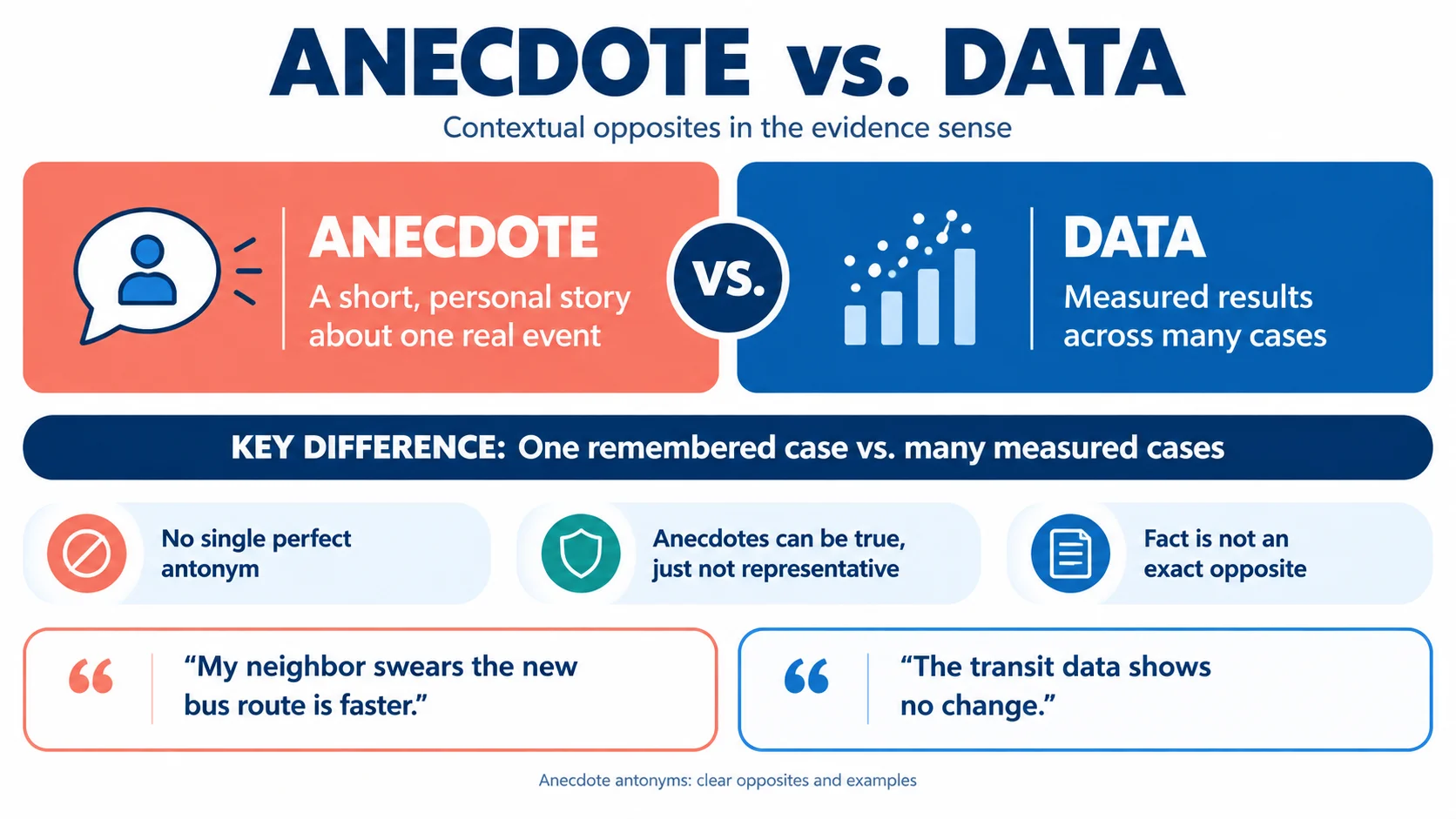
The opposite of anecdote is most often data, especially in arguments about evidence. An anecdote is a short, personal story about a real event. Dictionaries list no single perfect antonym, but statistics, data, and systematic evidence work as contextual opposites because they replace one story with measured patterns across many cases.
Part of speech: noun
Primary opposite: data (a contextual opposite)
An anecdote is a brief account of a particular incident, usually personal, told to entertain or to illustrate a point. It often comes secondhand and has not been verified.
When anecdote is used in the sense of evidence, as in “anecdotal evidence,” data is the strongest opposite. An anecdote rests on one case remembered by one person. Data rests on many cases that were recorded and measured.
There is no true direct antonym. Anecdote names a type of account, not a quality on a scale like hot and cold, so the best opposite depends on which sense you mean.
Direct and Strong Antonyms
Strictly speaking, these are not dictionary-listed direct antonyms. They are the strongest functional opposites, and each one fits the evidence sense of the word.
| Antonym | Tone or Nuance | Example Sentence |
|---|---|---|
| Data | Neutral, widely understood | My neighbor swears the new bus route is faster, but the transit data shows no change. |
| Statistics | Numerical, often journalistic | Instead of repeating a funny story, the nurse cited statistics on flu vaccination rates. |
| Empirical evidence | Formal, academic | The committee wanted empirical evidence, not one manager’s memory of a good quarter. |
| Controlled study | Scientific, highly formal | A single success story is encouraging, but a controlled study would tell us whether the program works. |
Each of these swaps one remembered case for information gathered on purpose and across many cases. That swap is the real opposition.
Contextual and Subtle Opposites
Anecdote has two main uses, and each one pulls toward a different opposite. All three pairings below are contextual, not exact antonyms.
| Context | Best Opposite | Why It Fits |
|---|---|---|
| Arguing a claim | Data | It replaces a single story with measured results. |
| Describing the scope of an account | Comprehensive report | An anecdote is brief and selective, while a full report is thorough and systematic. |
| Teaching a lesson | General principle | An anecdote shows one case, while a principle states what holds across cases. |
In arguments and research. Here anecdote means a story offered as proof. The opposite is anything systematic: data, statistics, or a study. A doctor might say, “I’ve seen this treatment work for a few patients, but that’s anecdotal until we have trial results.”
In storytelling. Here anecdote means a short, entertaining tale told in conversation or in a speech. Nothing is a perfect opposite, because no word names “a story that is not short and not personal.” The closest contrast is a thorough, formal account, such as a full history or a detailed report. A speaker who opens with an anecdote about a failed product launch is doing something different from one who delivers a forty-page postmortem.
In teaching and persuasion. An anecdote works by example, so its opposite is abstraction. A principle or general rule states the lesson directly, without the story that carries it.
Formality also shifts the choice. In casual conversation, people often say “hard numbers” or “the facts” as the foil to a story. In academic writing, “empirical evidence” or “quantitative data” is the expected pairing.
Words That Seem Opposite But Are Not
Two words show up often as supposed antonyms. Neither is an exact opposite.
Fact. Many people assume fact is the opposite of anecdote because anecdotes feel unreliable. But an anecdote can be entirely true. A true story about your grandfather’s first job is still an anecdote, and it is full of facts. The real difference is not truth versus falsehood. It is one case versus many measured cases. Saying “that’s just an anecdote” questions how representative the story is, not whether it happened.
Fiction. Fiction contrasts with anecdote on one point only: an anecdote is traditionally about something that really occurred, while fiction is invented. That makes fiction a related contrast, not an antonym. Fiction and anecdote can also look alike on the surface, since both are short narratives. The word fable has the same problem. A fable is an invented story built around a moral, so it differs from an anecdote in origin, not in being its opposite.
Subtle Tone Differences
The words around anecdote carry different strengths, and the choice changes how a sentence lands.
Anecdote can sound warm in conversation and dismissive in debate. “Let me tell you an anecdote” is friendly. “That’s just an anecdote” is a challenge.
Case study sits in the middle. It is still one case, but it is documented and analyzed. A hospital might publish a case study about one patient’s recovery, which carries more weight than a story told at a dinner party and less than a large trial.
Data point is a useful middle ground too. One measurement is data, yet one data point alone does not settle much. “That’s a data point, not a trend” is a common workplace line.
Statistics feels stronger and more final than data, and in everyday speech it can sound cold. A manager who answers a worried employee’s story with a spreadsheet may be accurate and still come across as dismissive.
Frequently Asked Questions
Is there a direct antonym for anecdote?
No dictionary establishes a single direct antonym. Anecdote names a kind of account, not a measurable quality. Writers use data, statistics, or empirical evidence as contextual opposites when anecdote means a story offered as proof.
What is the opposite of anecdote in a scientific context?
In science, the opposite is systematic evidence, such as data from a controlled study. Anecdotal evidence comes from individual reports. Scientific evidence comes from methods designed to measure results across many cases and reduce bias.
Can I use “fact” as the opposite of anecdote in a sentence?
Use it carefully. Anecdotes can be true, so fact is not an exact opposite. “Data” or “statistics” is more precise: “The statistics tell a different story than the anecdote he shared at the meeting.”
Practical Word Choice
1. Identify the intended meaning. Ask whether you mean a story told for fun, or a story offered as proof. For the first, you are contrasting scope and formality. For the second, you need an evidence word like data.
2. Match the context, tone, strength, and formality. Use “numbers” or “the facts” in casual speech, “statistics” in journalism, and “empirical evidence” in academic or professional writing. Choose a softer contrast like “case study” when you want to respect the story without treating it as proof.
Final Thoughts
Anecdote has no single, clean antonym, and that is the key point. What opposes it depends on what the word is doing in the sentence. As evidence, the opposite is data. As a short informal story, the contrast is a thorough, formal account. As a teaching tool, the contrast is a general principle.
Context matters because these opposites carry different strengths and tones. A casual conversation, a research paper, and a business meeting each call for a different choice, and the wrong one can sound either too blunt or too vague.
When you want a precise contrast, name what is missing from the anecdote: many cases, measurement, or breadth. The right opposite usually follows from that. What is a time you heard an anecdote that data later confirmed, or contradicted.