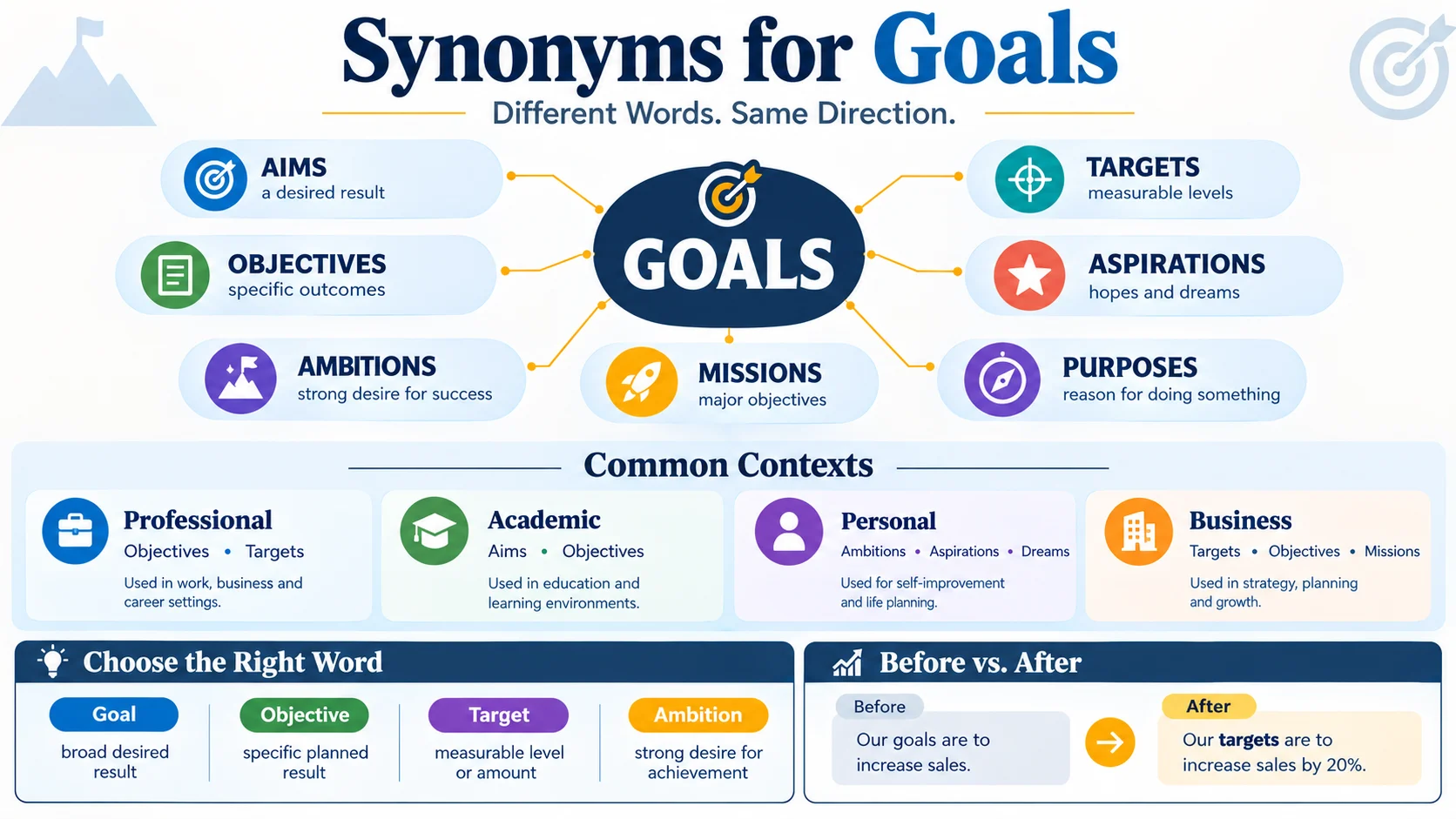
The best synonyms for goals include aims, objectives, targets, purposes, ambitions, aspirations, intentions, missions, plans, and dreams. The right replacement depends on context: objectives works well in professional writing, targets suggests measurable results, while ambitions and aspirations emphasize personal or long-term hopes.
What Does “Goals” Mean?
Definition
Goals are desired results, achievements, or outcomes that a person, organization, or group intends to accomplish. The word can describe something relatively immediate, such as finishing a project, or something long-term, such as building a successful career.
Cambridge defines goal as an aim or purpose and notes that it is commonly used for something a person or organization wants to achieve. In business English, goals can also refer to specific achievements a team or employee is expected to reach.
For example:
- My goals are to graduate and find a good job.
- The company established new sales goals.
- She set personal goals for the year.
- Our primary goal is to improve customer satisfaction.
The word goals is broad, which is why different synonyms work better in different situations.
Common Uses
You may use goals when discussing:
- Personal development
- Career planning
- Business performance
- Academic achievement
- Fitness and health plans
- Financial planning
- Projects
- Relationships
- Long-term ambitions
- Organizational strategy
Best Synonyms for Goals
| Synonym | Meaning | Best Used When | Example |
|---|---|---|---|
| Aims | Things you intend to achieve | General or formal contexts | Our aims include improving service. |
| Objectives | Specific things you plan to accomplish | Business and academic writing | The project has three key objectives. |
| Targets | Results or levels you intend to reach | Measurable outcomes | We exceeded our sales targets. |
| Purposes | Reasons for doing something | Explaining intention | The purposes of the program are clear. |
| Ambitions | Strong desires for future achievement | Career and personal success | Her ambitions include becoming a CEO. |
| Aspirations | Important hopes or desires | Long-term personal plans | His career aspirations are ambitious. |
| Intentions | What you plan or intend to do | Plans and decisions | Our intentions are to expand next year. |
| Missions | Important objectives or causes | Organizations and meaningful projects | Their mission is to improve access to education. |
| Dreams | Desired future achievements | Personal and emotional contexts | Her dream is to start a business. |
| Plans | Steps or arrangements for achieving something | Practical situations | We have plans to expand the company. |
Not every synonym is interchangeable in every sentence. Cambridge specifically distinguishes aim, goal, objective, and target: an aim is something you intend to achieve, a goal is closely related but emphasizes achieving a particular result, an objective is often used in work or business, and a target generally refers to a specific number, level, or amount.
Synonyms by Context
Formal Writing
For formal writing, strong alternatives include:
Aims:
“Our aims are to improve efficiency and reduce costs.”
Objectives:
“The study has three primary objectives.”
Purposes:
“The purposes of this policy are clearly defined.”
Intentions:
“The organization stated its intentions for the upcoming year.”
Ends:
“The program was established with specific ends in mind.”
Among these, aims and objectives are particularly natural in reports, proposals, essays, and institutional documents.
Professional Writing
In workplace and business writing, consider:
- Objectives
- Targets
- Aims
- Priorities
- Milestones
- Performance objectives
- Business objectives
- Strategic objectives
For example:
“The team achieved its quarterly goals.”
can become:
“The team achieved its quarterly objectives.”
Or, when the result is measurable:
“The team exceeded its quarterly targets.”
Targets are especially useful when the goal involves a number, quota, percentage, deadline, or measurable performance level.
Academic Writing
Academic alternatives include:
- Objectives
- Aims
- Purposes
- Intended outcomes
- Research objectives
- Research aims
Examples:
“The goals of this study are to examine consumer behavior.”
A more academic version is:
“The objectives of this study are to examine consumer behavior.”
Another option is:
“The primary aim of this study is to examine consumer behavior.”
Daily Conversation
In casual conversation, natural alternatives include:
- Plans
- Dreams
- Aims
- Hopes
- Ambitions
- Things I want to achieve
For example:
“One of my goals is to travel more.”
You could say:
“One of my dreams is to travel more.”
Or:
“One thing I want to achieve is traveling more.”
The original word goals is usually the most natural choice in everyday speech.
Professional Alternatives for Goals
If you are writing a resume, cover letter, business report, performance review, or LinkedIn profile, these alternatives can make your wording more precise.
Objectives
Use objectives when describing clearly defined professional outcomes.
Resume example:
“Established quarterly objectives that improved team productivity.”
Targets
Use targets for measurable results.
Resume example:
“Exceeded annual sales targets by 18%.”
Milestones
Use milestones for significant stages or checkpoints in a larger project.
Business example:
“The development team reached its first product milestone.”
Priorities
Use priorities when you mean the things that deserve attention rather than final outcomes.
Professional example:
“Our immediate priorities include improving response times and reducing costs.”
Strategic Objectives
Use strategic objectives when discussing high-level organizational plans.
Business example:
“The company established strategic objectives for international expansion.”
Simple Alternatives for Goals
If you want an easier word, try:
- Aims
- Plans
- Hopes
- Dreams
- Targets
- Things to achieve
- Things you want to accomplish
For simple everyday English, aims, plans, and things you want to achieve are particularly easy to understand.
For example:
Original:
“I have several goals for this year.”
Simple:
“I have several things I want to achieve this year.”
Casual:
“I have a few plans for this year.”
Stronger Alternatives for Goals
Some alternatives add a stronger sense of determination or importance.
Ambitions
Ambitions suggests a strong desire to accomplish something significant.
Example:
“She has ambitious career goals.”
Alternative:
“She has ambitious career aspirations.”
Aspirations
Aspirations often refers to important hopes for the future, particularly career, personal, or social development.
Example:
“His professional aspirations include leading an international team.”
Mission
Mission suggests an important objective or purpose, often involving an organization, cause, or long-term commitment.
Example:
“The organization’s mission is to expand access to education.”
Dream
Dream is more personal and emotional than goal.
Example:
“Her goal is to open a bakery.”
More emotional:
“Her dream is to open a bakery.”
Cambridge lists ambition, aspiration, dream, hope, and mission among words related to something someone wants to achieve, while also distinguishing their typical uses.
Difference Between Similar Synonyms
Goals vs. Aims
Goal and aim are extremely close. An aim often describes the intended result of an action, while goal can emphasize the result someone wants to achieve.
- Aim: Our aim is to raise awareness.
- Goal: Our goal is to reach 10,000 customers.
Goals vs. Objectives
Objectives often sound more specific, formal, and professional.
- Goal: Improve customer satisfaction.
- Objective: Increase customer satisfaction scores by 15% this quarter.
This is why objectives frequently appears in business, academic, and project-management contexts.
Goals vs. Targets
A target is usually more measurable.
- Goal: Increase sales.
- Target: Increase sales by 20% this year.
If a goal includes a specific number, percentage, amount, or performance level, target may be the more precise choice.
Goals vs. Ambitions
Ambitions usually carry a stronger sense of personal drive or achievement.
- Goal: Get a promotion.
- Ambition: Become a senior executive.
Goals vs. Aspirations
Aspirations often describe hopes for the future, especially career or personal development.
- Goal: Complete my degree.
- Aspiration: Build a meaningful career in science.
Goals vs. Purposes
A goal is something you want to achieve. A purpose is the reason something exists or is done.
- Goal: Increase website traffic.
- Purpose: Provide useful information to readers.
This distinction matters because purpose is not always a direct replacement for goal.
Business, Academic, and Daily Examples
Business Example
Original:
“Our goals for the next quarter include increasing sales and improving retention.”
Alternative:
“Our objectives for the next quarter include increasing sales and improving retention.”
If specific numerical results are involved:
“Our targets for the next quarter include a 15% increase in sales.”
Academic Example
Original:
“The goals of this research are to examine and compare two methods.”
Alternative:
“The objectives of this research are to examine and compare two methods.”
For academic papers, aim, objective, and purpose can sound more precise than the general word goal.
Daily Conversation Example
Original:
“One of my goals is to learn Spanish.”
Natural alternatives include:
- “One of my aims is to learn Spanish.”
- “One of my plans is to learn Spanish.”
- “One of my dreams is to become fluent in Spanish.”
- “Something I want to achieve is learning Spanish.”
The best choice depends on tone. Dream sounds more personal, while plan sounds more practical.
Synonym Analysis: Which Word Should You Choose?
Aim
Meaning: A result you intend to achieve.
Best Used For: General and formal writing.
Tone: Neutral to formal.
Difficulty: Easy.
Usage Frequency: Very Common.
Best For: Essays, reports, business writing, everyday conversation.
Objective
Meaning: A specific thing you plan to achieve.
Best Used For: Professional, academic, and organizational writing.
Tone: Formal and professional.
Difficulty: Medium.
Usage Frequency: Very Common.
Best For: Resumes, reports, research papers, business writing.
Target
Meaning: A particular level, amount, or result you intend to reach.
Best Used For: Measurable goals.
Tone: Professional and practical.
Difficulty: Easy.
Usage Frequency: Very Common.
Best For: Business writing, sales, marketing, performance reports.
Ambition
Meaning: A strong desire to achieve something significant.
Best Used For: Career and personal achievement.
Tone: Motivational.
Difficulty: Easy.
Usage Frequency: Common.
Best For: Resumes, personal statements, essays, interviews.
Aspiration
Meaning: An important hope or desire for the future.
Best Used For: Long-term personal or professional development.
Tone: Formal and polished.
Difficulty: Medium.
Usage Frequency: Common.
Best For: Resumes, academic writing, career discussions.
Mission
Meaning: An important purpose or objective.
Best Used For: Organizations, causes, and major projects.
Tone: Strong and purposeful.
Difficulty: Easy.
Usage Frequency: Very Common.
Best For: Business writing, nonprofit writing, marketing copy.
Opposite Words
Depending on the meaning, possible opposites or contrasting concepts for goals include:
- Aimlessness
- Lack of direction
- Inaction
- Indifference
- Purposelessness
- Neglect
- Disinterest
The exact opposite depends on context. For example, aimlessness contrasts with having clear goals, while inaction describes failing to act toward a desired result.
FAQs
What is another word for goals?
Common alternatives for goals include aims, objectives, targets, purposes, ambitions, aspirations, intentions, missions, plans, and dreams.
What is a formal synonym for goals?
Objectives and aims are strong formal alternatives. In academic and professional writing, objectives is especially common.
What is a professional word for goals?
Objectives, targets, and strategic objectives are common professional alternatives. Use targets when the desired outcome is measurable.
What is another word for goals on a resume?
Good resume alternatives include objectives, achievements, targets, aspirations, and career objectives. Choose the word based on whether you are describing a desired outcome, measurable result, or career direction.
What is another word for personal goals?
Depending on the context, you can use personal aims, aspirations, ambitions, plans, dreams, or things you want to achieve.
What is another word for career goals?
Common choices include career objectives, professional aspirations, career ambitions, and professional aims.
What is another word for business goals?
Use business objectives, strategic objectives, performance targets, or organizational aims.
Are goals and objectives the same?
They are closely related, but objective often sounds more specific and formal. In professional contexts, objectives may describe concrete outcomes that support a broader goal.
Are goals and targets the same?
Not always. A target generally refers to a particular level, amount, or measurable result, while a goal can be broader.
What is the difference between goals and ambitions?
A goal is something you want to achieve, while an ambition usually expresses a strong desire for significant achievement, especially in personal or professional life.
Conclusion
The best synonym for goals depends on what you are trying to express. Aims and objectives work well in formal, academic, and professional writing, while targets are better for measurable results. For personal or long-term plans, ambitions, aspirations, and dreams can add more meaning and emotion.
Choosing the right alternative is not just about avoiding repetition. It helps make your writing more precise, natural, and appropriate for the situation. Whether you are writing a resume, research paper, business report, or everyday message, consider the exact meaning and tone you want before replacing the word goals.