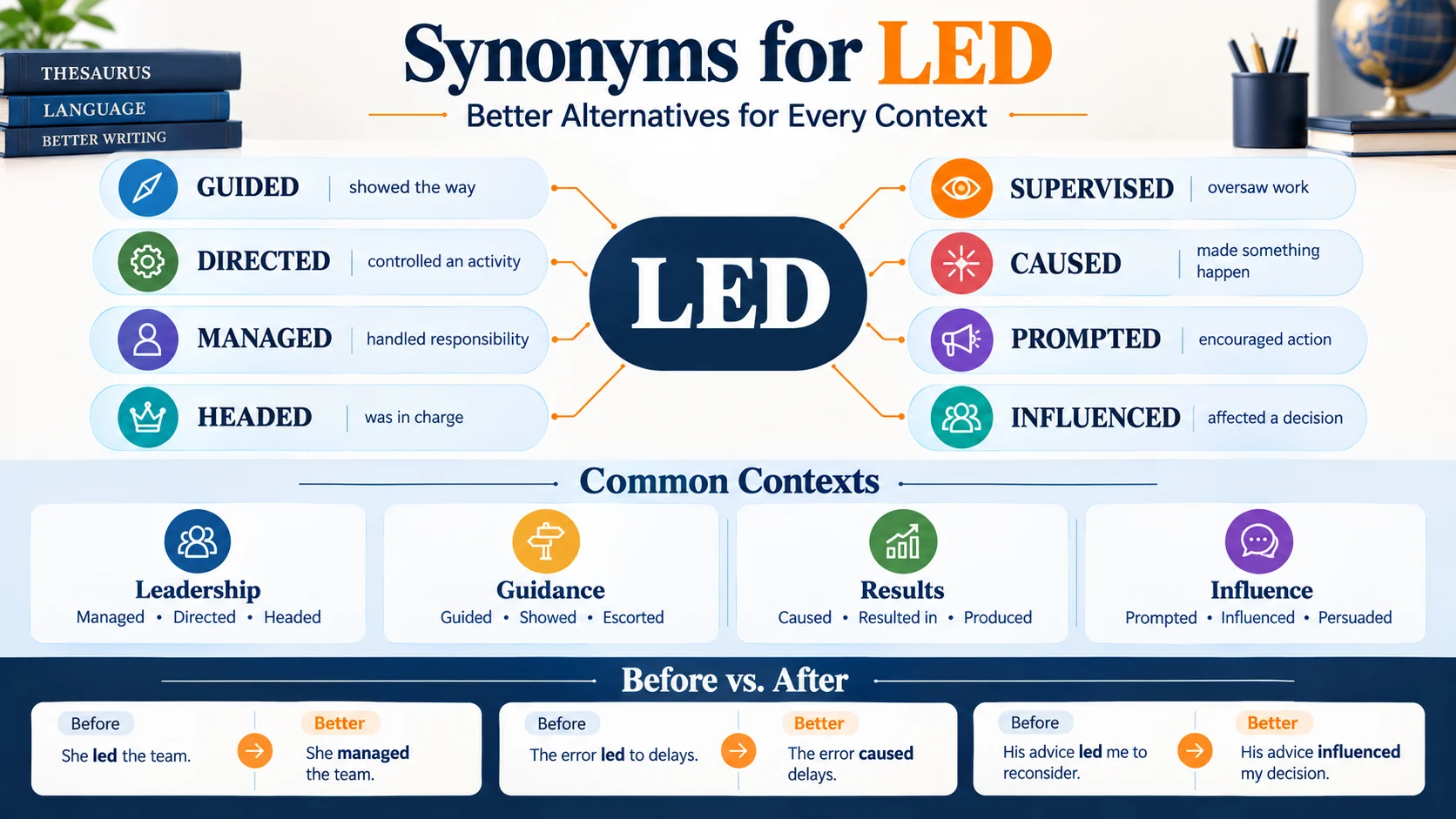
Another word for led depends on the context. Common synonyms include guided, directed, managed, headed, supervised, influenced, prompted, and caused. For example, use managed for leading a team, guided for showing the way, and caused when led to describes a result.
What Does Led Mean?
Definition
Led is the past tense and past participle of lead. Its meaning depends heavily on the sentence. It can mean guided someone, directed a group, managed an activity, went ahead of others, caused a result, influenced a decision, or resulted in an outcome.
For example:
- She led the team through a difficult project. → guided
- He led the meeting. → directed or chaired
- The mistake led to delays. → caused or resulted in
- She led the race for most of the afternoon. → was ahead
- His advice led me to reconsider the decision. → influenced or prompted
Because led has several meanings, there is no single synonym that works in every sentence. Collins separates the word into meanings including guiding, being ahead, resulting in something, influencing someone, and managing.
Common Uses
The word led commonly appears in sentences about:
- Leadership
- Guidance
- Management
- Direction
- Results and consequences
- Influence
- Movement
- Competition
- Research and analysis
- Personal experiences
The most accurate synonym should match the intended meaning rather than simply replacing the word mechanically.
Best Synonyms for Led
| Synonym | Meaning | Best Used When | Example |
|---|---|---|---|
| Guided | Showed someone the way or helped them | Direction and support | She guided the new employees through training. |
| Directed | Controlled or gave instructions | Projects, teams, activities | He directed the research team. |
| Managed | Was responsible for running something | Business and professional settings | She managed the department for three years. |
| Headed | Was in charge of something | Teams, departments, organizations | He headed the marketing division. |
| Conducted | Organized or carried out an activity | Meetings, research, interviews | She conducted the experiment. |
| Chaired | Presided over a meeting or committee | Formal meetings | He chaired the committee meeting. |
| Supervised | Oversaw people’s work | Workplace and academic settings | She supervised the project team. |
| Caused | Made something happen | Results and consequences | The error caused a delay. |
| Resulted in | Produced a particular outcome | Reports and analysis | The change resulted in higher costs. |
| Prompted | Caused someone to act or respond | Decisions and reactions | The warning prompted an investigation. |
| Influenced | Affected someone’s thinking or behavior | Opinions and decisions | Her research influenced the final decision. |
| Preceded | Came before something or someone | Time, order, movement | The introduction preceded the main discussion. |
Synonyms by Context
Formal Writing
For formal writing, choose words that precisely describe what led means.
Directed, conducted, supervised, preceded, resulted in, and prompted are useful alternatives.
Example:
Original:
The study led to further investigation.
Formal alternative:
The study resulted in further investigation.
This version clearly emphasizes the relationship between the study and its outcome.
Professional Writing
In resumes, reports, business documents, and workplace communication, alternatives such as managed, directed, headed, supervised, and oversaw can be more specific than led.
Instead of:
Led a team of 10 employees.
You might write:
Managed a team of 10 employees.
Or:
Supervised a team of 10 employees.
The choice depends on your actual responsibility. Managed generally emphasizes responsibility for operations or people, while supervised emphasizes oversight.
Academic Writing
Academic writing often benefits from precise cause-and-effect language.
Useful alternatives include:
- Resulted in
- Caused
- Contributed to
- Prompted
- Influenced
- Produced
- Generated
For example:
The intervention led to improved test scores.
Could become:
The intervention resulted in improved test scores.
Or, if the evidence supports a causal claim:
The intervention caused an improvement in test scores.
Be careful with caused, because it makes a stronger causal claim than simply saying something led to an outcome.
Daily Conversation
In everyday English, simple alternatives usually sound more natural.
Depending on context, you can use:
- Guided
- Showed
- Took
- Directed
- Helped
- Brought
- Caused
For example:
She led me to the right room.
Natural alternative:
She showed me the right room.
Professional Alternatives for Led
When writing a resume, led is common, but a more precise verb can communicate your actual responsibility.
Managed
Meaning: Was responsible for operating or organizing something.
Tone: Professional
Difficulty: Easy
Best for: Resumes, business writing, management descriptions
Example:
Managed a five-person customer support team.
Directed
Meaning: Controlled or guided an activity or group.
Tone: Professional and authoritative
Difficulty: Medium
Best for: Resumes, business reports, project descriptions
Example:
Directed the implementation of a new customer-service system.
Supervised
Meaning: Oversaw the work of people or a process.
Tone: Professional
Difficulty: Easy
Best for: Resumes, workplace communication, academic projects
Example:
Supervised daily operations and employee scheduling.
Oversaw
Meaning: Had responsibility for monitoring or managing something.
Tone: Professional
Difficulty: Medium
Best for: Resumes, reports, business writing
Example:
Oversaw the development of three software projects.
Headed
Meaning: Was the person in charge of a department, team, or organization.
Tone: Professional
Difficulty: Easy
Best for: Resumes, biographies, business writing
Example:
Headed the company’s digital marketing department.
Simple Alternatives for Led
If you want an easy replacement, consider:
Guided, showed, directed, took, helped, managed, went ahead of, or caused.
The best choice depends on the sentence.
For example:
She led us through the building.
→ She guided us through the building.
He led the discussion.
→ He directed the discussion.
The mistake led to confusion.
→ The mistake caused confusion.
The road led to the village.
→ The road went to the village.
Stronger Alternatives for Led
Some alternatives can communicate a more specific or authoritative meaning.
Commanded emphasizes authority.
The captain commanded the unit.
Chaired emphasizes responsibility for a formal meeting or committee.
She chaired the board meeting.
Directed emphasizes active control and decision-making.
He directed the project from its initial planning stage.
Orchestrated emphasizes carefully coordinating multiple elements.
She orchestrated the company’s product launch.
Spearheaded emphasizes taking the initiative in starting or driving an important project.
He spearheaded the company’s expansion into new markets.
However, these words should describe what actually happened. A thesaurus replacement should not make a person’s role sound more powerful than it was.
Difference Between Similar Synonyms
Led vs. Guided
Led can mean taking responsibility for moving a person or group toward a destination or goal.
Guided usually emphasizes helping or showing someone the way.
The manager led the team.
The mentor guided the student.
Led vs. Managed
Led emphasizes leadership or direction.
Managed emphasizes responsibility for organizing, operating, or controlling something.
She led the project strategy.
She managed the project’s budget and schedule.
Led vs. Directed
Directed usually sounds more authoritative and emphasizes giving instructions or controlling an activity.
He led the team through the transition.
He directed the team during the emergency.
Led vs. Caused
These words can overlap when led to describes an outcome, but they are not always interchangeable.
Poor planning led to delays.
Poor planning caused delays.
Caused generally makes the causal relationship more direct and definite.
Led vs. Influenced
Influenced is appropriate when something affected a person’s thoughts, behavior, or decision.
Her experience influenced her career choice.
It would not normally replace led when someone physically guided another person.
Business, Academic, and Daily Examples
Business Example
Original:
Sarah led the company’s customer-service initiative.
Possible alternatives:
Sarah directed the company’s customer-service initiative.
Sarah managed the customer-service initiative.
Sarah headed the customer-service initiative.
Each version emphasizes a slightly different aspect of responsibility.
Academic Example
Original:
The findings led to additional research.
Possible alternatives:
The findings prompted additional research.
The findings resulted in additional research.
The findings inspired further investigation.
For academic writing, resulted in and prompted can make the relationship clearer when they accurately describe the evidence.
Daily Conversation Example
Original:
He led me to the parking lot.
Possible alternatives:
He guided me to the parking lot.
He showed me the way to the parking lot.
He took me to the parking lot.
The simplest alternative is often the most natural in casual conversation.
Opposite Words
The appropriate opposite of led depends on its meaning.
When led means guided, possible opposites include:
- Followed
- Trailed
- Was guided
- Came behind
When led means was in charge, possible contrasting ideas include:
- Followed
- Obeyed
- Was subordinate to
- Took direction from
When led means was ahead, the opposite can be:
- Trailed
- Fell behind
- Followed
When led to means caused, an opposite concept may be:
- Prevented
- Avoided
- Blocked
- Prevented from happening
These are contextual opposites rather than universal antonyms.
FAQs
What is another word for led?
The best synonym depends on the meaning. Guided, directed, managed, headed, supervised, caused, resulted in, prompted, influenced, and preceded are common alternatives.
What is a formal synonym for led?
Formal alternatives include directed, supervised, conducted, managed, headed, oversaw, resulted in, and prompted. Choose according to the exact meaning.
What is a professional alternative for led?
For professional writing, managed, directed, supervised, headed, oversaw, and spearheaded can replace led when they accurately describe the person’s responsibilities.
What word can replace led on a resume?
Depending on the accomplishment, try managed, directed, supervised, oversaw, headed, coordinated, or spearheaded. The strongest choice is the one that accurately describes what you actually did.
What is another word for led to?
Common alternatives include caused, resulted in, produced, generated, prompted, contributed to, brought about, and gave rise to.
What is another word for led a team?
Possible alternatives include managed a team, directed a team, supervised a team, headed a team, or guided a team.
What is another word for led a meeting?
Depending on the situation, you can say chaired the meeting, conducted the meeting, directed the meeting, or presided over the meeting.
Is guided a synonym for led?
Yes. Guided is a synonym when led means showing someone where to go or helping someone progress toward a goal. It is not appropriate for every meaning of led.
Is managed a synonym for led?
Yes, in leadership and workplace contexts. However, managed specifically emphasizes responsibility for organizing or operating something, while led can have a broader meaning.
Is caused a synonym for led?
Sometimes. In phrases such as “the decision led to higher costs,” caused can be an alternative. However, caused may express a more direct causal relationship.
Conclusion
The best synonym for led depends on what the sentence is trying to say. Use guided when someone showed the way, managed when someone was responsible for operations, directed when someone controlled an activity, headed when someone was in charge, and resulted in or caused when led to describes an outcome. For influence, prompted or influenced may be more precise.
Rather than replacing led with the most impressive-sounding word, choose the alternative that preserves the original meaning. That approach produces clearer resumes, stronger academic writing, and more natural everyday English.