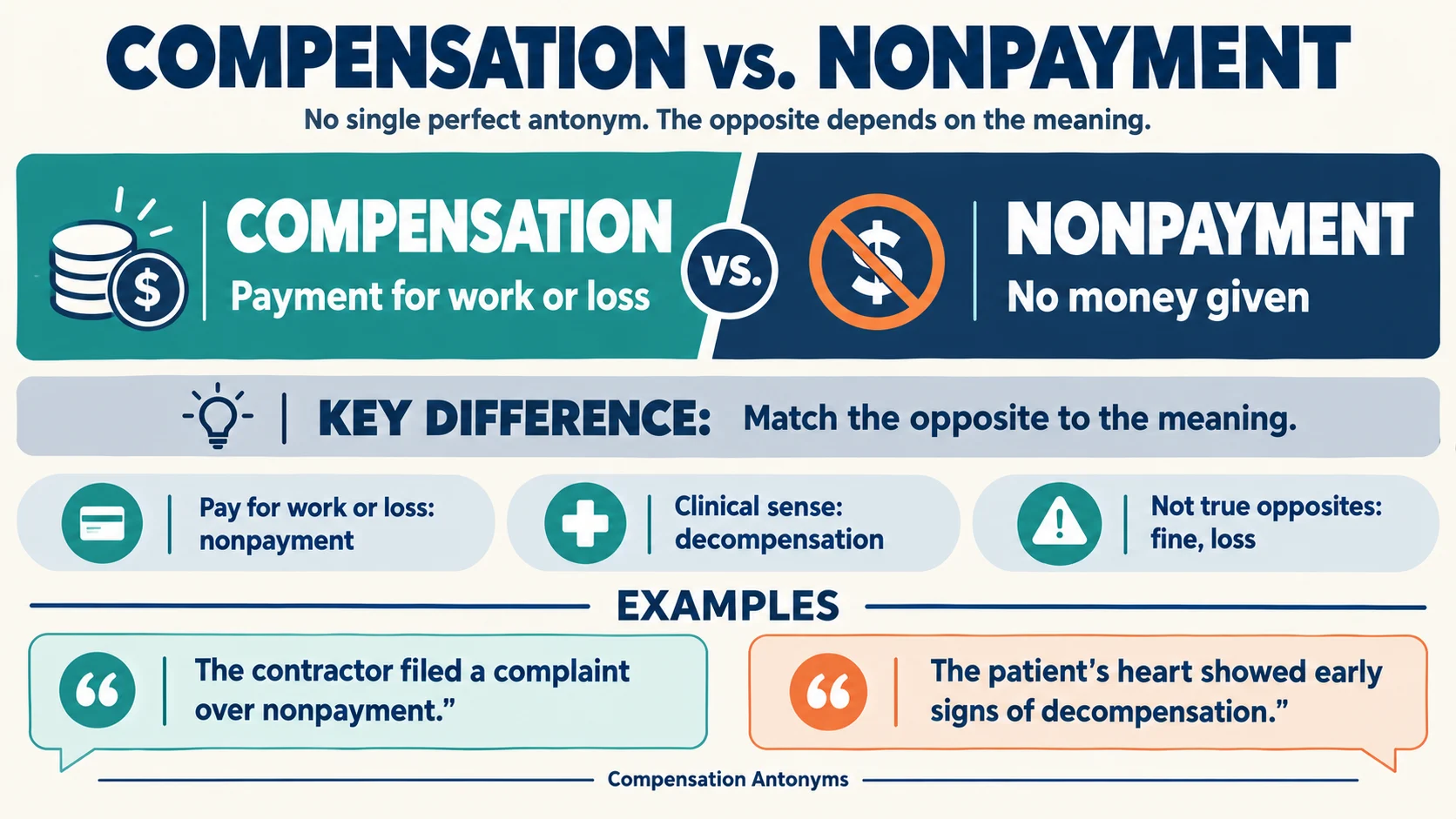
Compensation has no single perfect antonym. When it means payment for work or loss, the strongest contextual opposite is nonpayment, meaning no money is given. In clinical settings, where compensation means the body or mind offsetting a deficit, the established opposite is decompensation.
Part of speech: noun
Primary opposite: nonpayment (contextual, for the money sense)
Compensation has three main senses: pay for work, payment that makes up for a loss or injury, and something that offsets a weakness or deficit. Dictionaries do not list one settled antonym that covers all three.
When compensation means money owed for work or harm, nonpayment is the strongest contextual opposite. It names the absence of that payment. When compensation means offsetting a deficit in psychology or medicine, decompensation is the established opposite.
So the right answer depends on meaning. Anyone who offers a single word without asking which sense you need is oversimplifying.
Direct and Strong Antonyms
These are the closest established opposites, each tied to a specific sense.
| Antonym | Sense | Tone or Nuance | Example Sentence |
|---|---|---|---|
| Nonpayment | Pay for work or loss | Formal, legal, neutral | The contractor filed a complaint over nonpayment after finishing the kitchen remodel. |
| Decompensation | Offsetting a deficit | Technical, clinical | The cardiologist warned that the patient’s heart was showing early signs of decompensation. |
Nonpayment works because compensation is something given, and nonpayment is the failure to give it. It is common in contracts, invoices, and court filings.
Decompensation is a real term in medicine and psychology. It describes the point where coping mechanisms stop working. It is rare in everyday speech, so use it only in clinical or academic writing.
A note on uncompensated. This is an adjective, so it opposes the adjective compensated, not the noun compensation. It still works well in sentences: “She spent the summer on uncompensated overtime.” If your sentence needs a noun, choose nonpayment instead.
Contextual and Subtle Opposites
The best opposite shifts with the meaning of compensation. These are contextual choices, not direct antonyms.
| Context | Best Opposite (Contextual) | Why It Fits |
|---|---|---|
| Pay for a job | Nonpayment, or the phrase unpaid work | Describes labor that earns no money |
| Payment for harm | Uncompensated loss | Describes damage with no payment to offset it |
| Clinical or psychological | Decompensation | Describes the failure of the offsetting process |
| General offsetting | No established single word | English offers no neat opposite here |
Here is how each context sounds in real writing.
Pay for a job. “The startup asked for six weeks of unpaid work before discussing salary.” The phrase unpaid work flags a situation where compensation is absent.
Payment for harm. “After the flood, the family was left with an uncompensated loss of nearly $40,000.” The phrase is a noun phrase, so it fits formal writing where a single word would not.
Clinical use. “The therapist noted that her patient’s coping strategies were failing, a pattern known as decompensation.” Here compensation means healthy adaptation, and decompensation means its collapse.
General offsetting. If you write that strong defense compensated for weak offense, no single word cleanly reverses that idea. Rephrase instead: “Strong defense failed to make up for weak offense.” Forcing an antonym here would sound unnatural.
Words That Seem Opposite But Are Not
Two terms often get offered as opposites. Both are related contrasts, not antonyms.
Penalty or fine. Compensation is money received, and a fine is money paid out as punishment, so they seem like reverse images. But they are not true opposites. Both involve payment, and the real contrast is the direction of the money and the reason for it. “The airline paid a fine to the government and offered compensation to stranded passengers” shows both coexisting in one event.
Loss. Loss is what compensation responds to, not what reverses it. Someone who suffers a loss may receive compensation for it. “The company reported a loss, then received compensation from its insurer” shows the two working together. Treating them as opposites confuses the problem with the remedy.
Subtle Tone Differences
Even when you pick the right idea, word choice changes the tone.
Formality. Nonpayment is formal and fits legal or business writing. Unpaid is plainer and fits everyday speech. Going without pay is conversational. Compare “The vendor cited nonpayment” with “I worked there for months and never got paid.”
Strength. Nonpayment can describe a simple oversight. Wage theft, a related legal term, implies deliberate wrongdoing, so it is stronger and should be used only when that is accurate. Do not swap one for the other casually.
Register of the original word. Compensation itself is a formal, HR-friendly word for pay and benefits together. If you contrast it with something casual, the sentence can feel uneven. “Her compensation package included stock options, while her volunteer role offered no pay at all” keeps the tone consistent.
Frequently Asked Questions
What word means the opposite of compensation?
Compensation has no single perfect antonym. For payment, nonpayment is the closest contextual opposite, since it describes money that is owed but not given. For clinical use, decompensation fits. Choose based on which meaning of compensation you are contrasting.
What is the opposite of compensation in psychology?
In psychology and medicine, compensation means the mind or body offsetting a weakness. Decompensation is the opposite: the point where those coping mechanisms fail and function declines. Clinicians use it for conditions such as heart failure or a mental health crisis.
Should I write nonpayment or unpaid in a sentence?
Use nonpayment as a noun for the failure to pay, as in a legal or business setting. Use unpaid as an adjective for work or bills that have not been paid. “Unpaid internship” is natural; “internship nonpayment” is not.
Practical Word Choice
1. Identify the intended meaning. Ask whether compensation in your sentence means salary, repayment for harm, or offsetting a weakness. Each meaning points to a different opposite.
2. Match the context, tone, strength, and formality. Use nonpayment for legal or business writing, unpaid for everyday speech, and decompensation only for clinical contexts. If no word fits cleanly, rewrite the sentence.
Final Thoughts
Compensation does not have one clean antonym, and that is the key point. Nonpayment is the strongest contextual opposite for money, and decompensation is the established opposite in clinical settings. Penalty and loss often get mistaken for opposites, but they are related contrasts.
Context matters because compensation covers several ideas at once. A word that reverses pay will not reverse a coping mechanism, and the reverse is equally true. Choosing the right opposite is mostly a matter of naming the sense first.
When no single word works, a short rephrase is usually clearer than a forced antonym. Readers notice precision, and they notice strain too.
What sentence have you struggled to finish because the right opposite of compensation would not come to mind?