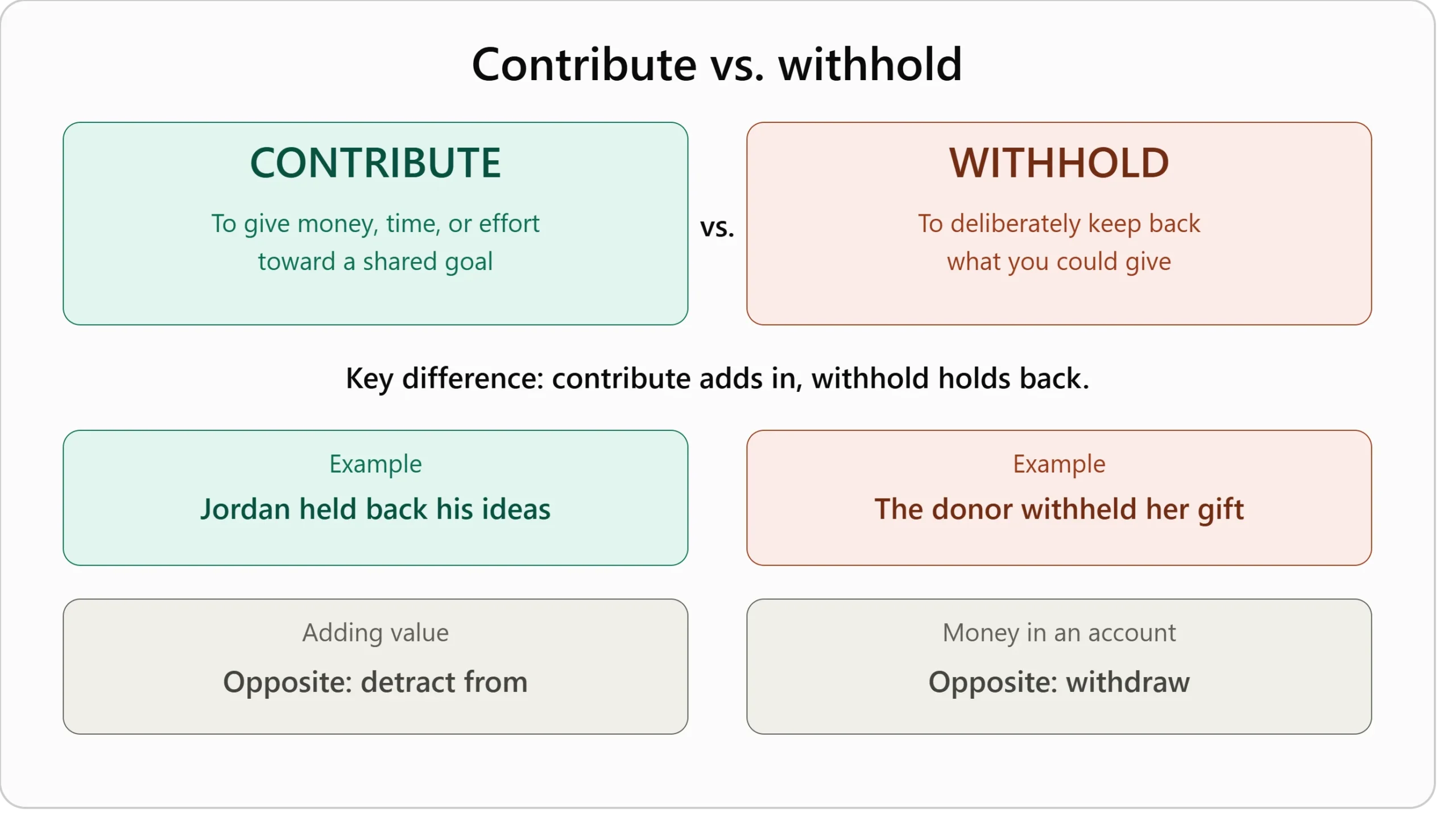
The opposite of contribute is withhold when contribute means to give money, time, or effort toward a shared goal. When it means to add to something’s quality or value, detract from is the stronger opposite. No single antonym fits every sense, so context decides the best choice.
Part of Speech: Verb
Primary Opposite: Withhold
Contribute means to give something, such as money, time, effort, or ideas, to a shared purpose, or to help bring about a result. When contribute means giving toward a group goal, withhold is the strongest direct opposite. It describes a deliberate choice to keep back what you could offer.
English has no single perfect antonym for contribute, because the word covers several ideas. The right opposite depends on which meaning you intend, so the sections below sort the options by sense.
Direct and Strong Antonyms
Think of a neighborhood block party fund. A neighbor who contributes pays in. A neighbor who withholds does not. These three words are the most natural opposites in everyday American English.
| Antonym | Tone or Nuance | Example Sentence |
|---|---|---|
| withhold | Formal and deliberate. Suggests a conscious choice not to give. | The donor decided to withhold her gift until the charity published its audit. |
| hold back | Informal and flexible. Can suggest hesitation instead of refusal. | Jordan held back his ideas because the meeting felt rushed. |
| detract from | Formal. Opposes contribute in the sense of adding value. | The cluttered slides detracted from an otherwise strong presentation. |
Detract from deserves a note. It is not the opposite of giving money or time. It is the opposite of contribute to when the word means adding to something’s quality. “The new bookshelves contribute to the room’s warm feel” pairs naturally with “The harsh overhead light detracts from it.”
Contextual and Subtle Opposites
Contribute has several major senses, and each one calls for a different opposite. The table below separates direct opposites from contextual ones.
| Context | Best Opposite | Why It Fits |
|---|---|---|
| Giving money or resources to a fund | withhold (direct) | It names the choice to keep back what could be given. |
| Adding quality, value, or atmosphere | detract from (direct) | It lessens something where contribute adds to it. |
| Helping cause a result | prevent or counteract (contextual) | It describes stopping or working against that result. |
| Putting money into an account | withdraw (contextual) | In finance, money goes in or comes out. |
| Sharing in a group effort | take (contextual) | It contrasts people who give with people who only draw from the pool. |
Consider the sense of being one factor in an outcome. “Poor planning contributed to the delays” has no tidy reverse. If good planning stopped the delays, prevent works. If a new schedule worked against the delays that were already building, counteract fits. Both are contextual, because neither is a mirror image of contribute.
The finance sense is more precise. “She contributes $500 a month to her 401(k) and plans not to withdraw anything until retirement.” Here withdraw is a clean opposite, but only in this setting. It makes no sense for ideas or effort. You would never say someone “withdrew” their ideas from a brainstorm.
The shared-resource sense works through contrast. “Some roommates contribute to the grocery fund, and others only take from it.” Take is a contextual opposite here. It would sound odd in a sentence about adding value to a design.
Words That Seem Opposite But Are Not
Receive
Receive is the other side of a transaction, not the reverse of contribute. “The food bank receives donations from neighbors who contribute.” One person can contribute and receive within the same group at the same time. Receive is a related contrast, not an antonym.
Distribute
Distribute means to hand something out to others. Contribute means to add to a pool. “The pantry distributes groceries every Friday” describes outflow, but it does not oppose the act of giving something in. A volunteer can contribute canned goods and also distribute them. These are related contrasts, and they can happen together.
Subtle Tone Differences
Choosing among opposites often comes down to strength, formality, and implied blame.
Withhold sounds official and intentional. “The manager withheld approval until the budget was final.” It fits reports, contracts, and professional writing.
Hold back sounds natural in conversation and carries less judgment. “He held back a little at the fundraiser because money was tight.” The sentence does not suggest he did anything wrong.
Refuse to contribute is the most direct and confrontational phrasing. “She refused to contribute to the group gift.” Notice that this is a negation of contribute, not a separate antonym. It works well when someone openly says no.
Detract from is mild. It means something lessens a quality, not that it ruins it. “The long intro detracted from the speech” suggests a weaker speech, not a failed one.
Frequently Asked Questions
What is the direct opposite of contribute?
When contribute means giving money, time, or effort, withhold is the strongest direct opposite. It means deliberately keeping back what you could give. For casual speech, hold back works well and sounds less formal.
Is detract the opposite of contribute?
Detract from is the opposite of contribute to when the meaning is adding value or quality. It does not work for giving money or time. “The noise detracted from the performance” is a typical use.
What should I say when someone refuses to help a group project?
Use withhold effort in formal writing and hold back in casual speech. If the person said no outright, say they refused to contribute. Choose the phrase that matches how deliberate the refusal was.
Practical Word Choice
Identify the intended meaning. Ask whether you mean giving something, adding value, or helping cause a result. Withhold fits giving, detract from fits value, and prevent or counteract fits results.
Match the context, tone, strength, and formality. Use withhold for professional or legal writing, hold back for conversation, and withdraw only when money moves out of an account.
Final Thoughts
Contribute is a flexible verb, so its opposite shifts with its meaning. Withhold is the clearest direct antonym for giving. Detract from is the clearest for adding value. Other options, such as withdraw, take, prevent, and counteract, work only in specific situations.
That is why a single universal antonym does not exist. Word choice here depends less on a dictionary pairing and more on what the sentence is actually saying. Words like receive and distribute may feel close, but they describe different parts of a process.
Before picking an opposite, decide what contribute means in your sentence, then choose the word that matches. How have you used the opposite of contribute at work or at home? Share your own example in the comments.