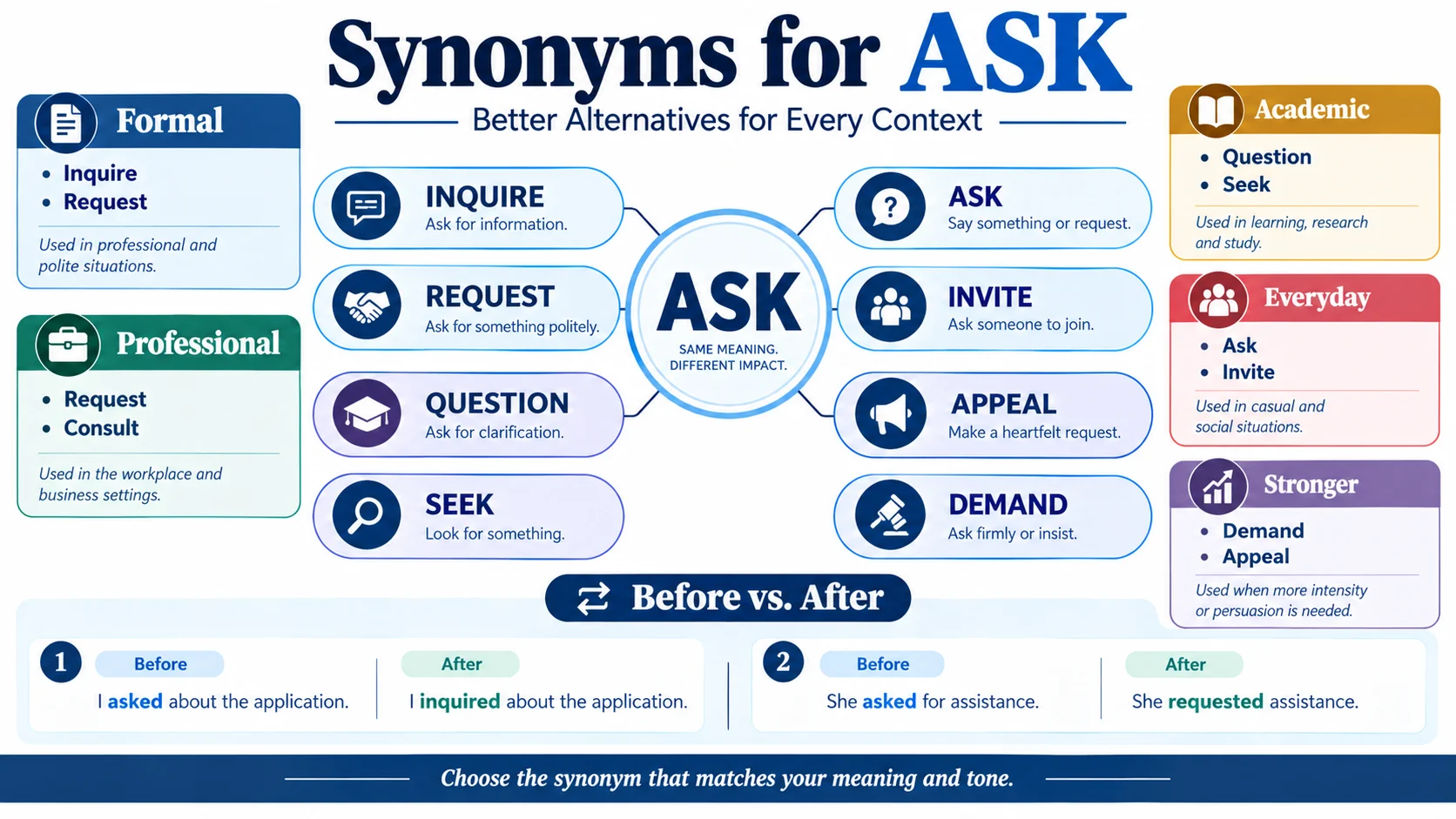
Another word for ask depends on the context. Common synonyms include request, inquire, question, seek, invite, consult, demand, and appeal. Use request for a polite need, inquire for formal information, question for seeking an answer, and demand when making a firm or forceful request.
What Does Ask Mean?
Definition
Ask is a common English verb meaning to request information, make a request, invite someone to do something, or seek permission. It can describe something as simple as asking a friend a question or as formal as asking an organization for assistance.
The best synonym depends on what you mean by ask.
For example:
- I asked her a question.
- I inquired about the job opening.
- I requested additional information.
- I sought professional advice.
- I invited him to dinner.
- I demanded an explanation.
These words are related, but they are not interchangeable in every sentence.
Common Uses
The word ask has several common meanings:
- To request something: “I asked for more time.”
- To seek information: “She asked where the office was.”
- To request permission: “He asked if he could leave early.”
- To invite someone: “They asked us to dinner.”
- To seek advice: “I asked my teacher for help.”
- To demand an explanation: “The manager asked why the deadline was missed.”
Because of these different meanings, choosing a more precise synonym can make your writing clearer and more professional.
Best Synonyms for Ask
| Synonym | Meaning | Best Used When | Example |
|---|---|---|---|
| Request | Politely ask for something | You need something from someone | I requested additional information. |
| Inquire | Ask for information | Formal or professional situations | She inquired about the position. |
| Question | Ask for an answer or explanation | You want information or clarification | He questioned the accuracy of the report. |
| Seek | Try to obtain or find something | Advice, information, help, or opportunities | She sought advice from her professor. |
| Appeal | Make a serious or earnest request | Help, support, or reconsideration | The organization appealed for donations. |
| Consult | Ask someone for advice or expertise | Professional or specialized guidance | We consulted an attorney. |
| Invite | Ask someone to attend or participate | Events and social situations | She invited her colleagues to dinner. |
| Demand | Ask forcefully | Strong or authoritative situations | The customer demanded an explanation. |
Request
Meaning: To politely or formally ask for something.
Best Used For: Professional communication, emails, business writing, and formal requests.
Tone: Polite and professional
Difficulty: Easy
Usage Frequency: Very Common
Best for: Resume writing, email writing, business writing, and academic writing.
Business Example:
“We requested a copy of the updated contract.”
Academic Example:
“The researcher requested access to the archived records.”
Daily Conversation Example:
“I requested a later checkout time.”
Inquire
Meaning: To ask for information.
Best Used For: Formal communication, customer service, business correspondence, and professional situations.
Tone: Formal
Difficulty: Medium
Usage Frequency: Common
Best for: Email writing, business writing, and formal communication.
Business Example:
“I am writing to inquire about the status of my application.”
Academic Example:
“The student inquired about the research requirements.”
Daily Conversation Example:
“She called to inquire about the store’s hours.”
Question
Meaning: To ask something or seek an explanation, especially when clarification is needed.
Best Used For: Interviews, discussions, investigations, and situations involving uncertainty.
Tone: Neutral
Difficulty: Easy
Usage Frequency: Very Common
Business Example:
“The manager questioned the figures in the report.”
Academic Example:
“Students were encouraged to question the author’s assumptions.”
Daily Conversation Example:
“I questioned him about what happened.”
Seek
Meaning: To try to obtain, find, or receive something.
Best Used For: Advice, information, assistance, opportunities, and professional or academic writing.
Tone: Professional
Difficulty: Medium
Usage Frequency: Common
Business Example:
“The company is seeking feedback from customers.”
Academic Example:
“The researcher sought additional evidence.”
Daily Conversation Example:
“I’m seeking advice about my career.”
Consult
Meaning: To ask an experienced or knowledgeable person for advice.
Best Used For: Experts, doctors, lawyers, teachers, consultants, and other professionals.
Tone: Professional
Difficulty: Medium
Usage Frequency: Common
Business Example:
“The company consulted its legal team before making the decision.”
Academic Example:
“Students should consult their instructor if they need clarification.”
Daily Conversation Example:
“I consulted my friend before buying the car.”
Demand
Meaning: To ask for something forcefully or with authority.
Best Used For: Strong complaints, negotiations, conflicts, or situations where someone believes they are entitled to an explanation or action.
Tone: Forceful
Difficulty: Easy
Usage Frequency: Common
Business Example:
“The client demanded a full explanation.”
Academic Example:
“The committee demanded evidence supporting the claim.”
Daily Conversation Example:
“She demanded to know why he was late.”
Synonyms by Context
Formal Writing
For formal writing, replace ask with a more precise word when appropriate.
Good choices include:
- Inquire
- Request
- Seek
- Appeal
- Solicit
Example:
Instead of:
“I am asking about the status of my application.”
Use:
“I am inquiring about the status of my application.”
The second version sounds more appropriate for formal correspondence.
Professional Writing
In business communication, request, inquire, and seek are particularly useful.
Ask:
“Can you send me the report?”
Professional:
“Could you please provide the report?”
More formal:
“I would like to request a copy of the report.”
The best choice depends on the relationship and level of formality.
Academic Writing
Academic writing often benefits from precise verbs such as inquire, investigate, question, seek, and examine.
For example:
- “The study asks whether the method is effective.”
- “The study examines whether the method is effective.”
However, examine is not a direct synonym for every use of ask. It works when the intended meaning involves investigating an issue rather than simply requesting information.
Daily Conversation
In everyday speech, simple alternatives usually sound most natural.
Useful choices include:
- Ask
- Question
- Request
- Invite
- Check with
- Talk to
For example:
“I asked Sarah about the meeting.”
You could say:
“I checked with Sarah about the meeting.”
This sounds natural in casual American English.
Professional Alternatives for Ask
If you want to sound polished without becoming overly formal, consider these alternatives:
- Request
- Inquire
- Seek
- Consult
- Clarify
- Solicit
- Invite
- Raise a question
The right replacement depends on the sentence.
For example, clarify works when you want someone to explain something:
“I asked about the instructions.”
can become:
“I asked for clarification about the instructions.”
For a business email, request is usually more natural than an unnecessarily formal word such as solicit.
Simple Alternatives for Ask
If you’re writing for a general audience, these words are easy to understand:
- Question
- Request
- Check
- Invite
- Talk to
- Find out
- Seek
Examples:
“I asked him for help.”
“I requested his help.”
Both work, but asked is more conversational while requested sounds more formal.
Stronger Alternatives for Ask
Sometimes ask does not communicate enough force. Depending on the situation, stronger alternatives include:
- Demand
- Insist
- Challenge
- Press
- Appeal
- Urge
These words have different meanings and should not be used as automatic replacements.
For example:
“The customer asked for a refund.”
is neutral.
“The customer demanded a refund.”
shows a much stronger attitude.
Similarly:
“She asked him to reconsider.”
is softer than:
“She urged him to reconsider.”
The second sentence suggests greater emphasis or persuasion.
Difference Between Similar Synonyms
Ask vs. Request
Ask is broad and natural in everyday English. Request is more specific and often more formal.
- “I asked for help.”
- “I requested assistance.”
Ask vs. Inquire
Ask works in almost any situation. Inquire specifically emphasizes seeking information and sounds more formal.
- “I asked about the price.”
- “I inquired about the price.”
Ask vs. Question
Question focuses on obtaining an answer or challenging information.
- “She asked him his name.”
- “She questioned his explanation.”
The second sentence can suggest doubt or scrutiny.
Ask vs. Demand
Ask usually sounds neutral or polite. Demand communicates force, authority, or insistence.
- “He asked for an explanation.”
- “He demanded an explanation.”
Ask vs. Seek
Seek often describes actively trying to obtain something such as advice, information, help, or an opportunity.
- “She asked for advice.”
- “She sought advice.”
The second version is more formal.
Opposite Words
The opposite of ask depends on the meaning.
Possible contrasting words include:
- Answer when ask means to pose a question
- Give when ask means to request something
- Refuse when ask means to make a request
- Decline when responding to an invitation
- Provide when someone requests information or assistance
There is no single opposite of ask that works in every context.
FAQs
What is another word for ask?
Common alternatives for ask include request, inquire, question, seek, consult, invite, appeal, and demand. The best synonym depends on whether you are requesting something, seeking information, asking for advice, inviting someone, or making a forceful request.
What is a formal synonym for ask?
Inquire and request are two common formal alternatives. Use inquire when seeking information and request when asking someone to provide something or take an action.
What is a professional alternative for ask?
Request is one of the most useful professional alternatives to ask. Inquire works well when you need information, while seek is useful for advice, feedback, assistance, or opportunities.
What word can replace ask in an email?
Depending on the situation, you can use request, inquire, seek, clarify, or confirm. For example, “I am writing to inquire about my application” sounds more formal than “I am writing to ask about my application.”
What is a stronger word for ask?
Demand is stronger than ask because it suggests force or authority. Insist and urge can also express stronger intent, although they have different meanings.
What is a polite synonym for ask?
Request is a polite and professional synonym. Phrases such as “Could you please,” “Would you mind,” and “I would like to request” can also make a request sound courteous.
What is another word for asking for help?
Depending on the context, you can say requesting assistance, seeking help, asking for support, appealing for assistance, or consulting someone.
What is another word for ask a question?
Question, inquire, and seek information can work depending on the context. “Question” is especially natural when referring to the act of asking something that requires an answer.
What is another word for ask for information?
Inquire is one of the closest alternatives. You can also use seek information, request information, or check depending on the level of formality.
What is another word for ask someone to do something?
Use request, invite, encourage, urge, instruct, or demand depending on the intended tone and relationship. These words vary significantly in strength and meaning.
Conclusion
The best synonym for ask depends on what you are trying to communicate. Use request for polite or professional requests, inquire for formal questions, question for seeking answers or clarification, seek for obtaining advice or information, consult for expert guidance, and demand when the request is forceful.
Because ask has several meanings, replacing it with a synonym is not simply a matter of choosing a more sophisticated word. The most effective choice is the one that accurately matches the situation, tone, and intended meaning.