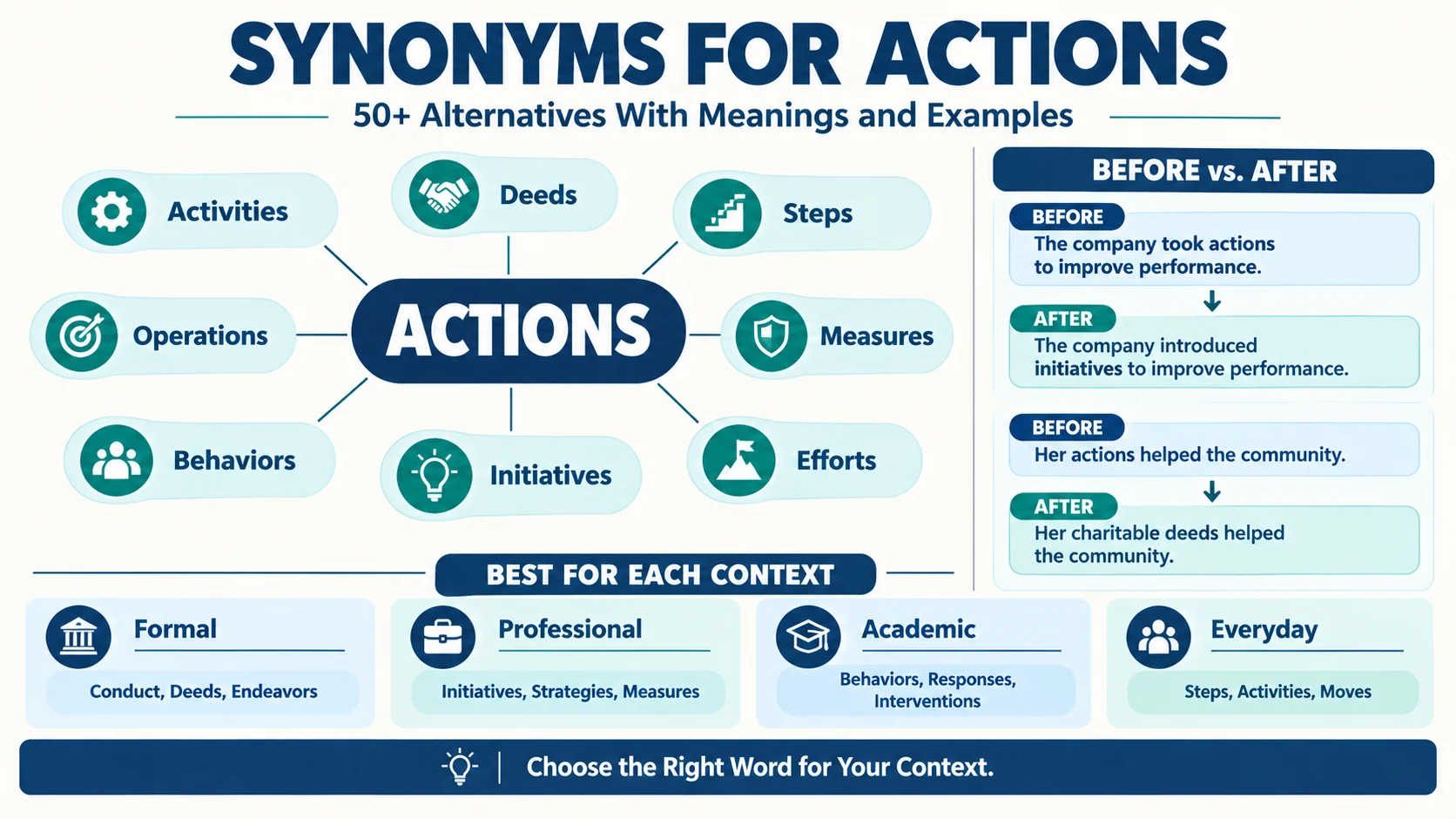
Synonyms for actions include activities, deeds, acts, steps, measures, efforts, moves, initiatives, operations, and behaviors. The best alternative depends on the context. Use steps for specific tasks, measures for deliberate responses, deeds for meaningful behavior, and initiatives for organized efforts toward a goal.
What Does Actions Mean?
Definition
The word actions is the plural form of action. It refers to things people do, activities they perform, decisions they make, or steps they take to achieve a particular result.
Actions can be physical, mental, personal, professional, or organizational. They may be intentional or unintentional, positive or negative.
For example:
- The company’s actions improved customer satisfaction.
- Her actions demonstrated courage and determination.
- Immediate actions were necessary to solve the problem.
Common Uses
The word actions appears in several contexts:
- Daily life: Things people do during their everyday routines.
- Business: Decisions, strategies, and activities taken to achieve objectives.
- Academic writing: Behaviors, processes, and responses examined in research.
- Legal contexts: Conduct or activities that may have legal consequences.
- Personal relationships: Behaviors and choices that affect other people.
Understanding the intended meaning helps you select a more precise synonym.
Best Synonyms for Actions
The following alternatives cover different meanings and writing situations.
| Synonym | Meaning | Best Used When | Example |
|---|---|---|---|
| Activities | Things people do regularly | General tasks or routines | Daily activities improve productivity. |
| Deeds | Things someone does, especially meaningful ones | Personal behavior or morality | Her kind deeds inspired others. |
| Acts | Individual things someone does | Specific behavior or events | His acts of generosity helped the community. |
| Steps | Individual stages or measures | Processes and plans | The team took steps to prevent delays. |
| Measures | Deliberate actions to address something | Business and problem-solving | New measures improved workplace safety. |
| Efforts | Work done to achieve something | Goals and achievements | Their efforts produced excellent results. |
| Moves | Decisions or actions taken strategically | Business, competition, and negotiation | The company made strategic moves. |
| Initiatives | Planned efforts to achieve objectives | Organizational improvements | New initiatives supported employee development. |
| Operations | Organized activities or processes | Business and technical environments | Daily operations continued without interruption. |
| Behaviors | Ways people act or respond | Psychology and social situations | Positive behaviors strengthen relationships. |
| Responses | Reactions to situations | Communication and problem-solving | Their responses addressed customer concerns. |
| Conduct | The way someone behaves | Formal, professional, and legal writing | Professional conduct matters in every workplace. |
| Procedures | Established ways of doing something | Official processes | Safety procedures protect employees. |
| Endeavors | Serious attempts to accomplish something | Formal and academic writing | Their endeavors supported scientific progress. |
Synonyms for Actions by Context
The most suitable synonym changes depending on the audience, purpose, and tone of your writing.
Formal Writing
In formal writing, choose words that communicate the exact nature of an action without sounding overly casual.
Good alternatives include:
- Deeds: Suitable for meaningful actions, especially those reflecting someone’s character.
- Conduct: Describes the way an individual behaves.
- Measures: Refers to deliberate actions taken to address an issue.
- Endeavors: Describes serious attempts to accomplish something.
- Proceedings: Refers to formal activities or events, particularly in legal and official settings.
Example: Instead of writing, “The government took actions to address the issue,” write, “The government introduced measures to address the issue.”
Professional Writing
Business communication often requires clear, practical language.
Useful alternatives include:
- Initiatives: Planned projects or efforts.
- Steps: Specific tasks taken toward a goal.
- Operations: Organized business activities.
- Strategies: Planned approaches for achieving objectives.
- Measures: Practical responses to challenges.
Example: “The management implemented new initiatives to improve employee performance.”
Academic Writing
Academic writing benefits from precise terminology that describes research, behavior, and processes.
Consider these alternatives:
- Behaviors: Observable ways individuals act.
- Activities: Tasks or processes performed during research.
- Responses: Reactions to particular conditions or stimuli.
- Interventions: Deliberate efforts to influence or improve a situation.
- Practices: Established methods or repeated activities.
Example: “The study examined participants’ behavioral responses to different environmental conditions.”
Daily Conversation
For everyday communication, simple and familiar words usually work best.
Common alternatives include:
- Things people do: A simple explanation of actions.
- Steps: Specific things someone does to reach a goal.
- Moves: Decisions or actions taken in a situation.
- Efforts: Attempts to accomplish something.
- Acts: Individual things someone does.
Example: Instead of saying, “Your actions surprised me,” you could say, “The things you did surprised me.”
Professional Alternatives for Actions
If you are writing a business report, workplace email, performance review, or resume, consider these professional alternatives.
| Alternative | Meaning | Professional Example |
|---|---|---|
| Initiatives | Planned efforts | Led initiatives to improve customer retention. |
| Measures | Deliberate steps | Introduced measures to reduce operational costs. |
| Strategies | Organized plans | Developed strategies to increase productivity. |
| Implementations | The process of putting plans into practice | Managed implementations of new business systems. |
| Interventions | Actions intended to improve a situation | Coordinated interventions to resolve workplace issues. |
| Operations | Organized business activities | Supported daily business operations. |
| Procedures | Established methods | Updated procedures to improve efficiency. |
Resume tip: Avoid using actions repeatedly in professional descriptions. Choose stronger words that communicate your actual contribution. For example, “Implemented new procedures” is more specific than “Took actions to improve performance.”
Simple Alternatives for Actions
If your goal is to make writing easier to understand, use familiar words instead of complicated vocabulary.
| Simple Word or Phrase | Example |
|---|---|
| Things done | The things done by the team made a difference. |
| Steps | We took steps to solve the problem. |
| Work | Their work helped the organization grow. |
| Efforts | Her efforts improved the situation. |
| Moves | His next moves surprised everyone. |
| Tasks | The team completed its daily tasks. |
| Activities | School activities encourage teamwork. |
These alternatives are especially useful in everyday conversations, beginner-level writing, and simple explanations.
Stronger Alternatives for Actions
Some words communicate more specific or powerful meanings than the general word actions.
- Deeds: Emphasizes meaningful or morally significant behavior.
- Interventions: Highlights deliberate involvement to change a situation.
- Initiatives: Suggests proactive efforts and leadership.
- Achievements: Emphasizes successful results rather than the actions themselves.
- Commitments: Highlights dedication to a responsibility or goal.
- Undertakings: Refers to serious or organized tasks.
- Accomplishments: Focuses on completed and successful efforts.
Example: “Her actions changed the organization” can become “Her initiatives transformed the organization.”
Remember that stronger words are not always interchangeable. An achievement is a result, while an action is something someone does.
Difference Between Similar Synonyms
Although many words are used as alternatives to actions, they have important differences.
Actions vs. Activities
Actions generally refer to individual things someone does or decisions they make. Activities often describe broader tasks, routines, or ongoing engagements.
Example:
- Actions: The manager approved the proposal.
- Activities: The manager organized several training activities.
Actions vs. Deeds
Actions is a general term for things people do. Deeds often carries a moral or emotional meaning, especially when describing helpful, courageous, or harmful behavior.
Example:
- Actions: His actions affected the community.
- Deeds: His charitable deeds helped struggling families.
Actions vs. Measures
Actions can describe almost anything someone does. Measures usually refer to specific steps taken to solve a problem, prevent something, or achieve a particular objective.
Example:
- Actions: The company announced several actions.
- Measures: The company introduced safety measures.
Actions vs. Behaviors
Actions usually refer to specific things someone does. Behaviors describe broader patterns or ways of acting.
Example:
- Actions: She apologized for her mistake.
- Behaviors: Her respectful behavior impressed the team.
Actions vs. Initiatives
Actions can be individual or general. Initiatives usually involve planned efforts designed to achieve a specific goal.
Example:
- Actions: The organization responded to complaints.
- Initiatives: The organization launched customer satisfaction initiatives.
Opposite Words for Actions
The opposite of actions depends on the intended meaning. There is no single antonym that works in every situation.
| Antonym or Opposite Expression | Meaning | Example |
|---|---|---|
| Inaction | Failure to take action | Inaction allowed the problem to grow. |
| Idleness | Lack of activity or work | Idleness reduced overall productivity. |
| Passivity | Lack of active involvement | Passivity prevented meaningful change. |
| Inactivity | A state of not being active | Inactivity affected the project’s progress. |
| Restraint | Holding back from acting | Restraint prevented an unnecessary argument. |
| Neglect | Failure to give proper attention | Neglect caused the situation to worsen. |
Important distinction: Inaction and inactivity are often the closest opposites when actions means things people do. However, restraint may be the better contrast when discussing deliberate decisions not to act.
FAQs About Synonyms for Actions
1. What is another word for actions?
Other words for actions include activities, deeds, acts, steps, measures, efforts, initiatives, and behaviors. The best choice depends on the sentence and intended meaning.
2. What is the most common synonym for actions?
Activities is one of the most common general alternatives. However, steps, acts, and measures may be more appropriate in specific situations.
3. What is a formal synonym for actions?
Formal alternatives include conduct, deeds, measures, endeavors, and proceedings. The correct choice depends on whether you are discussing behavior, efforts, or official activities.
4. What is a professional alternative for actions?
Professional alternatives include initiatives, strategies, measures, procedures, and operations. These words are especially useful in reports, workplace communication, and business documents.
5. What is another word for positive actions?
Positive actions can be described as good deeds, constructive efforts, helpful measures, beneficial activities, or positive initiatives.
6. What is another word for taking actions?
Alternatives include taking steps, implementing measures, making moves, initiating efforts, and putting plans into practice.
7. What is a stronger word for actions?
Stronger alternatives include initiatives, interventions, undertakings, and deeds. Select the word according to the type and importance of the action.
8. What is the opposite of actions?
Common opposites include inaction, inactivity, idleness, and passivity. The best antonym depends on the context.
9. Can I use activities instead of actions?
Yes, when referring to tasks, routines, or ongoing engagements. However, activities may not replace actions when describing a specific decision or individual behavior.
10. What is another word for actions in academic writing?
Academic alternatives include behaviors, responses, interventions, practices, and activities. Choose the term that most accurately describes the process or behavior being discussed.
Conclusion
Finding the right synonym for actions can make your writing clearer, more professional, and more meaningful. Words such as activities, deeds, acts, steps, measures, and initiatives offer useful alternatives, but each carries a slightly different meaning.
For everyday communication, use simple alternatives such as steps and activities. For professional writing, consider initiatives, strategies, and measures. In academic work, behaviors, responses, and interventions may provide greater precision.
The best synonym is not necessarily the most sophisticated word. It is the one that communicates your intended meaning accurately and naturally.