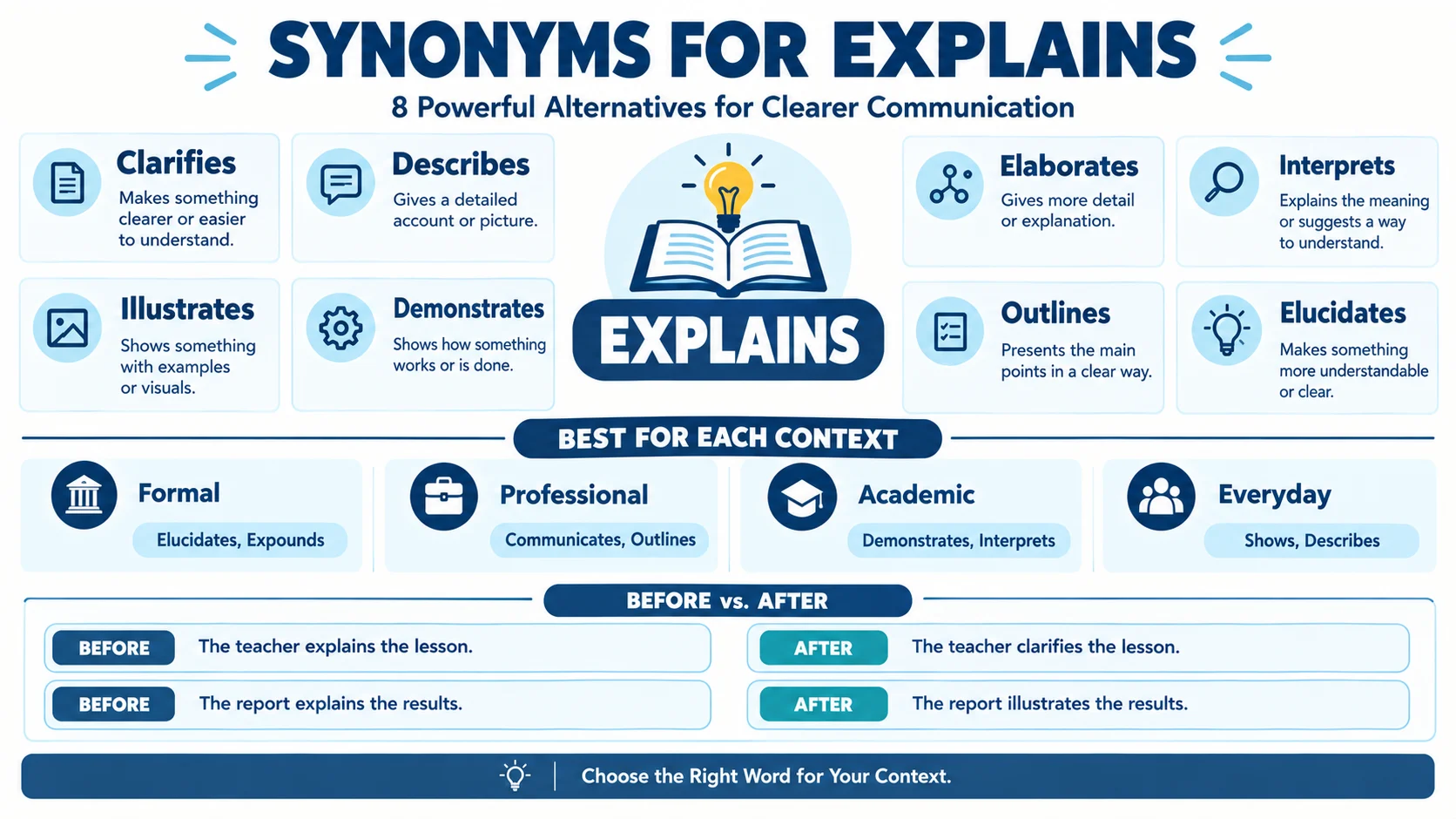
Another word for explains is clarifies, describes, illustrates, interprets, demonstrates, or elaborates. The best synonym depends on what you want to communicate. Use clarifies to make something easier to understand, describes to provide details, and demonstrates to show how something works.
What Does Explains Mean?
Definition
Explains is the third-person singular form of the verb explain. It means making something clear or understandable by providing information, details, reasons, or examples.
When someone explains something, they help another person understand a concept, situation, process, decision, or idea.
For example:
- The teacher explains the lesson to her students.
- The report explains why sales declined.
- The manager explains the company’s new policies.
The word is commonly used in education, business, professional communication, academic writing, and everyday conversations.
Common Uses
The word explains has several related meanings depending on the situation.
- Making something clear: She explains the instructions carefully.
- Providing reasons: The manager explains the reason for the delay.
- Describing a process: The guide explains how the software works.
- Interpreting information: The researcher explains the results.
- Providing evidence or examples: The article explains the issue through real-life examples.
Understanding these different uses helps you select a synonym that communicates the intended meaning more accurately.
Best Synonyms for Explains
The following table presents useful alternatives to explains, along with their meanings and appropriate contexts.
| Synonym | Meaning | Best Used When | Example |
|---|---|---|---|
| Clarifies | Makes something easier to understand | Removing confusion | She clarifies the instructions. |
| Describes | Gives details about something | Presenting information | He describes the process. |
| Illustrates | Makes an idea clear through examples | Supporting an explanation | The chart illustrates the results. |
| Demonstrates | Shows how something works or is true | Providing proof or showing a process | The experiment demonstrates the theory. |
| Elaborates | Provides additional details | Expanding an existing point | She elaborates on her argument. |
| Interprets | Explains the meaning of something | Analyzing information | The analyst interprets the findings. |
| Defines | States the meaning of something | Introducing terminology | The textbook defines the concept. |
| Outlines | Presents the main points | Summarizing information | The report outlines the procedure. |
| Specifies | States something precisely | Giving exact details | The document specifies the requirements. |
| Justifies | Provides reasons supporting something | Defending a decision | He justifies his recommendation. |
| Reveals | Makes previously unknown information known | Disclosing information | The study reveals important patterns. |
| Accounts for | Gives the reason for something | Explaining causes | This accounts for the difference. |
| Expounds | Explains something in detail | Formal or academic discussion | The professor expounds the theory. |
| Breaks down | Divides something into understandable parts | Simple explanations | She breaks down the complex topic. |
Synonyms by Context
Not every synonym works equally well in every situation. The right replacement depends on your audience, writing style, and purpose.
Formal Writing
Formal writing benefits from precise vocabulary that communicates information clearly without sounding conversational.
Consider these alternatives:
- Elucidates: Explains something in a clear and detailed way.
- Expounds: Presents an idea with considerable detail.
- Clarifies: Removes uncertainty or confusion.
- Interprets: Explains the meaning of information or evidence.
- Delineates: Describes or defines something precisely.
Example:
Original: The author explains the relationship between economic growth and employment.
Improved: The author elucidates the relationship between economic growth and employment.
Best choice: Elucidates works well when discussing complicated ideas in formal writing.
Professional Writing
In business communication, the best alternatives are direct, clear, and appropriate for workplace situations.
Useful professional synonyms include:
- Outlines: Presents important points or steps.
- Clarifies: Removes misunderstandings.
- Specifies: Provides exact information.
- Demonstrates: Shows evidence or practical results.
- Details: Provides specific information.
Business example:
Original: The manager explains the new company policy.
Improved: The manager outlines the new company policy.
For workplace emails, clarifies is particularly useful when correcting confusion.
Academic Writing
Academic writing often requires more precise language to communicate research findings, theories, and complex arguments.
Recommended alternatives:
- Illustrates: Supports an idea with examples or visual evidence.
- Interprets: Provides meaning or analysis.
- Demonstrates: Establishes something through evidence.
- Elucidates: Makes a complex concept understandable.
- Expounds: Discusses a theory or argument in detail.
Academic example:
Original: The research explains the relationship between sleep and memory.
Improved: The research demonstrates the relationship between sleep and memory.
Use demonstrates when research provides evidence. Use interprets when discussing what the findings mean.
Daily Conversation
In everyday English, simple alternatives usually sound more natural than formal vocabulary.
Common choices include:
- Shows: Makes something understandable.
- Tells: Gives information.
- Describes: Provides details.
- Breaks down: Makes something easier to understand.
- Goes over: Reviews or discusses information.
Daily conversation example:
Original: She explains how to use the application.
Improved: She shows me how to use the application.
For casual conversations, shows, tells, and breaks down are especially natural.
Professional Alternatives for Explains
If you are writing a business email, professional report, resume, or workplace document, consider choosing a more specific verb.
| Alternative | Best Application | Example |
|---|---|---|
| Communicates | Sharing information | The manager communicates expectations clearly. |
| Outlines | Presenting plans | The director outlines the project goals. |
| Articulates | Expressing ideas effectively | She articulates the company’s vision. |
| Demonstrates | Showing skills or results | The report demonstrates measurable improvements. |
| Clarifies | Resolving confusion | He clarifies the project requirements. |
| Details | Providing specific information | The proposal details the implementation process. |
Resume tip: Instead of writing “Explains technical concepts to customers,” consider “Communicates complex technical concepts to customers.” This sounds more action-oriented and emphasizes communication skills.
However, choose wording that accurately reflects what you actually did.
Simple Alternatives for Explains
If you want easy words that readers understand immediately, these alternatives work well:
| Simple Word | Meaning | Example |
|---|---|---|
| Shows | Makes something clear | The diagram shows the process. |
| Tells | Gives information | She tells us what happened. |
| Says | Expresses information | The report says why it happened. |
| Describes | Gives details | He describes the situation. |
| Teaches | Helps someone learn | The instructor teaches the method. |
| Points out | Draws attention to something | She points out the main problem. |
| Goes over | Reviews information | The teacher goes over the lesson. |
These words are especially useful in conversational writing, beginner-friendly explanations, blogs, and social media content.
Stronger Alternatives for Explains
Sometimes explains sounds too general. A stronger synonym can communicate greater precision, depth, or authority.
| Stronger Alternative | Meaning | Example |
|---|---|---|
| Elucidates | Makes a difficult concept clear | The professor elucidates the theory. |
| Expounds | Explains an idea extensively | The author expounds his argument. |
| Demonstrates | Shows something through evidence | The experiment demonstrates the results. |
| Substantiates | Supports a claim with evidence | The research substantiates the conclusion. |
| Justifies | Gives valid reasons for something | The report justifies the decision. |
| Deciphers | Makes something difficult to understand clear | The analyst deciphers the complex data. |
| Unpacks | Examines an idea in detail | The article unpacks the central argument. |
Remember that stronger words are not automatically better. For example, substantiates means supporting a claim with evidence, not simply explaining it.
Difference Between Similar Synonyms
Several synonyms for explains appear interchangeable, but their meanings and applications are different.
Explains vs. Clarifies
Explains provides information to help someone understand something. Clarifies makes information that is already confusing or unclear easier to understand.
- Explains: The teacher explains the chapter.
- Clarifies: The teacher clarifies a confusing section.
Explains vs. Describes
Explains focuses on reasons, meanings, or how something works. Describes focuses on characteristics, details, or what something looks like.
- Explains: She explains why the system failed.
- Describes: She describes the damaged system.
Explains vs. Illustrates
Explains communicates meaning directly. Illustrates makes an idea clearer through examples, comparisons, or visual materials.
- Explains: The article explains the concept.
- Illustrates: The article illustrates the concept with examples.
Explains vs. Demonstrates
Explains helps someone understand through information. Demonstrates shows how something works or provides evidence that something is true.
- Explains: The instructor explains the experiment.
- Demonstrates: The instructor demonstrates the experiment.
Explains vs. Elaborates
Explains communicates information. Elaborates adds further details to an idea that has already been introduced.
- Explains: The speaker explains the proposal.
- Elaborates: The speaker elaborates on the proposal.
Opposite Words of Explains
Antonyms are words with opposite meanings. The opposite of explains depends on the context.
| Antonym | Meaning | Example |
|---|---|---|
| Confuses | Makes something difficult to understand | His instructions confuse the students. |
| Obscures | Makes information unclear | The complicated language obscures the meaning. |
| Conceals | Keeps information hidden | The report conceals important details. |
| Misleads | Gives incorrect impressions | The advertisement misleads customers. |
| Complicates | Makes something more difficult | The new procedure complicates the process. |
| Withholds | Refuses to provide information | The company withholds important information. |
Confuses is often the closest everyday opposite, while conceals and withholds describe situations where information is intentionally not shared.
FAQs
1. What is another word for explains?
Common alternatives include clarifies, describes, illustrates, demonstrates, interprets, elaborates, and outlines. The best choice depends on whether you are providing details, explaining reasons, or showing evidence.
2. What is a formal synonym for explains?
Elucidates is a strong formal alternative. Other choices include expounds, interprets, clarifies, and delineates. These words work well in academic papers, professional reports, and formal discussions.
3. What is a professional alternative for explains?
Professional alternatives include communicates, outlines, clarifies, details, and demonstrates. For workplace communication, choose a word that accurately describes how you share information.
4. What is another word for explains in academic writing?
Academic alternatives include elucidates, demonstrates, illustrates, interprets, and expounds. Use demonstrates for evidence and interprets for explaining research findings.
5. What is a simple word for explains?
Simple alternatives include shows, tells, says, describes, and breaks down. These words are useful in everyday conversations and beginner-friendly writing.
6. What is a stronger word for explains?
Elucidates, expounds, demonstrates, and substantiates can be stronger alternatives in specific contexts. However, each word has a slightly different meaning.
7. What is another word for explains in a sentence?
You can replace explains with clarifies, describes, illustrates, or demonstrates. For example, “The teacher explains the lesson” can become “The teacher clarifies the lesson.”
8. What is the difference between explains and illustrates?
Explains communicates information or reasons, while illustrates makes an idea clearer through examples, comparisons, or visual evidence.
9. What is the opposite of explains?
Common opposites include confuses, obscures, conceals, misleads, and withholds. The correct antonym depends on the intended meaning.
10. What word can replace explains in a resume?
Consider communicates, presents, demonstrates, or articulates. For example, “Explains technical information” can become “Communicates technical information to diverse audiences.”
Conclusion
Choosing the right synonym for explains makes your writing more precise, natural, and engaging. Words such as clarifies, describes, illustrates, and demonstrates are useful for everyday communication, while elucidates, expounds, and interprets work better in formal and academic contexts.
For professional writing, consider communicates, outlines, and articulates. Rather than replacing explains with a complicated word every time, focus on the exact meaning you want to convey. The best synonym is the one that makes your message clearer to your reader.