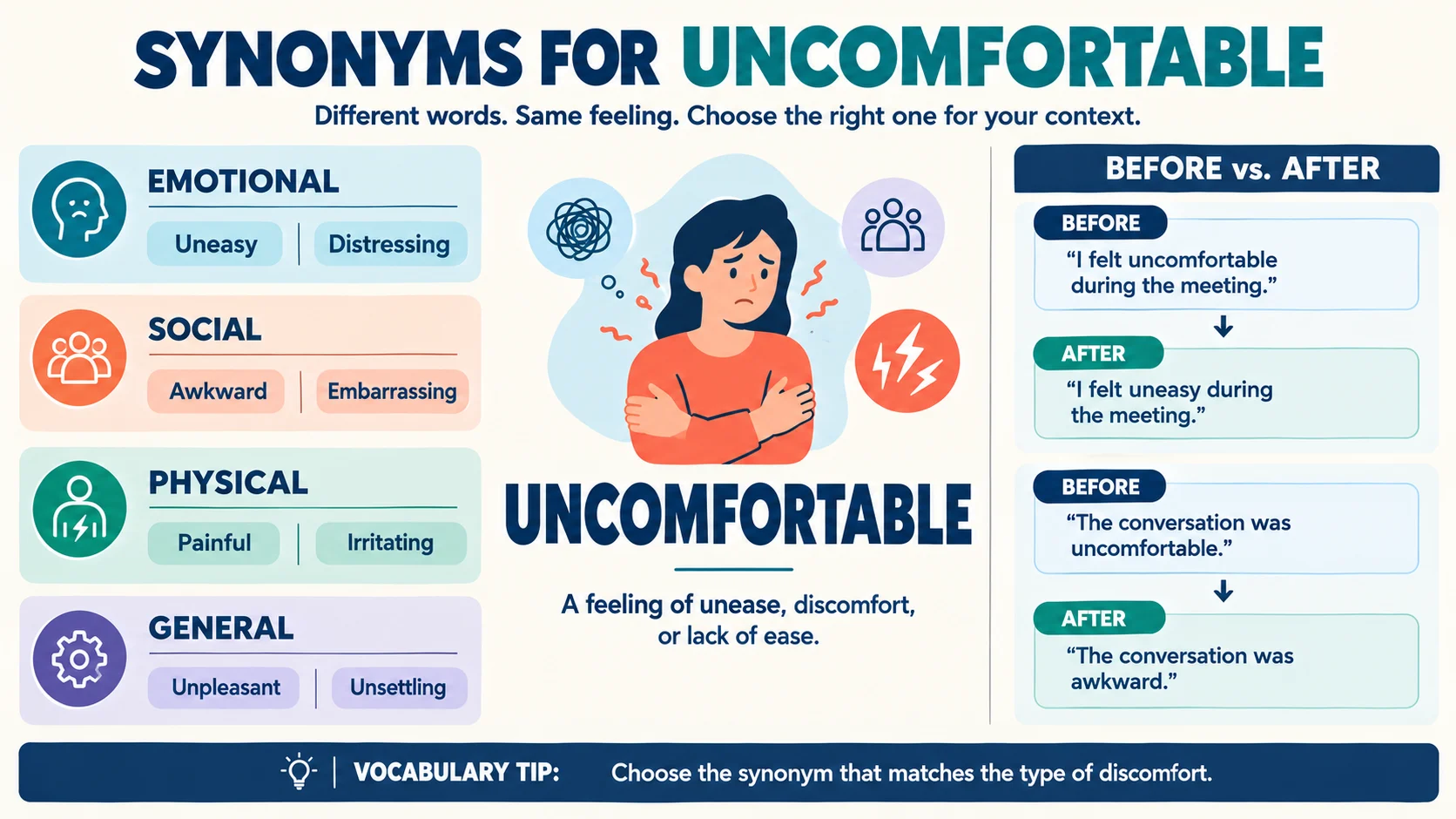
A synonym for uncomfortable depends on the situation. Common alternatives include uneasy, awkward, unpleasant, inconvenient, distressing, and uncomfortable itself. Use uneasy for emotional discomfort, awkward for socially difficult situations, painful for physical discomfort, and unpleasant for experiences you do not enjoy.
What Does Uncomfortable Mean?
Definition
The word uncomfortable is an adjective that describes a physical, emotional, or social condition that causes discomfort, uneasiness, embarrassment, or difficulty. It can refer to something that makes a person feel physically uncomfortable, emotionally troubled, or socially awkward.
For example, sitting on a hard chair for several hours can be physically uncomfortable. Similarly, discussing a sensitive subject with someone can create an uncomfortable feeling.
The word has several meanings depending on its context. Therefore, choosing the right synonym requires understanding what kind of discomfort you want to describe.
Common Uses
Uncomfortable commonly describes:
- Physical discomfort: A painful chair, tight clothing, or an unsuitable temperature.
- Emotional discomfort: Feeling nervous, worried, uneasy, or distressed.
- Social discomfort: Experiencing embarrassment or awkwardness during conversations.
- Difficult situations: Facing inconvenient, unpleasant, or challenging circumstances.
- Environmental conditions: Being in a noisy, crowded, or poorly ventilated space.
Best Synonyms for Uncomfortable
The following table presents useful alternatives with their meanings and practical examples.
| Synonym | Meaning | Best Used When | Example |
|---|---|---|---|
| Uneasy | Nervous or uncertain | Emotional discomfort | I felt uneasy about the decision. |
| Awkward | Socially difficult or embarrassing | Conversations and interactions | It was an awkward conversation. |
| Unpleasant | Not enjoyable or agreeable | Negative experiences | The meeting became unpleasant. |
| Distressing | Causing emotional suffering | Serious emotional situations | The news was distressing. |
| Painful | Causing physical or emotional pain | Physical or emotional suffering | His comments were painful. |
| Inconvenient | Causing difficulty or trouble | Practical situations | The new schedule is inconvenient. |
| Embarrassing | Causing shame or self-consciousness | Social mistakes | It was an embarrassing moment. |
| Discomforting | Causing uneasiness or discomfort | Emotional or physical situations | The experience was discomforting. |
| Troubling | Causing worry or concern | Uncertain situations | Her behavior was troubling. |
| Unsettling | Disturbing someone’s sense of security | Uncertain or disturbing experiences | The strange noise was unsettling. |
| Tense | Creating stress or nervousness | Conflicts and conversations | The atmosphere became tense. |
| Disturbing | Causing emotional disturbance | Upsetting experiences | The documentary was disturbing. |
| Irritating | Causing annoyance | Minor unpleasant situations | The constant noise was irritating. |
| Miserable | Extremely unpleasant or unhappy | Difficult conditions | We had a miserable journey. |
Synonyms for Uncomfortable by Context
Different situations require different words. A synonym that works in casual conversation may not be appropriate for academic or professional writing.
Formal Writing
In formal writing, choose precise alternatives that communicate the specific type of discomfort.
| Alternative | Meaning | Example |
|---|---|---|
| Distressing | Causing emotional suffering | The incident was distressing for everyone involved. |
| Unpleasant | Not enjoyable or agreeable | The investigation revealed an unpleasant situation. |
| Disconcerting | Causing confusion or uncertainty | The unexpected results were disconcerting. |
| Troubling | Creating concern | The findings present a troubling pattern. |
| Discomforting | Producing discomfort | The discussion raised several discomforting questions. |
Best choice: Distressing, disconcerting, and troubling are useful when describing serious emotional or psychological discomfort.
Professional Writing
Professional communication often benefits from neutral and respectful alternatives rather than emotionally strong language.
| Alternative | Meaning | Example |
|---|---|---|
| Challenging | Difficult to manage | The transition was challenging for the team. |
| Inconvenient | Causing practical difficulty | The proposed schedule is inconvenient. |
| Difficult | Not easy to handle | We encountered a difficult situation. |
| Unsatisfactory | Not meeting expectations | The working conditions were unsatisfactory. |
| Problematic | Creating complications | The current arrangement is problematic. |
Best choice: Challenging, inconvenient, and problematic are appropriate for workplace communication, business reports, and professional emails.
Academic Writing
Academic writing requires specific vocabulary that accurately explains emotional, social, or physical conditions.
Useful alternatives include:
- Distressing: The participants reported distressing experiences during the study.
- Adverse: The treatment produced adverse physical effects.
- Disconcerting: The unexpected findings were disconcerting to researchers.
- Unpleasant: Participants described the procedure as unpleasant.
- Aversive: The subjects demonstrated an aversive response to the stimulus.
Best choice: Adverse, aversive, and distressing are useful in academic discussions, depending on the subject and research context.
Daily Conversation
For everyday conversations, simple and familiar alternatives sound more natural.
| Alternative | Example |
|---|---|
| Awkward | Things got awkward when nobody answered. |
| Weird | I felt weird about the whole situation. |
| Uneasy | I feel uneasy walking alone at night. |
| Annoying | These shoes are really annoying to wear. |
| Unpleasant | The weather made the trip unpleasant. |
| Painful | My back feels painful after sitting all day. |
Best choice: Awkward, weird, uneasy, and annoying are common conversational alternatives.
Professional Alternatives for Uncomfortable
If you are writing a business email, workplace report, resume, or professional document, consider these alternatives:
- Challenging: Best for describing difficult working conditions or situations.
- Inconvenient: Appropriate when something creates practical difficulties.
- Problematic: Useful when an arrangement or situation creates complications.
- Unsatisfactory: Describes conditions that fail to meet expectations.
- Difficult: A neutral alternative for challenging circumstances.
- Unfavorable: Describes conditions that are not beneficial or desirable.
Business example: Instead of writing, “The working environment was uncomfortable,” you could write, “The working environment presented several challenging conditions.”
Email example: “I apologize for the inconvenience caused by the revised meeting schedule.”
Resume example: “Successfully managed challenging workplace situations while maintaining productivity.”
Note that these alternatives are not interchangeable in every sentence. Choose the one that communicates the actual problem.
Simple Alternatives for Uncomfortable
If you want an easy replacement that most readers understand, consider these words:
- Awkward: Socially embarrassing or difficult.
- Bad: Not good or enjoyable.
- Weird: Strange or unusual in a way that feels uncomfortable.
- Uneasy: Nervous or worried.
- Painful: Causing physical or emotional pain.
- Unpleasant: Not enjoyable.
- Annoying: Causing irritation.
- Difficult: Hard to experience or manage.
For example:
Original: “I felt uncomfortable during the conversation.”
Simpler alternatives:
- I felt awkward during the conversation.
- I felt uneasy during the conversation.
- I felt strange during the conversation.
Each sentence communicates a slightly different feeling.
Stronger Alternatives for Uncomfortable
Sometimes the word uncomfortable does not fully express the intensity of an experience. Stronger alternatives can communicate deeper emotional or physical discomfort.
| Stronger Word | Meaning | Example |
|---|---|---|
| Agonizing | Extremely painful | Waiting for the results was agonizing. |
| Excruciating | Intensely painful | He experienced excruciating pain. |
| Distressing | Causing serious emotional suffering | The situation was deeply distressing. |
| Intolerable | Too unpleasant to endure | The working conditions became intolerable. |
| Torturous | Extremely difficult or painful | The long wait felt torturous. |
| Harrowing | Extremely distressing or frightening | It was a harrowing experience. |
| Miserable | Causing extreme unhappiness | We spent a miserable night outdoors. |
These words are stronger than uncomfortable and should be reserved for situations that genuinely justify their intensity.
Difference Between Similar Synonyms
Although many words can replace uncomfortable, their meanings are not exactly the same. Understanding these differences helps you select the most accurate word.
Uncomfortable vs. Awkward
Uncomfortable describes general physical, emotional, or social discomfort. Awkward specifically refers to situations that feel embarrassing, socially difficult, or unnatural.
Example:
- Uncomfortable: This chair is uncomfortable.
- Awkward: The conversation became awkward.
Uncomfortable vs. Uneasy
Uncomfortable is a broad term, while uneasy usually describes an emotional feeling of nervousness, uncertainty, or worry.
Example:
- Uncomfortable: I felt uncomfortable in the crowded room.
- Uneasy: I felt uneasy about his explanation.
Uncomfortable vs. Unpleasant
Uncomfortable describes a lack of physical or emotional ease. Unpleasant describes something disagreeable or not enjoyable.
Example:
- Uncomfortable: The shoes were uncomfortable.
- Unpleasant: The argument was unpleasant.
Uncomfortable vs. Distressing
Uncomfortable can describe mild discomfort, whereas distressing suggests significant emotional pain, worry, or suffering.
Example:
- Uncomfortable: The question made me uncomfortable.
- Distressing: The incident was distressing for the entire family.
Uncomfortable vs. Inconvenient
Uncomfortable describes a lack of comfort, while inconvenient refers to something that creates practical difficulty or disruption.
Example:
- Uncomfortable: The hotel bed was uncomfortable.
- Inconvenient: The hotel’s location was inconvenient.
Opposite Words of Uncomfortable
Antonyms of uncomfortable describe comfort, ease, satisfaction, or relaxation.
| Antonym | Meaning | Example |
|---|---|---|
| Comfortable | Providing physical or emotional ease | The chair is comfortable. |
| Relaxed | Free from tension or anxiety | She felt relaxed at home. |
| At ease | Feeling calm and confident | Everyone felt at ease. |
| Pleasant | Enjoyable or agreeable | We had a pleasant conversation. |
| Cozy | Warm, comfortable, and inviting | The room felt cozy. |
| Peaceful | Free from disturbance | It was a peaceful evening. |
| Reassuring | Reducing worry or uncertainty | His response was reassuring. |
| Satisfactory | Meeting expectations | The final arrangement was satisfactory. |
FAQs
1. What is another word for uncomfortable?
Common synonyms include uneasy, awkward, unpleasant, distressing, inconvenient, painful, and unsettling. The best alternative depends on whether you mean physical discomfort, emotional uneasiness, or social awkwardness.
2. What is a formal synonym for uncomfortable?
Distressing, disconcerting, unpleasant, troubling, and discomforting are formal alternatives. Select one based on the specific type of discomfort being described.
3. What is a professional alternative for uncomfortable?
Challenging, inconvenient, problematic, unsatisfactory, and difficult are useful professional alternatives. They help communicate workplace problems without sounding unnecessarily emotional.
4. What is another word for feeling uncomfortable?
Uneasy, awkward, nervous, anxious, embarrassed, and unsettled can describe the feeling of being uncomfortable.
5. What is a stronger word for uncomfortable?
Intolerable, agonizing, excruciating, harrowing, and distressing are stronger alternatives. Their meanings vary, so use them according to the severity of the experience.
6. What is a synonym for uncomfortable in a social situation?
Awkward, embarrassing, tense, and uneasy are suitable alternatives when describing socially uncomfortable situations.
7. What is another word for physically uncomfortable?
Painful, irritating, restrictive, unpleasant, and intolerable can describe physical discomfort, depending on its cause and intensity.
8. What is a simple word for uncomfortable?
Awkward, uneasy, unpleasant, and annoying are simple alternatives that work in many everyday conversations.
9. What is the opposite of uncomfortable?
Comfortable, relaxed, peaceful, pleasant, cozy, and at ease are common opposites of uncomfortable.
10. Can awkward and uncomfortable be used interchangeably?
Sometimes. Both words can describe socially difficult situations. However, awkward usually refers to embarrassment or social tension, while uncomfortable has a broader meaning that includes physical and emotional discomfort.
Conclusion
Choosing the right synonym for uncomfortable depends on the situation and the feeling you want to communicate. Words such as uneasy, awkward, and unpleasant work well in everyday conversations, while challenging, problematic, and unsatisfactory are more appropriate for professional writing. For stronger emotional or physical experiences, consider distressing, intolerable, or agonizing.
Understanding these differences helps you improve your vocabulary, avoid repetition, and communicate more accurately in academic, professional, and everyday writing.