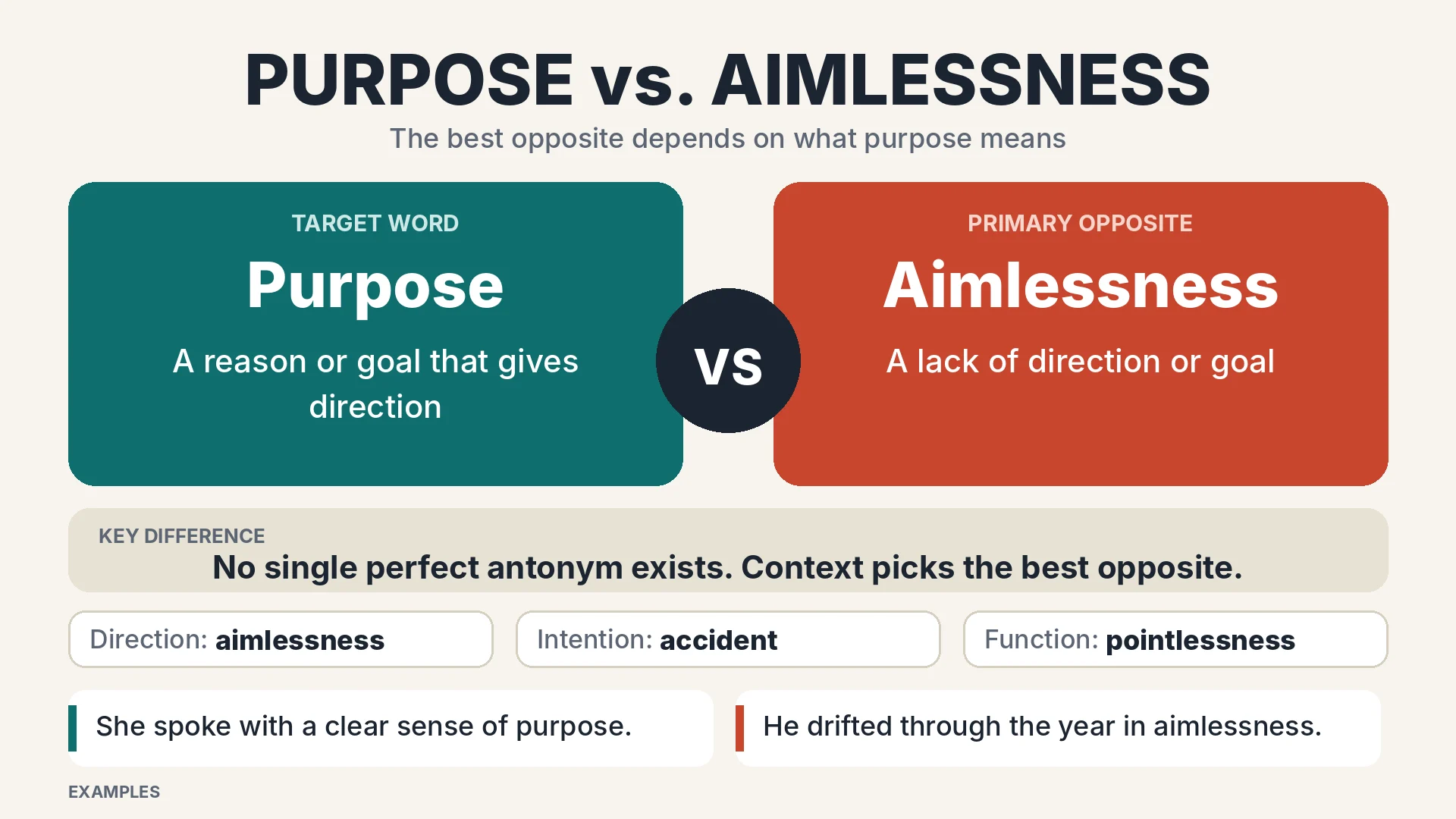
The strongest opposite of purpose is aimlessness, which describes a lack of direction or goal. Purpose means the reason something exists or the intention behind an action. English has no single perfect antonym, so context matters: accident opposes intentional purpose, and pointlessness opposes meaningful purpose.
Part of Speech: Noun. (Purpose also works as a formal verb meaning “to intend,” but that use is rare in everyday American English.)
Primary Opposite: Aimlessness
Purpose is the reason something exists, or the goal a person has in mind. It also carries a second, more personal meaning: determination, as in “a sense of purpose.”
When purpose means direction or resolve, aimlessness is the strongest direct opposite. Both words describe a person’s relationship to a goal, and aimlessness says there isn’t one.
Unlike hot and cold, purpose has no single, universally established antonym. It has several senses, so the best opposite shifts with the meaning you intend.
Direct and Strong Antonyms
Only two words qualify as true opposites of the main sense of purpose. Both are gradable, since a person can feel slightly aimless or deeply aimless.
| Antonym | Tone or Nuance | Example Sentence |
|---|---|---|
| Aimlessness | Neutral to mildly critical; suggests drifting without a goal | After graduation, Marcus felt a growing aimlessness and wondered what all his effort was for. |
| Purposelessness | Formal and abstract; names the absence of purpose itself | The audit described the committee’s purposelessness: it had met for a year without a single assigned task. |
Aimlessness is more natural in conversation and personal writing. Purposelessness appears more often in academic, philosophical, or analytical prose, where the writer wants to name the missing quality directly.
Contextual and Subtle Opposites
Purpose covers three major meanings, and each one has its own best opposite. The words below are contextual opposites, not direct antonyms, except where noted.
| Context | Best Opposite | Why It Fits |
|---|---|---|
| Direction or resolve | Aimlessness (direct) | It describes having no goal to steer toward. |
| Intention behind an act | Accident (contextual) | It describes something that happened without planning or intent. |
| Reason or function | Pointlessness (contextual) | It describes something with no useful reason to exist. |
Direction or resolve. “She walked into the interview with purpose” contrasts naturally with “He wandered through the week without direction.” The opposite here is a missing goal.
Intention behind an act. The phrase “on purpose” means deliberately, and its opposite is “by accident.” Accidentally and unintentionally also work. If the action was an error, “by mistake” is the better fit: “I sent the email to the wrong client by mistake.”
Reason or function. When you ask what purpose a thing serves, the opposite is a lack of any reason. “The extra approval step felt like pure pointlessness” captures that. Futility and meaninglessness also fit, but each carries a different weight, covered below.
Words That Seem Opposite But Are Not
Two words often get offered as opposites of purpose. Neither is an exact antonym.
Apathy. Apathy means a lack of interest or concern. It is a related contrast, not an opposite, because it describes feeling, while purpose describes direction. Someone can care deeply and still lack direction: “She cared about helping people but felt aimless about how to start.” Likewise, a person with a clear purpose can feel apathetic about one boring task.
Failure. Failure is the opposite of success, not of purpose. A person or project can have a clear purpose and still fall short. “The campaign had a well-defined purpose and still failed to reach it.” Failing means the goal was missed, not that there was no goal.
Subtle Tone Differences
Related opposites differ in strength, formality, and emotional weight, so choosing the right one improves precision.
Accident is neutral and factual. “The fire was an accident” reports what happened without blame. Mistake implies an error, and often some responsibility: “Leaving the door unlocked was a mistake.” Fluke is informal and usually describes a surprising, lucky outcome: “Winning the raffle was a total fluke.”
Pointlessness, futility, and meaninglessness also differ. Pointlessness is conversational and often practical: “That meeting was pointless.” Futility is more formal and suggests effort that cannot succeed, as in “the futility of arguing with a deadline.” Meaninglessness is emotional or philosophical and points to a missing sense of significance.
Even aimlessness has a softer partner. Calling someone aimless can sound critical, while saying they are “between directions” sounds kinder. Match the word to how you want the reader to feel.
Frequently Asked Questions
What is the opposite of purpose?
The closest opposite is aimlessness, meaning a lack of direction or goal. No single antonym fits every sense, so purposelessness, pointlessness, or accident may work better depending on whether you mean direction, usefulness, or intention.
What is the opposite of “on purpose”?
The opposite of “on purpose” is “by accident.” Accidentally and unintentionally also work. Use “by mistake” when the action was an error, as in “I grabbed your coat by mistake.”
Is pointlessness the opposite of purpose?
Pointlessness is a contextual opposite, not a direct one. It fits when purpose means a reason for existing or a useful function, as in a pointless meeting. For personal direction, aimlessness is more precise.
Practical Word Choice
Identify the intended meaning first. Ask whether you mean direction (“a sense of purpose”), intention (“on purpose”), or function (“the purpose of this tool”). Each question points to a different opposite: aimlessness, accident, or pointlessness.
Match context, tone, strength, and formality. Use aimlessness or pointlessness in conversation. Choose purposelessness or futility for formal or academic writing. Pick mistake over accident when the sentence needs to imply responsibility.
Final Thoughts
Purpose is a flexible word, and that flexibility is why it has no single perfect antonym. Aimlessness is the strongest opposite when purpose means direction or resolve. Accident and pointlessness take over when the meaning shifts to intention or function.
Context decides the right choice because each opposite negates a different part of the idea. One removes the goal, another removes the intent, and the third removes the reason. Words like apathy and failure sound close but describe feelings and outcomes, so they belong to separate conversations.
Before you write the opposite of purpose, finish the sentence in your head and ask what is actually missing. The answer usually names the right word. What sentence have you struggled to finish with the right opposite of purpose?