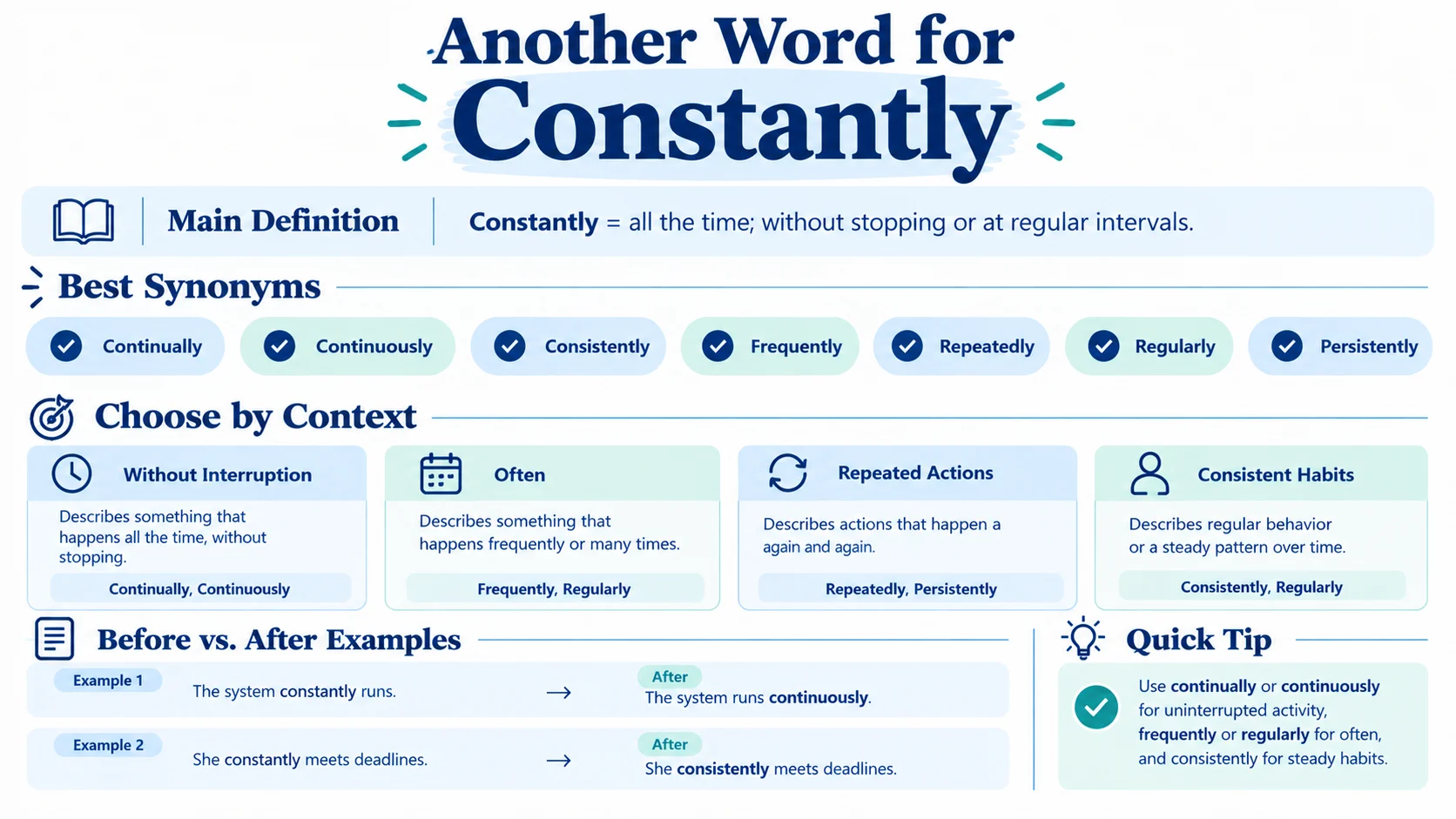
Another word for constantly depends on the context. Common synonyms include continually, continuously, consistently, frequently, repeatedly, regularly, persistently, and incessantly. Use continuously for something happening without interruption, frequently for something occurring often, and consistently for something done reliably over time. The best alternative depends on how often an action happens and whether it stops between occurrences.
What Does Constantly Mean?
Definition
Constantly is an adverb that means happening continuously, occurring very frequently, or taking place repeatedly over a period of time. It can describe actions, thoughts, changes, habits, or conditions.
For example:
- She constantly checks her phone.
- The machine runs constantly throughout the day.
- He is constantly looking for ways to improve.
- Prices are constantly changing.
The word can suggest that something happens without stopping or that it occurs so often that it becomes noticeable or annoying. Its precise meaning depends on the sentence.
Common Uses
The word constantly appears in several contexts:
- Continuous activity: Something happens without interruption, such as a machine running constantly.
- Frequent actions: Someone does something again and again, such as constantly checking messages.
- Repeated thoughts: A person continually thinks about a problem or situation.
- Ongoing change: Conditions or circumstances change constantly.
- Consistent behavior: Someone maintains a particular habit or pattern over time.
Although these meanings overlap, they are not identical. Choosing the right synonym can make your sentence more precise.
Best Synonyms for Constantly
| Synonym | Meaning | Best Used When | Example |
|---|---|---|---|
| Continually | Happening repeatedly over time, often with breaks | Repeated actions or ongoing developments | She continually improves her writing. |
| Continuously | Happening without interruption | Machines, processes, or uninterrupted activity | The system operates continuously. |
| Consistently | Happening in a steady, reliable way | Habits, performance, and repeated results | He consistently meets his deadlines. |
| Frequently | Happening often | Common events or regular actions | She frequently visits the library. |
| Repeatedly | Happening again and again | Recurring actions or attempts | He repeatedly asked the same question. |
| Regularly | Happening at predictable intervals or as a habit | Schedules and routines | They regularly review their progress. |
| Persistently | Continuing despite difficulty or resistance | Effort, problems, or determined behavior | She persistently pursued her goals. |
| Incessantly | Continuing without stopping, often annoyingly | Noise, talking, complaints, or interruptions | The phone rang incessantly. |
| Always | Happening at all times or on every relevant occasion | General habits or enduring conditions | He always arrives early. |
| Constantly | Happening continually or very frequently | General repeated or ongoing activity | She constantly looks for new ideas. |
| Repeatedly | Occurring multiple times | Warnings, mistakes, or repeated behavior | The warning appeared repeatedly. |
| Endlessly | Seemingly continuing without an end | Long processes or exaggerated descriptions | The meeting seemed to continue endlessly. |
| Unceasingly | Continuing without stopping | Formal or literary descriptions | The rain fell unceasingly. |
| Habitually | Happening as an established habit | Regular personal behavior | He habitually checks his schedule. |
| Routinely | Happening as part of an established procedure | Work tasks and daily activities | Employees routinely inspect the equipment. |
Synonyms by Context
Formal Writing
In formal writing, continually, consistently, persistently, regularly, and repeatedly are useful alternatives.
Continually works when an action or development occurs again and again.
Example: Researchers continually refine their methods as new evidence becomes available.
Consistently is better when emphasizing reliability or an established pattern.
Example: The organization consistently follows its published procedures.
Persistently highlights continued effort despite obstacles.
Example: The researcher persistently investigated the unexplained results.
For formal reports, choose the word that describes the actual pattern rather than using constantly as a general intensifier.
Professional Writing
In business communication, consistently, regularly, routinely, frequently, and continuously can make descriptions more precise.
Consistently is especially useful for describing performance.
Business example: The team consistently meets its quarterly targets.
Routinely describes tasks performed as part of normal operations.
Business example: The department routinely reviews customer feedback.
Continuously fits processes that operate without interruption.
Business example: The monitoring system continuously tracks network activity.
For resumes, consistently and routinely often communicate professional habits more clearly than constantly.
Academic Writing
Academic writing often benefits from frequently, repeatedly, consistently, continually, and continuously.
Use frequently when describing how often an event occurs.
Academic example: Students frequently use digital resources to support independent learning.
Use repeatedly when the same event, test, or observation occurs multiple times.
Academic example: The experiment repeatedly produced similar results.
Use consistently when findings or behaviors follow a reliable pattern.
Academic example: The results consistently supported the original hypothesis.
Use continuously only when the process occurs without interruption, rather than simply occurring often.
Daily Conversation
In everyday English, always, all the time, often, over and over, and again and again are natural alternatives.
Examples:
- Instead of “He constantly complains,” say “He complains all the time.”
- Instead of “She constantly asks questions,” say “She keeps asking questions.”
- Instead of “I constantly think about it,” say “I think about it all the time.”
- Instead of “The problem happens constantly,” say “The problem keeps happening.”
These alternatives sound conversational and are easy to understand. However, all the time can exaggerate frequency, depending on the situation.
Professional Alternatives for Constantly
When writing a resume, email, report, or academic paper, choose a word that communicates the intended pattern of behavior.
Consistently
Meaning: In a steady, reliable, or uniform way.
Best Used For: Performance, work habits, quality, and recurring results.
Tone: Professional
Difficulty: Easy
Usage Frequency: Very Common
Best For: Resume, Email Writing, Essay Writing, Business Writing
- Business example: Consistently exceeded customer satisfaction targets.
- Academic example: The study consistently produced comparable findings.
- Daily conversation example: She consistently helps whenever I need her.
Frequently
Meaning: Often or on many occasions.
Best Used For: Repeated events, habits, communication, and observations.
Tone: Neutral
Difficulty: Easy
Usage Frequency: Very Common
Best For: Essay Writing, Email Writing, Academic Writing, Business Writing
- Business example: The team frequently communicates with clients.
- Academic example: This pattern frequently appears in the available data.
- Daily conversation example: I frequently visit my grandparents.
Continuously
Meaning: Without interruption.
Best Used For: Processes, systems, monitoring, and uninterrupted activity.
Tone: Neutral to formal
Difficulty: Medium
Usage Frequency: Common
Best For: Academic Writing, Marketing Copy, Business Writing
- Business example: The system continuously monitors transaction activity.
- Academic example: The sensor continuously records temperature changes.
- Daily conversation example: The fan ran continuously throughout the night.
Persistently
Meaning: Continuing firmly despite difficulty, delay, or opposition.
Best Used For: Effort, investigation, determination, or recurring problems.
Tone: Formal to neutral
Difficulty: Medium
Usage Frequency: Common
Best For: Resume, Essay Writing, Academic Writing
- Business example: The sales team persistently pursued new opportunities.
- Academic example: The researcher persistently examined alternative explanations.
- Daily conversation example: She persistently worked toward her goal.
Simple Alternatives for Constantly
If you want a simple and natural replacement, consider these options:
- Always: For something that happens every time or at all times.
- Often: For something that happens many times.
- All the time: For frequent actions in casual conversation.
- Again and again: For repeated events.
- Regularly: For routines and scheduled activities.
- Over and over: For repeated actions, sometimes with frustration.
- Every day: When something happens daily.
- Without stopping: When an activity continues without interruption.
For example, “She constantly checks her email” could become “She checks her email all the time.” If the action happens at predictable intervals, “She regularly checks her email” may be more accurate.
Stronger Alternatives for Constantly
Sometimes a more expressive word makes your writing stronger.
Incessantly emphasizes an activity that continues without stopping, often to an irritating degree.
Example: The neighbors talked incessantly throughout the night.
Unceasingly emphasizes uninterrupted continuation and is more formal or literary.
Example: The organization worked unceasingly to provide assistance.
Persistently highlights determination or an ongoing problem that does not go away.
Example: The team persistently searched for a solution.
Endlessly suggests that something seems to have no end. It can be literal or exaggerated.
Example: The discussion seemed to continue endlessly.
Relentlessly emphasizes intense, determined, or unyielding continuation.
Example: The company relentlessly pursued its expansion goals.
These alternatives carry different emotional tones. Use incessantly for irritating repetition, persistently for determination, and relentlessly for forceful, sustained effort.
Difference Between Similar Synonyms
Constantly vs. Continually: Both describe ongoing or repeated activity. Continually often suggests recurring actions with breaks, while constantly can suggest either frequent repetition or uninterrupted activity.
Constantly vs. Continuously: Continuously specifically emphasizes an absence of interruption. Constantly is broader and can describe frequent actions that stop and start.
Constantly vs. Consistently: Consistently emphasizes reliability or uniformity, not necessarily frequency. Someone can consistently perform a task once a week without doing it constantly.
Constantly vs. Frequently: Frequently means often, but it does not necessarily suggest excessive repetition or uninterrupted activity.
Constantly vs. Repeatedly: Repeatedly emphasizes that something happens multiple times. Constantly can suggest a more ongoing or persistent pattern.
Constantly vs. Always: Always can mean every time or at all times. Constantly usually emphasizes ongoing activity or frequent repetition and may sound more intense.
Constantly vs. Persistently: Persistently emphasizes continuing despite resistance or difficulty, while constantly focuses more on frequency or continuation.
Opposite Words
The opposite of constantly depends on the meaning of the sentence.
| Synonym or Meaning | Opposite | Example |
|---|---|---|
| Happening all the time | Occasionally | She occasionally checks her messages. |
| Happening frequently | Rarely | He rarely misses a meeting. |
| Happening repeatedly | Once | The alarm sounded once. |
| Happening continuously | Intermittently | The machine operates intermittently. |
| Happening regularly | Irregularly | The service runs irregularly. |
| Continuing persistently | Sporadically | The team worked sporadically on the project. |
These words describe different kinds of contrast rather than serving as universal antonyms.
FAQs
What is another word for constantly?
Common synonyms include continually, continuously, consistently, frequently, repeatedly, regularly, and persistently. The best choice depends on whether you mean without interruption, often, or in a steady pattern.
What is a formal synonym for constantly?
Formal alternatives include continually, continuously, persistently, unceasingly, and incessantly. Choose according to the meaning and tone of the sentence.
What is a professional alternative for constantly?
Consistently, regularly, routinely, frequently, and continuously are useful in professional writing. Use consistently for reliable performance and continuously for uninterrupted processes.
What word can replace constantly in academic writing?
Use frequently for events that occur often, repeatedly for multiple occurrences, consistently for reliable patterns, and continuously for uninterrupted processes.
What is another word for constantly thinking about something?
Possible alternatives include continually thinking about, repeatedly thinking about, obsessing over, and dwelling on. Dwelling on often suggests repeatedly focusing on something troubling.
What is another word for constantly changing?
Useful alternatives include continually changing, frequently changing, ever-changing, and fluctuating. Fluctuating is especially suitable for prices, temperatures, and measurable conditions that rise and fall.
What is another word for constantly working?
Depending on the context, use working continuously, working consistently, working tirelessly, or working persistently. Tirelessly emphasizes sustained effort, not necessarily literal uninterrupted work.
Is constantly the same as continuously?
No. Constantly can describe frequent repeated actions or uninterrupted activity. Continuously specifically means without interruption.
What is the opposite of constantly?
Common opposites include occasionally, rarely, intermittently, sporadically, and infrequently. The right choice depends on how the original sentence uses constantly.
Is constantly a positive or negative word?
It can be either. “Constantly improving” sounds positive, while “constantly complaining” sounds negative. The surrounding words determine its tone.
Conclusion
The best another word for constantly depends on how an action or condition occurs. Choose continuously for uninterrupted activity, frequently for something that happens often, consistently for reliable behavior, and repeatedly for actions that occur again and again.
For stronger expression, use incessantly for irritating repetition, persistently for determined effort, or relentlessly for intense continuation. Selecting the right synonym helps make your writing more precise, natural, and effective in academic, professional, and everyday situations.