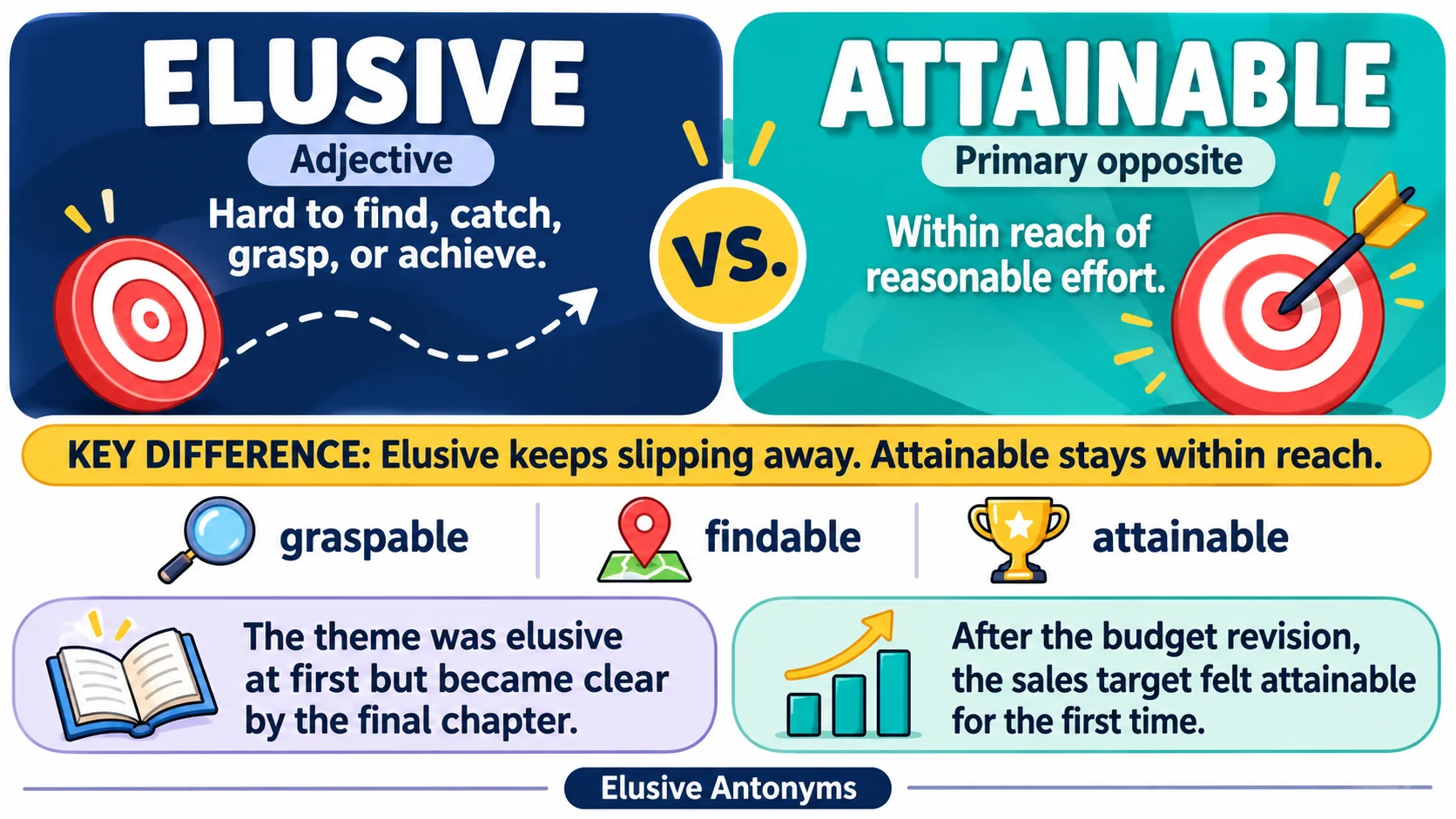
The strongest opposite of elusive is attainable when it describes goals or success that are hard to reach. Elusive means difficult to find, catch, grasp, or achieve. No single perfect antonym exists, so the best choice shifts by meaning: clear for ideas, findable for hidden things.
Part of speech: Adjective
Primary opposite: Attainable
Elusive describes something that slips away from effort. A person may fail to catch it, find it, understand it, or achieve it. Dictionaries do not pair it with one fixed antonym, so the right opposite depends on which kind of slipperiness you mean.
When elusive means hard to achieve, attainable is the strongest direct opposite. A goal that is elusive keeps moving out of reach. A goal that is attainable sits within reach of reasonable effort.
Attainable also fits the most common uses of elusive in American English, such as an elusive win, an elusive promotion, or elusive peace. If your sentence is about an idea or a physical object, read on for better matches.
Direct and Strong Antonyms
These words oppose elusive most naturally. Each one covers a different sense, so none of them works everywhere.
| Antonym | Tone or Nuance | Example Sentence |
|---|---|---|
| Attainable | Neutral, common in business and personal goals | After the budget revision, the sales target felt attainable for the first time. |
| Obtainable | Slightly formal, often about resources or results | Reliable data was obtainable only through the state archive. |
| Graspable | Precise, used for ideas and concepts | The professor made quantum states graspable with a single coin toss demo. |
| Findable | Plain and practical, used for things that can be located | The old receipt was findable in under a minute once she checked the right folder. |
Attainable and obtainable are close, but they are not twins. Attainable suits achievements and aims. Obtainable suits things you can get, such as permits, tickets, or information.
Graspable is the cleanest opposite when elusive describes meaning. An elusive concept resists understanding, while a graspable one yields to it.
Contextual and Subtle Opposites
Elusive is polysemous in practice. It shifts depending on what is slipping away, so the best opposite shifts too. The words below work as opposites only in a specific meaning, and they are contextual, not universal.
| Context | Best Opposite | Why It Fits |
|---|---|---|
| Hard to catch or locate (a bird, a suspect) | Findable, catchable | Describes something that does not evade searching or pursuit. |
| Hard to achieve (success, a title) | Attainable, achievable | Places the goal within realistic reach. |
| Hard to understand or define (a feeling, a theme) | Clear, graspable | Describes meaning that comes into focus. |
| Hard to remember (a name, a dream) | Vivid, memorable | Describes something that stays in the mind. |
Formality matters as well. In a lab report, you might write that a result was reproducible. In a text to a friend, you would more likely say it was easy to find. Strength also varies. Obvious is a stronger opposite than clear because it suggests no effort is needed at all, while clear only suggests the effort pays off.
Elusive is gradable, which means it exists on a scale. Something can be somewhat elusive or extremely elusive. Its opposites are gradable too, so you can say fairly clear or completely obvious. That is why a single fixed antonym can feel wrong in some sentences.
Words That Seem Opposite But Are Not
Two terms often get offered as opposites, but they fail the test for different reasons.
Evasive. Evasive actually sits closer to elusive than to its opposite. It usually describes people or answers that avoid directness, as in an evasive reply to a reporter. Elusive can describe things with no intention at all, like an elusive melody. Both words involve slipping away, so evasive is a related term, not an antonym.
Visible. It is tempting to say visible is the opposite, since an elusive thing seems hidden. But elusive does not mean invisible. A fast fox in plain sight can still be elusive if you cannot catch it. Visible describes whether something can be seen. Elusive describes whether it can be caught, found, or understood. Those are different questions.
Subtle Tone Differences
Small choices change how a sentence lands.
Compare these two lines. “The solution was obvious” suggests anyone would have seen it right away. “The solution was graspable” suggests it took some work but made sense in the end. The first praises simplicity, and the second respects effort.
Attainable carries a quiet realism. “A fair price is attainable” sounds measured and practical. “A fair price is guaranteed” is a promise, and attainable never makes one. It only says the target is within reach.
Formality shifts the feel as well. A hiring manager might write that candidates with that skill set are accessible in this market. A coworker at lunch would say they are not hard to find. Both express the same opposition to elusive in different registers.
Frequently Asked Questions
What is the direct antonym of elusive?
There is no single fixed antonym. Attainable is the closest direct opposite when elusive means hard to achieve. For ideas, graspable fits better, and for things hard to locate, findable is the more natural choice.
What is the opposite of elusive when describing an idea?
Clear or graspable. An elusive idea resists understanding or definition, so its opposite is one that comes into focus. In a sentence, you might say the theme was elusive at first but became clear by the final chapter.
Can I use obvious instead of attainable in my writing?
Only when ease is the point. Obvious opposes elusive when something is easy to notice or understand. It does not fit goals, since an obvious goal is not necessarily a reachable one. Use attainable for achievements.
Practical Word Choice
Identify the intended meaning first. Ask what is slipping away. If it is a goal, choose attainable. If it is an idea, choose clear or graspable. If it is something you are searching for, choose findable.
Match context, tone, strength, and formality. Use obtainable in formal or professional writing and easy to find in casual speech. Choose obvious only when you want to stress that no effort is needed.
Final Thoughts
Elusive does not have one perfect opposite because it describes several kinds of escape. The word can point to something hard to catch, hard to reach, or hard to understand, and each meaning calls for a different counterpart.
That is why context decides the best choice. Attainable leads for goals, graspable leads for ideas, and findable leads for things you are trying to locate. Treating evasive and visible as opposites would blur the meaning rather than sharpen it.
Before you pick a word, name what is slipping away. The answer usually points straight to the right opposite. What is a goal, idea, or object that felt elusive until it finally became clear for you.