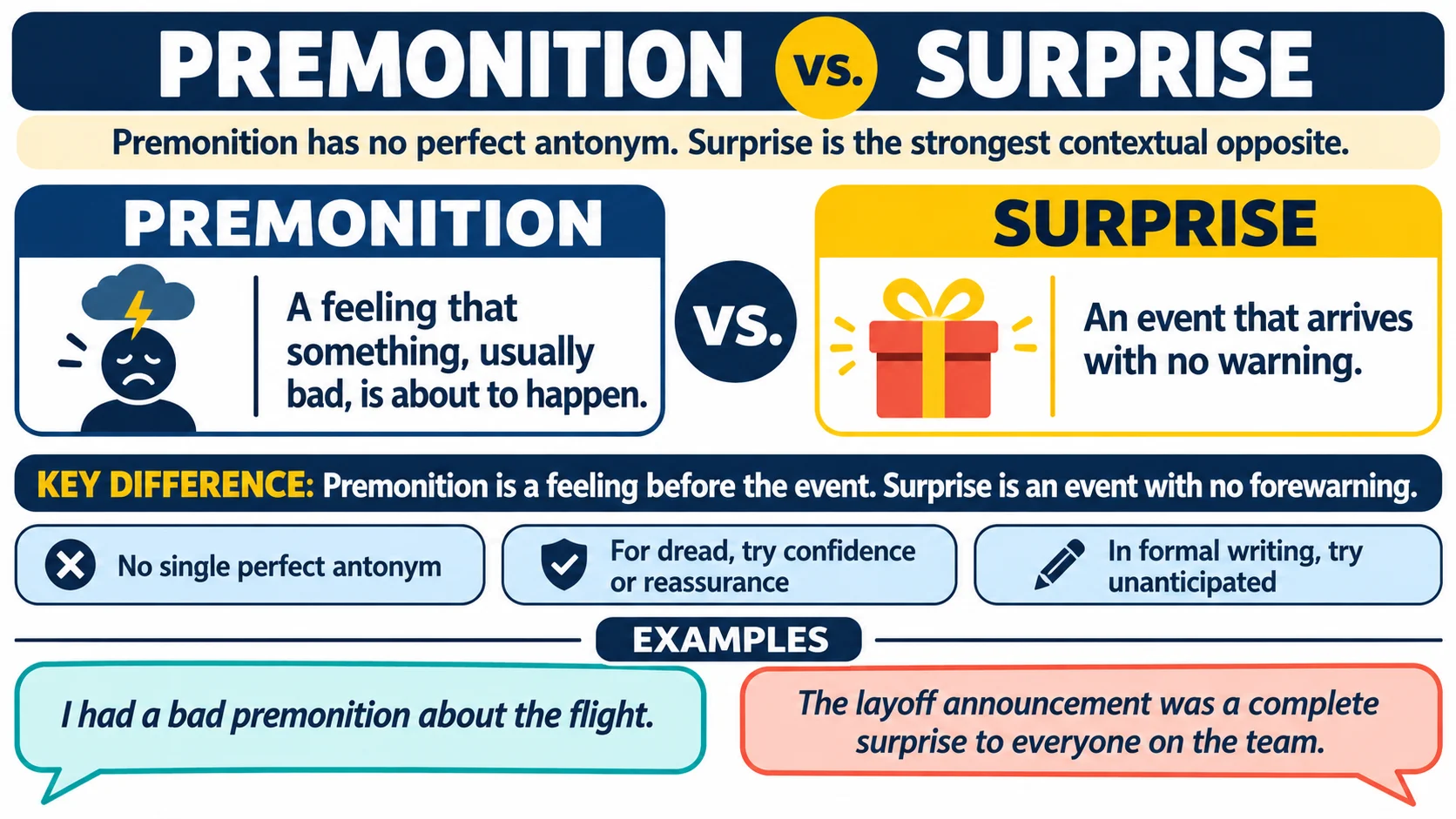
Premonition has no single perfect antonym, but surprise is the strongest contextual opposite. A premonition is a feeling that something, usually bad, is about to happen. Surprise describes an event that arrives with no warning at all. When the sense is foreboding, confidence or reassurance works better.
Part of Speech: Noun
Primary Opposite: Surprise (contextual)
A premonition is a strong feeling, often uneasy, that a particular event is coming, usually before any evidence supports it. Standard English dictionaries do not list one established antonym, so no word qualifies as a perfect direct opposite.
When premonition means a sense that something is about to happen, surprise is the strongest contextual opposite, because it names an event that arrives without forewarning. When premonition means dread, confidence or reassurance fits better.
Direct and Strong Antonyms
Premonition is an unusual word because its meaning combines two ideas: a feeling and a forecast. That makes a clean one-word opposite hard to find. The words below are the most natural options in American English. Each one is contextual, and none is a strict dictionary antonym.
| Antonym | Tone or Nuance | Example Sentence |
|---|---|---|
| Surprise | Neutral and widely usable. Can be pleasant or unpleasant. | The layoff announcement was a complete surprise to everyone on the team. |
| Bolt from the blue | Informal, dramatic idiom. Implies a sudden shock. | The diagnosis hit her like a bolt from the blue after a clean checkup. |
| Confidence | Calm and positive. Opposes the dread in a bad premonition. | He walked into the interview with total confidence, not a hint of worry. |
| Reassurance | Warm and supportive. Suggests a feeling that things will be fine. | The doctor’s call gave us real reassurance after a week of anxious guessing. |
Notice that surprise opposes the forewarning, while confidence and reassurance oppose the dread. These are different kinds of opposition, which is why one word cannot cover every situation.
Contextual and Subtle Opposites
The best opposite depends on which part of premonition you want to contrast. Here is how the choice changes by meaning.
| Context | Best Opposite | Why It Fits |
|---|---|---|
| A forewarning of a coming event | Surprise | It describes an event with no advance sign. |
| A feeling of dread or doom | Confidence, reassurance | It names a feeling that all will go well. |
| Formal or professional writing | Unforeseen event, unanticipated development | It sounds measured and suits reports and memos. |
All three are contextual. None would appear in a dictionary as a fixed antonym of premonition.
Strength matters too. A premonition can be faint, like a vague unease before a trip, or intense, like a conviction that something terrible will happen. A mild surprise opposes a faint premonition well. For an intense one, a bolt from the blue captures the full contrast, because it signals a shock that no one saw coming.
Formality also shifts the choice. In a casual text, you might say, “Total surprise, honestly.” In a business email, “an unanticipated change in scope” sounds more appropriate.
Words That Seem Opposite But Are Not
Some words look like natural opposites but belong in the category of related contrasts. Two are especially common.
Hindsight. Hindsight is understanding an event after it has happened, so it sits at the opposite end of a timeline from premonition. That relationship is real, but it is not antonymy. A premonition is a feeling about the future, while hindsight is an analysis of the past. One can even follow the other, as in, “In hindsight, my premonition about that deal was right.”
Déjà vu. Déjà vu is the feeling that a new moment has happened before, so it mirrors premonition by pointing backward instead of forward. Still, it is not an exact opposite. Both are strange feelings about time, which makes them closer cousins than enemies. A person can feel déjà vu at a moment they never anticipated, and that has nothing to do with whether a premonition came first.
Subtle Tone Differences
Premonition itself carries a specific tone. It suggests something unexplained and usually grim, and it often feels slightly mystical. A hunch is lighter and more casual. Foreboding stresses the dread more than the prediction.
The opposites vary in the same way.
Surprise is the most flexible choice because it is neutral. “The party was a wonderful surprise” works just as well as “The audit was an unpleasant surprise.” A premonition rarely sounds cheerful, but a surprise can.
Bolt from the blue adds emphasis. It tells the reader the event was not only unexpected but also jarring. “The merger news came out of nowhere” is a plainer way to say it.
Reassurance and confidence shift the focus from the event to the person’s emotional state. “I had a bad premonition about the flight” contrasts naturally with “I felt calm reassurance about the flight.” Here the contrast is between two feelings, not between a feeling and an event.
Frequently Asked Questions
What word means the opposite of premonition when it signals bad news?
Reassurance or confidence usually fits. A premonition of trouble is a feeling of dread, and these words describe the feeling that things will turn out fine. Calm assurance is another everyday alternative in conversation.
Is hindsight the opposite of premonition?
Not exactly. Hindsight is understanding an event after it has happened, while a premonition is a feeling before it happens. They sit at opposite ends of a timeline, but hindsight is a related contrast, not a true antonym.
Which opposite should I use in a sentence about an unexpected event?
Use surprise for a neutral tone, unforeseen or unanticipated for formal writing, and bolt from the blue for a dramatic, informal voice. Match the word to how much shock you want the sentence to carry.
Practical Word Choice
- Identify the intended meaning. Ask whether you are contrasting the forewarning (use surprise) or the dread (use confidence or reassurance).
- Match context, tone, strength, and formality. Choose unanticipated for a report, surprise for general writing, and bolt from the blue when you want drama.
Final Thoughts
Premonition has no perfect one-word antonym, and that is useful to know. The word blends a feeling with a forecast, so its opposite changes depending on which part you want to contrast. Surprise handles the forewarning, while confidence and reassurance handle the dread.
Context drives the choice because each opposite carries its own tone and strength. A neutral memo, a personal story, and a tense scene in fiction all call for different words, even when the underlying idea is the same.
One last tip is to say the sentence aloud with your chosen opposite. If it sounds natural, it probably is. What is the best example of a surprise you never saw coming?