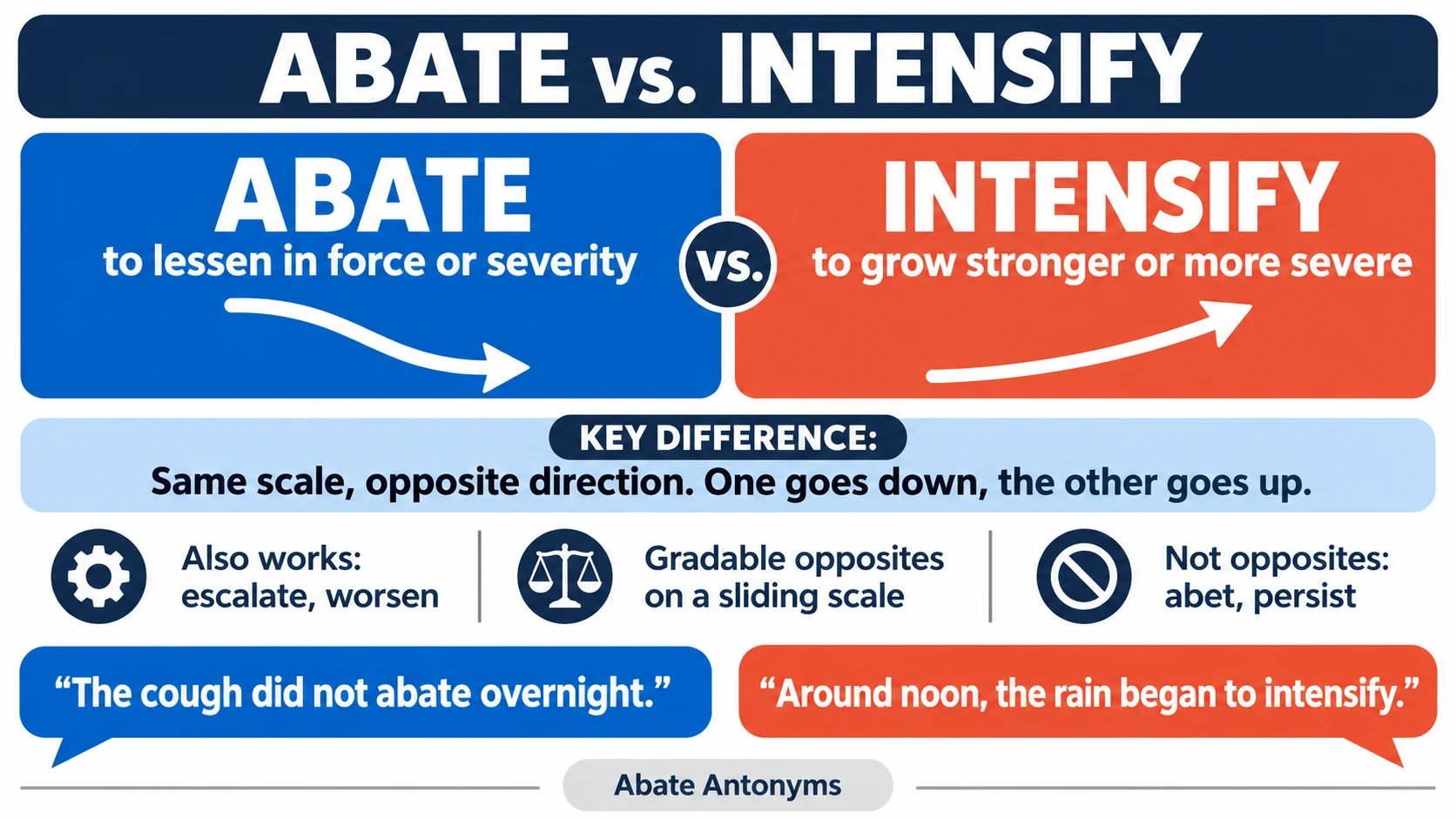
The opposite of abate is intensify. To abate means to become less intense, as when a storm, pain, or fear weakens over time. Intensify means to grow stronger or more severe. Depending on context, escalate, worsen, or flare up can also work as natural opposites.
Part of speech: verb
Primary opposite: intensify
Abate usually means to lessen in force or severity. Winds abate, pain abates, and public anger abates. When abate carries this meaning, intensify is the strongest direct opposite. Both words describe movement along the same scale of force, so they pair cleanly: one slides down the scale, the other climbs it.
Abate has a second, more formal sense, meaning to reduce or put an end to something, such as a tax or a legal nuisance. In that sense, no single perfect antonym exists, and the best opposite depends on what is being reduced. The sections below sort these out.
Direct and Strong Antonyms
These words oppose abate in its main sense of weakening or easing.
| Antonym | Tone or Nuance | Example Sentence |
|---|---|---|
| intensify | Neutral and widely usable; the most balanced choice | “Around noon, the rain began to intensify, and the game was postponed.” |
| escalate | Suggests a step-by-step climb, often in conflict or cost | “A small disagreement over deadlines started to escalate once the client got involved.” |
| worsen | Plain and negative; focuses on harm or decline | “The cough did not abate overnight. If anything, it worsened.” |
Abate and intensify are gradable opposites. Instead of an on and off switch, they sit at opposite ends of a sliding scale. That is why a storm can abate slightly, abate fully, or abate and then intensify again.
Contextual and Subtle Opposites
The best opposite shifts with meaning. The words below are contextual alternatives, not universal antonyms.
| Context | Best Opposite | Why It Fits |
|---|---|---|
| Weather or natural forces | intensify, strengthen | Describes wind, flooding, or heat gaining force |
| Pain, symptoms, or illness | worsen, flare up | Focuses on a condition getting more severe |
| Emotions or conflict | escalate, mount | Shows tension building over time |
| Taxes, fees, or costs | raise, increase | Reverses a reduction in amount |
| Legal nuisance or violation | allow to continue, perpetuate | Contrasts with ending the problem |
Consider two sentences. “The city agreed to abate the late fees” means the fees were reduced or waived. The opposite action would be that the city decided to raise the late fees. Intensify would sound strange there, because fees do not have intensity. In the same way, “The noise ordinance requires owners to abate the nuisance” means the owners must stop it. Perpetuate fits as a contextual contrast, but it is not a standard dictionary antonym.
Words That Seem Opposite But Are Not
Abet
Abet looks and sounds similar to abate, so writers sometimes assume they are linked. They are not. To abet means to help or encourage, usually in wrongdoing, as in “He was charged with aiding and abetting the fraud.” It has no meaning of increase or decrease, so it cannot be the opposite of abate. The overlap is only in spelling.
Persist
Persist means to continue, often despite resistance. It is a related contrast, not a direct antonym. A fever can persist while still easing slightly, and a storm can persist at the same strength without growing. Abate describes a drop in intensity, while persist describes continuation. Compare “The pain persisted all week” with “The pain intensified all week.” Only the second sentence shows a true reversal of abate.
Subtle Tone Differences
Choosing among the opposites of abate comes down to precision and tone.
Intensify is neutral and works in nearly any register, from casual speech to academic writing. “Her interest in the project began to intensify after the pilot results.”
Escalate carries a sense of rising steps and often signals conflict, cost, or risk. “Tensions escalated after the budget meeting.”
Worsen is blunt and emphasizes decline. It suits medical, personal, or safety contexts. “His symptoms worsened after the second dose.”
Flare up is more informal and implies a sudden return or burst. “My allergies flare up every April.”
Formality matters on the abate side too. Abate is formal and common in news, legal, and weather writing. In casual speech, people usually say ease up or die down. Matching the opposite to that register keeps a sentence natural: “The rain finally died down” pairs with “The wind picked up,” while “The rain finally abated” pairs with “The wind intensified.”
Frequently Asked Questions
What is the direct antonym of abate?
The strongest direct antonym of abate is intensify. Abate means to lessen in force, and intensify means to grow stronger. Escalate and worsen are also strong opposites, depending on whether the situation involves rising conflict or increasing severity.
What is the opposite of abate when it refers to taxes or fees?
When abate means to reduce or cancel an amount, such as a property tax, the best contextual opposites are raise and increase. Intensify does not fit, because amounts of money have size rather than intensity.
Can I use worsen as the opposite of abate in a sentence?
Yes, when the subject is something harmful, like pain, symptoms, or a crisis. “The flooding worsened” works well. For neutral subjects, such as wind or interest, intensify is the more accurate and natural choice.
Practical Word Choice
Identify the intended meaning. Decide whether abate means weakening in force or reducing an amount. For force, choose intensify, escalate, or worsen. For amounts, choose raise or increase.
Match the context, tone, strength, and formality. Use escalate for conflict, worsen for harm, and intensify when you want a neutral, flexible option. Choose flare up for casual speech.
Final Thoughts
The key distinction is simple. Abate means to lessen, and intensify means to strengthen. They sit on the same scale, which is why they work as direct opposites when the subject is a force such as weather, pain, or emotion.
Context decides everything else. When abate means to cut an amount or end a legal problem, the better opposite changes to raise, increase, or allow to continue. Words like abet and persist can look or feel related, but they do not reverse abate’s meaning.
Before you choose, ask what is changing and in which direction. That one question usually leads to the right word. What sentence have you written or heard where abate or one of its opposites fit perfectly?