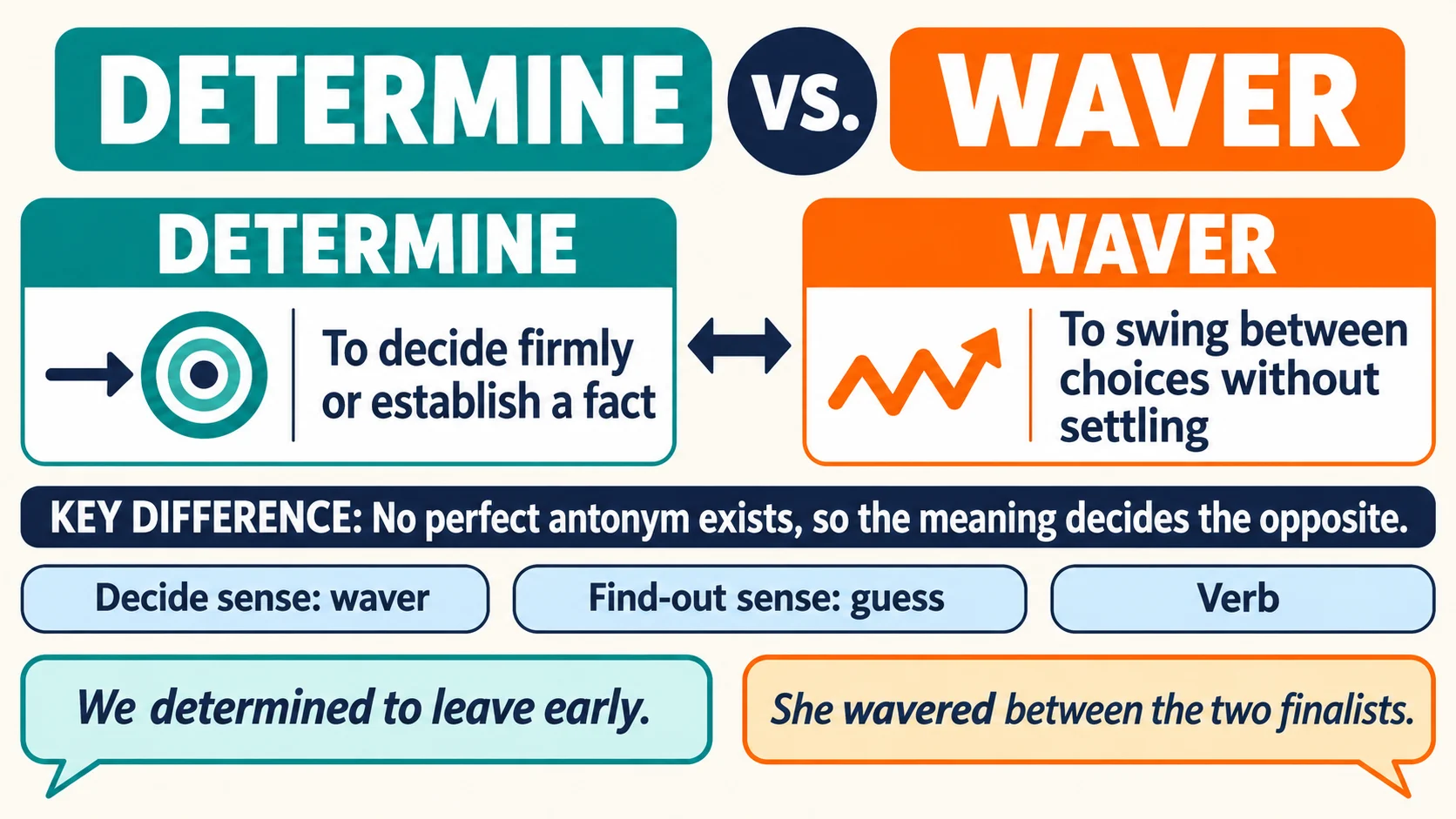
The opposite of determine depends on its meaning. When determine means to decide or settle something, the closest opposites are waver and hesitate. When it means to find out a fact, guess or assume fits best. English has no single perfect antonym, so context decides which opposite works.
Part of speech: verb
Primary opposite: waver (contextual, for the decision sense)
Determine has three main meanings: to decide or settle something firmly, to find out a fact through investigation, and to control or cause an outcome. Dictionaries do not assign it one fixed antonym. When determine means to make a firm decision, waver is the strongest contextual opposite, because it describes a person who cannot commit to a choice. When it means to establish a fact, guess is the better contrast. Neither is a perfect mirror image, and this guide labels each pairing honestly.
Direct and Strong Antonyms
Determine has no single direct antonym that works in every sense. Every option below is a contextual antonym, meaning it opposes determine only in the sense listed.
| Antonym | Sense | Tone or Nuance | Example Sentence |
|---|---|---|---|
| waver | decide | Neutral, slightly literary | After weeks of interviews, she still wavered between the two finalists. |
| hesitate | decide | Neutral, everyday | He hesitated at the door, unsure whether to knock. |
| defer | decide | Formal | The committee deferred its ruling until March. |
| guess | find out | Informal | Without lab results, the vet had to guess at the cause. |
| assume | find out | Neutral, professional | Do not assume the budget is approved; confirm it with finance. |
Contextual and Subtle Opposites
The best opposite shifts with meaning. Match the sense first, then choose the word.
| Context | Best Opposite | Why It Fits |
|---|---|---|
| Decide or resolve (“We determined to leave early.”) | waver | Describes failing to settle on a choice |
| Ascertain a fact (“Investigators determined the cause.”) | guess | Replaces confirmed knowledge with speculation |
| Cause or control (“Training determines the result.”) | leave to chance | No single word exists; this phrase removes control |
| End a legal agreement (“The lease determines in June.”) | renew | Continues what determine would end |
The last row is rare in everyday speech. Most American readers meet determine in the first three senses. Formality matters too. Defer suits meetings and legal writing, while hesitate fits conversation.
Words That Seem Opposite But Are Not
Common Grammatical or Semantic Confusions
Two words often get mistaken for antonyms.
Undetermined looks like a natural opposite, but it is an adjective describing an unresolved state, as in “The cause of the fire remains undetermined.” It is the negated result of determine, not an opposing action.
Ignore sometimes gets suggested because ignoring evidence can stop someone from reaching a conclusion. But ignoring means refusing to consider information, while wavering or guessing means failing to reach certainty. “The manager ignored the data” does not mean she was unable to decide.
Subtle Tone Differences
Related choices shift strength and formality.
Waver suggests swinging back and forth: “Voters wavered until the final debate.” Hesitate suggests a brief pause before acting: “She hesitated before signing the contract.” Defer is deliberate and procedural: “The board deferred the decision pending an audit.” These three describe different kinds of not deciding, so swapping them can change your meaning.
For the fact sense, guess is casual and openly uncertain, while assume sounds more professional and implies a working premise: “We assumed the shipment had arrived because the tracking page said delivered.”
Frequently Asked Questions
What is the opposite of determine when it means to decide?
When determine means to decide firmly, waver is the strongest contextual opposite. It describes someone who keeps changing course instead of settling. Hesitate and defer also work, but they suggest a pause or a postponement rather than ongoing back and forth.
What is the opposite of determine when it means to find out a fact?
Guess is the closest contrast, because it replaces verified knowledge with speculation. Assume works in professional settings, where it means treating something as true without confirming it. Neither is a strict antonym, so sentence context should guide your choice.
Which opposite of determine works best in professional writing?
Defer and assume suit professional writing best. Defer fits decisions that are intentionally postponed, as in meeting minutes. Assume fits unverified facts, as in project plans. Avoid guess in formal reports unless you want to signal open uncertainty.
Practical Word Choice
- Identify the intended meaning. Ask whether determine means decide, find out, or control an outcome. Each sense points to a different opposite.
- Match the context, tone, strength, and formality. Use defer in a board memo, hesitate in a casual story, and guess when you want to signal open uncertainty.
Final Thoughts
Determine has no perfect antonym because it carries several meanings, and each one has its own opposite. Waver opposes the decision sense, guess opposes the discovery sense, and a phrase like leave to chance opposes the control sense.
Context matters because these words are not interchangeable. Wavering is ongoing indecision, deferring is a deliberate delay, and assuming is acting without confirmation. Choosing the wrong one can quietly change what your sentence says.
Here is one habit that helps. Swap determine for a simpler synonym first, such as decide or find out. Whichever fits tells you which opposite to use. Which opposite of determine do you reach for most often, and what sentence would you write with it?