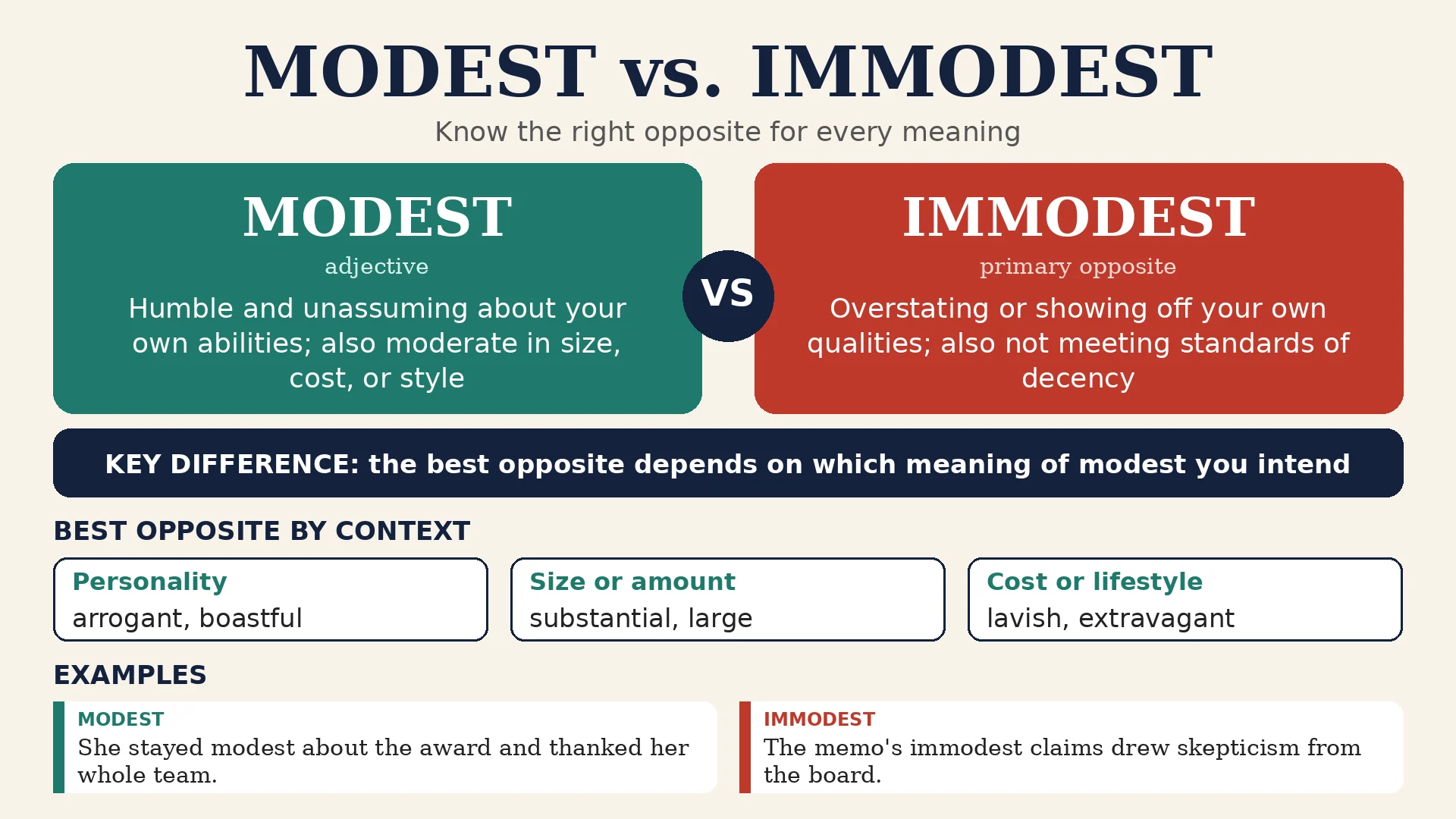
When modest means humble and unassuming, its strongest opposites are arrogant and boastful. Modest is an adjective that can also mean moderate in size, price, or style, where lavish and substantial fit better. The only direct antonym that works across most senses is immodest.
Part of speech: Adjective
Primary opposite: Immodest
Modest describes a person who does not exaggerate their abilities or achievements. It also describes things that are limited in size, cost, or style, and dress or behavior that follows conventional standards of decency.
When modest means unassuming about one’s own qualities, immodest is the strongest direct opposite. It is also the only antonym that carries over to nearly every sense of the word, including propriety. In everyday American English, though, people often choose arrogant or boastful to describe a personality, because immodest can sound formal or suggest clothing.
No single word is a perfect opposite in every context. Modest has several meanings, so the best antonym depends on which one you intend.
Direct and Strong Antonyms
Modest and immodest sit on a scale rather than forming a strict either/or pair. Someone can be fairly modest, not very modest, or openly immodest. The other words below are contextual antonyms for the personality sense, and each one carries a different shade of meaning.
| Antonym | Type | Tone or Nuance | Example Sentence |
|---|---|---|---|
| Immodest | Direct | Formal; covers claims, behavior, and dress | The brochure made immodest promises about guaranteed results. |
| Arrogant | Contextual | Strong and negative; implies looking down on others | His arrogant tone in meetings made junior staff afraid to speak up. |
| Boastful | Contextual | Focuses on bragging out loud | After the promotion, he grew boastful and mentioned his new title at every dinner. |
| Conceited | Contextual | Excessive pride in oneself; slightly dated | She was too conceited to admit the idea had come from her intern. |
Contextual and Subtle Opposites
Because modest is polysemous, the right opposite changes with meaning. Matching the sense first prevents awkward word choices.
| Context | Best Opposite | Why It Fits |
|---|---|---|
| Attitude toward oneself | Arrogant, boastful | They describe inflated self-regard, which is what modesty avoids. |
| Size or amount | Substantial, large | They contrast with something deliberately limited or small. |
| Cost or lifestyle | Lavish, extravagant | They describe spending or style beyond what is necessary. |
| Dress or conduct | Immodest, revealing | They contrast with conventional standards of decency. |
Attitude. A modest person downplays their role. “She stayed modest about the award and thanked her whole team.” The opposite would be someone who claims all the credit: “He gave an arrogant speech and never mentioned his colleagues.”
Size or amount. Here modest means smaller than you might expect. “The company reported a modest profit this quarter.” If the profit were considerable, you would call it substantial or large. Words like huge or enormous overshoot, since modest rarely means tiny.
Cost or lifestyle. Modest describes plain, affordable things. “They lived in a modest two-bedroom house near the school.” The contrast is a lavish estate or an extravagant lifestyle. Ostentatious fits when the point is showing off wealth, not just having it.
Dress or conduct. In this older and more formal sense, modest means avoiding what others might consider improper. The opposite is immodest, as in “The dress code bans immodest clothing.” Writers should use this sense carefully, because standards vary widely between communities and eras.
Words That Seem Opposite But Are Not
Proud
Proud looks like a natural opposite, but it is not. Pride is a feeling of satisfaction, and it is often healthy. “She is proud of her team and still modest about her own role.” Only excessive pride, which people call arrogance or conceit, truly opposes modesty.
Confident
Confident describes belief in your abilities, while modest describes how you present them. The two can coexist. “A confident surgeon can still be modest about her success rate.” Treating confident as an antonym would mislabel many capable, humble people.
Subtle Tone Differences
The contextual antonyms are not interchangeable, and the differences matter in professional writing.
Boastful targets behavior. It suggests someone who talks about their accomplishments too often. “His boastful emails about sales numbers annoyed the rest of the team.”
Arrogant targets attitude and usually hits harder. It implies the person believes they are better than others. “The arrogant manager dismissed every suggestion without listening.”
Conceited points to an inflated opinion of oneself and can sound old-fashioned in modern business writing.
Immodest is the most neutral and formal of the group. “The memo’s immodest claims drew skepticism from the board.” It criticizes without the sharp edge that arrogant carries, which makes it useful in academic or editorial writing.
If you want a gentler tone in conversation, you might say someone is “not exactly modest” instead of calling them arrogant. That phrasing softens the criticism while keeping the meaning.
Frequently Asked Questions
What is the direct antonym of modest?
Immodest is the direct antonym. It reverses the meaning of modest through the prefix im-, and it works for claims, behavior, and dress. For personality, many speakers prefer arrogant or boastful because they sound more natural in casual conversation.
What is the opposite of modest when describing a salary or a house?
When modest means small or plain in cost or size, use substantial, large, lavish, or extravagant. For example, a modest salary contrasts with a substantial one, while a modest home contrasts with a lavish estate.
Can I use immodest to describe someone’s personality?
Yes, but it is formal. Immodest works well for claims and statements, such as “an immodest proposal.” In casual speech, boastful or arrogant usually sounds more natural when you describe how a person acts around others.
Practical Word Choice
- Identify the intended meaning. Ask whether modest refers to personality, size, cost, or propriety. Then choose arrogant, substantial, lavish, or immodest accordingly.
- Match the context, tone, strength, and formality. Use boastful for bragging, arrogant for a harsher judgment, and immodest for a formal, measured tone.
Final Thoughts
The key distinction is that modest has more than one meaning, so no single antonym covers all of them. Immodest is the closest all-purpose opposite, while arrogant, boastful, substantial, and lavish each win in a specific context.
Context matters because these words carry different strengths. Calling a colleague boastful is milder than calling them arrogant, and calling a budget lavish says something different from calling it substantial. The right word depends on what you want your reader to understand.
Before you write, decide which sense of modest you are contrasting. That one step usually points you straight to the best opposite. What is a sentence of your own where modest or its opposite fits perfectly?