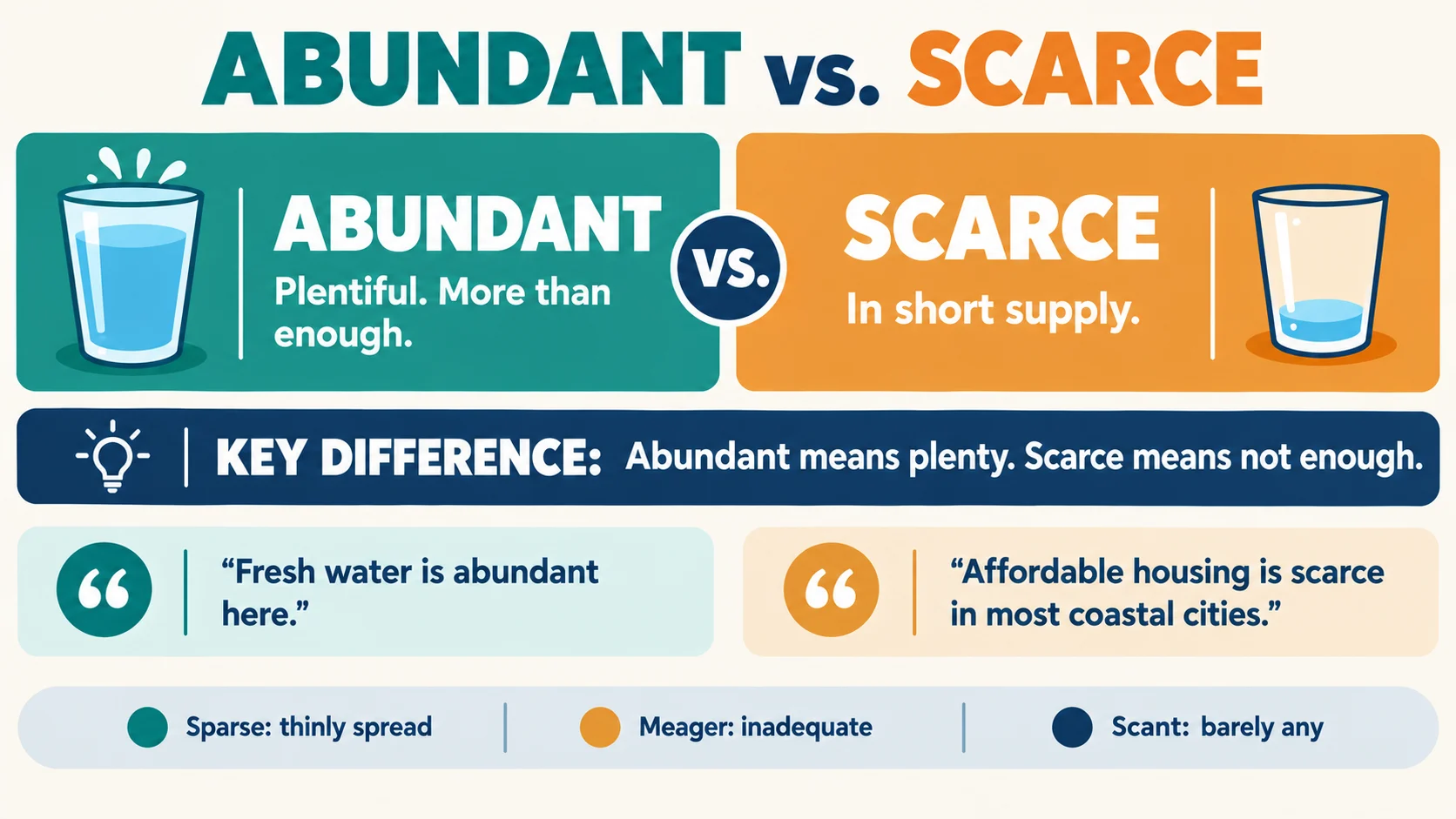
The opposite of abundant is scarce. Abundant describes something present in large, more than sufficient quantities, while scarce describes something in short supply. Sparse, meager, and scant also work as opposites, depending on context. When abundant means rich in something, lacking or deficient is often the better choice.
Part of Speech: Adjective
Primary Opposite: Scarce
Abundant means present in large quantities, usually more than enough. When abundant describes a supply, such as water, jobs, or evidence, scarce is the strongest direct opposite. Both words are gradable, so they mark opposite ends of a quantity scale instead of forming an either/or pair.
No single word opposes every sense of abundant. It can describe supply, richness, or intensity, and each calls for a slightly different opposite. The sections below sort the options by meaning.
Direct and Strong Antonyms
These words work as genuine opposites when abundant means plentiful.
| Antonym | Tone or Nuance | Example Sentence |
|---|---|---|
| Scarce | Neutral and standard; stresses short supply | Affordable housing is scarce in most coastal cities. |
| Sparse | Neutral; stresses thin spread across space | Cell service is sparse along the northern stretch of the highway. |
| Meager | Mildly negative; stresses an inadequate amount | She got by on a meager income during graduate school. |
| Scant | Formal; stresses barely any | The report offers scant evidence for that claim. |
All four describe too little of something. Scarce focuses on supply, sparse on distribution, meager on adequacy, and scant on near absence.
Contextual and Subtle Opposites
Abundant changes its best opposite as its meaning shifts. The pairings below are contextual, not universal.
| Context | Best Opposite | Why It Fits |
|---|---|---|
| Resource supply (“Fresh water is abundant here.”) | Scarce | Contrasts plenty with short supply |
| Wildlife or plant coverage (“abundant wildlife”) | Sparse | Contrasts dense presence with thin spread |
| Evidence or information (“abundant evidence”) | Scant | Pairs naturally with these nouns |
| Richness in a quality (“abundant in vitamin C”) | Lacking, deficient | Contrasts having plenty with falling short |
| Energy or enthusiasm (“abundant energy”) | Limited, low | Contrasts a large reserve with a small one |
Deficient and lacking suggest falling below a needed level, so they suit health, resources, and skills. “The soil was deficient in nitrogen” sounds natural. “The soil was scarce in nitrogen” does not.
Insufficient is a looser contextual option. It says something is not enough, while abundant says it is more than enough, so the pair works best when need is the focus: “Funding was abundant last year, but it is insufficient now.”
Words That Seem Opposite But Are Not
Rare. This is the most common mix-up. Rare describes how seldom something occurs or is found, and its standard opposite is common. Scarce describes a shortage relative to need. Compare “Snow is rare in Phoenix” with “Water is scarce in Phoenix.” The first is about frequency, the second about supply. Rare is a related contrast, not a direct antonym of abundant.
Absent. Absent means not present at all. Abundant is gradable, so its opposite on the scale is a small amount, not zero. “Parking is scarce downtown” means you might find a few spots. “Parking is absent downtown” means you will find none. Absent and nonexistent are complementary extremes that fit “none,” not “little.”
Subtle Tone Differences
Close opposites send different signals, and the right one depends on what you want to convey.
Scarce sounds neutral and works in news, economics, and everyday talk: “Skilled electricians are scarce right now.”
Meager adds judgment. “The company offered a meager raise” signals disappointment in a way that “a small raise” does not.
Scant leans formal and suits professional writing: “Reviewers gave the proposal scant attention.”
Sparse is spatial or visual: “Only a sparse crowd showed up for the Tuesday matinee.”
For a casual register, the phrase “in short supply” fits easily in conversation: “Parking spots are in short supply on game days.”
Frequently Asked Questions
What is the direct opposite of abundant?
The direct opposite is scarce. When abundant means plentiful, scarce means in short supply. Sparse, meager, and scant are close alternatives that stress thin spread, inadequate amount, or barely any. Choose based on whether the shortage involves supply, coverage, or adequacy.
What is the opposite of abundant in “abundant in vitamin C”?
When abundant means rich in something, as in a fruit abundant in vitamin C, the best contextual opposites are lacking in, low in, or deficient in. Scarce works poorly here because it describes the supply of the thing itself, not what a food contains.
Can I use scant instead of scarce in a sentence?
Not always. Scant often appears before nouns like evidence, attention, or detail, as in “scant evidence.” Scarce more commonly follows a linking verb, as in “water is scarce.” Both can appear in other positions, but those patterns sound most natural to American readers.
Practical Word Choice
- Identify the intended meaning. Ask whether abundant means a plentiful supply, richness in a quality, or a large amount of a feeling. Then choose scarce, deficient, or limited accordingly.
- Match context, tone, strength, and formality. Use scant in formal writing, meager when you want to signal disappointment, and sparse when describing how something is spread out.
Final Thoughts
Abundant has one clearest opposite, scarce, but the word covers more than supply. It can describe richness and intensity too, which is why no single antonym fits every sentence.
Context decides the best choice. Scarce handles shortages, sparse handles thin spread, scant handles near absence, and deficient handles falling short of a needed level. Rare and absent look similar but answer different questions.
Before you pick an opposite, ask what kind of shortage you mean. That one check usually points to the right word. What is your favorite sentence using abundant or one of its opposites?