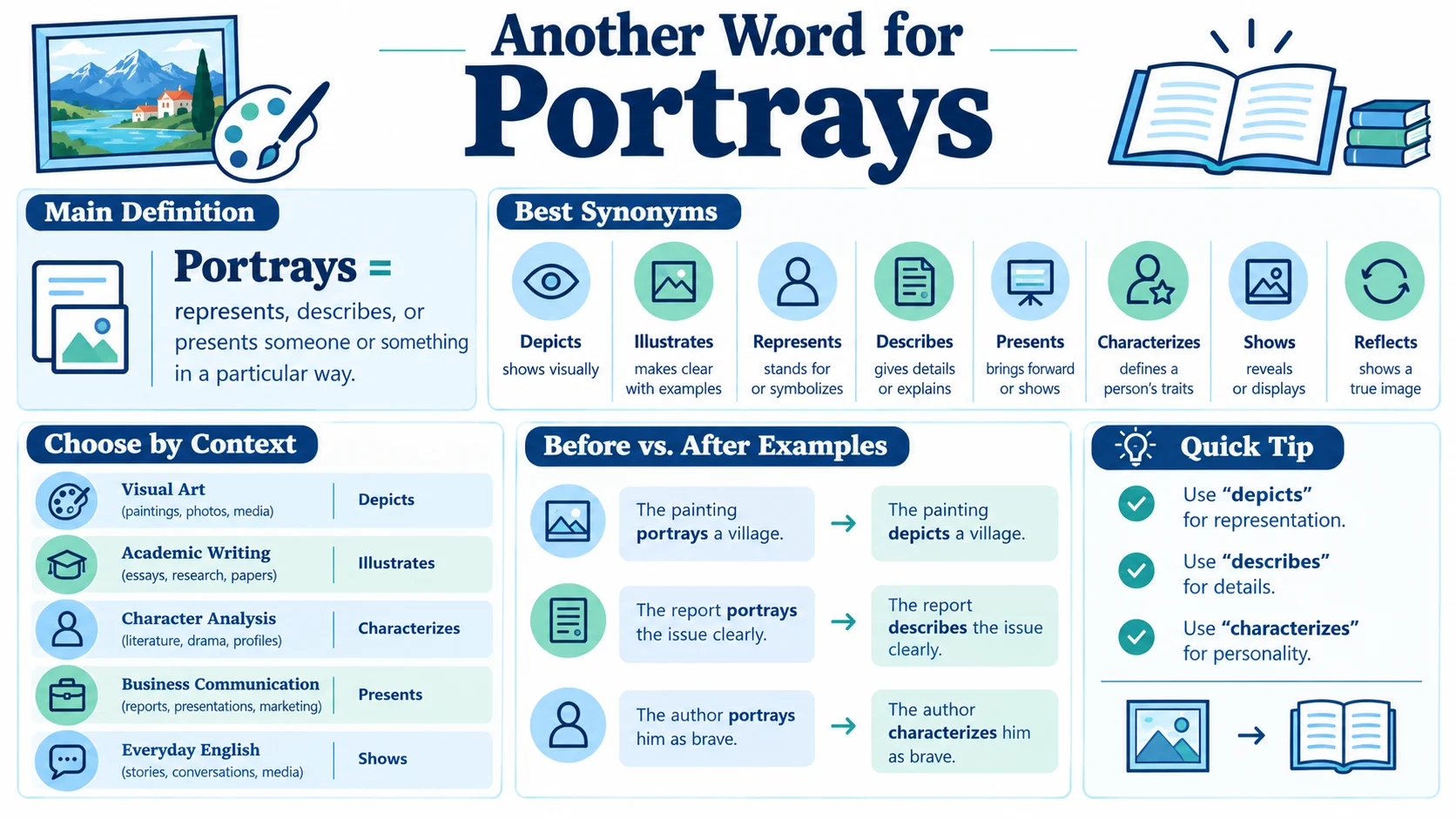
Another word for portrays is depicts, which means to represent or show someone, something, or a situation. Other useful synonyms include illustrates, represents, describes, presents, characterizes, and shows. The best replacement depends on context. Use depicts for visual representation, illustrates for explaining ideas, and characterizes for describing personality or behavior.
What Does Portrays Mean?
Definition
Portrays is the third-person singular form of the verb portray. It means to represent, describe, or present a person, place, event, idea, or situation in a particular way.
The word commonly appears in literature, journalism, film reviews, academic writing, art criticism, and professional communication. It can refer to a visual representation, a written description, an actor’s performance, or the way someone presents a subject to an audience.
For example, “The documentary portrays the challenges faced by rural communities” means that the documentary presents or depicts those challenges.
Portrays can also suggest a particular interpretation. In “The report portrays the company as unreliable,” the word indicates how the report represents the company’s reputation or behavior.
Common Uses
The word portrays appears in several contexts:
- Art and photography: The painting portrays a peaceful village.
- Literature: The novel portrays its main character as ambitious.
- Film and television: The actor portrays a determined detective.
- Journalism: The article portrays the situation as a serious concern.
- Academic writing: The study portrays a complex relationship between two variables.
- Business communication: The campaign portrays the brand as trustworthy.
The intended meaning determines the best synonym. Depicts often works for visual representation, describes emphasizes details, and characterizes focuses on qualities or traits.
Best Synonyms for Portrays
The following words offer useful alternatives, but they are not interchangeable in every sentence.
| Synonym | Meaning | Best Used When | Example |
|---|---|---|---|
| Depicts | Represents something visually or descriptively | Art, film, and literature | The painting depicts a coastal village. |
| Illustrates | Explains or demonstrates an idea | Academic and educational writing | The example illustrates the main argument. |
| Represents | Stands for or presents something | General, professional, and academic contexts | The symbol represents freedom. |
| Describes | Explains what someone or something is like | Reports and detailed accounts | The article describes the challenges. |
| Presents | Shows or introduces something in a particular way | Reports, presentations, and media | The report presents a balanced view. |
| Characterizes | Describes distinctive qualities or traits | Literature and analysis | The author characterizes him as cautious. |
| Shows | Makes something visible or understandable | Everyday and general writing | The photograph shows the damage. |
| Portrays as | Presents someone or something in a particular way | Opinions and interpretations | The article portrays the decision as risky. |
| Illustrates | Makes a point clear through examples or images | Essays and explanations | The case illustrates the importance of planning. |
| Reflects | Represents or reveals a quality or condition | Analysis and interpretation | The story reflects social changes. |
| Depicts as | Presents a subject with a particular image or quality | Reviews and criticism | The film depicts the leader as compassionate. |
| Embodies | Represents an idea or quality in a person or thing | Literary and professional writing | She embodies the spirit of teamwork. |
| Portrays realistically | Presents something in a believable way | Film, fiction, and reviews | The series portrays family life realistically. |
| Characterizes as | Describes someone or something in a particular way | Formal analysis | The study characterizes the trend as unusual. |
| Frames | Presents information from a particular perspective | Media, politics, and business | The article frames the issue as a public concern. |
Quick tip: Choose depicts for representation, describes for details, illustrates for explanation, and characterizes for qualities or personality.
Synonyms for Portrays by Context
Formal Writing
In formal writing, the strongest replacement is the one that accurately communicates how a subject is represented.
Useful alternatives include depicts, represents, characterizes, presents, and reflects.
Example:
Original: The report portrays the policy as ineffective.
Revised: The report characterizes the policy as ineffective.
The revised sentence emphasizes the report’s assessment of the policy. Alternatively, “The report presents the policy as ineffective” focuses on how the report communicates its position.
Professional Writing
Professional documents benefit from direct, precise language. The best replacement depends on whether you are discussing company image, research findings, customer perceptions, or performance.
Useful alternatives include presents, represents, shows, and reflects.
Business example
Original: The advertisement portrays the company as environmentally responsible.
Revised: The advertisement presents the company as environmentally responsible.
Another option: The campaign projects an environmentally responsible image.
The verb projects is especially useful when discussing the image a business intentionally communicates to customers.
Academic Writing
Academic writing often requires a distinction between describing evidence and interpreting it.
Useful alternatives include depicts, illustrates, characterizes, represents, and reflects.
Academic example
Original: The novel portrays the effects of social inequality.
Revised: The novel depicts the effects of social inequality.
Alternative: The author characterizes the protagonist as a product of social inequality.
The first revision emphasizes representation. The second focuses on the protagonist’s defining circumstances. Select a verb that matches the evidence and the claim being made.
Daily Conversation
In everyday American English, simple words often sound more natural than formal alternatives.
| Instead of Portrays | Use | Example |
|---|---|---|
| Portrays a person | Shows | The movie shows him as a good friend. |
| Portrays a situation | Describes | She describes the situation honestly. |
| Portrays an idea | Represents | That logo represents the company. |
| Portrays an event | Shows | The video shows what happened. |
| Portrays someone negatively | Makes someone seem | The article makes him seem dishonest. |
The phrase makes someone seem is particularly useful when you want to explain how a person is presented without implying that the presentation is accurate.
Professional Alternatives for Portrays
These alternatives are useful for business reports, resumes, emails, presentations, and marketing content.
1. Represents
Meaning: Stands for, expresses, or presents something.
Best used for: Brand identity, data interpretation, business communication, and abstract ideas.
Tone: Neutral and professional.
Difficulty: Easy.
Usage frequency: Very common.
Best for: Resume writing, email writing, essay writing, marketing copy, and business writing.
- Business example: The new logo represents the company’s commitment to quality.
- Academic example: The variable represents the participant’s overall score.
- Daily conversation example: This picture represents an important memory.
2. Presents
Meaning: Shows or communicates information in a particular way.
Best used for: Reports, presentations, company image, and arguments.
Tone: Neutral to formal.
Difficulty: Easy.
Usage frequency: Very common.
Best for: Email writing, essays, marketing copy, and business writing.
- Business example: The proposal presents a practical solution.
- Academic example: The paper presents evidence supporting the hypothesis.
- Daily conversation example: The movie presents a different view of friendship.
3. Characterizes
Meaning: Describes the distinctive qualities of someone or something.
Best used for: Personality, behavior, literary analysis, and research interpretation.
Tone: Formal and analytical.
Difficulty: Advanced.
Usage frequency: Common.
Best for: Essay writing, academic writing, and professional reports.
- Business example: The review characterizes the leadership team as adaptable.
- Academic example: The author characterizes the protagonist as morally conflicted.
- Daily conversation example: She characterizes him as quiet but dependable.
4. Depicts
Meaning: Represents something through an image, scene, performance, or description.
Best used for: Art, literature, photography, films, and visual analysis.
Tone: Neutral to formal.
Difficulty: Medium.
Usage frequency: Common.
Best for: Essays, academic writing, marketing copy, and descriptive content.
- Business example: The campaign depicts customers using the product in everyday settings.
- Academic example: The illustration depicts the stages of cellular development.
- Daily conversation example: The picture depicts a beautiful mountain landscape.
Simple Alternatives for Portrays
If you want to make your writing easier to understand, consider these alternatives.
Shows: The simplest general replacement.
Example: The documentary portrays the effects of pollution.
Simpler: The documentary shows the effects of pollution.
Describes: Best when words explain a person’s appearance, behavior, or situation.
Example: The article portrays the working conditions.
Simpler: The article describes the working conditions.
Presents: Useful when something is shown to an audience in a particular way.
Example: The report portrays a positive outlook.
Simpler: The report presents a positive outlook.
Makes someone seem: Useful when discussing how a story, article, or statement influences perception.
Example: The film portrays the manager as cruel.
Simpler: The film makes the manager seem cruel.
Shows as: Useful for straightforward descriptions of how someone or something is presented.
Example: The novel portrays the hero as brave.
Simpler: The novel shows the hero as brave.
Stronger Alternatives for Portrays
Some words provide a more specific or forceful meaning than portrays.
- Depicts: Emphasizes representation in an image, story, or scene.
- Characterizes: Highlights defining traits or qualities.
- Frames: Emphasizes the perspective used to present an issue.
- Projects: Suggests that someone or an organization communicates a particular image.
- Embodies: Suggests that a person or thing represents a quality exceptionally well.
- Exposes: Reveals something hidden, often a problem or wrongdoing.
- Reveals: Makes a previously unknown fact or quality apparent.
- Dramatizes: Presents something in an intensified or theatrical way.
Examples:
- The documentary exposes corruption in the organization.
- The article frames the debate as a question of fairness.
- The athlete embodies determination and discipline.
- The film dramatizes the consequences of war.
These words are not universal substitutes. For instance, exposes implies revealing something, while portrays does not necessarily suggest that anything was hidden.
Difference Between Similar Synonyms
Choosing the right synonym means understanding what each verb emphasizes.
| Word | Main Difference | Example |
|---|---|---|
| Portrays | Represents a subject in a particular way | The film portrays the family as resilient. |
| Depicts | Represents a scene, subject, or event | The painting depicts a family gathering. |
| Describes | Provides information about characteristics or details | The writer describes the family’s home. |
| Illustrates | Makes an idea clearer through an example or image | The story illustrates the value of cooperation. |
| Represents | Stands for or expresses something | The family represents hope in the novel. |
| Characterizes | Identifies defining traits | The author characterizes the father as strict. |
| Reflects | Reveals or mirrors a condition, quality, or reality | The story reflects changing social attitudes. |
| Frames | Presents something from a particular perspective | The report frames the decision as necessary. |
Portrays vs. Depicts
Both words refer to representation. Depicts is especially natural for visual scenes and concrete descriptions, while portrays is frequently used for people, personalities, social conditions, and interpretations.
Portrays vs. Describes
Describes emphasizes details about a subject. Portrays emphasizes how that subject is represented or presented to an audience.
Portrays vs. Characterizes
Characterizes is particularly useful when discussing traits, behavior, personality, or defining qualities. It is often a strong choice in literary criticism.
Portrays vs. Illustrates
Illustrates often means making a point clear through an example. Portrays focuses more broadly on representing a subject, whether accurately, imaginatively, positively, or negatively.
Opposite Words for Portrays
The best antonym depends on what portrays means in the sentence. There is no single opposite that works in every context.
| Opposite or Contrast | Meaning | Example |
|---|---|---|
| Conceals | Keeps something hidden | The report conceals important details. |
| Misrepresents | Presents something inaccurately | The article misrepresents the findings. |
| Distorts | Changes the appearance or meaning of something | The image distorts the original scene. |
| Hides | Prevents something from being seen or known | The advertisement hides the product’s limitations. |
| Omits | Leaves information out | The summary omits key evidence. |
| Obscures | Makes something difficult to see or understand | The wording obscures the main argument. |
Misrepresents is a useful contrast when portrays means presenting someone or something in a particular way. Conceals is more suitable when the intended contrast is between showing information and hiding it.
FAQs
1. What is the best synonym for portrays?
Depicts is one of the best general alternatives, especially for visual or descriptive representation. Represents, describes, and characterizes may be more appropriate in specific contexts.
2. What is a formal synonym for portrays?
Characterizes, depicts, and represents are useful formal alternatives. Choose characterizes when discussing traits and depicts when discussing representation.
3. What is a professional alternative for portrays?
Presents and represents work well in professional documents. Projects is useful when describing the image a company or individual communicates.
4. What word can replace portrays in an essay?
Use depicts, illustrates, characterizes, reflects, or represents, depending on the sentence. For literary analysis, characterizes is especially useful when discussing personality.
5. Is portrays the same as depicts?
The words are similar, but depicts often emphasizes visual or descriptive representation, while portrays can also emphasize how a person, character, or situation is presented.
6. What is another word for portrays positively?
Alternatives include celebrates, praises, presents favorably, and depicts positively. These options express a more favorable attitude than portrays alone.
7. What is another word for portrays negatively?
Depending on the sentence, use criticizes, vilifies, depicts unfavorably, or casts in a negative light. These words vary in strength and should be chosen carefully.
8. What is another word for portrays in literature?
Depicts, characterizes, represents, and describes are common alternatives in literary analysis. Use characterizes when discussing a character’s personality and depicts when discussing scenes or events.
9. What is the opposite of portrays?
Possible contrasts include conceals, misrepresents, distorts, and hides. The most accurate choice depends on whether the sentence concerns representation, accuracy, or visibility.
10. Can portrays be used for a person?
Yes. It can describe an actor playing a role or an author presenting a character in a particular way. For example, “The actor portrays a courageous doctor” describes the actor’s performance.
Conclusion
The best alternative to portrays depends on what you want to communicate. Use depicts for visual or descriptive representation, describes for details, illustrates to explain an idea, represents for broader meaning, and characterizes to discuss personality or defining qualities.
For professional and academic writing, choose precise verbs that reflect the evidence and intended meaning. For everyday communication, shows is often the clearest option.