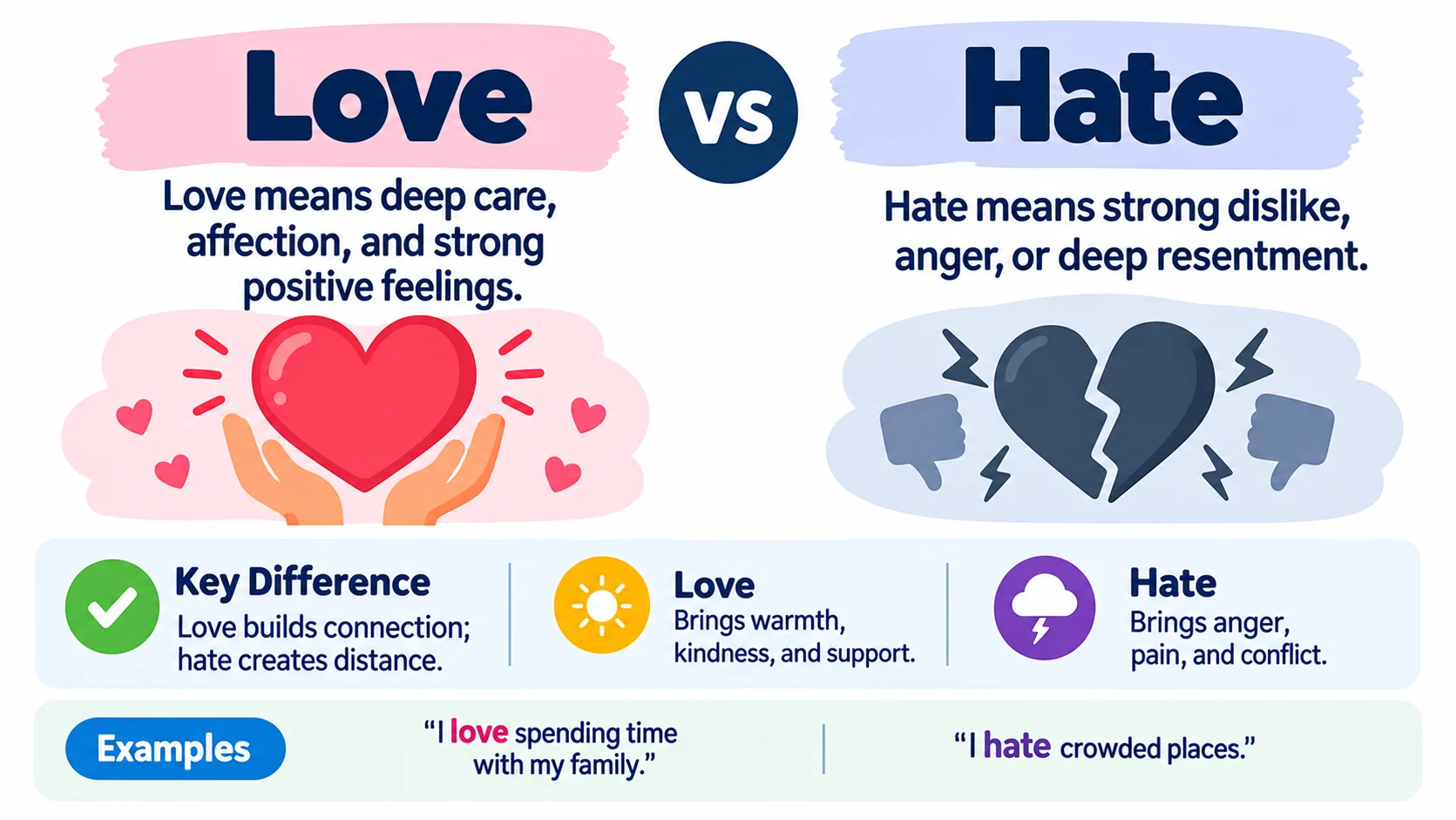
The strongest antonym of love is hate, especially when love means deep affection or care and hate means intense dislike or hostility. Other contextual opposites include dislike and detest. When love refers to emotional attachment, indifference can describe an absence of caring rather than a direct opposite.
- Part of Speech: Noun and verb
- Primary Opposite: Hate
- Definition of Love: A strong feeling of affection, care, attachment, or deep enjoyment toward someone or something.
- Why Hate Fits: When love describes strong positive feelings toward a person or thing, hate expresses strong negative feelings toward that person or thing.
The relationship is clearest when both words describe emotional attitudes. However, love has several meanings, so the most accurate opposite depends on the sentence. Loving a person, loving a hobby, and saying you love a particular food do not necessarily call for the same contrasting word.
Direct and Strong Antonyms
| Antonym | Tone or Nuance | Example Sentence |
|---|---|---|
| Hate | Strong hostility or intense dislike | He hates the way his coworkers treat new employees. |
| Dislike | Mild or moderate negative feeling | I dislike driving in heavy traffic. |
| Detest | Very strong dislike or aversion | She detests dishonesty in personal relationships. |
| Abhor | Intense moral or emotional rejection | They abhor cruelty toward animals. |
| Loathe | Deep, often emotional dislike | He loathes being treated as if he cannot make his own decisions. |
Hate is the clearest general antonym of love when both words describe feelings. The other choices express negative attitudes with different levels of intensity or emphasis.
Dislike is milder than hate, while detest, abhor, and loathe communicate especially strong aversion. These words are useful alternatives in particular contexts, but they are not equally strong opposites in every sentence.
Contextual and Subtle Opposites
Love can describe affection, enjoyment, commitment, or preference. Each meaning creates a slightly different contrast.
| Context | Best Opposite | Why It Fits |
|---|---|---|
| Romantic love | Hate, or loss of affection in context | Contrasts positive feelings with intense negative feelings, though relationships can change in other ways. |
| Love for a hobby | Dislike | Expresses a lack of enjoyment or preference. |
| Love for a particular food | Hate or dislike | Communicates a negative taste preference. |
| Love and emotional attachment | Indifference, contextually | Suggests a lack of emotional concern or involvement. |
| Love as a preference | Prefer not to, or dislike | Expresses an opposing choice or preference. |
| Love as commitment and care | Neglect, contextually | Contrasts active care with a failure to provide attention or support. |
These contextual alternatives require care. Indifference means a lack of interest, concern, or emotional involvement. It does not necessarily mean hatred. Someone can feel indifferent toward a stranger without disliking that person.
Similarly, neglect is not a direct antonym of love. It describes failing to give someone or something the attention or care it needs. A person may neglect a relationship despite still feeling love.
Consider these examples:
- “I love hiking, but I dislike camping.”
- “She once loved the attention, but now she feels indifferent to it.”
- “He loves his children, yet he sometimes neglects their emotional needs.”
Each sentence shows why context matters when choosing the opposite of love.
Words That Seem Opposite But Are Not
Common Grammatical or Semantic Confusions
1. Fear
Fear is sometimes mistaken for the opposite of love because both emotions can strongly influence relationships. However, fear means feeling threatened, anxious, or afraid. It does not automatically mean someone lacks love.
For example, “I love my partner, but I fear losing them” expresses affection and anxiety at the same time. Fear and love can coexist, so fear is not a direct antonym.
2. Forget
Forgetting someone may seem like the opposite of loving them, particularly in romantic situations. However, forget refers to failing to remember, not to feeling the opposite emotion.
For example, “I still love her, even though we haven’t spoken in years” shows that love can remain despite distance or limited contact. Forgetting and loving describe different concepts.
Subtle Tone Differences
The negative words associated with love differ in intensity and meaning.
- Dislike sounds relatively mild. “I dislike that restaurant” expresses a negative preference without suggesting intense hostility.
- Hate is stronger. “I hate how he treats people” communicates a much more intense negative reaction.
- Indifference suggests that something does not matter much emotionally. “I’m indifferent to their opinion” means the opinion has little effect on you.
- Neglect focuses on behavior rather than emotion. “She neglected the friendship” describes a failure to maintain it, not necessarily an absence of love.
For professional and academic writing, choose the word that accurately describes the feeling or behavior. Do not substitute hate for every situation in which love is absent.
Frequently Asked Questions
What is the direct antonym of love?
Hate is the most widely understood antonym of love when both words describe emotional feelings. Love expresses affection, care, or attachment, while hate expresses intense dislike or hostility. For milder situations, dislike may be more appropriate.
Is indifference the opposite of love?
Indifference can be a contextual opposite of love when love means emotional involvement or concern. However, indifference means a lack of interest or concern, not necessarily hostility. A person may be indifferent toward someone without actively disliking them.
What is a good opposite of love in a sentence?
The best opposite depends on the meaning. Use hate for intense negative feelings, dislike for a milder preference, and indifference for a lack of emotional concern. For example, “I love the idea” can contrast naturally with “I dislike the idea.”
Practical Word Choice
1. Identify the intended meaning. Determine whether love describes affection, enjoyment, preference, or emotional commitment before choosing an opposite.
2. Match the context and intensity. Use dislike for mild preferences, hate for strong negative feelings, and indifference when the key idea is a lack of concern.
Final Thoughts
The clearest antonym of love is hate, especially when the words describe opposing emotional attitudes. Other words, including dislike, detest, and abhor, communicate negative feelings with different levels of intensity.
However, the absence of love does not always mean hatred. Indifference may describe emotional distance, while neglect describes a failure to provide care or attention. Understanding these distinctions helps you select the most accurate word for everyday conversations, relationships, and professional writing.
When choosing an antonym, consider whether you mean the opposite emotion, a lack of affection, or behavior that conflicts with caring. Which word would you use as the opposite of love in your own example?