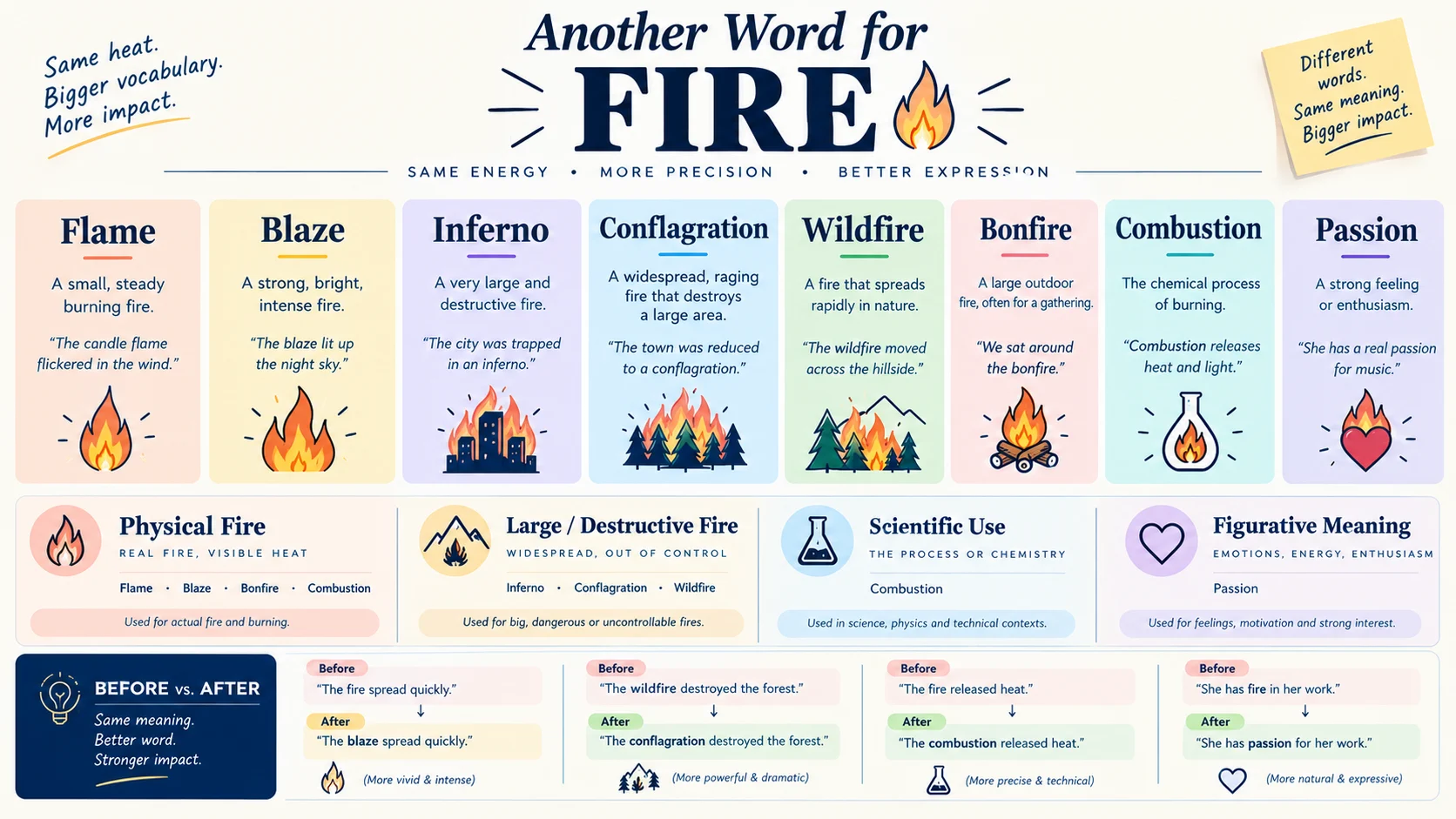
Another word for fire depends on its meaning. For a burning flame, use flame, blaze, flames, inferno, or conflagration. For firing a weapon, use shoot, discharge, or launch. For dismissing someone from a job, use dismiss, terminate, or sack. For enthusiasm, passion, energy, or zeal may work.
What Does Fire Mean?
Definition
The word fire has several meanings in American English. As a noun, it commonly refers to the visible heat, light, and flames produced when something burns. It can also describe a large destructive blaze, gunfire, enthusiasm, or intense energy.
As a verb, fire can mean to shoot a weapon, dismiss someone from employment, launch something, or cause an object to begin burning.
Because the word has several meanings, the best synonym depends heavily on the sentence.
Common Uses
Here are some common meanings of fire:
- Burning material: “The fire spread through the building.”
- Flame: “The fire gave off a warm glow.”
- Large destructive blaze: “Fire destroyed several acres of forest.”
- Gunfire: “The soldiers came under fire.”
- Dismissal from employment: “The company decided to fire him.”
- Enthusiasm or passion: “She has a real fire for teaching.”
- Energy or intensity: “The team played with fire.”
- Launching something: “The system fired the rocket.”
This range of meanings explains why there is no single perfect synonym for fire in every situation.
Best Synonyms for Fire
| Synonym | Meaning | Best Used When | Example |
|---|---|---|---|
| Flame | Visible burning gas or material | Referring to the visible part of a fire | “A small flame flickered in the fireplace.” |
| Blaze | A strong or bright fire | Describing an intense or noticeable fire | “A blaze broke out in the warehouse.” |
| Inferno | A very large, intense, destructive fire | Dramatic or severe fires | “The building was engulfed in an inferno.” |
| Conflagration | A large, destructive fire | Formal, technical, or serious writing | “The conflagration damaged several structures.” |
| Flames | The visible burning parts of a fire | Everyday descriptions | “The flames rose above the roof.” |
| Embers | Glowing remains of a fire | Describing a fire that is dying down | “Only glowing embers remained.” |
| Bonfire | A large outdoor fire | Outdoor gatherings or controlled fires | “Everyone gathered around the bonfire.” |
| Wildfire | An uncontrolled fire in vegetation | Forest, grassland, or natural fires | “The wildfire spread rapidly.” |
| Combustion | The process of burning | Scientific or technical writing | “Combustion releases heat and light.” |
| Passion | Strong enthusiasm or emotion | Figurative uses | “She has a passion for science.” |
| Zeal | Strong enthusiasm or dedication | Formal or professional writing | “He approached the project with zeal.” |
Flame
Flame is one of the closest everyday alternatives to fire, but the two words are not always interchangeable.
A fire can contain flames, while a flame usually refers specifically to the visible, glowing part of combustion.
Best used for: physical descriptions, fireplaces, candles, lamps, and poetic writing.
Business example: “The flame-resistant material protects workers from heat.”
Academic example: “The flame changed color as the chemical composition varied.”
Daily conversation: “The candle flame keeps going out.”
Tone: Neutral
Difficulty: Easy
Usage frequency: Very Common
Best for: Essays, emails, general writing, and everyday conversation
Blaze
Blaze suggests a bright, strong, or intense fire. It often sounds more dramatic than fire.
Best used for: house fires, forest fires, dramatic descriptions, and news-style writing.
Business example: “The warehouse blaze caused significant property damage.”
Academic example: “Researchers examined how wind affected the spread of the blaze.”
Daily conversation: “We saw a huge blaze across the street.”
Tone: Neutral to dramatic
Difficulty: Easy
Usage frequency: Common
Best for: News writing, essays, storytelling, and general communication
Inferno
Inferno describes an extremely large or intense fire. It is stronger and more dramatic than fire.
Best used for: destructive fires and dramatic descriptions.
Example: “Firefighters battled the inferno for several hours.”
This word works especially well when you want to emphasize danger, heat, size, or destruction.
Tone: Dramatic
Difficulty: Medium
Usage frequency: Common
Best for: Journalism, storytelling, essays, and dramatic writing
Conflagration
Conflagration is a formal word for a large and destructive fire.
It is less common in everyday conversation but can work well in academic, historical, technical, or formal writing.
Example: “The massive conflagration destroyed much of the historic district.”
Tone: Formal
Difficulty: Advanced
Usage frequency: Less Common
Best for: Academic writing, historical writing, professional reports, and formal prose
Synonyms by Context
Formal Writing
For formal writing, consider:
- Conflagration
- Combustion
- Blaze
- Inferno
- Fire outbreak
The right choice depends on whether you are describing the physical process of burning or a destructive event.
For example, combustion is appropriate in a scientific context, while conflagration works better when describing a large destructive fire.
Professional Writing
Professional alternatives include:
- Fire outbreak
- Blaze
- Combustion
- Fire incident
- Thermal event
Example:
Instead of:
“The fire caused serious damage.”
You might write:
“The fire incident caused extensive structural damage.”
For technical documents, however, use the most precise term rather than simply choosing a more complicated synonym.
Academic Writing
Academic writing often benefits from precise terminology.
Use combustion when discussing the scientific process of burning. Use wildfire for uncontrolled vegetation fires. Use conflagration when discussing a large destructive fire in a historical or analytical context.
Example:
“Combustion occurs when a substance reacts chemically with an oxidizer and releases energy.”
Daily Conversation
In everyday speech, the simplest alternatives usually sound best:
- Flame
- Blaze
- Bonfire
- Flames
- Fire
For example:
“The flames were getting higher.”
sounds more natural in casual conversation than:
“The conflagration was becoming increasingly intense.”
Professional Alternatives for Fire
The best professional alternative depends on what fire means.
If you mean a workplace dismissal, use:
- Dismiss
- Terminate
- Release
- Let go
- Remove from the position
Example:
“The company fired the employee.”
Professional:
“The company terminated the employee’s employment.”
If you mean firing a weapon, consider:
- Discharge
- Shoot
- Fire upon
- Launch
Example:
“The officer fired the weapon.”
More formal:
“The officer discharged the weapon.”
Simple Alternatives for Fire
If you want an easy replacement, these words are usually the most accessible:
- Flame
- Blaze
- Flames
- Bonfire
- Wildfire
- Burning
For most general writing, flame and blaze are the closest natural alternatives when fire refers to something burning.
Stronger Alternatives for Fire
When you want to emphasize intensity or destruction, use:
- Inferno
- Conflagration
- Blaze
- Firestorm
- Wildfire
Inferno vs. Blaze
Both describe intense fires, but inferno usually emphasizes extreme heat and destruction, while blaze emphasizes a strong, visible fire.
“A blaze broke out in the kitchen.”
“The entire building became an inferno.”
Fire vs. Flame
Fire refers to the overall phenomenon of burning. Flame usually refers to the visible part of that fire.
“The fire warmed the room.”
“The flames danced above the logs.”
Fire vs. Conflagration
Fire is an ordinary, broad term. Conflagration specifically suggests a large and destructive fire and has a much more formal tone.
Fire vs. Inferno
An inferno is an extremely intense or destructive fire. Therefore, it is a stronger word than the general term fire.
Fire as a Verb: Different Synonyms
The verb fire has several unrelated meanings.
Fire Someone
When fire means removing someone from a job, possible alternatives include:
- Dismiss
- Terminate
- Discharge
- Remove
- Let go
- Release
Example:
“The manager fired the employee.”
Professional alternative:
“The manager terminated the employee’s employment.”
Fire a Weapon
When fire means using a weapon, alternatives include:
- Shoot
- Discharge
- Fire upon
- Open fire
Example:
“The soldiers fired their weapons.”
Formal alternative:
“The soldiers discharged their weapons.”
Fire a Rocket
When fire means launching a rocket or projectile, alternatives include:
- Launch
- Send
- Deploy
- Release
Example:
“The team fired the rocket.”
More precise:
“The team launched the rocket.”
Fire as a Metaphor
Fire often represents energy, passion, motivation, anger, or determination.
Depending on the sentence, useful alternatives include:
- Passion
- Energy
- Drive
- Zeal
- Enthusiasm
- Intensity
- Motivation
- Spirit
For example:
“She has fire in her.”
Possible alternatives:
“She has passion.”
“She has tremendous drive.”
“She brings incredible energy to her work.”
In this sense, replacing fire with a direct physical synonym such as flame would change the meaning.
Opposite Words for Fire
The opposite of fire depends on the intended meaning.
For a burning fire, possible opposites include:
- Extinguishment
- Cold
- Darkness
- Ice
For the action of firing a weapon, the opposite may be:
- Cease fire
- Hold fire
- Lower the weapon
For the verb meaning to dismiss an employee, the opposite could be:
- Hire
- Employ
- Retain
- Recruit
For example:
“The company fired three workers.”
Opposite:
“The company hired three workers.”
FAQs
What is another word for fire?
Common alternatives for fire include flame, blaze, inferno, conflagration, bonfire, wildfire, and combustion. The best choice depends on whether you mean a physical fire, a destructive blaze, or a figurative sense such as passion.
What is a formal synonym for fire?
Conflagration is a formal synonym for a large destructive fire. Combustion is more appropriate when discussing the scientific process of burning.
What is a professional alternative for fire?
If fire means dismissing an employee, professional alternatives include terminate, dismiss, discharge, release, and let go. “Terminate employment” is particularly common in formal workplace communication.
What word can replace fire in an essay?
For a physical fire, flame, blaze, inferno, or conflagration may work. For scientific writing, combustion is often more precise. Always choose based on the exact meaning of the sentence.
What is a synonym for fire that means passion?
Passion, enthusiasm, zeal, drive, energy, and intensity can replace fire when it means strong enthusiasm or motivation.
What is a stronger word for fire?
Inferno is a strong alternative when describing an extremely intense fire. Conflagration is also stronger in the sense of a large, destructive fire.
What is another word for fire in a professional setting?
If you mean terminating employment, use dismiss, terminate, discharge, release, or let go. If you mean a physical fire, fire incident, blaze, or combustion may be appropriate depending on the context.
What is another word for fire in a sentence?
The best replacement depends on the sentence. For example, “The fire burned brightly” could become “The flames burned brightly,” while “The company fired him” could become “The company dismissed him.”
What is the difference between fire and flame?
Fire describes the overall process or phenomenon of burning, while flame usually refers to the visible, glowing part of combustion. A fire can contain one or many flames.
What is the opposite of fire?
There is no single opposite for every meaning of fire. For a weapon, cease fire may be appropriate. For employment, hire is an opposite of fire. For a burning object, extinguish expresses the action of putting the fire out.
Conclusion
The best synonym for fire depends on what you mean. Use flame for the visible part of a fire, blaze for a strong or noticeable fire, inferno for an extremely intense fire, and conflagration for a large destructive blaze. In scientific writing, combustion is often more precise.
When fire functions as a verb, the alternatives change. Use dismiss or terminate when discussing employment, shoot or discharge for weapons, and launch for rockets or projectiles. For the figurative meaning of passion or enthusiasm, words such as drive, energy, passion, and zeal are better choices.
The most effective synonym is not necessarily the most sophisticated one. Choose the word that preserves the original meaning, fits the tone, and sounds natural in the sentence.