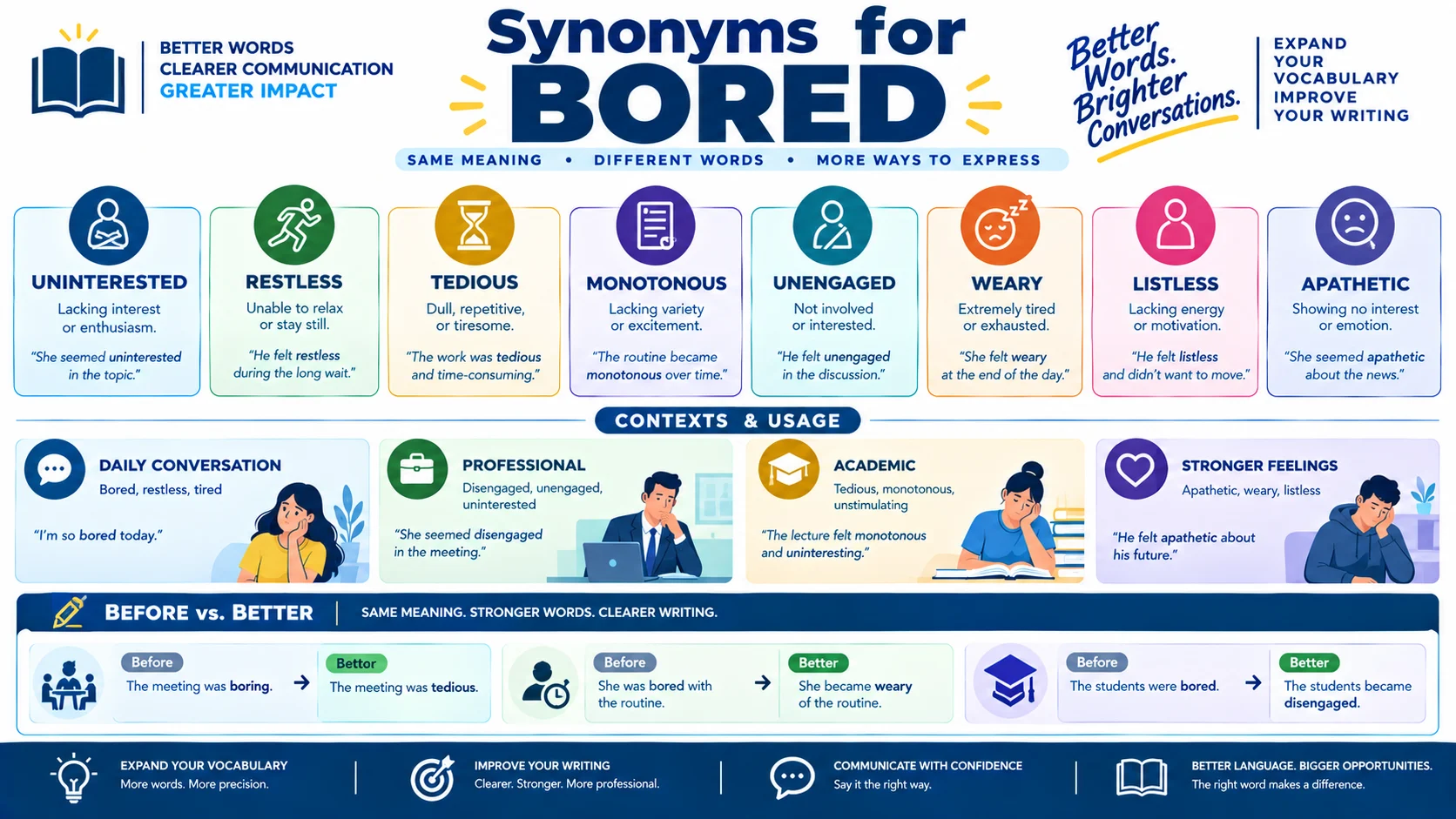
The best synonyms for bored include uninterested, restless, unengaged, weary, listless, apathetic, dull, tedious, and monotonous. Use restless when you want activity, uninterested when you lack interest, and tedious or monotonous when something feels boring because it is repetitive or too long.
What Does Bored Mean?
Definition
Bored means feeling uninterested, tired of an activity, or mentally unstimulated because there is nothing engaging or exciting happening. The best synonym depends on what kind of boredom you want to describe.
For example, uninterested works when someone does not care about a subject, while restless suggests that someone wants something to do. Weary can describe boredom caused by repetition or prolonged exposure.
Common Uses
The word bored is common in everyday American English. You might use it when talking about a slow day, repetitive work, an uninteresting class, or a conversation that does not hold your attention.
Examples:
- I was bored during the long meeting.
- She felt bored after watching the same show all weekend.
- The students became bored with the repetitive exercise.
- He looked bored at the party.
Because bored is informal and familiar, replacing it with a more precise synonym can make your writing clearer and more expressive.
Best Synonyms for Bored
| Synonym | Meaning | Best Used When | Example |
|---|---|---|---|
| Uninterested | Not interested or engaged | Lack of interest | She seemed uninterested in the discussion. |
| Unengaged | Not actively involved | Work or professional settings | Several employees appeared unengaged. |
| Restless | Unable to relax because you want activity | Waiting or inactivity | I felt restless during the long delay. |
| Weary | Tired or worn down | Repetition or prolonged situations | He became weary of the same routine. |
| Tired | Lacking energy or enthusiasm | General conversation | I’m tired of doing the same thing. |
| Disinterested | Impartial or lacking personal interest | Formal contexts | The mediator remained disinterested. |
| Apathetic | Showing little interest or concern | Stronger emotional detachment | The audience seemed apathetic. |
| Listless | Lacking energy or enthusiasm | Describing someone’s mood | She felt listless all afternoon. |
| Dull | Lacking excitement or interest | Activities, events, or experiences | The lecture was dull. |
| Tedious | Boring because it is repetitive or lengthy | Formal and academic writing | The task became tedious after several hours. |
| Monotonous | Repetitive and lacking variation | Work or routines | The monotonous schedule exhausted him. |
| Unstimulated | Lacking mental or emotional stimulation | Psychology, education, or formal writing | The children became unstimulated by the routine. |
Uninterested
Meaning: Having little or no interest in something.
Best used for: Conversations, subjects, activities, and topics.
Tone: Neutral.
Difficulty: Easy.
Usage frequency: Very common.
Best for: Email writing, essays, business writing, and daily conversation.
Examples:
- Business: The client appeared uninterested in the proposal.
- Academic: Students may become uninterested when lessons lack variety.
- Daily conversation: I’m uninterested in watching another movie tonight.
Uninterested is often one of the easiest replacements for bored when the real meaning is simply “not interested.”
Restless
Meaning: Unable to remain still or relaxed because you want activity or change.
Best used for: Waiting, inactivity, long journeys, and situations where someone wants something to happen.
Tone: Neutral and descriptive.
Difficulty: Easy.
Usage frequency: Very common.
Best for: Daily conversation, essays, and descriptive writing.
Examples:
- Business: Employees may become restless during unnecessarily long meetings.
- Academic: Participants became restless after several hours of testing.
- Daily conversation: I got restless sitting at home all day.
Restless is stronger than bored when inactivity makes someone physically or mentally uncomfortable.
Tedious
Meaning: Boring because something takes too long, repeats itself, or requires considerable effort.
Best used for: Tasks, procedures, writing, work, and academic activities.
Tone: Formal.
Difficulty: Medium.
Usage frequency: Common.
Best for: Essays, academic writing, professional writing, and business communication.
Examples:
- Business: Completing the paperwork was tedious.
- Academic: The researcher described the data-entry process as tedious.
- Daily conversation: Cleaning the entire house was tedious.
Instead of saying, “The process was boring,” you can say, “The process was tedious” when repetition or length is the reason.
Monotonous
Meaning: Repetitive and lacking variety.
Best used for: Routines, jobs, sounds, schedules, and repeated activities.
Tone: Neutral to formal.
Difficulty: Medium.
Usage frequency: Common.
Best for: Academic writing, professional writing, and descriptive writing.
Example:
The monotonous routine made the job feel less engaging.
Monotonous is more specific than bored. It describes the repetitive quality of something rather than directly describing someone’s feeling.
Apathetic
Meaning: Showing little interest, enthusiasm, or concern.
Best used for: People, attitudes, social situations, and emotional reactions.
Tone: Formal and stronger.
Difficulty: Advanced.
Usage frequency: Common.
Best for: Academic writing, business writing, and serious discussions.
Example:
The manager noticed an apathetic attitude among several team members.
Be careful with this synonym. Someone who is bored is not necessarily apathetic. Apathy suggests a deeper lack of concern or motivation.
Synonyms by Context
Formal Writing
For formal writing, avoid relying too heavily on bored. More precise choices include:
- Tedious
- Monotonous
- Unengaging
- Unstimulating
- Listless
- Weary
For example:
Basic: The procedure was boring.
More precise: The procedure was tedious because it required repeated manual checks.
The second sentence explains why the experience was boring.
Professional Writing
In workplace communication, words such as unengaged, uninterested, disengaged, and unmotivated may communicate the situation more clearly.
Basic: The employees were bored during the training.
Professional: Several employees appeared disengaged during the training session.
However, these words are not always interchangeable. Disengaged can suggest that someone has stopped actively participating, while bored simply describes a lack of stimulation.
Academic Writing
Academic writing benefits from precise alternatives such as:
- Tedious
- Monotonous
- Unengaging
- Unstimulating
- Disengaged
- Listless
Basic: Students became bored with the lesson.
Academic: Students became disengaged when the lesson relied heavily on repetitive activities.
This version gives the reader more information about the nature of the problem.
Daily Conversation
For casual American English, simple alternatives usually sound most natural:
- Tired
- Restless
- Uninterested
- Dull
- Sleepy
- Unexcited
- Sick of it
Examples:
- I’m bored.
- I’m restless.
- I’m tired of this.
- This movie is dull.
- I’m sick of doing the same thing.
The best choice depends on exactly what you mean.
Professional Alternatives for Bored
When writing an email, report, performance review, or workplace document, consider these alternatives:
Disengaged: Not actively participating or emotionally involved.
Unengaged: Not sufficiently involved or interested.
Unmotivated: Lacking motivation to act.
Uninterested: Showing little interest.
Unstimulated: Not receiving enough intellectual or mental stimulation.
Weary: Tired of something because it has continued for too long.
Example:
Instead of saying, “The employee was bored,” a professional report might say, “The employee appeared disengaged during repetitive tasks.”
This wording focuses on observable behavior rather than making a personal judgment.
Simple Alternatives for Bored
If you need an easy word that most readers immediately understand, try:
- Tired
- Dull
- Restless
- Uninterested
- Unexcited
- Fed up
- Sick of it
These alternatives work particularly well in texts, social media posts, casual emails, and everyday conversations.
For example:
Bored: I’m bored with this routine.
Simple: I’m tired of this routine.
Bored: The movie was boring.
Simple: The movie was dull.
Stronger Alternatives for Bored
Some words communicate more than ordinary boredom.
Apathetic
Suggests very little interest, concern, or emotional response.
Listless
Suggests a lack of energy and enthusiasm.
Weary
Suggests tiredness caused by prolonged repetition or experience.
Disengaged
Suggests that someone has withdrawn attention or participation.
Fed Up
An informal expression suggesting frustration or annoyance with something that has continued too long.
For example:
I’m not just bored with the routine. I’m fed up with doing the same task every day.
Notice that fed up introduces frustration, which bored does not necessarily contain.
Difference Between Similar Synonyms
Understanding the small differences between synonyms helps you choose the right word.
Bored vs. Uninterested
Bored means something fails to hold your attention.
Uninterested means you do not have much interest in the subject itself.
You can be bored during a subject you normally enjoy. You can also be uninterested in a subject without feeling especially bored.
Bored vs. Restless
Bored means you lack stimulation.
Restless means you want movement, activity, or change.
Someone sitting through a three-hour flight may feel both bored and restless.
Bored vs. Apathetic
Bored usually describes temporary lack of stimulation.
Apathetic suggests little concern, enthusiasm, or emotional investment.
A bored student may still care about getting a good grade. An apathetic student may show little concern about the grade.
Bored vs. Weary
Bored focuses on lack of interest.
Weary focuses on tiredness, especially after prolonged repetition or experience.
For example:
She was bored with the assignment.
means the assignment failed to interest her.
She was weary of the assignment.
suggests she had become tired of dealing with it.
Bored vs. Tedious
Bored describes a person’s feeling.
Tedious usually describes the thing causing the feeling.
Correct examples:
- I was bored.
- The task was tedious.
You would not normally say, “I was tedious” to mean “I was bored.”
Opposite Words
The opposite of bored depends on the situation. Useful antonyms include:
- Interested
- Engaged
- Excited
- Entertained
- Fascinated
- Enthusiastic
- Stimulated
- Absorbed
- Intrigued
- Attentive
For example:
Bored: The students were bored by the presentation.
Opposite: The students were engaged by the presentation.
Bored: She looked bored during the movie.
Opposite: She looked fascinated by the movie.
FAQs
What is another word for bored?
Common synonyms for bored include uninterested, restless, unengaged, weary, listless, apathetic, dull, tedious, monotonous, and unstimulated. The best choice depends on whether you mean a lack of interest, repetition, inactivity, tiredness, or lack of engagement.
What is a formal synonym for bored?
Tedious, monotonous, unengaging, unstimulating, weary, and listless can work in formal writing, depending on the sentence. For example, “The process was tedious” is more formal and specific than “The process was boring.”
What is a professional alternative for bored?
Disengaged or unengaged can be useful professional alternatives when describing a person’s lack of participation or involvement. Unmotivated may work when the issue specifically concerns motivation.
What word can replace bored in an essay?
Good choices include unengaged, uninterested, tedious, monotonous, unstimulated, and weary. Choose the word based on whether you are describing a person, activity, task, routine, or emotional state.
What is a synonym for feeling bored?
Depending on the situation, you can say restless, uninterested, listless, unengaged, weary, or unexcited. “Restless” is particularly useful when boredom makes you want to do something different.
What is a better word for boring?
Try dull, tedious, monotonous, unengaging, unstimulating, repetitive, or uninteresting. “Tedious” works especially well when something is boring because it is long or repetitive.
Is uninterested the same as bored?
Not exactly. Uninterested means lacking interest in something, while bored usually means feeling that something is not stimulating or engaging enough. The two words can overlap, but they describe slightly different ideas.
Is tedious another word for bored?
Not directly. Tedious generally describes something that is boring because it is repetitive, lengthy, or tiresome. Bored describes the person’s resulting feeling.
What is a sophisticated word for bored?
Words such as listless, apathetic, weary, and unstimulated can sound more sophisticated, but each has a slightly different meaning. Use the most precise word rather than choosing a synonym simply because it sounds advanced.
What is the opposite of bored?
Common opposites include interested, engaged, excited, fascinated, entertained, enthusiastic, stimulated, and absorbed. The appropriate antonym depends on the situation.
Conclusion
The best synonym for bored depends on what you are actually trying to say. Use uninterested when someone lacks interest, restless when they want activity, tedious when something is boring because it is lengthy or repetitive, and monotonous when a lack of variety is the problem. For professional writing, disengaged or unengaged may be more precise.
Instead of automatically replacing bored with a complicated word, identify the exact feeling or situation first. The right synonym will make your sentence clearer, more natural, and more specific.