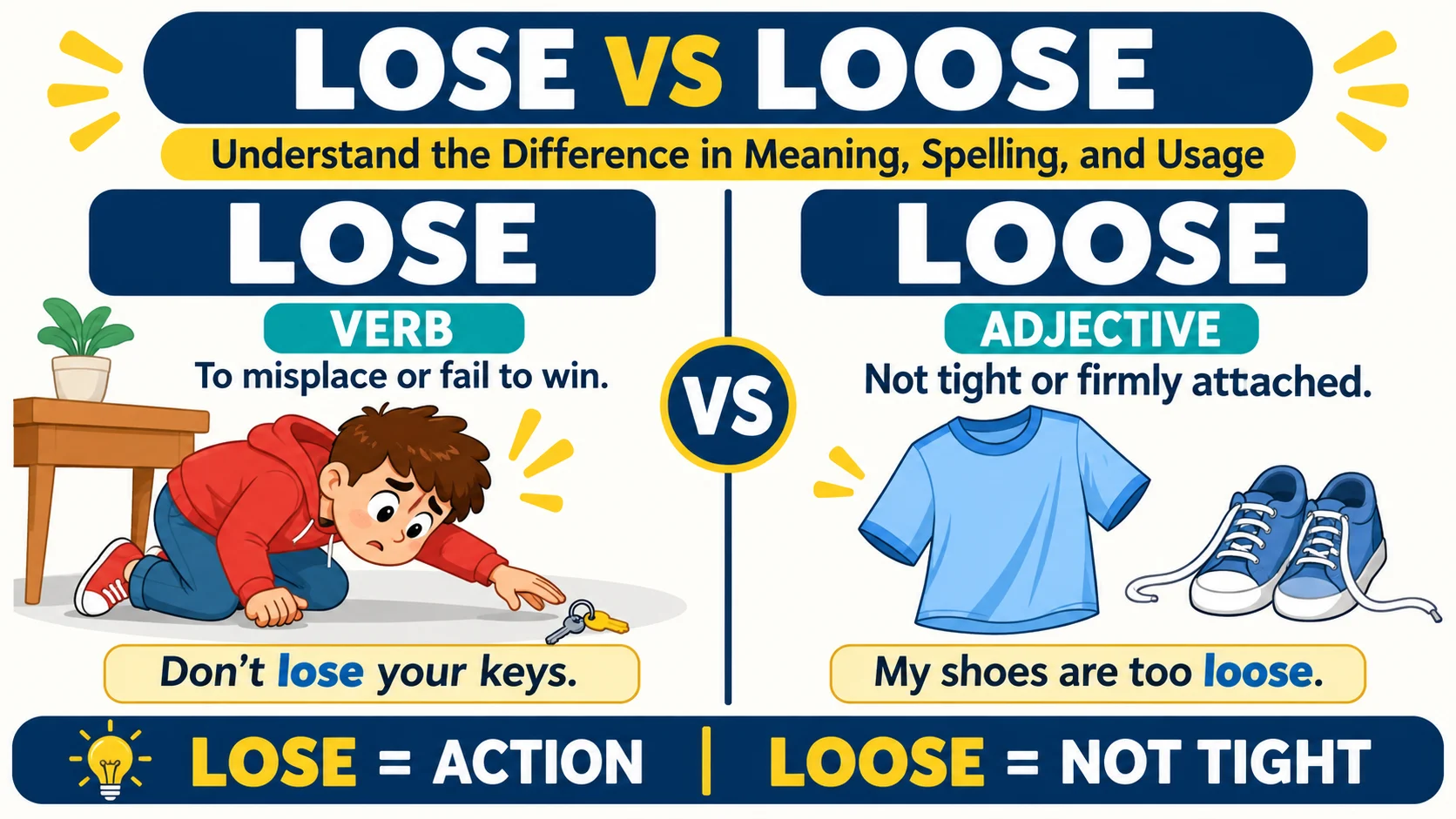
Lose vs loose have different meanings, spellings, and pronunciations. Lose is a verb that means to misplace something, fail to win, or no longer have something. Loose is an adjective that means not tight, free, or not firmly attached. For example, you can lose your keys, but you can have loose keys in a bag.
Have you ever stopped while writing and wondered whether to use lose or loose? You are not alone. These two words look almost the same, but they have very different meanings. Even good writers, students, and professionals sometimes mix them up.
The confusion often happens because both words contain similar letters. However, one extra letter can change the meaning of a sentence. For example, writing “I do not want to loose my job” is incorrect. The correct sentence is “I do not want to lose my job.”
Understanding lose vs loose is important for clear writing. A small spelling mistake can make an email, school assignment, social media post, or business message look less professional.
The good news is that learning the difference is easy. You only need to remember a few simple rules. This guide explains the meanings, pronunciation, grammar, examples, common mistakes, and practical ways to use both words correctly. You will also find exercises to test your knowledge and build confidence.
Quick Answer: Lose vs Loose
The main difference between lose and loose is their meaning and grammatical use.
| Word | Part of Speech | Meaning | Example |
|---|---|---|---|
| Lose | Verb | To misplace, fail to win, or no longer have something | I do not want to lose my phone. |
| Loose | Adjective | Not tight, free, or not firmly attached | My shirt is too loose. |
Remember this simple rule:
- Lose = You cannot find something, you fail to win, or you no longer have something.
- Loose = Something is not tight, secure, or firmly attached.
For example:
- Do not lose your money.
- These pants are too loose.
If you are talking about an action or something that happens, you probably need lose. If you are describing something that is not tight, you probably need loose.
Definition and Explanation of Lose vs Loose
To understand lose vs loose, it helps to study each word separately. Although they look similar, they perform different jobs in a sentence.
What Does Lose Mean?
Lose is a verb. It describes an action, event, or situation in which someone no longer has something, cannot find something, or fails to win.
It can also describe a reduction in something, such as weight, money, time, or interest.
Here are the most common meanings of lose:
1. To misplace something
When you lose something, you cannot find it.
Examples:
- I always lose my car keys.
- She does not want to lose her phone.
- He lost his wallet at the shopping mall.
- Please do not lose these important documents.
2. To fail to win
Lose can describe a situation in which a person, team, or group does not win a competition.
Examples:
- Our team may lose the final match.
- They lost the football game yesterday.
- Nobody wants to lose a competition.
- The team played well but still lost.
3. To no longer have something
Lose can also mean that something is taken away or no longer belongs to you.
Examples:
- He may lose his job.
- She does not want to lose her friendship.
- They lost their home during the storm.
- You could lose your chance if you wait too long.
4. To reduce something
We also use lose when talking about reducing weight, money, time, or other things.
Examples:
- I want to lose five pounds.
- The company may lose money this year.
- We lost valuable time during the meeting.
- She is trying to lose weight.
5. To become unaware of something
Lose can describe a situation in which someone stops understanding, remembering, or following something.
Examples:
- I lost interest in the movie.
- Do not lose focus during the exam.
- He lost track of time while reading.
- She lost her train of thought during the speech.
What Does Loose Mean?
Loose is usually an adjective. It describes something that is not tight, firmly attached, fixed, or controlled.
It can also mean free or not restricted.
Here are the most common meanings of loose:
1. Not tight
Loose describes clothes, shoes, or other objects that have extra space.
Examples:
- These jeans are too loose.
- My shoes feel loose.
- She prefers loose clothing.
- The shirt is loose around the waist.
2. Not firmly attached
Loose can describe something that is not properly fixed or connected.
Examples:
- The door handle is loose.
- There is a loose wire behind the computer.
- One button on my shirt is loose.
- The chair has a loose leg.
3. Free or not tied
Loose can describe an animal or object that is not tied, locked, or held in place.
Examples:
- The dog is loose in the garden.
- A loose horse ran across the field.
- Keep the children away from the loose equipment.
- The bird escaped because its cage door was loose.
4. Not strict or controlled
Loose can also describe rules, arrangements, or systems that are not strict.
Examples:
- The school has loose rules about clothing.
- They follow a loose schedule.
- The group works under loose supervision.
- The plan has a loose structure.
5. Not exact or closely connected
Loose can describe an idea, connection, or explanation that is not very precise.
Examples:
- There is a loose connection between the two events.
- The story is based on a loose interpretation of history.
- His explanation was rather loose.
- The report provides a loose summary of the results.
Lose vs Loose: Main Differences
The easiest way to understand lose vs loose is to compare their grammar, meaning, and pronunciation.
| Feature | Lose | Loose |
|---|---|---|
| Part of speech | Verb | Usually an adjective |
| Main meaning | Misplace or fail to win | Not tight or firmly attached |
| Spelling | One O | Two O’s |
| Pronunciation | LOOZ | LOOSS |
| Sound ending | Z sound | S sound |
| Past tense | Lost | No regular past-tense form |
| Third-person form | Loses | Not applicable in ordinary adjective use |
| Present participle | Losing | Not applicable in ordinary adjective use |
| Example | Do not lose your keys. | My shoes are loose. |
Lose Is an Action Word
A verb tells us what someone or something does.
Lose describes an action or change. It can happen in the past, present, or future.
Examples:
- I lose my glasses often.
- She lost her phone yesterday.
- They are losing the game.
- He does not want to lose his opportunity.
Notice how the word changes according to the tense.
Loose Is a Describing Word
An adjective gives information about a person, place, thing, or situation.
Loose describes the condition of something.
Examples:
- The shirt is loose.
- I bought loose trousers.
- The screw became loose.
- The dog was loose in the street.
In these sentences, loose tells us more about a noun.
The Pronunciation Difference
Pronunciation is another helpful way to remember lose vs loose.
Although the words look similar, they do not sound the same.
| Word | Pronunciation | Ending Sound |
|---|---|---|
| Lose | LOOZ | Z |
| Loose | LOOSS | S |
Lose sounds like “choose” without the ch sound.
Loose sounds like “moose” without the m sound.
Try saying both words aloud:
- Lose: LOOZ
- Loose: LOOSS
The final sound is different. Lose ends with a buzzing Z sound, while loose ends with an S sound.
This pronunciation trick can help you remember the correct spelling when speaking or writing.
Advantages and Disadvantages of Understanding Lose vs Loose
Learning the difference between lose and loose may seem like a small grammar lesson. However, it can improve your writing, communication, and confidence.
Here are some practical benefits and limitations to consider.
Advantages of Learning the Difference
1. Better spelling accuracy
Knowing when to use lose and loose helps prevent common spelling mistakes.
For example:
Incorrect: I do not want to loose my keys.
Correct: I do not want to lose my keys.
2. Clearer communication
Using the correct word helps readers understand your message without confusion.
For example:
- “I might lose my phone” describes a possible problem.
- “My phone case is loose” describes its condition.
Both sentences communicate different ideas.
3. More professional writing
Correct spelling matters in emails, reports, applications, and business documents.
A simple mistake can affect how readers view your writing skills.
4. Better grammar knowledge
Understanding the difference teaches you how verbs and adjectives work.
You learn that lose describes an action, while loose usually describes a condition.
5. Improved reading and vocabulary
Recognizing both words helps you understand books, articles, conversations, and online content more easily.
Disadvantages of Confusing the Words
There are several problems that can happen when writers use lose and loose incorrectly.
- Meaning changes: A spelling mistake can make a sentence confusing.
- Poor writing quality: Repeated mistakes can make content appear unprofessional.
- Lower reader confidence: Readers may question the accuracy of your work.
- Grammar problems: Incorrect word choices can weaken otherwise good sentences.
- Communication issues: The reader may misunderstand what you are trying to say.
The solution is simple: learn the meaning, check the sentence, and practice using both words.
Real-World Examples of Lose vs Loose
One of the best ways to understand lose vs loose is to see how people use these words in everyday situations.
Let’s look at some common examples.
Lose vs Loose in Daily Conversation
People use both words when talking about everyday activities.
| Situation | Correct Sentence | Explanation |
|---|---|---|
| Misplacing something | I do not want to lose my keys. | Lose means misplace. |
| Wearing clothes | My jacket is too loose. | Loose means not tight. |
| Forgetting something | I always lose my glasses. | Lose means fail to keep or find. |
| A broken object | The table leg is loose. | Loose means not firmly attached. |
| Missing an opportunity | You may lose your chance. | Lose means no longer have an opportunity. |
Lose vs Loose at School
Students often encounter these words in assignments, exams, and classroom conversations.
Examples:
- Do not lose your notebook.
- My school uniform is loose.
- I do not want to lose marks in the exam.
- The pages in this book are loose.
- She lost her place while reading.
- The teacher gave us a loose outline for the project.
Writing tip: Before submitting an assignment, check whether the word describes an action or a condition.
Lose vs Loose at Work
Both words can appear in professional communication.
Examples:
- The company does not want to lose important clients.
- We may lose money if costs increase.
- The office chair has a loose wheel.
- There is a loose connection in the computer cable.
- Do not lose the original project files.
- The manager provided a loose timeline for the project.
In professional writing, using the right word helps keep instructions and reports clear.
Lose vs Loose in Sports
Sports provide some of the easiest examples.
Examples:
- Our team does not want to lose the championship.
- The player lost the final match.
- The goalkeeper has a loose grip on the ball.
- A loose ball rolled toward the goal.
- The team could lose its position in the league.
- The athlete wore loose training clothes.
Notice that lose describes the result of a game, while loose describes the condition or movement of something.
Lose vs Loose in Health and Fitness
These words are also common in health and fitness discussions.
Examples:
- I want to lose weight.
- She is trying to lose body fat.
- These workout pants are too loose.
- The doctor noticed loose skin after significant weight loss.
- He does not want to lose muscle during training.
- Wear loose clothing during your workout if it feels more comfortable.
Remember that losing weight is an action, while loose clothing describes how something fits.
Lose vs Loose in Technology
Technology-related writing can also include both words.
Examples:
- Do not lose your saved files.
- The computer has a loose power cable.
- You may lose your internet connection.
- A loose USB connection can interrupt data transfer.
- Make sure you do not lose your password.
- The laptop battery connection is loose.
These examples show why choosing the correct word matters in technical instructions.
Lose vs Loose in Different English-Speaking Regions
The difference between lose and loose remains the same across major English-speaking regions.
Both words have the same basic meanings in American, British, Canadian, and Australian English.
| Region | Lose | Loose | Main Difference |
|---|---|---|---|
| American English | Misplace or fail to win | Not tight or secure | Same meaning |
| British English | Misplace or fail to win | Not tight or secure | Same meaning |
| Canadian English | Misplace or fail to win | Not tight or secure | Same meaning |
| Australian English | Misplace or fail to win | Not tight or secure | Same meaning |
| International English | Misplace or fail to win | Not tight or secure | Same meaning |
American English
In American English, lose and loose follow the standard meanings.
Examples:
- I do not want to lose my job.
- These pants are too loose.
Both forms are accepted in formal and informal writing.
British English
British English uses the same spelling and meanings.
Examples:
- Do not lose your keys.
- My trousers are loose.
The spelling difference between these words does not depend on British or American English.
Canadian English
Canadian English also follows the same rules.
Examples:
- She does not want to lose the competition.
- His jacket is loose around the shoulders.
Australian English
Australian English uses lose and loose in the same way.
Examples:
- We might lose the game.
- The dog is loose in the yard.
Important: Lose and loose are not regional spelling variations. They are separate words with different meanings.
Common Mistakes When Using Lose vs Loose
Even people with strong English skills sometimes confuse these words.
The most common reason is their similar spelling. However, understanding the following mistakes can help you avoid them.
Mistake 1: Using Loose Instead of Lose
Incorrect: I do not want to loose my phone.
Correct: I do not want to lose my phone.
Why?
The sentence describes the possibility of misplacing a phone. Therefore, the correct verb is lose.
Mistake 2: Using Lose Instead of Loose
Incorrect: My shoes are lose.
Correct: My shoes are loose.
Why?
The sentence describes how the shoes fit. Since they are not tight, loose is the correct adjective.
Mistake 3: Writing “Loose Weight”
Incorrect: I want to loose weight.
Correct: I want to lose weight.
Why?
Losing weight describes an action. You use the verb lose when talking about reducing body weight.
Mistake 4: Writing “Lose Clothing”
Incorrect: She prefers lose clothing.
Correct: She prefers loose clothing.
Why?
The sentence describes clothing that is not tight. The correct adjective is loose.
Mistake 5: Confusing Lost and Loose
Incorrect: I loose my wallet yesterday.
Correct: I lost my wallet yesterday.
Why?
Lost is the past tense of lose. Loose is not the past tense of lose.
Mistake 6: Writing “Loose the Game”
Incorrect: Our team might loose the game.
Correct: Our team might lose the game.
Why?
Failing to win a game is an action or result. Use lose.
Mistake 7: Writing “Lose Screw”
Incorrect: There is a lose screw in the chair.
Correct: There is a loose screw in the chair.
Why?
The screw is not firmly attached. Therefore, loose is the correct word.
Mistake 8: Confusing Lose and Loss
Incorrect: The company suffered a lose.
Correct: The company suffered a loss.
Why?
Lose is a verb, while loss is a noun.
Examples:
- The business may lose money.
- The business reported a financial loss.
Understanding the difference between lose, loose, and loss can improve your grammar even further.
Lose vs Loose vs Loss: What Is the Difference?
Many English learners confuse three related words: lose, loose, and loss.
They look similar, but each word has a different grammatical role.
| Word | Part of Speech | Meaning | Example |
|---|---|---|---|
| Lose | Verb | To misplace or fail to win | I do not want to lose. |
| Loose | Adjective | Not tight or firmly attached | My shoes are loose. |
| Loss | Noun | The act or result of losing | The team suffered a loss. |
What Does Loss Mean?
Loss is a noun. It describes the act, event, or result of losing something.
Examples:
- The company reported a financial loss.
- Losing a loved one is a painful loss.
- The team suffered a major loss.
- Weight loss takes time and effort.
- The loss of important data caused problems.
Lose vs Loss
Use lose when describing an action.
Use loss when naming the result of that action.
Examples:
- I do not want to lose my money.
- The loss of money affected the business.
Loose vs Loss
Loose describes something that is not tight.
Loss describes something that has been lost or the result of losing.
Examples:
- My shirt is loose.
- The company experienced a financial loss.
These words are not interchangeable.
Lose vs Loose vs Loosen
Another related word is loosen.
Loosen is a verb that means to make something less tight or to become less tight.
It is closely related to loose, but the two words have different grammatical uses.
| Word | Part of Speech | Meaning | Example |
|---|---|---|---|
| Lose | Verb | Misplace or fail to win | Do not lose your phone. |
| Loose | Adjective | Not tight | The screw is loose. |
| Loosen | Verb | Make something less tight | Loosen the screw. |
Examples of Loosen
- Please loosen your tie.
- The mechanic loosened the bolt.
- You can loosen the lid by turning it.
- The muscles begin to loosen after exercise.
Easy Way to Remember
- Lose = No longer have something.
- Loose = Not tight.
- Loosen = Make something less tight.
For example:
“The screw is loose, so I need to loosen it carefully without losing it.”
This sentence uses all three words correctly.
Lose vs Loose in Different Sentence Structures
Understanding sentence structure can make the difference even easier to remember.
Lose as a Main Verb
Lose can appear in different verb forms.
| Tense or Form | Example |
|---|---|
| Present simple | I lose things easily. |
| Third-person singular | She loses her keys often. |
| Past simple | He lost his wallet. |
| Present continuous | They are losing the game. |
| Future simple | We will lose time. |
| Present perfect | I have lost my phone. |
| Infinitive | I do not want to lose. |
| Gerund | Losing a match can be disappointing. |
Loose as an Adjective
Loose usually appears before a noun or after a linking verb.
Before a noun:
- She wears loose clothes.
- I found a loose wire.
- He bought loose shoes.
- The mechanic replaced a loose part.
After a linking verb:
- My shirt is loose.
- The handle feels loose.
- The dog seems loose.
- The connection became loose.
Loose as an Adverb or Verb
Although loose is usually an adjective, it can also appear in less common forms.
Loosely is an adverb.
Examples:
- Tie the ribbon loosely.
- The rules are loosely defined.
- The fabric hangs loosely.
Loose can also be a verb, although this use is less common in everyday English. It can mean to release or set something free.
Examples:
- The hunter loosed the arrow.
- The soldiers loosed a series of shots.
For ordinary writing, however, loose is most commonly used as an adjective.
Memory Tricks: How to Remember Lose vs Loose
If you frequently mix up these words, try these simple memory tricks.
Remember the Extra O
Loose has two O’s, while lose has only one.
You can remember this by connecting the extra O in loose with extra space.
For example:
- Loose shoes have extra space.
- Loose clothing is not tight.
- Loose screws are not firmly attached.
The word with two O’s describes something that has room or freedom.
Remember the Z Sound
Lose ends with a Z sound.
Think of the phrase:
“Do not lose your keys.”
The word lose sounds like the final sound in “choose.”
Remember the S Sound
Loose ends with an S sound.
Think of the word “moose.”
Both loose and moose have a similar ending sound.
Use the Action and Description Rule
Ask yourself one question:
Am I describing an action or a condition?
- If you describe an action, use lose.
- If you describe something that is not tight, use loose.
Examples:
- I might lose my wallet. (Action)
- My wallet is loose in my pocket. (Condition)
Use the Lost Test
Another simple trick is to see whether you can replace the word with lost.
If the sentence is about something you might have lost, you probably need lose.
For example:
“I do not want to lose my job.”
You can change it to:
“I do not want to have lost my job.”
The original sentence needs lose because it is the verb.
This trick does not work in every sentence, but it can help in many common situations.
Exercises: Practice Lose vs Loose
Practice is one of the best ways to remember the difference between lose and loose.
Try the following exercises before checking the answers.
Exercise 1: Fill in the Blanks
Choose the correct word: lose or loose.
- I do not want to _____ my phone.
- These shoes are too _____.
- Our team might _____ the final match.
- She prefers _____ clothing.
- Do not _____ your important documents.
- The door handle is _____.
- He wants to _____ weight.
- The dog is _____ in the garden.
- I always _____ my glasses.
- This screw feels _____.
Exercise 2: Choose the Correct Sentence
Select the sentence with the correct word.
1.
A. I do not want to loose my money.
B. I do not want to lose my money.
2.
A. My jacket is too loose.
B. My jacket is too lose.
3.
A. She might loose the competition.
B. She might lose the competition.
4.
A. The wire is lose.
B. The wire is loose.
5.
A. I want to lose weight.
B. I want to loose weight.
6.
A. The shirt feels loose.
B. The shirt feels lose.
Exercise 3: Correct the Mistakes
Each sentence contains one incorrect word. Rewrite it correctly.
- I do not want to loose my job.
- These pants are too lose.
- The company may loose money.
- My shoelaces are lose.
- She does not want to loose her opportunity.
- The chair has a lose leg.
- Our team did not want to loose the game.
- He bought a lose shirt.
Exercise 4: Advanced Grammar Practice
Choose the correct word from the options.
- The business suffered a financial (lose / loss).
- Please (loosen / loose) the tight knot.
- The player (lost / loose) the match.
- I have (lose / lost) my notebook.
- The dog was running (loose / lose) in the park.
- She tied her hair (loosely / losing).
- The team is (losing / loosing) confidence.
- The mechanic found a (loose / lose) bolt.
Exercise Answers and Explanations
Check your answers below to see how well you understand the difference.
Answers to Exercise 1
| No. | Correct Answer | Complete Sentence |
|---|---|---|
| 1 | Lose | I do not want to lose my phone. |
| 2 | Loose | These shoes are too loose. |
| 3 | Lose | Our team might lose the final match. |
| 4 | Loose | She prefers loose clothing. |
| 5 | Lose | Do not lose your important documents. |
| 6 | Loose | The door handle is loose. |
| 7 | Lose | He wants to lose weight. |
| 8 | Loose | The dog is loose in the garden. |
| 9 | Lose | I always lose my glasses. |
| 10 | Loose | This screw feels loose. |
Answers to Exercise 2
- B. I do not want to lose my money.
- A. My jacket is too loose.
- B. She might lose the competition.
- B. The wire is loose.
- A. I want to lose weight.
- A. The shirt feels loose.
Answers to Exercise 3
- I do not want to lose my job.
- These pants are too loose.
- The company may lose money.
- My shoelaces are loose.
- She does not want to lose her opportunity.
- The chair has a loose leg.
- Our team did not want to lose the game.
- He bought a loose shirt.
Answers to Exercise 4
| No. | Correct Answer | Explanation |
|---|---|---|
| 1 | Loss | A noun describing a financial result. |
| 2 | Loosen | A verb meaning to make less tight. |
| 3 | Lost | Past tense of lose. |
| 4 | Lost | Past participle of lose. |
| 5 | Loose | An adjective describing the dog’s freedom. |
| 6 | Loosely | An adverb describing how she tied her hair. |
| 7 | Losing | Present participle of lose. |
| 8 | Loose | An adjective describing the bolt. |
Related Words and Comparisons
Learning lose vs loose also helps you understand other English words that look or sound similar.
Here are some useful comparisons.
Lose vs Lost
Lose is the present form of the verb.
Lost is its past tense and past participle.
Examples:
- I do not want to lose my wallet.
- I lost my wallet yesterday.
- I have lost my wallet.
Do not use loose as a past-tense form.
Loose vs Loosely
Loose is an adjective.
Loosely is an adverb.
Examples:
- The shirt is loose.
- The shirt hangs loosely.
The adjective describes the shirt, while the adverb describes how it hangs.
Lose vs Misplace
Both words can describe something that is no longer where it should be.
However, misplace usually refers to putting something somewhere and then forgetting where it is.
Lose has a broader meaning.
Examples:
- I misplaced my keys on the desk.
- I may lose my keys while traveling.
- She misplaced her notebook.
- The team could lose the match.
You can misplace a notebook, but you can also lose a match. The words do not always have the same meaning.
Lose vs Fail
Lose can mean to fail to win a competition.
Fail has a wider meaning. It can describe not achieving a goal, meeting a standard, or completing something successfully.
Examples:
- Our team may lose the match.
- I do not want to fail my exam.
- The company lost the contract.
- The machine failed to start.
Loose vs Tight
Tight is an opposite of loose in many situations.
| Loose | Tight |
|---|---|
| Loose shoes | Tight shoes |
| Loose clothing | Tight clothing |
| Loose screw | Tight screw |
| Loose grip | Tight grip |
| Loose knot | Tight knot |
Examples:
- My shoes are loose.
- My shoes are too tight.
- The screw is loose.
- The screw is tight.
Lose vs Win
Win is a common opposite of lose when talking about competitions.
Examples:
- Our team may lose the game.
- Our team may win the game.
- She does not want to lose the competition.
- She hopes to win the competition.
However, lose can have other meanings that do not always have win as an opposite.
For example, “lose your keys” does not mean the same as “win your keys.”
Frequently Asked Questions About Lose vs Loose
What is the main difference between lose and loose?
Lose is a verb that means to misplace something, fail to win, or no longer have something. Loose is usually an adjective that means not tight, free, or not firmly attached.
Is it lose weight or loose weight?
The correct phrase is lose weight. Lose is a verb that describes reducing body weight. Loose means not tight and is incorrect in this expression.
Is it lose or loose a game?
The correct phrase is lose a game. Lose describes failing to win a competition. For example, “Our team does not want to lose the final.”
Is loose an adjective or a verb?
Loose is most commonly an adjective. It describes something that is not tight or firmly attached. It can also be used as a less common verb meaning to release something.
Is lose a verb or a noun?
Lose is a verb. It describes an action, such as misplacing something or failing to win. The related noun is loss.
What is the past tense of lose?
The past tense of lose is lost. For example, “I lost my phone yesterday.” Lost is also the past participle used in sentences such as “I have lost my phone.”
Why do people confuse lose and loose?
People confuse lose and loose because they have similar spellings and meanings in some contexts. However, their pronunciation and grammatical functions are different. Lose has one O, while loose has two.
How do you pronounce lose and loose?
Lose is pronounced LOOZ, with a Z sound at the end. Loose is pronounced LOOSS, with an S sound. The difference in their final sounds can help you remember which word to use.
Is it loose clothes or lose clothes?
The correct phrase is loose clothes when describing clothes that are not tight. For example, “I prefer wearing loose clothes during summer.”
Is it lose your mind or loose your mind?
The correct expression is lose your mind. It is an idiom that can mean becoming extremely upset, excited, or unable to think clearly. Loose your mind is incorrect in this expression.
Is it lose control or loose control?
The correct expression is lose control. It means to stop being able to manage or direct a situation. For example, “The driver began to lose control of the car.”
What is the difference between lose, loose, and loss?
Lose is a verb meaning to misplace or fail to win. Loose is an adjective meaning not tight. Loss is a noun describing the result or experience of losing something.
Can loose be used in a sentence as a verb?
Yes. Loose can be a verb meaning to release or set something free. For example, “The archer loosed an arrow.” However, this use is less common than loose as an adjective.
What is the opposite of loose?
Tight is the most common opposite of loose when describing clothing, objects, or physical connections. For example, loose shoes are the opposite of tight shoes.
What is the easiest way to remember lose vs loose?
Remember that loose has an extra O and usually describes something with extra room or freedom. Lose has one O and describes an action, such as losing a game, job, or possession.
Conclusion
Understanding lose vs loose is simple once you learn their meanings and grammatical roles. Lose is a verb that means to misplace something, fail to win, or no longer have something. Loose is usually an adjective that describes something that is not tight, secure, or firmly attached.
The easiest way to remember the difference is to focus on the extra O in loose. Think of extra space in loose clothing or loose shoes. For lose, remember actions such as losing your keys, losing a game, or losing weight.
You should also learn the related words lost, loss, and loosen. They have different grammatical roles and should not be used interchangeably.
If you are unsure which word belongs in a sentence, read it carefully and ask whether you are describing an action or a condition. This simple habit can prevent many spelling mistakes.
With regular practice, you can use lose and loose correctly in emails, essays, reports, conversations, and everyday writing. Clear spelling makes your communication easier to understand and more professional.